Posted on 05/20/2021 7:41:42 AM PDT by Red Badger
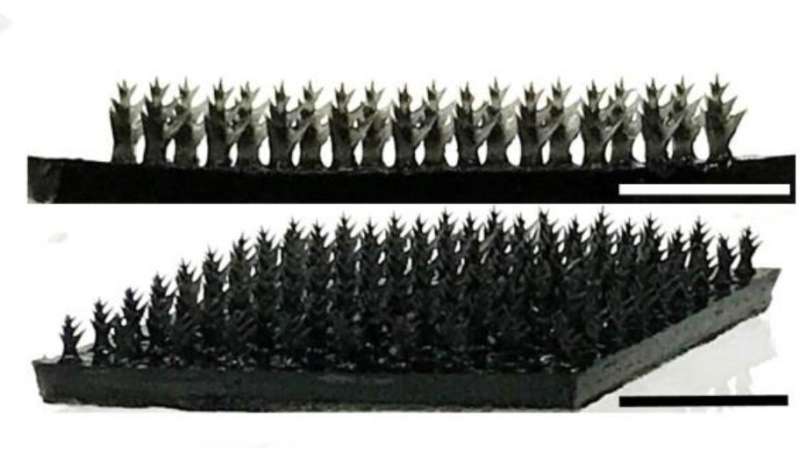
Images of representative fabricated PVA/PPy gel micro-tree array. Scale bar: 1 cm. Credit: California Institute of Technology
_____________________________________________________________________
Tiny structures inspired by the shape of cactus spines allow a newly created material to gather drinkable water from the air both day and night, combining two water-harvesting technologies into one.
The material, a micro-architected hydrogel membrane (more on that later), can produce water through both solar steam-water generation and fog collection—two independent processes that typically require two separate devices. A paper about the material was published in Nature Communications on May 14.
Fog collection is exactly what it sounds like. At night, low-lying clouds along sea coasts are heavy with water droplets. Devices that can coalesce and collect those droplets can turn fog into drinking water.
Solar-steam generation is another water-collection technique. It works especially well in coastal areas because it is also capable of water purification, though it works during the day instead of at night. In the method, heat from the sun causes water to evaporate into steam, which causes water to evaporate into steam, which can be condensed into drinking water.
Because the two technologies operate under such different conditions, they typically require different materials and devices to make them work. Now, a material developed at Caltech could combine them into a single device, working to generate clean water 24 hours a day.
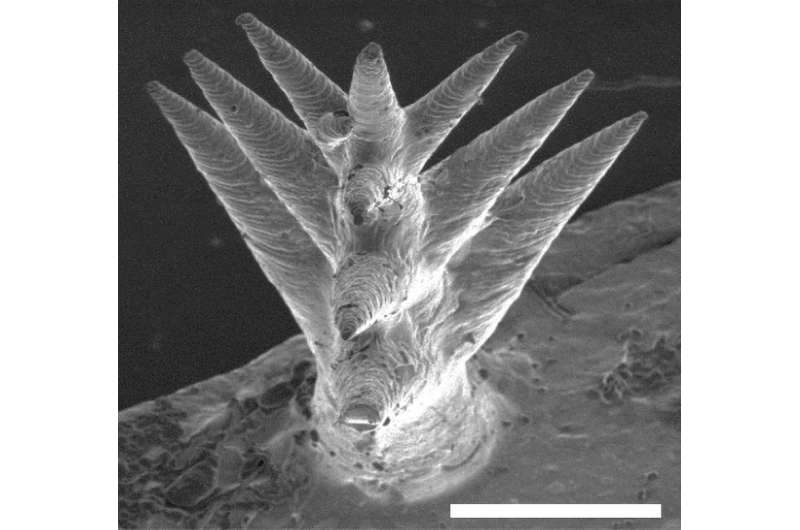
Images of an individual representative tree micro-topology. Scale bar: 1 mm. Credit: California Institute of Technology
____________________________________________________________________________
"Water scarcity is a huge issue that humanity will need to overcome as the world's population continues to grow," says Julia R. Greer, the Ruben F. and Donna Mettler Professor of Materials Science, Mechanics and Medical Engineering and Fletcher Jones Foundation Director of the Kavli Nanoscience Institute. "Water covers three-quarters of the globe, but only about one half of one percent is available freshwater."
Greer has spent her career developing micro- and nano-architected materials; that is, materials whose very shapes (controlled at each length scale, nanoscopic and microscopic) give them unusual and potentially useful properties. In this case, Greer collaborated with Ye Shi, formerly a postdoctoral scholar at Caltech and now a postdoctoral scholar at UCLA, to create a membrane of arrayed tiny spines that resemble Christmas trees but are in fact inspired by the shape of cactus spines.
"Cacti are uniquely adapted to survive dry climates," Shi says. "In our case, these spines, which we call 'micro-trees," attract microscopic droplets of water that are suspended in the air, allowing them to slide down the base of the spine and coalesce with other droplets into relatively heavy drops that eventually converge into a reservoir of water that can be utilized."
The spines are built out of a hydrogel; that is, a network of hydrophilic (water-loving) polymers that naturally attract water. Due to their tiny size, they can be printed onto a wafer-thin membrane. During the day, the hydrogel membrane absorbs sunlight to heat up water trapped beneath it, which becomes steam. The steam then recondenses onto a transparent cover, where it can be collected. During the night, the transparent cover folds up and the hydrogel membrane is exposed to humid air to capture fog. As such, the material can harvest water from both steam and fog.
In an operation test conducted during the night, samples of the materials ranging from 55–125 square centimeters in area were able to collect about 35 milliliters of water from fog. In tests during the day, the material was capable of collecting about 125 milliliters from solar steam.
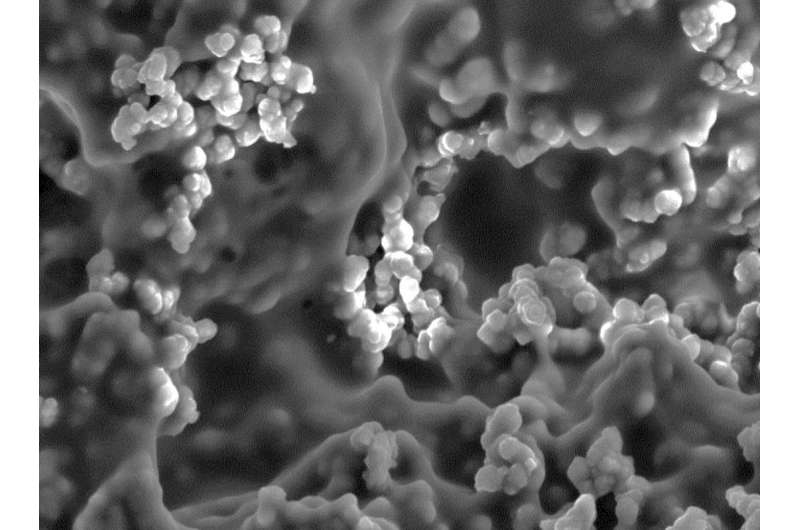
Porous structure of gel matrix. Credit: California Institute of Technology
________________________________________________________________________
The exact design of the membrane was created using the design program SolidWorks.
The hydrogel itself is a polyvinyl alcohol/polypyrrole (PVA/PPy) composite gel, a non-toxic and flexible material used in numerous applications including in capacitors, wearable strain and temperature sensors, and batteries.
To fine-tune the design of the micro-trees, Greer and Shi worked with Caltech's Harry Atwater, Howard Hughes Professor of Applied Physics and Materials Science; and Ognjen Ilic, formerly a postdoctoral scholar at Caltech and now Benjamin Mayhugh Assistant Professor of Mechanical Engineering at the University of Minnesota.
Using computer modeling, Ilic computed the heat distribution within the micro-trees to help define the size and shape that would be most effective at drawing water from the air. With this successful proof-of-concept, the team now hopes to find a private partner capable of commercializing the technology for water-scarce regions.
"It is really inspiring that a relatively simple hydrophilic polymer membrane can be shaped in a morphology that resembles cacti spines and be capable of tremendous enhancement in water collection. I guess evolution really works," Greer says.
The Nature Communications paper is titled "All-day Fresh Water Harvesting by Microstructured Hydrogel Membranes."
Explore further
Video:
Tiny shape-shifting polymers developed for potential medical applications
More information: Ye Shi et al, All-day fresh water harvesting by microstructured hydrogel membranes, Nature Communications (2021). DOI: 10.1038/s41467-021-23174-0
Journal information: Nature Communications
Provided by California Institute of Technology
Then maybe California. Taking moisture out one plan may impact somewhere else.
Also....add water to poor rainfall areas...cool it down....viola!, more clouds...more precipitation...then...more foliage...rinse and repeat..
So cactus are smarter than mankind, after all.
P.s.....funny tagline..
Check
Twenty years ago it was guesstimated that 1 in 8 or 1 in 10 people in the US were illegal. Who knows how many more are here today. Send them all back to where they came from and we’d have enough water.
Shamwow II!
Camper’s delight...
This is a physical impossibility to survive without exterior energy sources or significant water.
The temperature of the air is given at about 72 degrees minus 25 degrees Celcius. That is 48 degrees C or 118 degrees F. When the air temperature is above 100 degrees F, the body cannot cool itself by conduction. It has to cool itself by radiation or evaporation of water.
With the ground temperature much higher than the air temperature, cooling by radiation is essentially nil. It is far more likely heat would be *gained* by reflective radiation from the ground, not to mention solar energy.
That leaves evaporation, which is the major mechanism for human bodies to cool. It requires the evaporation of water. The evaporated water carries the heat away into the atmosphere. If the water is condensed, the heat of evaporation is returned to where it is condensed.
Thus, a "stillsuit" receives the heat the body has dumped, and has to release that heat to the environment, without giving it back to the body.
I suspect clever engineering with a compact, high energy source, could do it, perhaps by radiating the heat from a very hot radiator, shielded from the body. But, it requires a lot of energy to do it.
You cannot do it with muscle energy from the same body you are trying to cool.
It is just another suspension of disbelief, piled on many others in the novel. Good science fiction has one, around which the story is built.
I suppose it was a good fantasy novel, with quite a bit of magic disguised as technology.
Could not the energy of heat be recycled as well?
Thermoelectric devices are common. I use one at work every day, both thermocouples and a thermoelectric heat/cool device in our products we sell to government, civilian and military use all over the world.
One device gets very hot when DC voltage is applied in one direction, and gets freezing cold when applied in the other direction.
No.
To get work from heat, whether electrical or motion, you have to have a differential of heat. You can have hot and cold, or hot and much hotter or cold and much colder, but you must have the differential.
The greater the differential, the greater the work which can be done.
Every conversion process to go from an energy source to work involves some loss, most often as waste heat. This appears to be a universal, unavoidable, physical law, called the Second law of thermodynamics.
Some have put it this way: You cannot win. Moreover, you can never break even.
Some processes such as electrical to mechanical, can be very efficient, about 90%!
Heat to mechanical can approach 50%, with differentials in the hundreds to thousands of degrees, using very specialized, heat resistant materials.
The human body is about 25% efficient in converting potential chemical energy from food to mechanical energy. About 75% is converted to waste heat.
It does pretty well. Cars burning gasoline are, generally, less than 20% efficient, by comparison.
Atomic energy uses conversion processes to produce electricity, but atomic processes are simply tapping into a very energetic fuel. That "fuel" produces heat, which we then use like any other heat source.
This cactus-like structure, with its ability to trap water droplets, will also collect dust. How much water would it take to flush out the dust?
“Women and minorities hardest hit.”
There are over 40 minerals and metals in seawater. If those could be extracted profitably—then that technology can be transferred to the moon and mars and refined to take into account different elements dissolved into moon and mars water.
“If those could be extracted profitably”
Yes, “extracted profitably”, that’s the kicker.
Disclaimer: Opinions posted on Free Republic are those of the individual posters and do not necessarily represent the opinion of Free Republic or its management. All materials posted herein are protected by copyright law and the exemption for fair use of copyrighted works.