
Posted on 03/30/2021 5:54:03 AM PDT by Homer_J_Simpson


Free Republic University, Department of History presents U.S. History, 1855-1860: Seminar and Discussion Forum
Bleeding Kansas, Dred Scott, Lincoln-Douglas, Harper’s Ferry, the election of 1860, secession – all the events leading up to the Civil War, as seen through news reports of the time and later historical accounts
First session: November 21, 2015. Last date to add: Sometime in the future.
Reading: Self-assigned. Recommendations made and welcomed.
Posting history, in reverse order
https://www.freerepublic.com/tag/by:homerjsimpson/index?tab=articles
To add this class to or drop it from your schedule notify Admissions and Records (Attn: Homer_J_Simpson) by reply or freepmail.
Link to previous Harper’s Weekly thread
https://freerepublic.com/focus/f-chat/3944470/posts

Abraham Lincoln: Speeches and Writings 1859-1865, edited by Don E. Fehrenbacher

The Diary of George Templeton Strong, Edited by Allan Nevins and Milton Halsey Thomas
Descended into the barber's shop off the hall of the hotel; all the operators, men of color, mostly mulattoes, or yellow lads, good-looking, dressed in clean white jackets and aprons, were smart, quick, and attentive. Some seven or eight shaving chairs were occupied by gentlemen intent on early morning calls. Shaving is carried in all its accessories to a high degree of publicity, if not of perfection, in America; and as the poorest, or as I may call them without offence, the lowest orders in England have their easy shaving for a penny, so the highest, if there be any in America, submit themselves in public to the inexpensive operations of the negro barber. It must be admitted that the chairs are easy and well-arranged, the fingers nimble, sure, and light; but the affectation of French names, and the corruption of foreign languages, in which the hairdressers and barbers delight, are exceedingly amusing. On my way down a small street near the Capitol, I observed in a shop window, “Rowland's make easier paste,” which I attribute to an imperfect view of the etymology of the great “Macassar;” on another occasion I was asked to try Somebody's “Curious Elison,” which I am afraid was an attempt to adapt to a shaving paste, an address not at all suited to profane uses. It appears that the trade of barber is almost the birthright of the free negro or colored man in the United States. There is a striking exemplification of natural equality in the use of brushes, and the senator flops down in the seat, and has his noble nose seized by the same fingers which the moment before were occupied by the person and chin of an unmistakable rowdy.
In the midst of the divine calm produced by hard hand rubbing of my head, I was aroused by a stout gentleman who sat in a chair directly opposite. Through the door which opened into the hall of the hotel, one could see the great crowd passing to and fro, thronging the passage as though it had been the entrance to the Forum, or the “Salle de pas perdus.” I had observed my friend's eye gazing fixedly through the opening on the outer world. Suddenly, with his face half-covered with lather, and a bib tucked under his chin, he got up from his seat exclaiming, “Senator! Senator! hallo!” and made a dive into the passage — whether he received a stern rebuke, or became aware of his impropriety, I know not, but in an instant he came back again, and submitted quietly, till the work of the barber was completed.
The great employment of four fifths of the people at Willard's at present seems to be to hunt senators and congressmen through the lobbies. Every man is heavy with documents — those which he cannot carry in his pockets and hat, occupy his hands, or are thrust under his arms. In the hall are advertisements announcing that certificates, and letters of testimonial, and such documents, are printed with expedition and neatness. From paper collars, and cards of address to carriages, and new suits of clothes, and long hotel bills, nothing is left untried or uninvigorated. The whole city is placarded with announcements of facilities for assaulting the powers that be, among which must not be forgotten the claims of the “excelsior card-writer,” at Willard's, who prepares names, addresses, styles, and titles, in superior penmanship. The men who have got places, having been elected by the people, must submit to the people, who think they have established a claim on them by their favors. The majority confer power, but they seem to forget that it is only the minority who can enjoy the first fruits of success. It is as if the whole constituency of Marylebone insisted on getting some office under the Crown the moment a member was returned to Parliament. There are men at Willard's who have come literally thousands of miles to seek for places which can only be theirs for four years, and who with true American facility have abandoned the calling and pursuits of a lifetime for this doubtful canvass; and I was told of one gentleman, who having been informed that he could not get a judgeship, condescended to seek a place in the Post-Office, and finally applied to Mr. Chase to be appointed keeper of a “lighthouse,” he was not particular where. In the forenoon I drove to the Washington Navy Yard, in company with Lieutenant Nelson and two friends. It is about two miles outside the city, situated on a fork of land projecting between a creek and the Potomac River, which is here three quarters of a mile broad. If the French had a Navy Yard at Paris it could scarcely be contended that English, Russians, or Austrians would not have been justified in destroying it in case they got possession of the city by force of arms, after a pitched battle fought outside its gates. I confess I would not give much for Deptford and Woolwich if an American fleet succeeded in forcing its way up the Thames; but our American cousins, — a little more than kin and less than kind, who speak with pride of Paul Jones and of their exploits on the Lakes, — affect to regard the burning of the Washington Navy Yard by us, in the last war, as an unpardonable outrage on the law of nations, and an atrocious exercise of power. For all the good it did, for my own part, I think it were as well had it never happened, but no juris-consult will for a moment deny that it was a legitimate, even if extreme, exercise of a belligerent right in the case of an enemy who did not seek terms from the conqueror; and who, after battle lost, fled and abandoned the property of their state, which might be useful to them in war, to the power of the victor. Notwithstanding all the unreasonableness of the American people in reference to their relations with foreign powers, it is deplorable such scenes should ever have been enacted between members of the human family so closely allied by all that shall make them of the same household.
The Navy Yard is surrounded by high brick walls; in the gateway stood two sentries in dark blue tunics, yellow facings, with eagle buttons, brightly polished arms, and white Berlin gloves, wearing a cap something like a French kepi, all very clean and creditable. Inside are some few trophies of guns taken from us at Yorktown, and from the Mexicans in the land of Cortez. The interior inclosure is surrounded by red brick houses, and stores and magazines, picked out with white stone; and two or three green glass-plots, fenced in by pillars and chains and bordered by trees, give an air of agreeable freshness to the place. Close to the river are the workshops: of course there is smoke and noise of steam and machinery. In a modest office, surrounded by books, papers, drawings, and models, as well as by shell and shot and racks of arms of different descriptions, we found Capt. Dahlgren, the acting superintendent of the yard, and the inventor of the famous gun which bears his name, and is the favorite armament of the American navy. By our own sailors they are irreverently termed “soda-water bottles,” owing to their shape. Capt. Dahlgren contends that guns capable of throwing the heaviest shot may be constructed of cast-iron, carefully prepared and moulded so that the greatest thickness of metal may be placed at the points of resistance, at the base of the gun, the muzzle and forward portions being of very moderate thickness.
All inventors, or even adapters of systems, must be earnest self-reliant persons, full of confidence, and, above all, impressive, or they will make little way in the conservative, status-quo-loving world. Captain Dahlgren has certainly most of these characteristics, but he has to fight with his navy department, with the army, with boards and with commissioners, — in fact, with all sorts of obstructors. When I was going over the yard, he deplored the parsimony of the department, which refused to yield to his urgent entreaties for additional furnaces to cast guns.
No large guns are cast at Washington. The foundries are only capable of turning out brass field-pieces and boat-guns. Capt. Dahlgren obligingly got one of the latter out to practise for us — a 12-pounder howitzer, which can be carried in a boat, run on land on its carriage, which is provided with wheels, and is so light that the gun can be drawn readily about by the crew. He made some good practice with shrapnel at a target 1200 yards distant, firing so rapidly as to keep three shells in the air at the same time. Compared with our establishments, this dockyard is a mere toy, and but few hands are employed in it. One steam sloop, the “Pawnee,” was under the shears, nearly ready for sea: the frame of another was under the building-shed. There are no facilities for making iron ships, or putting on plate-armor here. Everything was shown to us with the utmost frankness. The fuse of the Dahlgren shell is constructed on the vis inertӕ principle, and is not unlike that of the Armstrong.
On returning to the hotel, I found a magnificent bouquet of flowers, with a card attached to them, with Mrs. Lincoln's compliments, and another card announcing that she had a “reception” at three o'clock. It was rather late before I could get to the White House, and there were only two or three ladies in the drawing-room when I arrived. I was informed afterwards that the attendance was very scanty. The Washington ladies have not yet made up their minds that Mrs. Lincoln is the fashion. They miss their Southern friends, and constantly draw comparisons between them and the vulgar Yankee women and men who are now in power. I do not know enough to say whether the affectation of superiority be justified; but assuredly if New York be Yankee, there is nothing in which it does not far surpass this preposterous capital. The impression of homeliness produced by Mrs. Lincoln on first sight, is not diminished by closer acquaintance. Few women not to the manner born there are, whose heads would not be disordered, and circulation disturbed, by a rapid transition, almost instantaneous, from a condition of obscurity in a country town to be mistress of the White House. Her smiles and her frowns become a matter of consequence to the whole American world. As the wife of the country lawyer, or even of the congressman, her movements were of no consequence. The journals of Springfield would not have wasted a line upon them. Now, if she but drive down Pennsylvania Avenue, the electric wire thrills the news to every hamlet in the Union which has a newspaper; and fortunate is the correspondent who, in a special despatch, can give authentic particulars of her destination and of her dress. The lady is surrounded by flatterers and intriguers, seeking for influence or such places as she can give. As Selden says, “Those who wish to set a house on fire begin with the thatch.”
SOURCE: William Howard Russell, My Diary North and South, p. 50-4
https://civilwarnotebook.blogspot.com/2015/03/diary-of-william-howard-russell-good_15.html
I forgot to ping the list to George Strong’s diary entry at #4. Another note - An editorial in today’s NY Times is called “A New Minister.” The subject is London Times correspondent William Howard Russell, whose diary entries I recently began posting. He is on #5 today on this thread.
https://freerepublic.com/focus/f-chat/3944470/posts#25

Bruce Catton, The Coming Fury
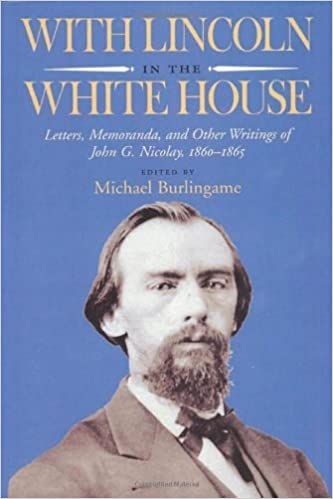

With Lincoln in the White House: Letters, Memoranda, and Other Writings of John G. Nicolay, 1860-1865, edited by Michael Burlingame
Gustavus V. Fox sends two notes to Montgomery Blair regarding a secret plan to resupply Fort Sumter
https://civilwarnotebook.blogspot.com/2018/03/gustavus-v-fox-to-montgomery-blair.html
https://civilwarnotebook.blogspot.com/2018/03/gustavus-v-fox-to-montgomery-blair_23.html
Major Anderson’s engineering officer describes the guns on Morris Island and Fort Moultrie in a report to the army Chief Engineer in Washington.
https://civilwarnotebook.blogspot.com/2016/08/captain-john-g-foster-to-brevet.html
Easter Sunday. — I dined with Lord Lyons and the members of the Legation; the only stranger present being Senator Sumner. Politics were of course eschewed, for Mr. Sumner is Chairman of the Committee on Foreign Relations of the Senate, and Lord Lyons is a very discreet Minister; but still there crept in a word of Pickens and Sumter, and that was all. Mr. Fox, formerly of the United States Navy, and since that a master of a steamer in the commercial marine, who is related to Mr. Blair, has been sent on some mission to Fort Sumter, and has been allowed to visit Major Anderson by the authorities at Charleston; but it is not known what was the object of his mission. Everywhere there is Secession resignation, in a military sense of the word. The Southern Commissioners declare they will soon retire to Montgomery, and that any attempt to reinforce or supply the forts will be a casus belli. There is the utmost anxiety to know what Virginia will do. General Scott belongs to the State, and it is feared he may be shaken, if the State goes out. Already the authorities of Richmond have intimated they will not allow the foundry to furnish guns to the seaboard forts, such as Monroe and Norfolk in Virginia. This concession of an autonomy is really a recognition of States' Rights. For if a State can vote itself in or out of the Union, why can it not make war or peace, and accept or refuse the Federal Government? In fact, the Federal system is radically defective against internal convulsion, however excellent it is or may be for purposes of external polity. I walked home with Mr. Sumner to his rooms, and heard some of his views, which were not so sanguine as those of Mr. Seward, and I thought I detected a desire to let the Southern States go out with their slavery, if they so desired it. Mr. Chase, by the way, expressed sentiments of the same kind more decidedly the other day.
SOURCE: William Howard Russell, My Diary North and South, p. 54-5
https://civilwarnotebook.blogspot.com/2015/03/diary-of-william-howard-russell-sunday.html
In previous posts our own DiogenesLamp has expressed some admiration for Secretary Seward, saying he, not Lincoln, should rightly have been nominated by Republicans in Chicago, and that Seward, not Lincoln, was more likely to have prevented Civil War.
But as of March 31, 1861 Seward is actively working to defend the Union and will soon describe Lincoln as "the best of us".
That "irrepressible conflict" Seward predicted in 1858 is "now" only days away...
I think this is likely correct, except for the "admiration" part. I have no particular admiration or disdain for Seward, I only acknowledge that he would have won the Chicago convention but for Lincoln's dirty tricks, and he would have been far less likely to have caused a civil war.
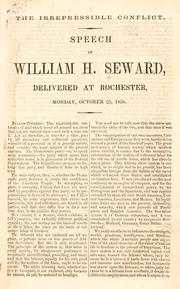 DiogenesLamp: "...he would have won the Chicago convention but for Lincoln's dirty tricks, and he would have been far less likely to have caused a civil war."
Lincoln's "dirty tricks" were no "dirtier" than Sewards' own, but they worked better because Lincoln had stronger support.
And the basic reason is that Senator Seward at the time was most famous for his "irrepressible conflict" speech in October, 1858.
It was a rare occasion of a slick politician speaking unpopular truth, and it made Seward anathema to both Southern slaveholders and Northern Doughfaced Southern sympathizers.
That's why Republicans in Chicago turned to Lincoln instead.


Bruce Catton, The Coming Fury
April 1, 1861.
1. We are at the end of a month‘s Administration, and yet without a policy either domestic or foreign.
2. This, however, is not culpable, and it has even been unavoidable. The presence of the Senate, with the need to meet applications for patronage, have prevented attention to other and more grave matters.
3. But further delay to adopt and prosecute our policies, for both domestic and foreign affairs, would not only bring scandal on the Administration, but danger upon the country.
4. To do this we must dismiss the applicants for office. But how? I suggest that we make the local appointments forthwith, leaving foreign or general ones for ulterior and occasional action.
5. The policy at home. I am aware that my views are singular, and, perhaps, not sufficiently explained. My system is built on this idea, as a ruling one, namely: that we must change the question, before the public, from one upon Slavery, or about Slavery, for a question upon Union or Disunion. In other words, from what would be regarded as a party question to one of Patriotism or Union.
The occupation or evacuation of Fort Sumter, although not, in fact, a slavery or party question, is so regarded. Witness the temper manifested by the Republicans in the free States, and even by Union men in the South. I would, therefore, terminate it, as a safe means of changing the issue. I deem it fortunate that the last Administration created the necessity.
For the rest, I would simultaneously defend all the forts in the Gulf, and have the Navy recalled from foreign stations, to be prepared for a blockade. Put the island of Key West under martial law.
This will raise distinctly the question of Union or Disunion. I would maintain every fort and possession in the South.
I would demand explanations from Spain and France categorically, at once. I would seek explanation from Great Britain and Russia, and send agents into Canada, Mexico, and Central America, to reuse a vigorous continental spirit of independence on this continent against European intervention, and if satisfactory explanations are not received from Spain and France, would convene Congress, and declare war against them.
But whatever policy we adopt, there must be an energetic prosecution of it. For this purpose, it must be somebody's business to pursue and direct it, incessantly.
Either the President must do it himself, and be all the while active in it, or devolve it on some member of his Cabinet. Once adopted, debates on it must end, and all agree, and abide. It is not my especial province; but I neither seek to evade, nor assume responsibility.
SOURCE: Frederick W. Seward, Seward at Washington, as Senator and Secretary of State, p. 535
https://civilwarnotebook.blogspot.com/2014/01/william-h-seward-to-abraham-lincoln.html

Continued from March 29 (reply #26).
https://freerepublic.com/focus/f-chat/3944470/posts#26


Doris Kearns Goodwin, Team of Rivals

Continued from March 29 (reply #27).
https://freerepublic.com/focus/f-chat/3944470/posts#27

David Herbert Donald, Lincoln

Abraham Lincoln: Speeches and Writings 1859-1865, edited by Don E. Fehrenbacher
Correspondence concerning the reinforcement of Fort Pickens. (Who is Commandant of the Brooklyn Navy Yard, Commander Foote or Capt. Breese?)
Abraham Lincoln to Commander Andrew Hull Foote, Commandant Navy Yard, Brooklyn, April 1, 1861
https://civilwarnotebook.blogspot.com/2018/03/abraham-lincoln-to-commander-andrew.html
Brevet Lieutenant-General Winfield Scott to Brevet Colonel Harvey Brown, April 1, 1861
https://civilwarnotebook.blogspot.com/2018/03/brevet-lieutenant-general-winfield.html
Abraham Lincoln, April 1, 1861
https://civilwarnotebook.blogspot.com/2018/03/abraham-lincoln-april-1-1861.html
Gideon Welles to Commodore Samuel Livingston Breese, April 1, 1861
https://civilwarnotebook.blogspot.com/2018/03/gideon-welles-to-commodore-samuel.html
Gideon Welles to Commodore Samuel Livingston Breese, April 1, 1861 – Received 6:30 p.m.
https://civilwarnotebook.blogspot.com/2018/03/gideon-welles-to-commodore-samuel_31.html
Commander Andrew Hull Foote to Gideon Welles, April 1, 1861
https://civilwarnotebook.blogspot.com/2018/04/commander-andrew-hull-foote-to-gideon.html
Correspondence concerning the resupply of Fort Sumter
Montgomery Blair to Gustavus V. Fox, April 1, 1861
https://civilwarnotebook.blogspot.com/2018/03/montgomery-blair-to-gustavus-v-fox_25.html
Brigadier-General Pierre Gustave Toutant-Beauregard to Leroy Pope Walker, April 1, 1861
https://civilwarnotebook.blogspot.com/2016/11/martin-j-crawford-to-leroy-pope-walker.html
Russell diary entry concerning Stephen A. Douglas
Diary of William Howard Russell: Monday, April 1, 1861
https://civilwarnotebook.blogspot.com/2015/03/diary-of-william-howard-russell-monday.html
Today’s big batch of posts -
“The Coming Fury,” on Seward’s memo to Lincoln on how to President, reply #14
Seward’s memo, #15
“Team of Rivals” excerpt on the same subject, #16
“Lincoln” excerpt, ditto, #17
Letters from Lincoln, including a reply to Seward, #18
Correspondence from Civil War Notebook on Fort Pickens, Fort Sumter and William H. Russell on Stephen A. Douglas.
Disclaimer: Opinions posted on Free Republic are those of the individual posters and do not necessarily represent the opinion of Free Republic or its management. All materials posted herein are protected by copyright law and the exemption for fair use of copyrighted works.