Posted on 02/07/2021 3:20:09 PM PST by MtnClimber
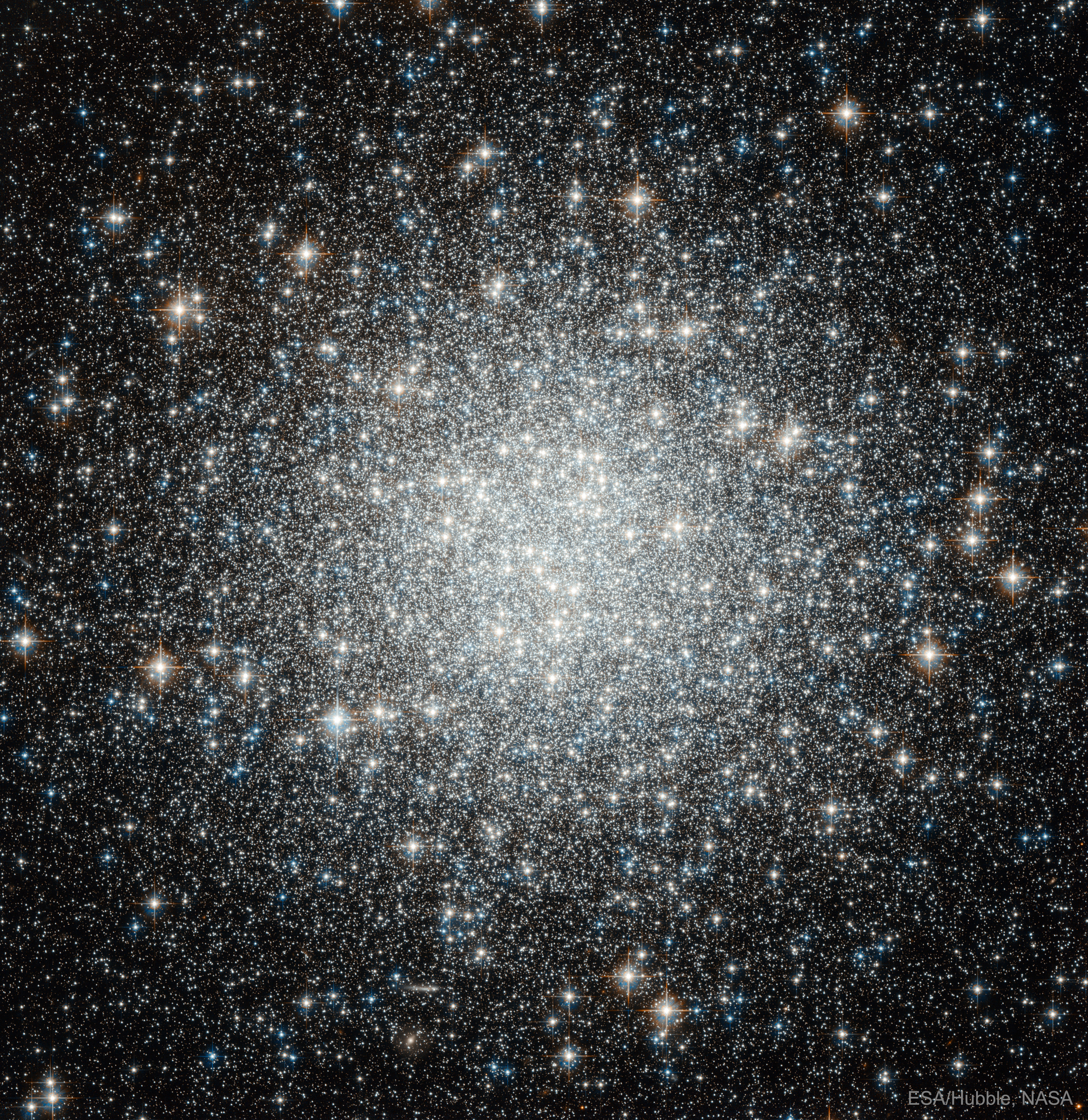
Explanation: If our Sun were part of this star cluster, the night sky would glow like a jewel box of bright stars. This cluster, known as M53 and cataloged as NGC 5024, is one of about 250 globular clusters that survive in our Galaxy. Most of the stars in M53 are older and redder than our Sun, but some enigmatic stars appear to be bluer and younger. These young stars might contradict the hypothesis that all the stars in M53 formed at nearly the same time. These unusual stars are known as blue stragglers and are unusually common in M53. After much debate, blue stragglers are now thought to be stars rejuvenated by fresh matter falling in from a binary star companion. By analyzing pictures of globular clusters like the featured image taken by the Hubble Space Telescope, astronomers use the abundance of stars like blue stragglers to help determine the age of the globular cluster and hence a limit on the age of the universe. M53, visible with a binoculars towards the constellation of Bernice's Hair (Coma Berenices), contains over 250,000 stars and is one of the furthest globulars from the center of our Galaxy.
For more detail go to the link and click on the image for a high definition image. You can then move the magnifying glass cursor then click to zoom in and click again to zoom out. When zoomed in you can scan by moving the side bars on the bottom and right side of the image.
All that out there but yet we’re the only ones?
I have to wonder how many planets are unseen in that photo.
The only discovery even more astounding would be that there is no intelligent life on other worlds and that we rally are the only ones...
Attributed to Albert Einstein
Magazine interview circa 1949
Imagine human scientific progress a thousand years from now.
Are human bodies really going to recognizable? Will we have bodies at all?
As Terence McKenna says, the question is not whether there are alien intelligences.
The proper question is how in the world we could possibly recognize them.
Agree with both of you. More and more these days, I’m starting to think of the original Star Trek episodes as prescient.


I wonder if a black hole is associated with the cluster formation.

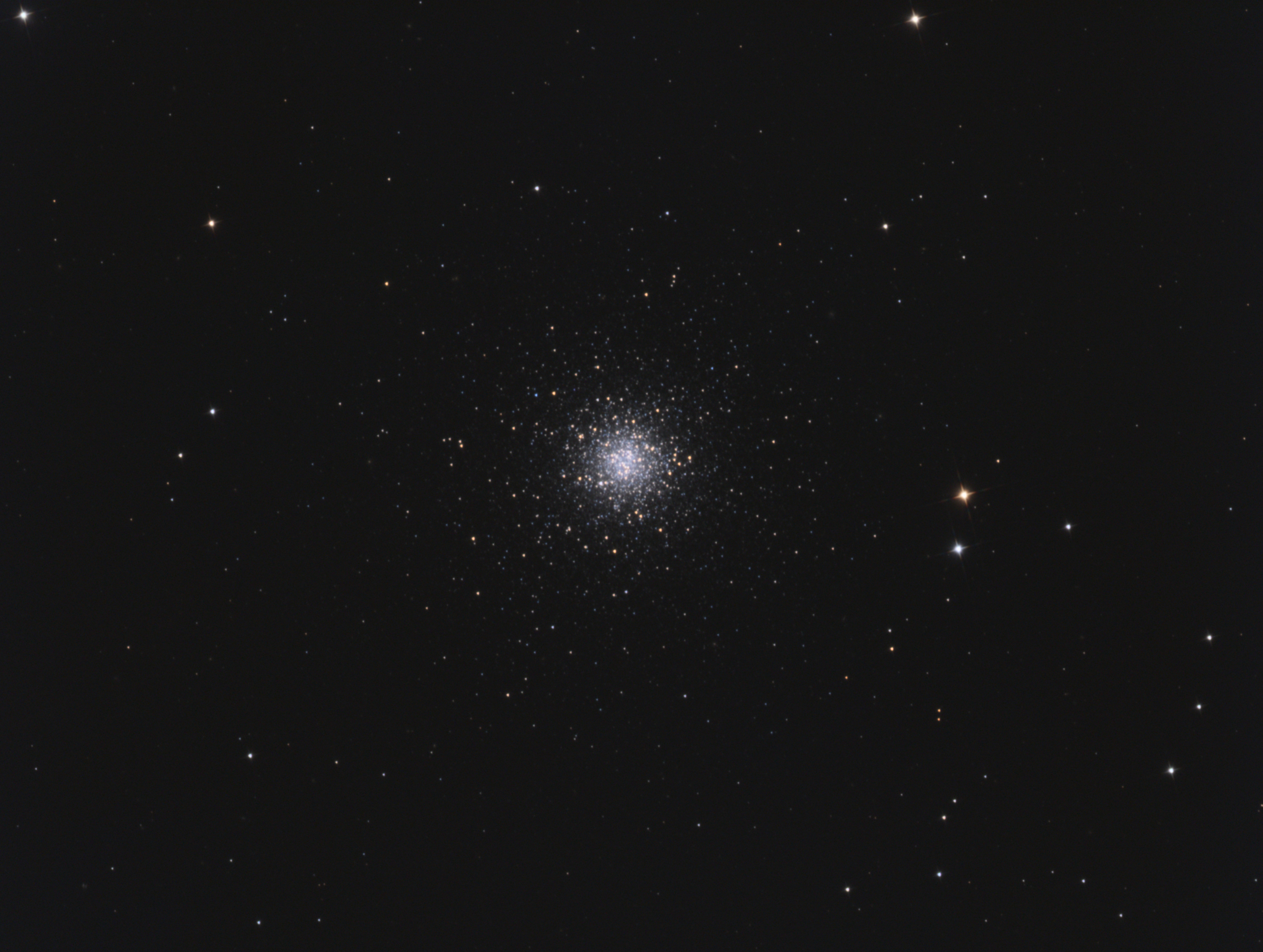
Not M15, but here's my M13 takens with a Canon 60D as part of the optical train on a 10"Schmidt Cassegrain telescope. I visit here often to keep things in perspective.
M13, the Great Globular Star Cluster in Hercules
Contains an estimated 300,000 stars
Distance to Earth: 22,180 light years
Age: 11.66 billion years
Radius: 72.50206546 light years
Wow, that is a really nice photo!
Great photo!
I think it was Arthur C Clarke who suggested civilizations on planets in globular clusters may not advance to space since blazing, constant starlight from thousands of suns would obliterate any signs of planets or galaxy architecture.
Yep. And the radiation must be intense in that neighborhood.☺
I'm working on a 5,000 year project right now...
One of my Favorite Visual Objects! If it is above the horizon, I usually check up on it. Easy to find as it has great guide stars for star hopping.
Very Rich part of the sky!
That picture is upside down! :)
The cluster ngc 5053 is a tough visual object. Very low surface brightness. I tried for years to actually see it, but, even at our dark sky site, it blended into the sky. I finally saw it with the 12.5inch.
Try reading Asimov’s “Nightfall”.
Probably!
Some globular clusters are the cores of dwarf galaxies that have been stripped of their gases. Omega Centaurus is a prime example of this.
But, I feel there would have to be a moderate sized Black Hole in the center. Otherwise, they wouldn’t be round, and, would drift apart like open clusters do.
Disclaimer: Opinions posted on Free Republic are those of the individual posters and do not necessarily represent the opinion of Free Republic or its management. All materials posted herein are protected by copyright law and the exemption for fair use of copyrighted works.