Posted on 12/31/2020 7:14:23 AM PST by Red Badger
The best present this holiday season came in a small package, parachuted into the Australian desert from far within our Solar System on 5 December 2020.
Inside, astronomers were delighted to unwrap the first significant samples of a rocky asteroid which is currently 9 million kilometres (5.6 million miles) away, and returned to Earth in "perfect" shape.
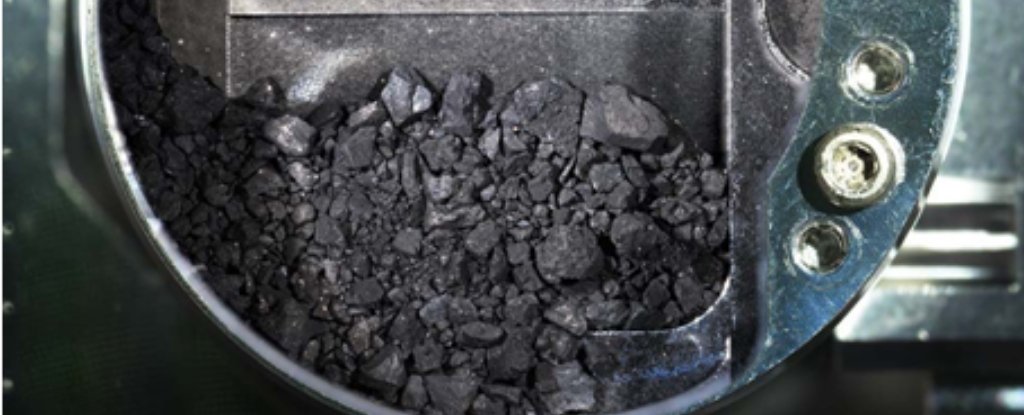
Photographs of the pristine pebbles have finally been released, and while the tiny, black-coloured grains inside may resemble nothing more than dirty coal, this galactic gift is hardly a rebuke. It's the culmination of a five-year-long journey, requiring careful planning and execution.
The samples were originally collected by Japan's Hayabusa2 mission, which was sent to circle and sample the diamond-shaped asteroid called Ryugu, following the success of its first mission.
The initial Hayabusa spacecraft returned from the asteroid Itokawa in 2010 with the first direct sample of a near-Earth object. Altogether, the surface material weighed less than a milligram, and yet that was still enough to yield crucial information about the asteroid's age and geologic history.
The new samples from Ryugu - scooped up last year - date back even further and contain more material than astronomers dared hope for, amounting to roughly 5.4 grams.
The name Ryugu refers to a magical underwater "dragon palace" in Japanese folklore, in which a fisherman finds himself being presented with a mysterious box to return home with - rather like Hayabusa's sealed capsules.
The treasure in this case is thought to be over 4.5 billion years old - a relic of our early Solar System, containing potentially ancient material that once formed our Sun and its orbiting planets.
Opening the carefully sealed chambers, astronomers have found many particles larger than a millimetre. Those in chamber C were slightly bigger than the rest and were collected from the mission's second touchdown.
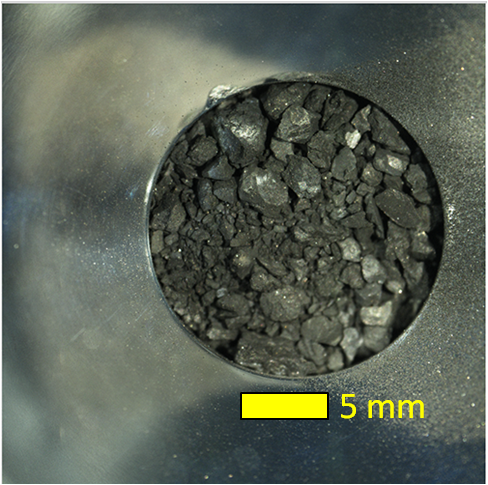 Sample catcher chamber A, captured by an optical microscope. (JAXA)
Because this landing took place a little to the north of a crater intentionally created earlier in the mission, researchers expected the sample to contain chunks of subsurface material. That would be quite the achievement, since all other asteroid samples collected in space merely come from the surface.
Before these direct samples, most of our knowledge on the topic of asteroids came from meteorites, which are asteroids or comets that find themselves smashing into Earth's surface.
Unfortunately, without the protection of a human-made capsule, much of that material is destroyed or contaminated by our planet's atmosphere upon entry, not to mention all the weathering that occurs once these rocks come to rest on the ground.
Ryugu is a C-type asteroid which means its rock is highly porous and contains a lot of carbon and water. Astronomers suspect this particular pile of dark rubble was formed billions of years ago, when it broke off another large body of rock somewhere in the asteroid belt between Mars and Jupiter.
Because Ryugu's surface appears unusually dry and shows red colouration, some experts think it once flew closer to the Sun.
Still, not all the material collected in these containers is quite so primordial. One of the capsules does contain an obvious anachronism (pictured below).
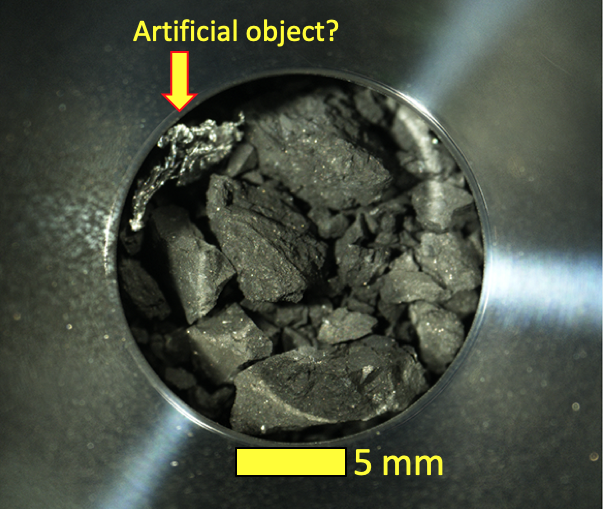
"Artificial material seems to be present in chamber C," reads a press release from the Hayabusa2 project.
"The origin is under investigation, but a probable source is aluminium scraped off the spacecraft sampler horn as the projectile was fired to stir up material during touchdown."
Later, an update from Twitter said the object was still unconfirmed, but that it might have separated from the sampler horn used during collection.
Scientists are already starting to analyse these new samples, including some gas trapped inside the capsules, which is thought to have been collected on the surface of Ryugu as well.
If researchers are correct, it will be the world's first gas sample returned from deep space.
Quite the present indeed.
Mind. Blown.
I think this is pretty cool. Interesting. Looks like charcoal!
Cool stuff.

Must have been naughty this year.
Here is a question I have yet to get an answer for from any space authority:
Why do asteroids, meteors and the like all look like rocks?.....................
The artificial object is suspected to be a piece of the explosive charge they used to blast into it.
Cool! A US nickel weighs about 5 grams.
It'd be funny if they found a couple of old beer can pull-off tabs in the collection sample.
it might have separated from the sampler horn used during collection.
—
Or Someone is missing something and will be coming to return the favor
Perhaps because that is what they are...they don’t have the normal erosive forces (this is just my guess) that one might see on a planet...so they are just big pieces of rock with debris that surrounded them at their formation, and eventually ended up settling on them.
That is my guess, and I am sticking with it.
By the way-Happy New Year to you, Red Badger. We have had many pleasant and informative discussions over the past year here on FR...all the best to you!
As some ancient astronaut theorists believe.
So Japan is sending spaceships to asteroids. Well, we’re BETTER than them, as we have BLM majors at our big universities.
Deal with that, Japan!
Holy Schist, Batman! It’s totally pyroclastic, Dude! Way Sedimentary.
It’s part of an alien’s iPhone.
Not necessary and too expensive. (45 years in aerospace)
All the astrophysicists tell us that these things, asteroids, comets and even planets themselves, come from the remnants of stars that have gone nova or supernova at the end of their long and industrious lives.
They tell us that these stars elements then coalesce into new stars and planetary rings that form new planets.
Where, and how, then, do they become ‘rocks’?
Happy New Year!.............................
Should be a drinking game for that phrase
Like “Hi Bob” from Newhart

Artificial material seems to be present in chamber C
May not be artificial..................
Disclaimer: Opinions posted on Free Republic are those of the individual posters and do not necessarily represent the opinion of Free Republic or its management. All materials posted herein are protected by copyright law and the exemption for fair use of copyrighted works.