Posted on 12/15/2020 7:30:18 AM PST by Red Badger
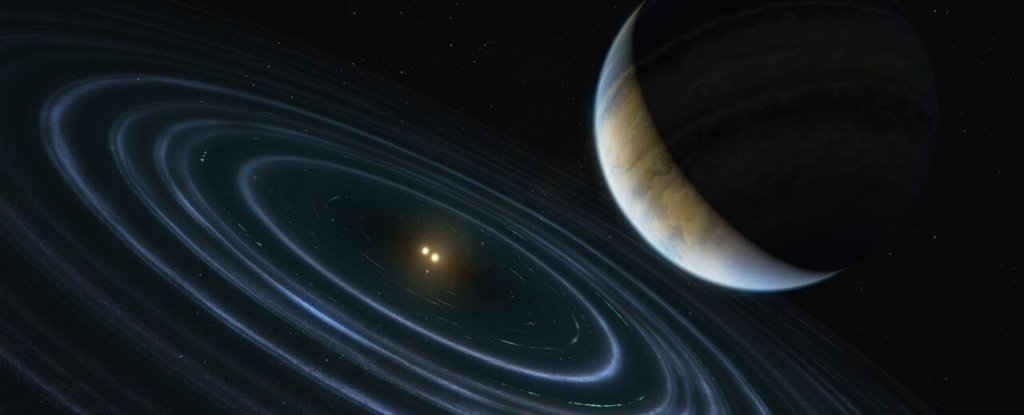
Artist's impression of the HD 106906 system. (ESA/Hubble, M. Kornmesser)
===================================================================
Most of the over 4,300 confirmed exoplanets discovered to date share something in common - a relatively close orbit to their host star.
Now, astronomers have found something extraordinary - a giant exoplanet on a bizarre, 15,000-year orbit around a binary star. It's the first time scientists have been able to characterise such a huge orbit.
The exoplanet is called HD 106906 b, clocking in at 11 times the mass of Jupiter. It orbits a pair of hot, main-sequence yellow-white stars called HD 106906; these stars are just 15 million years old and orbit it each other in a mere 100 days. The whole system is 336 light-years away.
Although the place is overall very different from our own Solar System, the huge orbit of HD 106906 b is reminiscent of an elusive object astronomers are hoping to find closer to home - the hypothetical, extremely wide-orbit Planet Nine.
"This system draws a potentially unique comparison with our Solar System," said astronomer Meiji Nguyen of the University of California, Berkeley.
"It's very widely separated from its host stars on an eccentric and highly misaligned orbit, just like the prediction for Planet Nine. This [raises] the question of how these planets formed and evolved to end up in their current configuration."
The reason most of the exoplanets we find are relatively close to their stars is pretty simple, and it has to do with how we usually find and confirm exoplanets.
Two methods are the most commonly used - the transit method, where telescopes look for faint dips in the light of a star as an orbiting exoplanet passes in front of it, known as a transit; and the wobble method, very small changes in the wavelengths of a star's light as it is tugged by the exoplanet's gravity.
For both these methods, a single dip in starlight or a single wobble could be anything; generally astronomers want a few dips or wobbles, at regular intervals, in order to confirm an exoplanet.
So you can see why something on a larger orbit would be harder to confirm; Jupiter, for example, is on a 12-year orbit. So you'd have to be staring at the sky for a while.
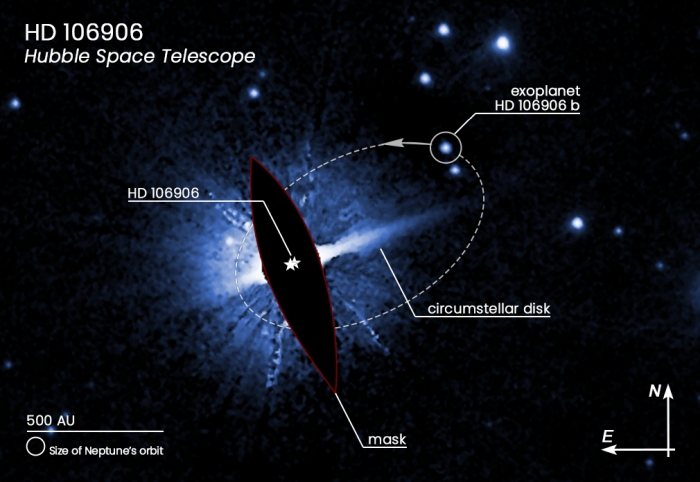
(NASA, ESA, M. Nguyen/UC Berkeley, R. De Rosa/ESO, and P. Kalas/UC Berkeley/SETI Institute)
=============================================================
But HD 106906 b, first discovered in 2013, is a rare beast: an exoplanet that has been imaged directly. Most of the time exoplanets are too faint and too close to their host star for this, but HD 106906 b's distance means it doesn't disappear in the bright shine of its binary stars.
Still, working out the exoplanet's orbit wasn't easy. For that, a team of researchers needed data from the Hubble Space Telescope. Going back 14 years into the archives, they managed to obtain more data on HD 106906 b's slowly changing position at a distance of 737 astronomical units from its stars.
As you can imagine, an exoplanet on a 15,000-year orbit won't appear to move much in 14 years, but it was enough that astronomers could piece the orbit together.
The 15,000-year orbital period is only one part of what they learnt. The other, more baffling part is that the exoplanet is on a high orbital inclination - at a pronounced angle to the debris disc of material surrounding the two stars.
"To highlight why this is weird, we can just look at our own Solar System and see that all of the planets lie roughly in the same plane," Nguyen said.
"It would be bizarre if, say, Jupiter just happened to be inclined 30 degrees relative to the plane that every other planet orbits in. This raises all sorts of questions about how HD 106906 b ended up so far out on such an inclined orbit."
One possibility is that HD 106906 b wasn't born orbiting the binary stars. In this scenario, the exoplanet would have been a rogue, wandering space untethered until it passed close enough to a star (or binary) to be captured in orbit.
Another scenario - and one that the team is leaning towards - is that HD 106906 b formed in the binary's debris disc. Initially, drag in the disc would have caused the exoplanet's orbit to decay towards the star. There, at a closer orbit, the gravitational interactions between the two stars could have kicked the exoplanet out to a much farther, highly inclined orbit that became stabilised by a passing star.
Both scenarios could lead to the odd, eccentric orbit that produces irregularity observed in the debris disc orbiting the binary.
VIDEO AT LINK...................
"It's like arriving at the scene of a car crash, and you're trying to reconstruct what happened," said astronomer Paul Kalas of UC Berkeley.
"Is it passing stars that perturbed the planet, then the planet perturbed the disc? Is it the binary in the middle that first perturbed the planet, and then it perturbed the disc? Or did passing stars disturb both the planet and disc at the same time? This is astronomy detective work, gathering the evidence we need to come up with some plausible storylines about what happened here."
And both scenarios have been proposed for Planet Nine (although in Planet Nine's case, Jupiter did the kicking), a hypothetical Solar System planet predicted to be around 5 to 10 times the mass of Earth, on an orbit around 300 to 700 astronomical units from the Sun.
There is significant doubt that Planet Nine exists, but HD 106906 b shows not just that such a strange orbit is possible, but that it can happen relatively early in the lifespan of a planetary system.
But there's more work to be done on HD 106906 b.
"There are still a lot of open questions about this system," said astronomer Robert De Rosa of the European Southern Observatory in Chile.
"It is likely that both observers and theorists alike will be studying HD 106906 for years to come, unraveling the many mysteries of this remarkable planetary system."
The research has been published in The Astronomical Journal.
X-O Planet PinG!......................
This was all explained in the documentary “K-pax”.
The author must mean Planet 10
Didn’t you just post about this the other day? Got some travel plans?
Different planet....................
But, I want to be like Felicia.... She’s Always Going Somewhere!.........................
Disclaimer: Opinions posted on Free Republic are those of the individual posters and do not necessarily represent the opinion of Free Republic or its management. All materials posted herein are protected by copyright law and the exemption for fair use of copyrighted works.