Posted on 11/06/2020 6:32:21 AM PST by Red Badger
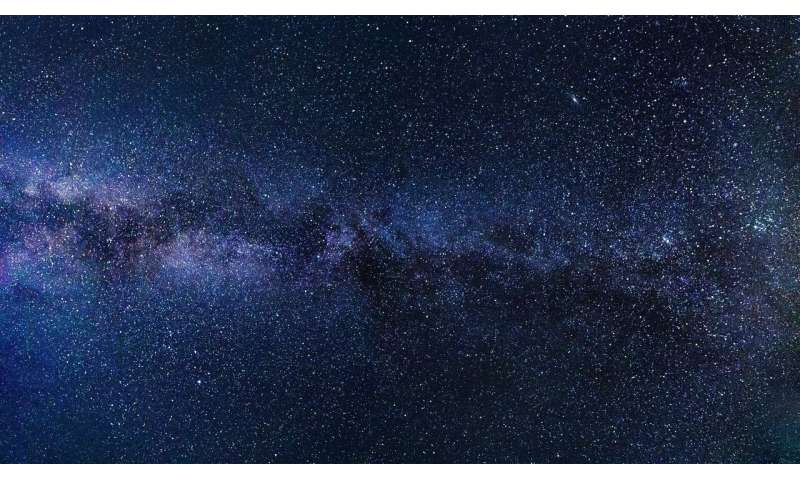
Credit: Pixabay/CC0 Public Domain
===========================================================================
Astrophysicists consider that around 40% of the ordinary matter that makes up stars, planets and galaxies remains undetected, concealed in the form of a hot gas in the complex cosmic web. Today, scientists at the Institut d'Astrophysique Spatiale (CNRS/Université Paris-Saclay) may have detected, for the first time, this hidden matter through an innovative statistical analysis of 20-year-old data. Their findings are published on November 6, 2020 in Astronomy & Astrophysics.
Galaxies are distributed throughout the universe in the form of a complex network of nodes connected by filaments, which are in turn separated by voids. This is known as the cosmic web. The filaments are thought to contain almost all of the ordinary (so-called baryonic) matter of the universe in the form of a diffuse, hot gas. However, the signal emitted by this diffuse gas is so weak that in reality 40 to 50% of the baryons go undetected.
These are the missing baryons, hidden in the filamentary structure of the cosmic web, that Nabila Aghanim, a researcher at the Institut d'Astrophysique Spatiale (CNRS/Université Paris-Saclay) and Hideki Tanimura, a post-doctoral researcher, together with their colleagues, are attempting to detect. In a new study, funded by the ERC ByoPiC project, they present a statistical analysis that reveals, for the first time, the X-ray emission from the hot baryons in filaments.
This detection is based on the stacked X-ray signal, in the ROSAT2 survey data, from approximately 15,000 large-scale cosmic filaments identified in the SDSS3 galaxy survey. The team made use of the spatial correlation between the position of the filaments and the associated X-ray emission to provide evidence of the presence of hot gas in the cosmic web and for the first time, measure its temperature.
These findings confirm earlier analyses by the same research team, based on indirect detection of hot gas in the cosmic web through its effect on the cosmic microwave background. This paves the way for more detailed studies, using better quality data, to test the evolution of gas in the filamentary structure of the cosmic web.
CNRS is the Centre national de la recherche scientifique, or the French National Center for Scientific Research. It is a publicly funded research organization, under the authority of the French Ministry of Research, and is the largest of several French research organizations with the legal status of Public Scientific and Technological Institution (Etablissement public à caractčre scientifique et technologique, or EPST, in French.) Research at CNRS covers all the major fields of scientific research, and is organized into 9 research institutes.
Website http://www.cnrs.fr/
Yes. It’s in found ballots.
“Yes. It’s in found ballots.”
All for Harris.
Love that site. Think I found it through here. Maybe from you. Thanks.
But only for Democrats, of course!..............................
They are made of ‘ballotons’.
Thanking you.
Dark matter has always been a stupid theiry.
Hot Gas Theory. well known by the kilted Scots for many generations, going back to the druids , whose name for it in ancient Gaelic was “cosmic fart.”
Disclaimer: Opinions posted on Free Republic are those of the individual posters and do not necessarily represent the opinion of Free Republic or its management. All materials posted herein are protected by copyright law and the exemption for fair use of copyrighted works.