Posted on 03/25/2020 7:03:46 PM PDT by nickcarraway
Boston University announced last week that some scientists at their National Emerging Infectious Disease Lab (NEIDL) will temporarily suspend their work on Ebola to begin studying SARS-CoV-2, better known as the coronavirus.
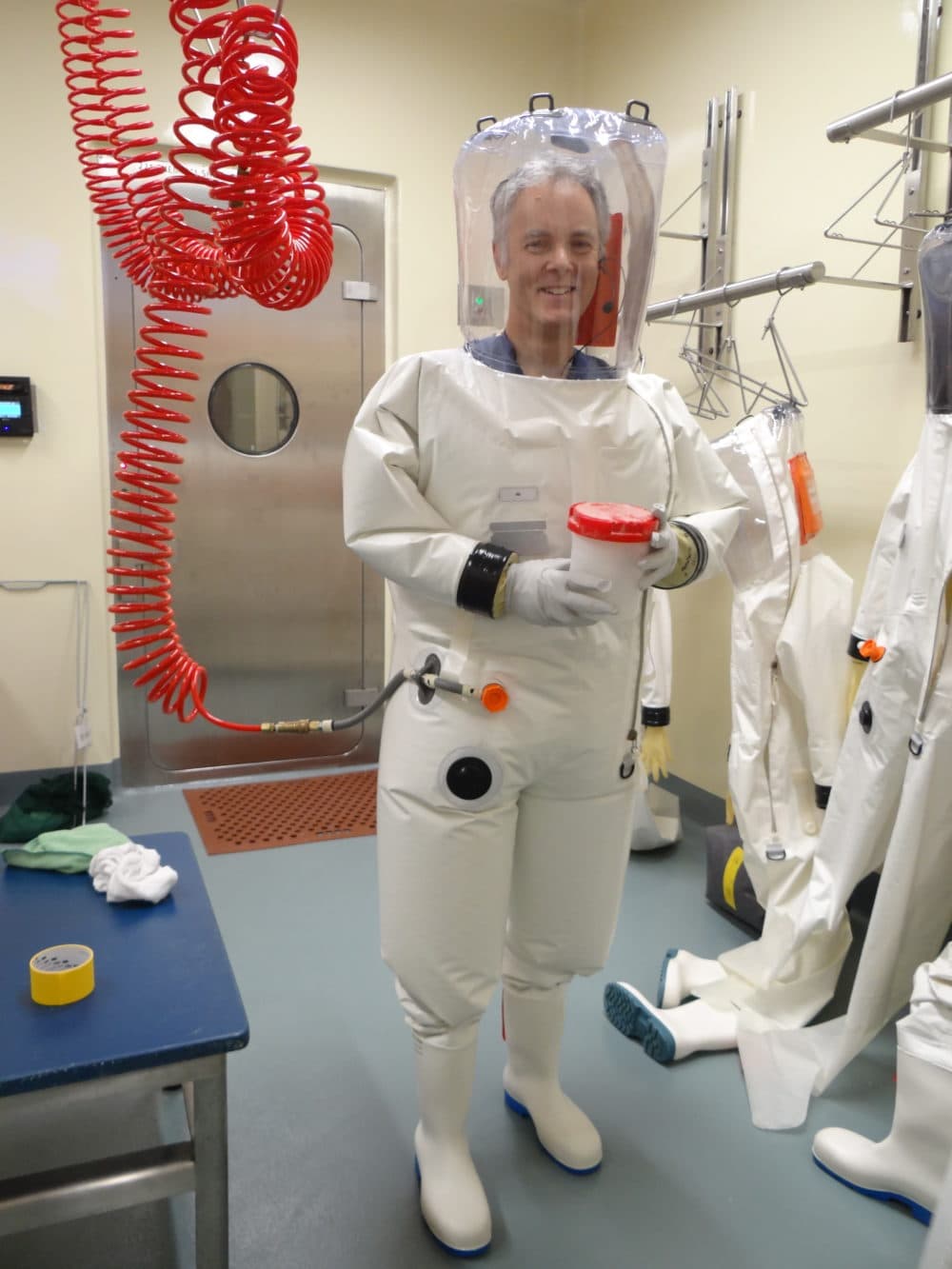
Virologist Robert Davey is leading the effort. Next week, Davey and his colleagues will begin work in a BSL-4 lab — the kind with scientists in spacesuits — screening compounds that might help patients with COVID-19.
WBUR spoke to Davey about what his team will be doing, and what they hope to find. The conversation has been edited and condensed for clarity.
What are you going to do with the coronavirus at the NEIDL that's different from what other labs are doing?
The NEIDL was built to be a high containment lab in one of the best academic cities in the country. We have a lot of experience working at BSL-4, so I think we can do things pretty efficiently.
Do you need a BSL-4 to work with coronavirus?
No, you don't – it’s a level 3 agent. But there are a number of reasons I'm doing it in a BSL-4. I'm very good at screening for small molecules — drugs — and I'm set up in the BSL-4. I have a lot of expensive equipment that was already working to find treatments for Ebola virus, so I can easily deploy that for the coronavirus. If I tried to do it at BSL-3, I'd have to move all my equipment out and train all my personnel and it would take a long, long time. And we don't have a lot of time on our side.
Also, the personal protective equipment that you use in the BSL-3 is the same stuff being used in a hospital. And this is now in very short supply, so that that can limit the amount of work can do in your lab. Whereas BSL-4 equipment, you can only use in a BSL-4 lab.
Does working with live coronavirus make it more dangerous?
No, it's a level 3 agent.
Is there any advantage to working with live virus?
Yeah, I mean, at the end of the day, everything has to be tested with live virus. There are times when people have found a drug that works in model systems, but it has absolutely no effect on the live virus. So even though you can get good ideas from those systems, you still need to make sure it works for the live virus.
Are you guys the only lab in Boston working with live virus?
I am not aware of any other group.
Why is that the case?
It really depends on how quickly you can reconfigure what you're doing. Some people are only working on tuberculosis, so they have no expertise to work on viruses. So it’s a personnel training problem. Another group was short on supplies because of the ongoing PPE problem. We have the perfect match – we have the virology expertise and we have the equipment and the containment lab to deal with it. So we're well-poised to do the work.
The virus popped up in China around December and you started filing the paperwork to work on it in January – you’re just starting work now?
Yes. We broke the vial open in the BSL-4 yesterday and put it onto cells. The day we got approved.
Why did it take it three months to get approved?
When we started thinking about this, the first thing we did was talk to our biosafety groups at Boston University and the city of Boston and discuss the situation. We asked if they would be amenable to having special review sessions, and they were very, very cooperative. I think we increased the efficiency of the process by at least three times.
How did you get samples to work with? Did a FedEx show up with a bunch of coronavirus?
It gets transported through a secure courier service. We received the virus a number of weeks ago, and placed in the freezer. And then it was just a matter of getting the final approvals — that's when I was able to take it from the freezer and start cultivating it.
What happens next?
That's when the hard work begins. So typically what we do is we have these plates that have 384 little holes in them. And each of those little holes has some growth medium, and then we add a drug. And then on top of that, we put the virus. In a couple of days, we ask, did the virus get into those cells or not? And from that we can find small molecules or drugs which can block the virus infection.
How many drugs do you expect to test?
We can test thousands a day. I'm expecting to test probably 20,000. We’ll keep testing until we find something that works.
Where do you start?
We have a library coming from the Broad Institute, which is FDA-approved drugs. That means they’ve gone through clinical trials, so you could advance that very quickly towards being a treatment, maybe in six months. If it's something new, you have to do a lot more a lot more testing to make sure it’s safe.
What about malaria drugs like chloroquine?
There’s been a lot of discussion about chloroquine and similar drugs — I don't think they're there where they need to be for treatment of the disease. But we have a library of chloroquine derivatives, and we did some work with Ebola where we showed that we could actually do chemistry on chloroquine-like molecules and make them more effective against the virus without harming the patient. So that's another library we would be interested to try.
Are there any existing drugs out there that you think might be good candidates that aren't already on people's radar?
The virus has a very interesting relationship with a protein called ACE-2, which is involved in regulating blood pressure. The ACE-2 protein serves as a virus receptor, and there are drugs that alter its function. And so it is possible that something like that could play a role.
How do you feel about putting aside your Ebola research to work on this?
It is a bit disruptive, but Ebola will be still be there after this. We need to deal with the current situation and I'm excited to be working on it. I'm hoping that something we will do will contribute to a treatment.
That’s racist! How dare they use the term Ebola to describe the virus because that is where it came from!
They should be studying how AOC got out of BU with a degree.
Successful therapy against Covid-19 virus from New York State:
Dr. Vladimir (Zev) Zelenko
Board Certified Family Practitioner
501 Rt 208, Monroe, NY 10950
845-238-0000
March 23, 2020
To all medical professionals around the world:
My name is Dr. Zev Zelenko and I practice medicine in Monroe, NY. For the last 16 years, I have cared for approximately 75% of the adult population of Kiryas Joel, which is a very close knit community of approximately 35,000 people in which the infection spread rapidly and unchecked prior to the imposition of social distancing.
As of today my team has tested approximately 200 people from this community for Covid-19, and 65% of the results have been positive. If extrapolated to the entire community, that means more than 20,000 people are infected at the present time. Of this group, I estimate that there are 1500 patients who are in the high-risk category (i.e. >60, immunocompromised, comorbidities, etc).
Given the urgency of the situation, I developed the following treatment protocol in the pre-hospital setting and have seen only positive results:
1. Any patient with shortness of breath regardless of age is treated.
2. Any patient in the high-risk category even with just mild symptoms is treated.
3. Young, healthy and low risk patients even with symptoms are not treated (unless their circumstances change and they fall into category 1 or 2).
My out-patient treatment regimen is as follows:
1. Hydroxychloroquine 200mg twice a day for 5 days
2. Azithromycin 500mg once a day for 5 days
3. Zinc sulfate 220mg once a day for 5 days
The rationale for my treatment plan is as follows. I combined the data available from China and South Korea with the recent study published from France (sites available on request). We know that hydroxychloroquine helps Zinc enter the cell. We know that Zinc slows viral replication within the cell. Regarding the use of azithromycin, I postulate it prevents secondary bacterial infections. These three drugs are well known and usually well tolerated, hence the risk to the patient is low.
Since last Thursday, my team has treated approximately 350 patients in Kiryas Joel and another 150 patients in other areas of New York with the above regimen.
Of this group and the information provided to me by affiliated medical teams, we have had ZERO deaths, ZERO hospitalizations, and ZERO intubations. In addition, I have not heard of any negative side effects other than approximately 10% of patients with temporary nausea and diarrhea.
In sum, my urgent recommendation is to initiate treatment in the outpatient setting as soon as possible in accordance with the above. Based on my direct experience, it prevents acute respiratory distress syndrome (ARDS), prevents the need for hospitalization and saves lives.
With much respect,
Dr. Zev Zelenko
cc: President Donald J. Trump; Mr. Mark Meadows, Chief of Staff
Video at Link
8 posted on 3/24/2020, 5:02:30 PM by Candor7 ((Obama Fascism)http://www.americanthinker.com/articles/2009/05/barack_obam_the_quintessentia_1.html))
Disclaimer: Opinions posted on Free Republic are those of the individual posters and do not necessarily represent the opinion of Free Republic or its management. All materials posted herein are protected by copyright law and the exemption for fair use of copyrighted works.