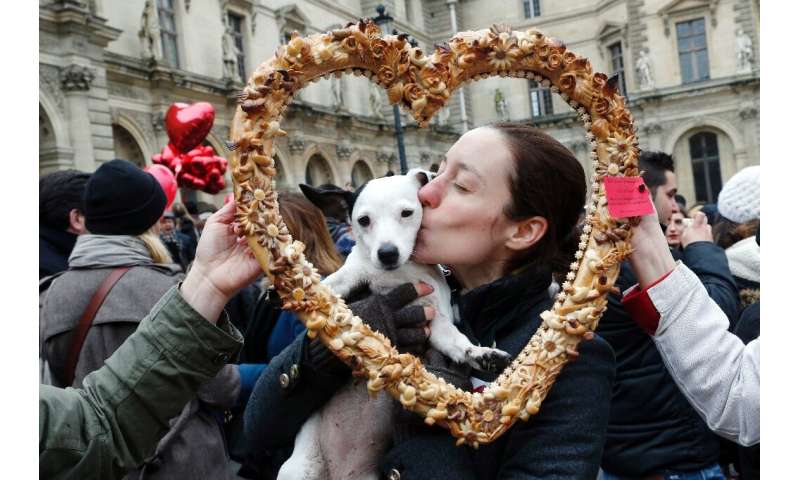
 The idea that animals can experience love was once anathema to the psychologists who studied them, seen as a case of putting sentimentality before scientific rigor.
 Posted on 02/20/2020 6:46:08 AM PST by Red Badger
The idea that animals can experience love was once anathema to the psychologists who studied them, seen as a case of putting sentimentality before scientific rigor.
But a new book argues that, when it comes to dogs, the word is necessary to understanding what has made the relationship between humans and our best friends one of the most significant interspecies partnerships in history.
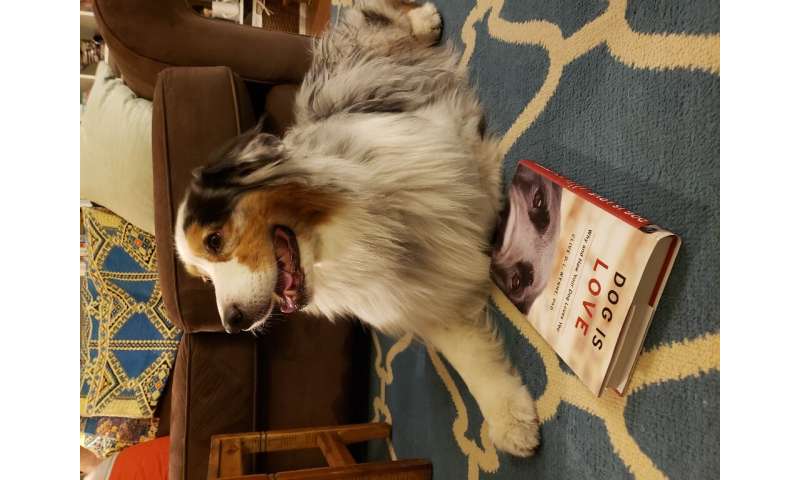
Clive Wynne, founder the Canine Science Collaboratory at Arizona State University, makes the case in "Dog is Love: Why and How Your Dog Loves You."
The animal psychologist, 59, began studying dogs in the early 2000s, and, like his peers, believed that to ascribe complex emotions to them was to commit the sin of anthropomorphism—until he was swayed by a body evidence that was growing too big to ignore.
"I think there comes a point when it's worth being skeptical of your skepticism," the Englishman said in an interview with AFP.
Canine science has enjoyed a resurgence in the past two decades, much of it extolling dogs' smarts.
Titles like "The Genius of Dogs" by Brian Hare have advanced the idea that dogs have an innate and exceptional intelligence.
Wynne, however plays spoilsport, arguing that Fido is just not that brilliant.
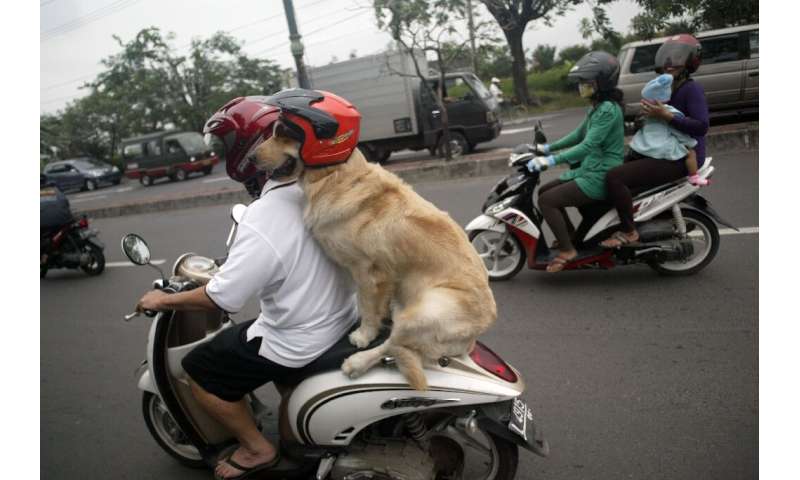
Pigeons can identify different kinds of objects in 2D images; dolphins have shown they understand grammar; honeybees signal the location of food sources to each other through dance; all feats that no dogs have ever been known to accomplish.
Even wolves, dogs' ancestor species known for their ferocity and lack of interest in people, have shown the ability to follow human cues—including, in a recent Swedish study, by playing fetch.
Wynne proposes a paradigm shift, synthesizing cross-disciplinary research to posit that it is dogs' "hypersociability" or "extreme gregariousness" that sets them apart.
Williams syndrome gene
One of the most striking advances comes from studies regarding oxytocin, a brain chemical that cements emotional bonds between people, but which is, according to new evidence, also responsible for interspecies relationships between dogs and humans.

Recent research led by Takefumi Kikusui at Japan's Azabu University has shown that levels of the chemical spike when humans and their dogs gaze into each others' eyes, mirroring an effect observed between mothers and babies.
In genetics, UCLA geneticist Bridgett vonHoldt made a surprising discovery in 2009: Dogs have a mutation in the gene responsible for Williams syndrome in humans—a condition characterized by intellectual limitations and exceptional gregariousness.
"The essential thing about dogs, as for people with Williams syndrome, is a desire to form close connections, to have warm personal relationships—to love and be loved," writes Wynne.
Numerous insights have also been gleaned through new behavior tests—many devised by Wynne himself and easy to replicate at home with the help of treats and cups.
One involved researchers using a rope to pull open the front door of a dog's home and placing a bowl of food at an equal distance to its owner, finding that the animals overwhelmingly went to their human first.
Magnetic resonance imaging has drilled down on the neuroscience, showing that dogs' brains respond to praise as much or even more than food.
But although dogs have an innate predisposition for affection, it requires early life nurturing to take effect.
Nor is the love affair exclusive to humans: A farmer who raised pups among a penguin colony on a tiny Australian island was able to save the birds from maurading foxes, in an experiment that was the basis for a 2015 film.
All you need is love
For Wynne, the next frontiers of dog science may come through genetics, which will help unravel the mysterious process by which domestication took place at least 14,000 years ago.
Wynne is an advocate for the trash heap theory, which holds that the precursors to ancient dogs congregated around human dumping grounds, slowly ingratiating themselves with people before the enduring partnership we know today was established through joint hunting expeditions.
It's far less romantic than the popular notion of hunters who captured wolf pups and then trained them, which Wynne derides as a "completely unsupportable point of view" given the ferocity of adult wolves who would turn on their human counterparts.
New advances in the sequencing of ancient DNA will allow scientists to discover when the crucial mutation to the gene that controls Williams syndrome occurred.
Wynne guesses this happened 8,000 - 10,000 years ago, at the end of the last Ice Age, when humans began regularly hunting with dogs.
What makes these findings important, beyond advancing science, is their implications for dogs' welfare, he argues.
That means rejecting brutal, pain-based training methods like choke collars based on debunked understandings of "dominance" popularized by celebrity trainers who demand dog owners become "pack leaders."
"All your dog wants is for you to show them the way," says Wynne, through compassionate leadership and positive reinforcement.
It also means carving out time to meet their social needs instead of leaving them isolated for most of the day.
"Our dogs give us so much, and in return they don't ask for much," he says.
"You don't need to be buying all these fancy expensive toys and treats and goodness knows what that are available.
"They just need our company, they need to be with people."
They do have diet sensitivities. Corn allergies are not uncommon, if there’s a lot of scratching and itchiness but you know no fleas are present, I’d suspect that immediately, especially if there’s any thinning of their coat. Labs can have the same issue.
Pook (my black lab) never drank my beer. I trained him to never touch any thing in the house I did not give him, I could put a roasted chicken on the floor and leave it out all night, it would remain untouched.
Real birds stealing his kibble in the back yard? those are DEaD BIRDS! Pook was a bird killin SOB LOL
There is a hypothetical test for that.
Lock your spouse and your dog in the trunk of the car. Come back an hour later and see which is happy to see you.
He was sweet til the end.
My dog always sleeps at my feet looking out towards the bedroom door, like he is on guard.
I hardly ever get sick, knock on wood, but last week I was was laid low by a bad cold. I know my dog sensed this as on the worst couple of nights he slept right next to my left side looking up at me. I know they can sense when we are down.
My three are show-offs, know they’re funny and love getting peoples attention!
A dog’s love is truly unconditional.
Do a test. Pick up your dog and throw him in the trunk of your car. Do the same with your wife. Close the trunk lid. Return two hours later and open the trunk.
Which of the two is happy to see you?
Feel for you! It is never easy! But just remember all the great times you had with him and how much loved he gave to your wife and you.
There is no coincidence DOG is GOD spelled backwards. My dog is much better than 90% of the people I meet.
Chick magnets!
Interesting. Carried to an extreme that case might be made.
In reality I don’t see dog lovers (of which I am one) as cowards. Rather, I’m trying to make the point that one reason one may prefer the company of dogs is that, in that relationship, the person is, quite literally, god. We are in the image of God. That is, we are his imagers on this planet. In a way, he’s saying to everything on the planet that as far as it is concerned, mankind is in charge, we are “god”. We’re his agent on this planet.
And if there are any other planets with life on them, I suspect he’s chosen a species there to be his imager there. His agent. His equivalent as far as life on that planet is concerned.
I think any dog lover will appreciate this story of Spitfire (the Michael Jordan of dogs) and his owner.
https://www.youtube.com/watch?v=zh76f7oHjYE
My Dad had a wonderful English bulldog named Jenny. She LOVED kids and had an amazing personality. We have many great memories and funny stories about her.
My Dad passed away at a very early age from heart issues (he was 42).
Jenny wandered the house crying and miserable for weeks afterward. Mom took some of Dad’s clothes and lined her bed with them. That seemed to calm Jenny some, but she was never the same.
Jenny died three months later, in that very bed.
Mom always said that Jenny died of a broken heart, and I agree with her.
Nobody can ever tell me that dogs cannot love. Period.
Thanks :)
RIP
It’s my experience that smaller dogs live a bit longer.
I dont know if this is a hard and fast rule.
Our neighbor has had a series of wiener dogs.
All lived into 15-16-17 year range...
Cute story!
I’m a Lab Lover, too. Two Blacks, Cinder & Murphy, and a Yellow, Miss Lucy. Wonderful, devoted dogs, all!
I've always said you can tell a lot about people with respect to pets.
People who don't have pets are definitely odd. Maybe their (current) situation makes it difficult/impossible, but long term non-pet ownership is a clear signal.
Of course, (extreme) pet affection can swing the other way as well; witness the proverbial cat women.
With all that being said, among average pet owners (including myself), the short life cycles and overall responsibility (feeding, care, etc) are excellent tests of perseverance and dedication that model eventual elder human needs as well.
***Finally feeling a bit better after 8 weeks of
Misery., Wife and I need some time but
We’ll get another hound, its worth it
But a real gut punch when we lose them***
So sorry for y’all. Very few things in life suck as much as losing a dog.
We knew we would get another dog but life happened and we kept pushing it back.
When I found our new boy on line I sent a picture to my wife and within 30 seconds she replied “Where is he and go get him!” I’m thankful the rescue choose us to be his new people.
Disclaimer: Opinions posted on Free Republic are those of the individual posters and do not necessarily represent the opinion of Free Republic or its management. All materials posted herein are protected by copyright law and the exemption for fair use of copyrighted works.