
Posted on 01/22/2019 4:26:20 PM PST by BenLurkin
We do have a great materials group, but initially we will simply use high-quality 301 stainless.... For ascent you want something that’s strong at cryogenic temperatures. For entry, you want something that can withstand high heat. So the mass of the heat shield is driven by the temperature at the interface between the heat shield tiles and the air frame. Whether it’s mechanical or if it’s bonded on—whatever the interface point is—determines the thickness of the heat shield. But steel, you can do 1500, 1600 degrees Fahrenheit.
With steel, now you’ve got something where you can comfortably be at a 1500 F interface temperature instead of, say, a 300 F, so you have five times the temperature capability at interface point. What that means is that for a steel structure, the leeward side of the back shell does not need any heat shielding.
On the windward side, what I want to do is have the first-ever regenerative heat shield. A double-walled stainless shell—like a stainless-steel sandwich, essentially, with two layers. You just need, essentially, two layers that are joined with stringers. You flow either fuel or water in between the sandwich layer, and then you have micro-perforations on the outside—very tiny perforations—and you essentially bleed water, or you could bleed fuel, through the micro-perforations on the outside. You wouldn’t see them unless you got up close. But you use transpiration cooling to cool the windward side of the rocket. So the whole thing will still look fully chrome, like this cocktail shaker in front of us. But one side will be double-walled and that serves a double purpose, which is to stiffen the structure of the vehicle so it does not suffer from the fate of the Atlas. You have a heat shield that serves double duty as structure.
(Excerpt) Read more at popularmechanics.com ...
I don’t know if Marty Balin would agree.
Like our WALL, Elon?!
He should have made it with asbestos.
I used to have a Rocket Ship in my School Lunch Box.
Back then we called it a Thermos. Worked great unless you dropped it.
Porous 301 stainless that uses the fuel for coolant. What could possibly go wrong?
L
Ping.
I guess that’s why no one has ever made a fuel tank out of 301 stainless...
Water would require an extra storage tank, and could freeze from the rapid evaporation in spite of the heat and clog the opening (according to Musk in a Tweet today).
Rocket fuel won’t burn without on oxidizer. I’d say the engineers have already worked out any possible reaction with the plasma around the bottom of the ship.
But one side will be double-walled and that serves a double purpose, which is to stiffen the structure of the vehicle so it does not suffer from the fate of the Atlas. You have a heat shield that serves double duty as structure.
...
And initially he wanted to use the fuel tanks as part of the structure. I wonder if that’s still planned.
Musk had to convince his own engineers to go with stainless, so whether this works or fails it’s all going to be on him. If it does work it will be the most amazing bit of rocketry ever. I can’t imagine the government ever being this innovative and getting the job done in such a quick time. A test orbiter could be ready by this summer. The hopper should be ready in a few weeks. They are putting the fuel tanks in it now.

"Can I buy some pot from you?"
He should have made it with asbestos.
...
They already use a really good and reusable heat shield on the Dragon cargo capsule and the soon to be launched crew capsule.
He should make it out of a used cement mixer. It’s been done before.
Salvage 1
Genre Science fiction
Created by Mike Lloyd Ross
Starring
Andy Griffith
Joel Higgins
Trish Stewart
Richard Jaeckel
Jacqueline Scott
J. Jay Saunders
Heather McAdam
Salvage 1 is an American science fiction series that was broadcast for 16 episodes (of the 20 produced) on ABC during 1979. The pilot film, Salvage, was shown on January 20, 1979, to high ratings.[citation needed]
This show is one of the first new filmed shows from Columbia Pictures Television to not display a copyright notice under the show’s logo at the beginning, but rather at the end.
Plot
The pilot centers on Harry Broderick (Andy Griffith) who owns the Jettison Scrap and Salvage Co. and is a specialist in reclaiming trash and junk to sell as scrap. His dream is to recover equipment left on the moon during Apollo Program missions. In the show’s opening title narration, Harry states:
I want to build a spaceship, go to the moon, salvage all the junk that’s up there, bring it back and sell it.
He invites the former astronaut Addison “Skip” Carmichael (Joel Higgins) and NASA fuel expert Melanie “Mel” Slozar (Trish Stewart) to assist him in this effort.
Broderick and his ragtag crew complete their mission and go on to further adventures in the subsequent series.
The Vulture
Harry builds a spaceship dubbed Vulture, made completely from reclaimed salvage and powered by a chemical called monohydrazine. The main body of Vulture is composed of a Texaco gasoline semi-trailer tank truck with a cement mixer as the capsule. This is augmented with three shorter rocket boosters placed 120 degrees around the main tank.
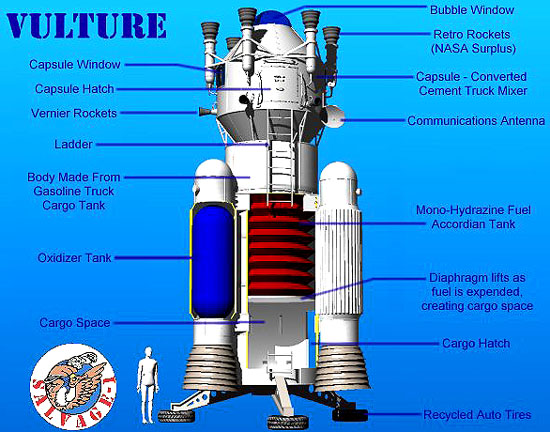
I actually watched that show...
Thanks for the ping. His argument for stainless steel makes sense, but I don’t know enough about this subject to make any comment.
Me too.
I kind of wonder if he considered hydrogen embrittlement at elevated temperatures in his selection. The stainless piping systems I ran at 900 degrees and higher all used low carbon 304l or 316l. 301ss has nearly twice the carbon content of 304. https://www.marlinwire.com/blog/what-is-the-difference-between-301-and-304-stainless-steel-with-regard-to-corrosion-properties I still remember a few things in the quest for hypersonics during the mid 90s, lol. X-files (cough)
Uh, this is nonsense.
Titanium is 1/4 the weight and will take heat up to 6,000 deg F.
Disclaimer: Opinions posted on Free Republic are those of the individual posters and do not necessarily represent the opinion of Free Republic or its management. All materials posted herein are protected by copyright law and the exemption for fair use of copyrighted works.