Posted on 12/02/2025 8:23:31 AM PST by DFG
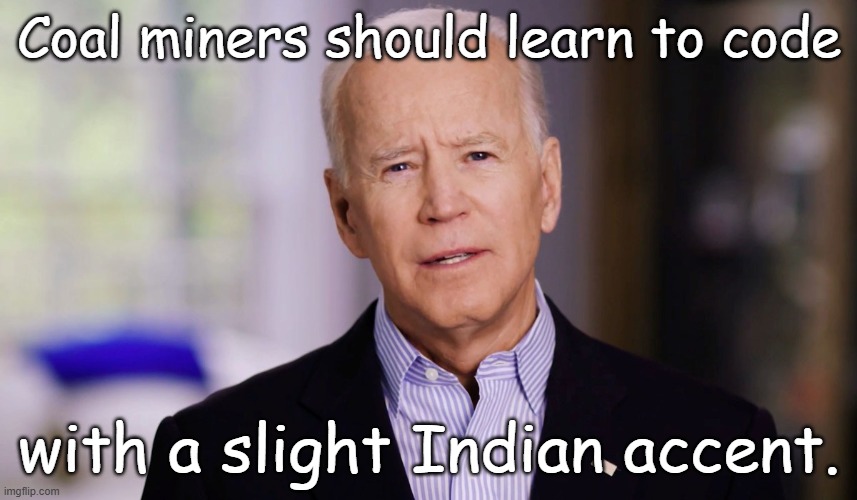
They were promised lucrative and stable careers if they “learned to code” and earned a degree in software engineering.
Instead, many Americans in the tech industry have been left disillusioned as they face mass layoffs and chronic unemployment — a crisis they say stems from an addiction to cheap foreign labor pipelines that are made accessible through programs like H-1B, and are touted by companies as a way to hire the “best and brightest.”
“At this point, I’m doing something else,” Jonathan, a cybersecurity professional who is leaving the industry entirely out of frustration, told the Daily Caller News Foundation. “My career is basically dead in the water because of these problems.”
Jonathan lost his job in the industry in November 2024 and in the months since, he’s submitted well over 200 applications for tech-related positions in the Seattle area, but received a grand total of zero offers — despite five years of experience and purportedly demonstrating high competency in every interview assessment thrown his way.
He wished to be identified only by his first name out of fear of retribution from past and potential employers, as did most of the seven tech employees who spoke with the DCNF.
Controversy surrounding the H-1B program, which very publicly split President Donald Trump’s inner circle shortly before he began his second term, has once again shot onto the national scene as the White House gives mixed signals on the program’s benefits. The issue has proven divisive for the Republican leader, who was elected to office on a pro-worker platform, but also has powerful allies in the tech world.
When reached for comment, the White House referred to recent statements made by press secretary Karoline Leavitt.
“The president does not support American workers being replaced,” Leavitt told a group of reporters earlier in November. “The president has a very nuanced, common-sense opinion on this issue … but ultimately [he] wants to see American workers in those jobs… There’s been a lot of misunderstanding of the president’s position.”
‘Disillusioned’ Public data suggests that many American engineers are being passed over for foreign workers.
Throughout 2025, major technology companies such as Microsoft, Meta, Amazon and Intel underwent layoffs — continuing what has been a years-long trend in the industry. The workers interviewed by the DCNF were not employed at these specific tech companies.
Roughly 428,000 tech workers lost their job between 2022 and 2023, and a total of 384 tech companies handed pink slips to roughly 124,000 workers in 2024, according to the Institute for Sound Public Policy (ISPP).
While H-1Bs have an outsized influence on the tech world, workers across all major industries are impacted by imported foreign labor.
The flow of H-1B workers into the U.S. has largely kept apace despite these mass layoffs, with the ISPP finding that the number of H-1B visa workers has grown 80% since the Great Recession low in 2011. Experts estimate that nearly 660,000 H-1B workers were living in the U.S. in October 2024.
Established by Congress in 1990, the H-1B program was originally intended to utilize “highly specialized” foreign labor, according to the U.S. Citizenship and Immigration Services. Although it’s a nonimmigrant visa, H-1B holders can eventually become eligible to apply for legal permanent residence, allowing them to stay in the country indefinitely.
The tech industry dominates the use of H-1Bs, with tech companies accounting for nearly 70% of H-1B petitions annually, according to Nation Connections, a site dedicated to helping individuals navigate immigration laws in different countries.
Other American-born tech workers have shared similar experiences to Jonathan’s, and have stayed silent due to fear of retaliation.
“I do feel kind of disillusioned with the industry,” said Riley, who graduated with a software engineering degree in 2021. “Software engineers have a higher unemployment rate right now than art history majors.”
Art history majors have a 3% unemployment rate, according to the Federal Reserve Bank of New York, which compiled data released in February. Computer engineering majors, on the other hand, currently suffer from a 7.5% unemployment rate.
Riley said he noticed a monumental shift in the hiring practices of an Austin-based company he worked at for several years. He claims the company — which had faced consistent complaints from engineers about pay — increasingly staffed its engineering departments with employees from South America and eventually established an office in Colombia to better utilize the continent’s workforce.
“I believe that that was done in order to, you know, reduce their labor costs so that they could get engineers without negotiating with [the American-born engineers] or caving to their demands,” Riley said.
Jonathan described a similar situation after the California-based company he worked for introduced an India development center. Roughly six months after the center was launched, he said the company stopped hiring outside of India altogether. About a year after he left, Jonathan’s former coworker informed him that around half of the company’s security personnel was let go.
“You’re going to lose advancement opportunities, you’re going to have HR problems and you’re going to be not a team player if you don’t advocate with open arms the idea of an Indian development center being opened up to your company or a billion H-1Bs flooding the market,” Jonathan said about the situation he was facing and the continued pressure to not speak out.
‘We’re All In The Process Of Being Replaced’ India stands far above any other nation as the top source of foreign labor, making up 72% of all H-1B recipients between October 2022 and September 2023, per a March 2024 report from the Department of Homeland Security.
“We’re all in the process of being replaced,” John, who worked for an insurance company in Connecticut, told the DCNF.
John said there were around 350 IT employees — all purportedly American — at his company when he first began in 2006. Throughout his decade at the company, he claims they were all steadily booted out in favor of foreign workers.
“Most of the time they had them train their Indian replacements before they left as a condition of receiving their severance,” he told the DCNF. “So what I saw over a period of time was a whole bunch of lives being destroyed.”
“A lot of the younger kids can’t find employment,” John said of the industry. “They spent a whole bunch of money learning all of this stuff — computer programs, cloud platforms, this that the other thing — but they can’t find work.”
The tech employees who spoke to the DCNF are struggling to find work in the U.S. at a time when college debt has skyrocketed to historical highs. Roughly 44 million Americans owe more than $1.7 trillion in student debt, according to the National Conference of State Legislatures. Engineering degrees in general are consistently ranked as one of the costliest to earn.
Like his coworkers before him, John was ultimately “replaced” and handed a severance agreement that forbids him from discussing the matter publicly.
“Coming home to western Washington from Alaska, I assumed that finding a better-paying job would be no issue — we are home to some of the nation’s largest tech companies,” Luke Hawthorne told the DCNF. “I spent nearly a year over 2022 and 2023 searching for my current job, a job which pays me about the same as I was making before.”
While Hawthorne still considers himself lucky to be employed, he said his current salary “doesn’t even approach” the threshold it takes to afford a home in his area of Washington State. His home state’s software developer workforce grew by more than 16% through H-1B certifications over just a 9-month period, with 83% of these positions approved at or below Washington State’s median wage, according to public data he analyzed and shared with the DCNF.
“The ‘best and brightest’ argument simply doesn’t square with how the program is being used,” Hawthorne said. “Another important aspect of it is that you aren’t competing just with the new arrivals, but with all of the tech workers who have been replaced — I have friends with talent and experience who have been out of work for years.”
Many of the tech workers who spoke to the DCNF have since become involved with U.S. Tech Workers, an advocacy group that highlights the plight of American employees negatively affected by the H-1B program and pushes Washington, D.C., for change.
Trump, who has implemented some of the most hawkish immigration policies since returning to office, has appeared to give mixed signals on the issue as major players within his own inner circle disagree over reform.
The president’s coalition appeared fragmented in the weeks leading up to his second presidential inauguration, with business magnate Elon Musk touting H-1Bs in December 2024 and Vivek Ramaswamy suggesting that the U.S. needs foreign talent because American culture “venerated mediocrity over excellence.” Georgia GOP Rep. Marjorie Taylor Greene, a former a top Trump ally who is resigning from Congress, said in November she would introduce legislation completely phasing out the H-1B program, accusing tech companies of abusing the system at the expense of Americans.
Trump initially appeared to side with the pro-H-1B faction, declaring in December 2024 that he was “a believer” in the visa program. In what appeared to be a major shift into the pro-American worker camp, Trump in September signed a proclamation slapping a $100,000 fee on all new H-1B applications, but opponents of the program have criticized the fee’s limitations and workarounds. Earlier in November, Trump once again publicly touted the need for H-1Bs to import foreign workers.
As Washington, D.C., continues to debate the value of H-1Bs, American tech workers say they’ve been left out to dry.
“I graduated college seven years ago and I remember in high school them telling us, ‘learn to code and you’ll have a good job,'” Joseph Ibrahim, an unemployed tech worker based in Florida, told the DCNF. “Well, it turns out they outsource the coding jobs also, not just the manufacturing jobs.”
Ibrahim got a degree in information systems, business analytics and information systems, but has been struggling to find work since April. Unlike many of the tech workers who spoke to the DCNF, he had no problem being identified by his full name.
“What are they gonna do?” Ibrahim asked. “They’re already not hiring me.”
“You know, if I went into college and on the pamphlet, there were like, ‘pros and cons of studying something in computer science: you may have to train your replacement at some point in your career,’ I would have never studied this,” he said.
Code-wala go home!
Tech is a bad field. It did work out OK for me, but I got in decades ago and have now retired.
They can offshore your job.
They can bring foreigners here to take away your job.
Your job can be automated.
Your job can be eliminated by fools upstairs who don’t understand why technology is important.
And technology changes all the time — it’s real work to stay up to speed, and if you don’t, they will bring in a new foreigner who just graduated with the latest skill and who will work cheap.
It’s a pretty foolish career path at this point.
But, from the view of a national economy of a developed nation — you REALLY want your citizens to pursue technology and grow your own economy with your own people and keep all the skills, money, and knowledge right here at home.
The government has to make some serious changes to make technology a good field again.
FIFY.
The H1B program might have had some good ideas in the beginning, but it has far outlived that purpose.
The brain drain long ago reached diminishing returns.
Nowadays Indian visa holders get into positions of management and then only hire other Indians.
They really do act like they think all Americans are stupid.
If you manage to get hired they will do what they can to drive you out of that position.
Put an Indian in charge of a company and the more Indians they’ll import telling US workers to get stuffed
These filthy pagans are all over banking. They get into HR and only hire other filthy pakis and pagans. They don’t bathe, they don’t wash their hands and their food stinks. Canceling T-mobile because they just made one CEO.
“cheap foreign labor”
Do tell, just like reliving my frustration this morning that MS Word STILL doesn’t remember printer settings.
Asshats.
Happened to me in 2008 - crash and everything
Changed EVERYTHING I once knew as normal
Just like we need to get non-English speaking immigrants from driving 18-wheelers, we need most of our tech to be Americans. Now that the H1B problem is impacting both tech and trade jobs, I hope that Americans will rally against overuse of H1B's.
1. Like almost any STEM field, it is universal in nature and therefore easily transferable across borders.
2. It doesn't require professional licensure.
The second one is a big one, because it's what sets an IT professional apart from, say, a medical doctor, a professional engineer, lawyer, or a CPA. The educational requirements for licensure in some of these fields represent a high barrier to entry for foreigners who might otherwise be qualified to do the work.
Bingo! The program may have a need but we have no plenty of programmers in country.
I worked with a French H1B who was excellent, but the generic Asian programmers I worked with were all average, at best. Resume stuffing, massive use of AI and earlier computer helps. Lots of output (sometimes) but cludgy code that creates more problems than it solves. Kinda like modern M$ …
I want my...
I want my...
I want my H 1 B....
Look at them yo-yos.
That’s the way you do it...
I saw the writing on the wall after we fixed the Y2K problem and switched from being a COBOL programmer to being a business analyst. The latter is communication intensive, which is harder for Indians with broken English to tackle. It served me well until I retired four years ago.
However, I dearly loved being a COBL programmer and really hated business analysis. But it paid the bills.
Same here. Retired four years ago after almost 40 years in mainframe environments.
Th H1B visa program should be canceled. It has been misused to the point of destroying STEM for Americans. It reduces opportunities and salaries for Americans. And it strip mines human capital from foreign nations.
My dear son-in-law is caught in this mess. He is one of the smartest men I know, and has put out hundreds of resumes since graduating in 2022. He took a job as a security guard to pay the bills.
One of Mr.GG2’s friends has been out of work for over 5 years due to this carp. He’s A coder and previously made over $200,000 per year. Now he’s blackballed. Being ultra conservative and 100% American isn’t cool.
Why do people act like H-1B is something new...
Disclaimer: Opinions posted on Free Republic are those of the individual posters and do not necessarily represent the opinion of Free Republic or its management. All materials posted herein are protected by copyright law and the exemption for fair use of copyrighted works.