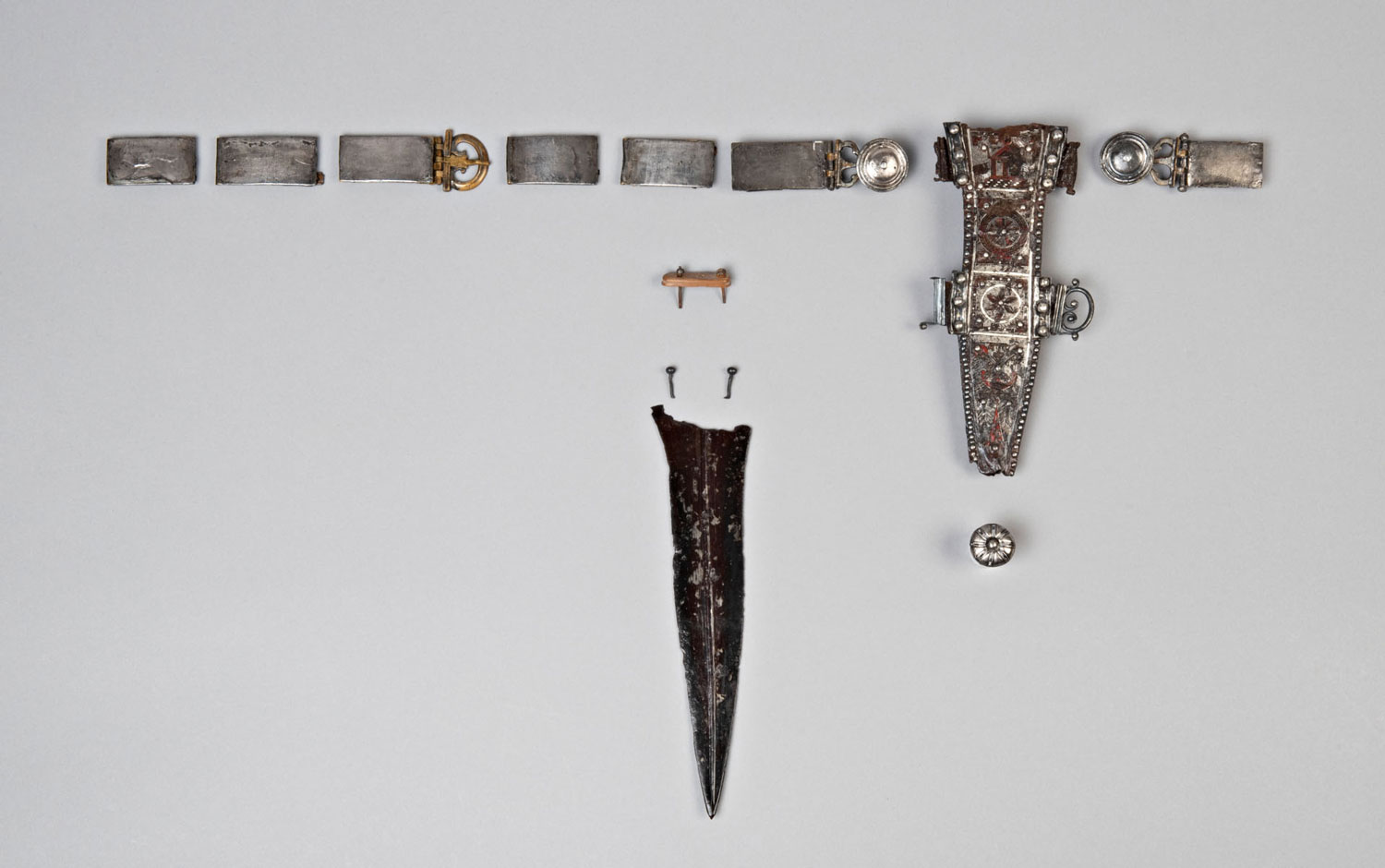
Roman military belt and daggerLeiden University
Posted on 11/16/2026 7:51:37 PM PST by SunkenCiv
Mark Driessen and Carol van Driel-Murray of the University of Leiden have reexamined the remains of a man discovered in a well at the Roman fort of Velsen on the coast of North Holland in 1977, according to a La Brújula Verde report. A military belt, a dagger, a ring, a fibula, and a sandal with a studded sole were also recovered from the well. Previous research suggested that the man had been killed in A.D. 28, during a rebellion by the local Frisians over taxes, as recorded by the Roman historian Tacitus in his Annals. Driessen, Driel-Murray, and their colleagues proposed additional possible reasons for the man's death. First, examination of the bones identified multiple stab wounds, including on the inside of the ribcage and the pelvis, indicating that the man had been brutally murdered. 3D models of the wounds show that they were probably made with a Roman military dagger, or pugio, perhaps the weapon found in the well next to the remains. This pugio had a nine-inch-long blade, as well as a new iron sheath decorated with silver and red and yellow enamel. The study also suggests that the murdered man stood more than six feet tall and was very muscular. He is thought to have been a soldier and not an officer, since the dagger was worn and his belt had been put together with mismatched pieces... To read about artifacts recovered from a military sanctuary on the Roman Empire's northern edge, go to "Romans Go Dutch."
(Excerpt) Read more at archaeology.org ...
Roman military belt and daggerLeiden University
I love everything you post SunkenCiv!
“ killed in A.D. 28, during a rebellion by the local Frisians over taxes…”
I’m probably not the only one to notice this was 28 A.D. and Jesus was still alive and acknowledged the obligation to pay taxes, stating, “Render therefore unto Caesar the things which are Caesar’s; and unto God the things that are God’s” (Matthew 22:21).
Maybe it was in connection to this rebellion and the real need to protect people by encouraging them to do so.
This water tastes funny
“
This water tastes funny”
It has body....
The rebellion in Frisia was thousands of miles away from Judea
So what? They were both under Roman rule, correct? News certainly traveled across the Empire.
“I love everything you post SunkenCiv!”
,,,,,,,,,,,,,,,,,,,,,,,,,,,,,,,,,,,,,,
Amen and Amen !!
And if you love art, see his bio.
Mr SunkenCiv : I’ve learned a great deal from your postings. This one is no exception. Thank you.
Yes, possiblythey could have, though both Judea and Frisia were fringe areas at the extreme opposite ends of the empire and far, far away from the galactic core.
It would be highly unlikely that ordinary people in Judea, including Jesus, would have heard about the Frisian rebellion of A.D. 28.
According to the Roman historian Tacitus, Emperor Tiberius deliberately suppressed details of the military losses in Frisia to avoid public embarrassment or having to appoint a powerful general to lead a new war. Because Rome downplayed the defeat, the story did not circulate widely even within the imperial capital
Non-official news reached Judea through Mediterranean sea trade and overland travelers. A trip from Italy to the eastern Mediterranean took several weeks in good weather, and merchants prioritized news affecting trade routes, imperial succession, or major wars over minor border skirmishes in modern-day Netherlands.
So, while theoretically possible it would not be very probable
DIY mechanic re-examines vehicle engine.
Albiet, a more common occurance in my world.
When you make conclusions way too fast....
Thanks! My pleasure.
Disclaimer: Opinions posted on Free Republic are those of the individual posters and do not necessarily represent the opinion of Free Republic or its management. All materials posted herein are protected by copyright law and the exemption for fair use of copyrighted works.