Skip to comments.
Why hasn't the Pantheon's dome collapsed? [13:33]
YouTube ^
| June 23, 2023
| Garrett Ryan, Ph.D (as toldinstone)
Posted on 07/12/2026 5:23:35 AM PDT by SunkenCiv
An in-depth look at the construction of Rome's Pantheon and its famous concrete dome. Why hasn't the Pantheon's dome collapsed? | 13:33
toldinstone | 628K subscribers | 662,909 views | June 23, 2023

Chapters:
0:00 Introduction
0:28 The purpose of the Pantheon
1:16 The design
1:58 Roman concrete
2:32 Quarries, contractors, and workforce
4:02 Foundations
4:44 Building the walls
5:41 Relieving arches and buttresses
6:35 Masterworks
8:08 Building the dome
9:51 The portico
10:54 Decoration
12:32 Insane Emperors, Sunken Cities, and Earthquake Machines
(Excerpt) Read more at youtube.com ...
TOPICS: History; Science; Travel
KEYWORDS: godsgravesglyphs; wasitsupposedto
Navigation: use the links below to view more comments.
first previous 1-20, 21-40, 41-60, 61-76 next last
To: Alas Babylon!
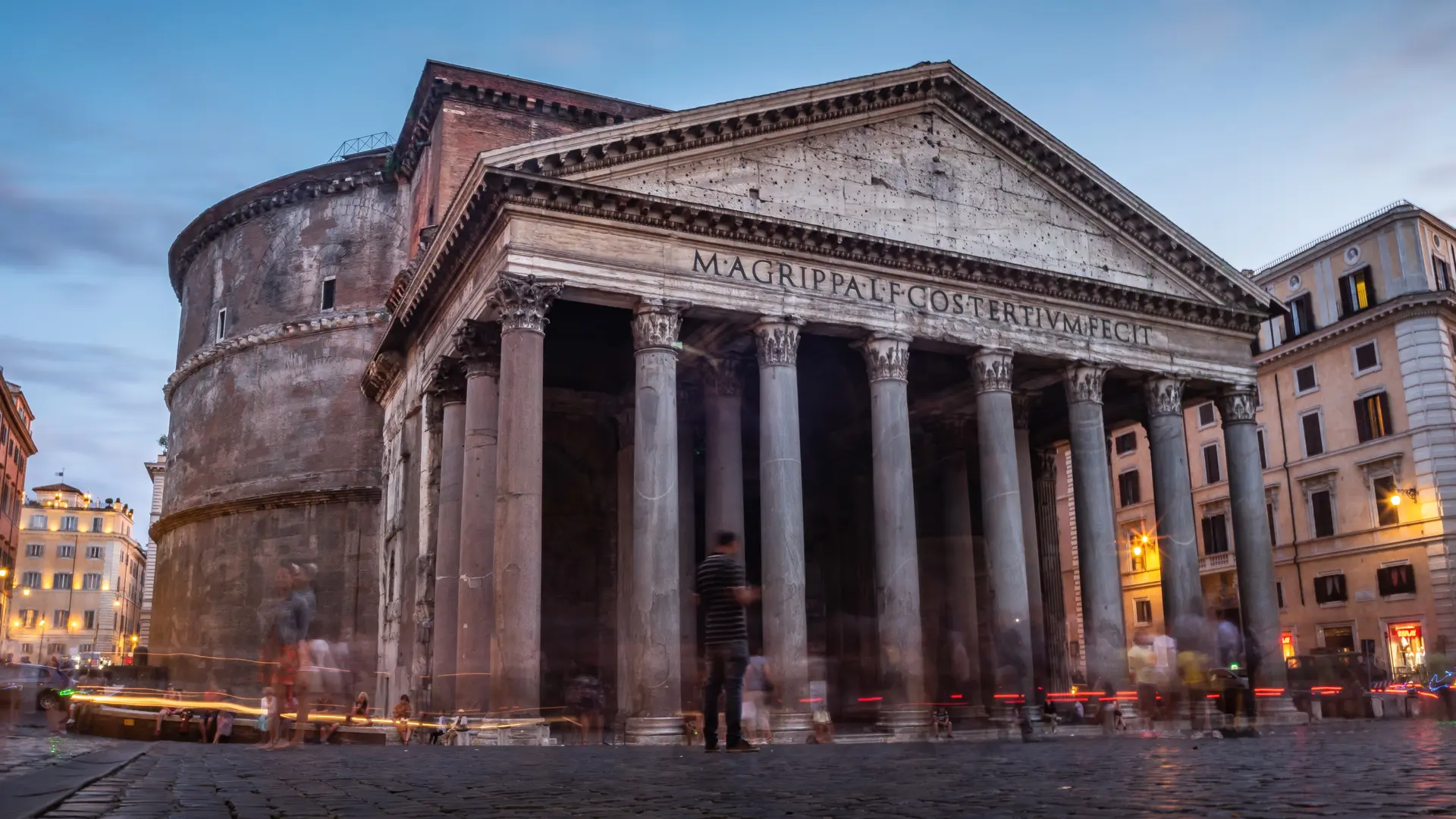
In Latin, the writing on the Pantheon says “M.AGRIPPA.L.F.COS.TERTIUM.FECIT.”
The Latin is succinct but it translates to mean that Marcus Agrippa, son of Lucius, built this when he was consul for the third time.
41
posted on
07/12/2026 9:28:41 AM PDT
by
Alas Babylon!
(The greatest power the media has is the power to ignore.)
To: SunkenCiv
Dang! I meant to buy fish sauce today... Seriously (I have some Southeast Asian dishes to make...)
42
posted on
07/12/2026 9:29:52 AM PDT
by
Alas Babylon!
(The greatest power the media has is the power to ignore.)
To: rlmorel; Liz
My pleasure. While compiling that list of pantheon / concrete topics, I realized, there are a lot of them, probably more than a third of them from me. At some point I should just break down and vacation there. 🙂
43
posted on
07/12/2026 9:30:21 AM PDT
by
SunkenCiv
(The Demagogic Party is just a collection of violent, rival street gangs.)
To: Made In The USA
After that, you get a glimpse of the Obama Library.
44
posted on
07/12/2026 9:39:46 AM PDT
by
GingisK
To: Alas Babylon!
45
posted on
07/12/2026 9:45:57 AM PDT
by
telescope115
(Ad Astra, Ad Deum…)
To: SunkenCiv
I was there....it was stupendous to stand in it.
46
posted on
07/12/2026 9:46:29 AM PDT
by
Liz
(“The heavens declare the glory of God; the skies the work of His hands." (Psalm 19:1))
To: rlmorel
I have not seen that movie yet….gotta do it.
47
posted on
07/12/2026 9:46:44 AM PDT
by
telescope115
(Ad Astra, Ad Deum…)
To: SunkenCiv
Concrete does not dry - it cures. The water molecules in the mix form the chemical bond. Evaporation actually weakens the hardening concrete.
48
posted on
07/12/2026 9:53:45 AM PDT
by
central_va
(I won't be reconstructed and I do not give a damn)
To: ansel12
The 2nd Punic War is fascinating.
49
posted on
07/12/2026 9:56:39 AM PDT
by
central_va
(I won't be reconstructed and I do not give a damn)
To: j.havenfarm
Wow, never saw it or even heard of it before. Thanks. Just astonishing and breathtaking, isn’t it?
To: Lowell1775
The Roman Arch was a popular technique used by the high denarius prostitutes.
51
posted on
07/12/2026 10:05:17 AM PDT
by
central_va
(I won't be reconstructed and I do not give a damn)
To: NFHale
Yes, that's the thing that baffles me. Not an ounce of rebar anywhere.
52
posted on
07/12/2026 10:19:48 AM PDT
by
Governor Dinwiddie
( O give thanks unto the Lord, for He is gracious, and his mercy endures forever. — Psalm 106)
To: SunkenCiv
It is truly an amazing piece of architecture and construction. The front and entranceway opens on a large restaurant and cafe lined piazza. If you go to Rome it is a must-see building.
53
posted on
07/12/2026 10:21:01 AM PDT
by
Rummyfan
(Ok In anyq war between the civilized man and the savage, support lthe civilized man.👨 so t tv)
To: SunkenCiv
54
posted on
07/12/2026 10:21:53 AM PDT
by
Rummyfan
(Ok In anyq war between the civilized man and the savage, support lthe civilized man.👨 so t tv)
To: FLT-bird
They also left a hole in the middle. Interesting. I thought the oculus was mainly to provide light.
55
posted on
07/12/2026 10:23:13 AM PDT
by
Rummyfan
(Ok In anyq war between the civilized man and the savage, support lthe civilized man.👨 so t tv)
To: All
It definitely rains through the Pantheon's oculus. I've been in it on rainy days when the center was cordoned off to keep tourists out of the wet.
Here's a video of rain in progress:
https://www.youtube.com/watch?v=73vEsV9nvmw
FF to about 4 minutes for the rain.
The shape does create a 'mist' effect that tends to cause raindrops to break up as they fall but the building was engineered knowing the rain still would get through. The floor is slightly crowned from the center to the perimeter, causing water to run away from the middle of the building. And there are 20-odd discretely camouflaged drains around the perimeter so there's very little puddling.
There is a monument to the Yankee soldiers from Illinois in the Vicksburg National Military Park that is a scaled-down replica of the Pantheon. It has an oculus in its dome, and the locals there also perpetuate the myth that it doesn't rain through the hole, but it does there, too.
https://en.wikipedia.org/wiki/Illinois_Memorial
Summer is the driest part of the Roman year so there's limited opportunity for the bulk of tourists to see for themselves.
To me, a greater mystery than the self-healing concrete is why the pediment over the portico is 10 feet lower than intended.

On the wall above and behind the pediment you can see where it originally was intended to come to. It mirrors the pitch of the roof on the pediment but there's no roof there, so something's obviously not right.
All anyone knows for certain is the columns there now are about 10 feet too short. They're made from Egyptian marble that would have come by boat across the Mediterranean so theories range from a simple engineering foul-up to the ship carrying the original columns being lost at sea. In any case it would have taken months to get proper replacements so they might have grabbed whatever columns were handy and made do with 10 feet too short.
RE: the inscription on the portico, it reads: M⸱AGRIPPA⸱L⸱F⸱COS⸱TERTIVM⸱FECIT
As it means in highly abbreviated Latin: Marcus Agrippa Lucii filius consul tertium fecit
What it means in English: Marcus Agrippa, son of Lucius, [during his] third term [as] consul did [made] this
To: Made In The USA
It’s awe inspiring to visit Rome, Florence, Venice, etc. and see incredible architecture and engineering, craftsmanship and artistry. And then you look at the inscription of when these structures were dedicated…. and then consider context: what tools, what science, what resources, etc. was available to them. Incredible.
Yes. Yes it is. Florence is my favorite city in the world.
57
posted on
07/12/2026 10:25:43 AM PDT
by
Rummyfan
(Ok In anyq war between the civilized man and the savage, support lthe civilized man.👨 so t tv)
To: NFHale
It just proves it only takes a few to ruin the barrel leading to why we can’t have nice things.
58
posted on
07/12/2026 11:03:50 AM PDT
by
BradyLS
(DO NOT FEED THE BEARS!)
To: Rummyfan
Interesting. I thought the oculus was mainly to provide light.Well it did do that.....but it also took away weight. The Romans used concrete at the top that had these little jugs in it (creating air pockets and thus lightening the concrete). They were looking for any kind of way to save weight. Obviously their design worked. 2000 years later its still here.
59
posted on
07/12/2026 11:27:08 AM PDT
by
FLT-bird
To: Governor Dinwiddie
Absolutely amazing isn’t it?
They had some brilliant engineers for sure.
60
posted on
07/12/2026 1:40:39 PM PDT
by
NFHale
(The Second Amendment - By Any Means Necessary.)
Navigation: use the links below to view more comments.
first previous 1-20, 21-40, 41-60, 61-76 next last
Disclaimer:
Opinions posted on Free Republic are those of the individual
posters and do not necessarily represent the opinion of Free Republic or its
management. All materials posted herein are protected by copyright law and the
exemption for fair use of copyrighted works.
FreeRepublic.com is powered by software copyright 2000-2008 John Robinson