Posted on 06/15/2026 7:46:23 PM PDT by Red Badger
On June 27, the asteroid will approach at a distance of around 0.01715 astronomical units. It hasn't been this close since at least 1600 CE.
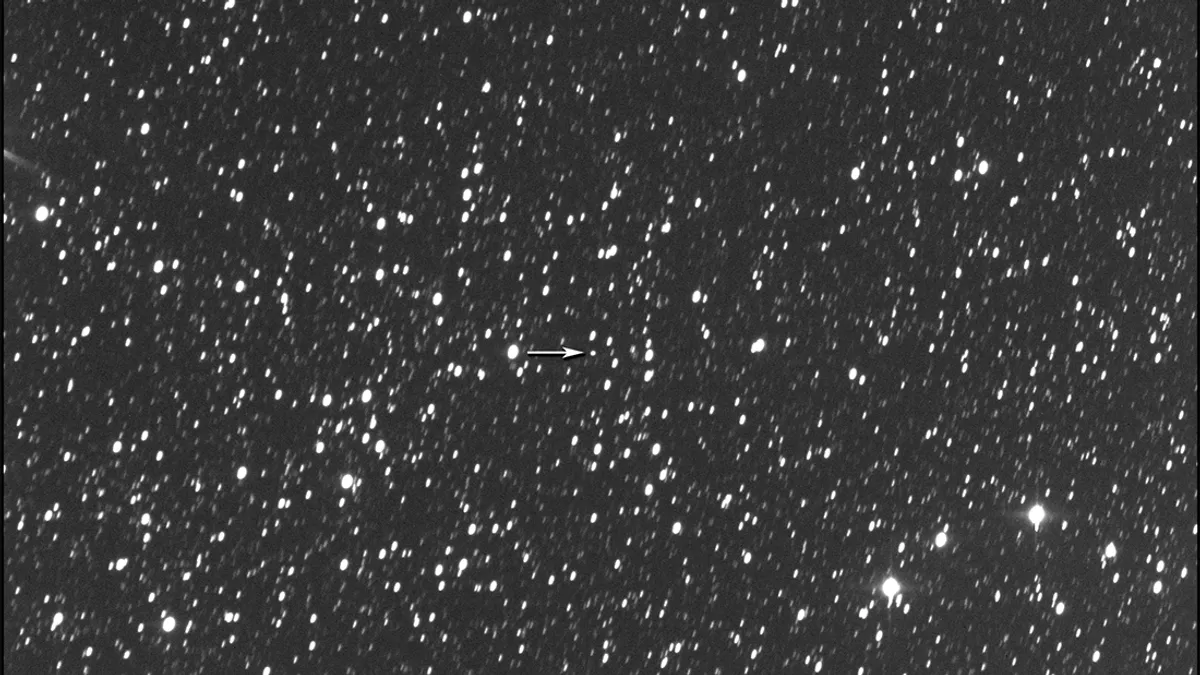
Potentially hazardous asteroid 152637 (1997 NC1) seen by the Virtual Telescope Project, when it was around 10.5 million kilometers (6.5 million miles) from Earth.
Image credit: Gianluca Masi/The Virtual Telescope Project
Potentially hazardous asteroid 152637 (1997 NC1) is about to make its closest approach in over 400 years, in an event only seen once every decade. At these distances, and given the size of the asteroid, it should be possible to view using a small telescope, or even binoculars.
Earth has gotten pretty good at monitoring the skies for potentially hazardous asteroids, or larger objects on courses that could see them potentially colliding with the Earth and doing significant damage. In our time scouring the Solar System, we have found no known asteroids that pose any danger to Earth for the next 100 years, at least.
VIDEO AT LINK.................
152637 (1997 NC1), discovered in 1997 by NASA's Near-Earth Asteroid Tracking (NEAT) program, is no exception. Observing the object several times and calculating its orbit, the asteroid is not expected to impact the Earth anytime soon. But it is an Aten-class asteroid, meaning that its path does bring it in close proximity to Earth on its journey slightly beyond the orbit of Earth, and taking it within the orbit of Venus.
On June 27, 2026, the asteroid will make an especially close approach to the Earth at a distance of around 0.01715 astronomical units (AU), with one AU being the average Earth to Sun distance.
That's close enough to be exciting (more on that in a moment), but at around 2,565,600 kilometers (1,594,100 miles) away, or around 6.5 lunar distances, it's a nice and comfortable "miss" of planet Earth. It is also the closest approach the object has had in at least 400 years, with 1600 CE being the furthest back that the object's path has been computed.
It will make a closer approach at around 0.01699 in the future, but unless you have the secret to immortality handy you will miss it, taking place on June 28, 2133.
So far, observations have shown us that the asteroid is quite a large one, but we aren't altogether too sure how large it is. This isn't because astronomers haven't bothered to measure it, but because it is difficult to gain an idea of an asteroid's sign from the light it reflects alone.
"Visible light from the sun reflects off the surface of the rocks. The more reflective, or shiny, the object is (a feature called albedo), the more light it will reflect," NASA explains. "Darker objects reflect little sunlight, so to a telescope from millions of miles away, a large dark asteroid can appear the same as a small, light one."
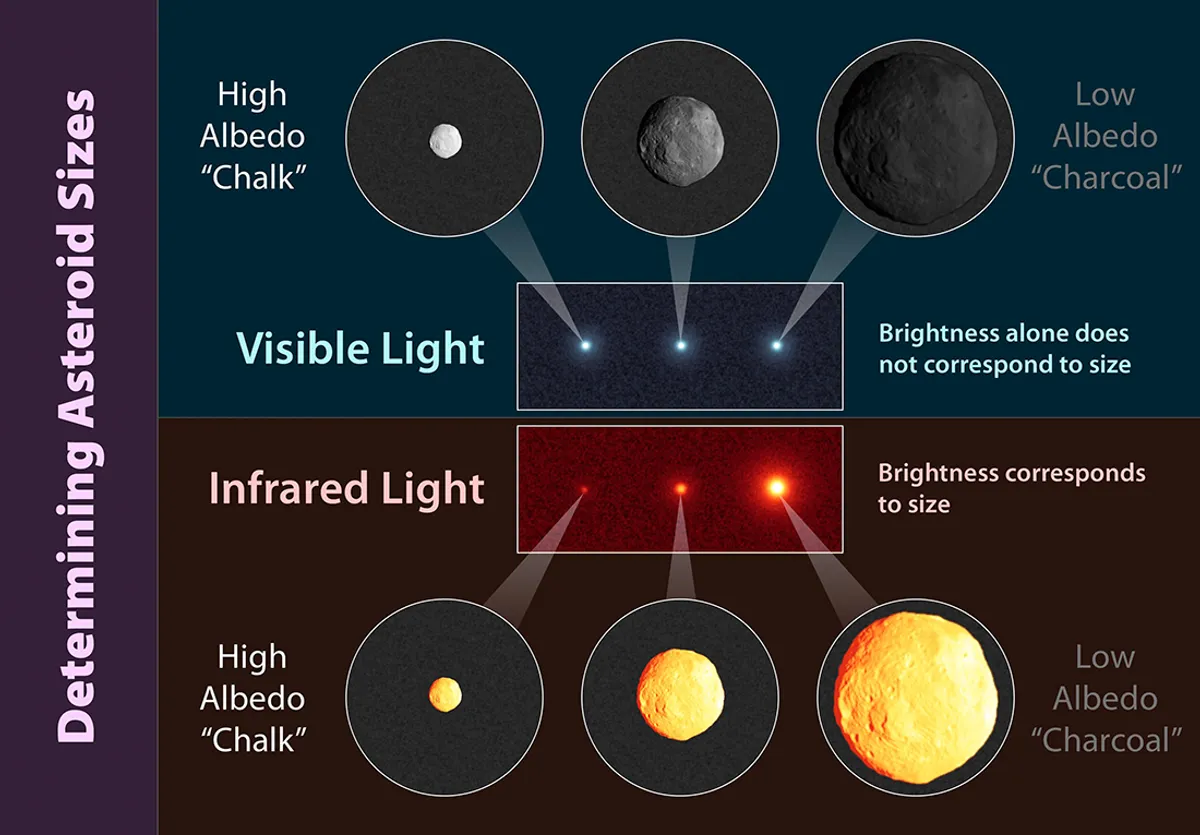
Visible light alone does not reveal an asteroid's size. Image credit: NASA/JPL-Caltech
As far as we can tell, asteroid 152637 (1997 NC1) is pretty big, but this latest close approach will give astronomers the opportunity to pin down how big.
"The absolute magnitude of 17.9 suggests a diameter within a factor of two of 900 meters [2,953 feet]. The diameter, optical albedo, and spectral class have been measured but give conflicting results," NASA explains. "If this object is an optically-dark B-type, then the diameter could be close to 1.5 km. We plan to use radar observations to help resolve the discrepancies regarding the diameter, spectral class, and optical albedo."
NASA plans to conduct observations on the object during the close approach, using the Goldstone Solar System Radar (GSSR).
“Every other technique in astronomy depends on reflected sunlight or emitted radiation,” Marina Brozovic, a radar astronomer at NASA’s Jet Propulsion Laboratory, explained to Eos. “We bring our own flashlight, and the echo comes back carrying lots of valuable information from super precise measurement of where that object is in space to physical characteristics [like] how fast it’s spinning.”
Using the GSSR, astronomers will hopefully be able to pin down more properties of the asteroid, with the next close approach not taking place until 2088. As well as being an opportunity to look at this specific asteroid, approaches by asteroids this size only take place around once every decade.
"The 2026 flyby distance is unusually close for an object this large," NASA adds. "The last encounter closer than this by an object with a brighter absolute magnitude (and presumably a larger diameter) was in January 2022 by 1994 PC1 (H = 16.6), which approached within 5.2 lunar distances (0.0133 au)."
During the approach, the asteroid is expected to peak at around magnitude 10, making it visible with small telescopes or perhaps even a decent pair of binoculars, though the brightness of the Moon may interfere with this somewhat.
It will be visible from northern locations as the asteroid approaches us, while southern viewers will be able to get a view of it as it recedes from Earth.
If you are unable to see it for yourself, the Virtual Telescope Project is planning on live-streaming observations on June 26 and 27, both beginning at 23:00 UTC. Better watch, with the next opportunity coming long after you are dead. Though just to reiterate, that won't be the asteroid's fault.
Superman will save us from an asteroid collision. Nothing to worry about!
Superman will save us from an asteroid collision. Nothing to worry about!
Rest assured God will deal with Earth’s passing in his timeline, not man’s guess.
Don’t look up!...............😏
Yes, I know, but I SAY CHRISTIAN ERA because it drives atheists bonkers...........
Thanks for the topic/ping! Sounds like a big one.
So,hot fudge Sunday comes on a Saturday.😗
It will eventually hit the Earth, maybe in a thousand years, maybe ten thousand, but it will hit..............
Current estimate is a bit more than half-mile diameter, so, the impact will be a bad, crazy day. Sounds like a good candidate for mining out of existence, or trajectory alteration tests.
That’s usually a short drive.
To bad Musk can’t land a rocket on it and check for rare earth minerals. One possible way for his Space stock to help get good income finding things we need.
I wonder if all those bright falling lights reported from various parts of the country are part of a wide spread cloud that travels with this particular asteroid?
Brave AI:
Estimates for the amount of space dust falling on Earth vary significantly depending on the measurement method, ranging from 5 to 300 metric tons per day.
Atmospheric Entry:
Studies measuring atmospheric sodium and iron levels suggest approximately 60 tons per day (about 22,000 tons annually) enter the atmosphere.
Surface Accumulation:
A study analyzing micrometeorites in Antarctic ice cores found that about 14 tons per day (5,200 tons annually) actually settle on the Earth’s surface.
Total Flux:
Other estimates based on satellite data and ice core rare elements suggest a higher total flux of 100 to 300 tons per day, with most material vaporizing in the upper atmosphere before reaching the ground.
NOTE: A Metric Ton, also spelled Tonne, Is 1000 kg or 2,204.6 pounds
Oh? Then: Carry on!
(I thought that I was correcting an unintentional mistake.)
Regards,
They thought that they were so smart and clever changing AD to CE way back when, I just came up with a new, and better Definition for their insanity!................
God gave man working brains and plenty of problems to solve. He assigned us stewardship of the place. Scripture clearly indicates that God expects us to use our brains and our hands. Did you ever stop to think that it just might be God’s will that we solve our own problems?
The annual meteor showers are the debris streams from comets (e.g. the Perseids are from 109P/Swift-Tuttle) so the debris follows the cometary path in a sort of dot-dash pattern. The Earth passes through these and the “shooting star” activity level stems from how much debris happens to be in our path. The more orbits completed by the comet, the more debris.
sidebar:
https://science.nasa.gov/solar-system/comets/1p-halley/
“Scientists calculate that an average periodic comet lives to complete about 1,000 trips around the Sun. Halley has been in its present orbit for at least 16,000 years, but it has shown no obvious signs of aging in its recorded appearances.”
more about Halley:
https://ntrs.nasa.gov/citations/19810054297
A 5” refractor has the camera attached. This is piggybacked on top of our 10” refractor, which people will still be able to look through at the eyepiece .
Now I’m in the hunt for finder charts of the event.
I don' think I'm cut out to be an astronomer...
Earth travels the cosmos in a shooting gallery ……
Disclaimer: Opinions posted on Free Republic are those of the individual posters and do not necessarily represent the opinion of Free Republic or its management. All materials posted herein are protected by copyright law and the exemption for fair use of copyrighted works.
