Posted on 03/31/2026 1:58:47 PM PDT by Libloather
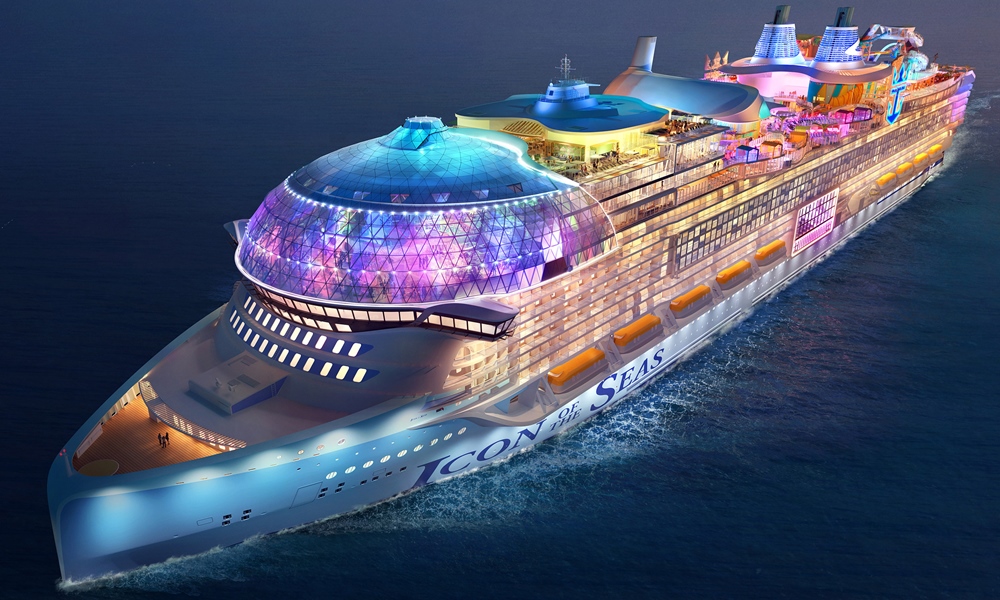
Royal Caribbean’s newest cruise ship is the world’s largest.
The Hero of the Seas, set to launch late next summer, includes a record-breaking water park, the most pools at sea, 28 dining options, a multi-level family treehouse, and a kinetic sculpture, just for kicks.
Billed by Royal Caribbean as “the most unstoppable, incredible, revolutionary family vacation ever,” the high-stimulation vessel, which appears to have been designed by an eleven-year-old child high on cocaine, will officially open for bookings on Thursday, April 2.
The Hero of the Seas belongs to Royal Caribbean’s Icon class, the cruise line’s newest generation of ships, which also includes Icon, Legend, and Star of the Seas.
These mega-ships combine resort-style amenities and family-focused neighborhoods.
“Icon Class truly set a new standard for family vacations, and Hero of the Seas takes that vision even further,” said Michael Bayley, president and CEO, Royal Caribbean, in a press release.
“With more water, more thrills and more choices for all ages, we’re continuing to build on what our guests love about Royal Caribbean and delivering the experiences families are looking for when vacationing together,” he continued.
While aboard Hero of the Seas, guests can swim at nine distinct pools, including family-friendly spaces, adult-only options, and, because maximalism and max escapism during an economic downturn are the vibe of this here vessel, the world’s largest onboard swim-up bar.
(Excerpt) Read more at nypost.com ...
Do the toilets work. ? The Navy may need to take notes.
LGBQ, etc approved ?
They should NEVER say UNSTOPPABLE!!! BEYOND STUPID....BAD LUCK, TOO!
Just ask Leo.

Don’t have anything against them, not my thing, but the math is, sooner or later one of these gigantic things is going to sink, and not just off shore like in Italy, but truly sink... and what’s that going to look like?
Some of the biggest ones have about 10,000 people onboard between customers and staff...
I have (another) dumb question: Would something like what happened to the USS Cole be enough to capsize her?
It is inevitable that a large ship will sink again one day, but the odds that any one ship on any cruise will sink or suffer a mishap are very, very small. Ships have lifeboats, and much, much improved navigation. As long as you don’t fall overboard, or get killed in fight, cruises are extremely safe.
according to the internet this ship “Hero of the Seas” is 250,000 deadweight tons
For comparison, the USS Gerald Ford is 100,000 DWT.

They haven't built it yet but here's the picture they offer. A floating (hopefully not sinking) city.
The cruise industry attracts all the hood rats that can't pass thru TSA Screening due to active warrants, legal problems, back child support, criminal activity, drugs, etc....
Lost my grandmother on the Yarmouth Castle Cruise ship. On ship fire.
I would rather stay in a luxury hotel at the beach.
I’d feel trapped on one of those ships.
Business is all about scaling.
In my opinion, capitalism, communism, and socialism are all methods of scaling. They’re systems for delivering necessities, luxuries, and progress to an entire population.
Capitalism is decentralized and self-funding. It routes resources to people who know how to use them to scale whatever it is that they’re enthusiastic about. If no one wants something, it the resources won’t be there to pay for scaling it up.
Another thing capitalism is really good at is recycling failure. We learn from failure; the harder we fail, the more we learn. Under other systems, people who fail either (1) become pariahs, or (2) are promoted without learning anything. That’s a double-barreled disadvantage.
Strip away all the other matters; freedom, morality, justice, etc., and what you’re left with is “which system is better at scaling value?” In an economic sense, that’s the whole story.
When loaded with crew, passengers, and all they need, the center of gravity has to be below the waterline, provided the line is painted at the right level. Otherwise, the ship will flip over. With such a huge superstructure, I have always wondered how they achieve that.
I’d need a month on that ship to fully enjoy it.
back in the early 2000’s i spent a week on the brand new Navigator of the Seas and barely experienced much of what the ship had to offer...
I’d feel trapped on one of those ships."
I'm with you.
I'd never heard of that ship sinking. Good article on Wiki: SS Yarmouth Castle.
I can't imagine the fear that went through people.
Hard to imagine cruise ships were that small in that era...

Yarmouth Castle departed Miami for Nassau on November 12, 1965, with 376 passengers and 176 crew members aboard, a total of 552 people. The ship was due to arrive in Nassau the next day. The captain on the voyage was 35-year-old Byron Voutsinas.My grandparents returned to Germany around 1959 on an ocean liner, their first (and only) time since emigrating to New York in 1927. Their voyages were uneventful.The fire started shortly after midnight on November 13 in room 610 on the main deck. At the time of the fire, the room was being used as a storage space and contained mattresses, chairs and other combustible materials. No sprinkler head was installed in the room. The source of the fire could not be determined; it may have been caused by jury-rigged wiring, sparks entering through the ventilation or by carelessness.
A watchman did a security patrol between 12:30 and 12:50 a.m. but failed to systematically check all areas of the ship and detect the fire. At some point between midnight and 1:00 a.m. crew and passengers began noticing smoke and heat and started searching for a fire. When they discovered it in room 610 and the toilet above, it had already begun to spread and attempts to fight the fire with fire extinguishers were not effective. Attempts to activate a fire alarm box were also unsuccessful. The bridge was unaware of the fire until about 1:10 a.m. By this time, Yarmouth Castle was 120 miles east of Miami and 60 miles northwest of Nassau.
At 1:00 a.m. the engine room alerted the bridge that smoke was coming through the ventilation system. The captain was summoned to the bridge, instructed the crew to sound the alarm, and departed to locate the fire. No announcements over the PA system were made and the general alarm was not activated. The general alarm would have sounded alarm bells throughout the ship, alerted the passengers, and summoned off-duty personnel to the emergency stations.
After about five minutes, the captain returned to the bridge and at 1:20 a.m. ordered the ship stopped. The radio officer could not send a distress call because of flames and smoke in the radio room. The fire forced the crew to leave the bridge, and the captain gave order to abandon ship at about 1:25 a.m. At this point the general alarm could no longer be sounded and they were unable to issue the complete "abandon ship" signal using the ship's whistle.
The captain proceeded to the lifeboat containing the emergency radio, but could not reach it. He and several crew members launched another lifeboat and abandoned ship at about 1:45 a.m. The captain later testified that he wanted to reach one of the rescue vessels to make an emergency call.
The remaining crew proceeded to alert passengers and attempted to help them escape their cabins. Some passengers tried to escape through cabin windows but found them difficult or impossible to open due to improper maintenance. The sprinkler system activated but was largely ineffective due to the severity of the fire. Crew members attempted to battle the flames with hoses, but were hampered by low hydrant pressure. The investigation later determined that more valves were open than the pumps could handle.
While some lifeboats burned and others could not be launched due to mechanical problems, half of the ship's boats made it safely away. Passengers near the bow could not reach the lifeboats, but some were later picked up by boats from rescue vessels.
The Finnish freighter Finnpulp was just eight miles ahead of Yarmouth Castle, also headed east. At 1:30 a.m., the ship's mate noticed that Yarmouth Castle had slowed significantly on the radar screen. Looking astern, he saw the glowing flames and notified the captain, John Lehto, who had been asleep. Lehto immediately ordered Finnpulp turned around. The freighter radioed Nassau three times but got no reply. At 1:36 a.m., the Finnpulp successfully contacted the Coast Guard in Miami. It was the first distress call sent out.
The passenger liner Bahama Star was following Yarmouth Castle at about twelve miles distance. At 2:15 a.m., Captain Carl Brown noticed rising smoke and a red glow on the water. Realizing that this was Yarmouth Castle, he ordered the ship ahead at full speed. Bahama Star radioed the U.S. Coast Guard at 2:20 a.m.
Finnpulp was the first ship on the scene, aiding the first lifeboat, which carried the Yarmouth Castle's captain. After picking up the passengers and some crew from that boat, the freighter turned to rescue further passengers from the burning ship. Finnpulp also launched its own boats to rescue passengers.
By this time, Bahama Star had arrived on the scene. The ship stopped 100 yards from Yarmouth Castle and launched lifeboats, which lined up against the starboard side of the burning ship. Some people jumped into the water and climbed aboard the lifeboats. Others descended ropes and rope ladders. Finnpulp lowered a motorboat, which towed some of the boats to Bahama Star.
Starting about 2:30 a.m. the U.S. Coast Guard began sending planes and later helicopters to assist in the rescue. The airborne operations would continue throughout the following day.
All survivors had been pulled aboard Finnpulp and Bahama Star by 4:00 a.m. Yarmouth Castle capsized onto her port side just before 6:00 a.m., and sank at 6:03 a.m.
The wreck has not been located but is thought to rest at a depth of 10,800 feet (3,300 m) in the Atlantic.
Aftermath
Fourteen critically injured people were taken by helicopter from Bahama Star to Nassau hospitals. Bahama Star rescued 240 passengers and 133 crew. Finnpulp rescued 51 passengers and 41 crew. Both ships arrived in Nassau on November 13.Eighty-seven people went down with the ship, and three of the rescued passengers later died at hospitals, bringing the final death toll to 90. Of the dead, only two were crew members: stewardess Phyllis Hall and ship's physician Lisardo Diaz-Toorens. While some bodies were recovered, most were lost with the ship.
The Yarmouth Castle fire was the worst disaster in North American waters since the SS Noronic burned and sank in Toronto Harbour with the loss of up to 139 lives in 1949.
Disclaimer: Opinions posted on Free Republic are those of the individual posters and do not necessarily represent the opinion of Free Republic or its management. All materials posted herein are protected by copyright law and the exemption for fair use of copyrighted works.