Posted on 02/24/2026 5:57:21 AM PST by MtnClimber
There it was on the front page of Saturday’s New York Times: with a small assist from the United States, the island nation of Cuba has almost entirely ended the use of fossil fuels. Finally, we have the first country in the world to achieve the climate movement’s Holy Grail and nirvana — Net Zero! Or at least a very close approximation. This should be cause for a huge celebration.
You would think that the Times, which has been demanding the elimination of fossil fuels for at least a couple of decades, would be leading the celebrations. But weirdly, now that Cuba has finally shown the way, the Times chooses to put a completely different spin on the achievement. The headline and subheadline are (print edition): “U.S. Choking Oil Deliveries To Cuba Ports; Military Action Brings a Nation to Its Knees.”
The piece reports that the Trump administration is helping Cuba to achieve Net Zero by preventing oil tankers from landing there. Somehow in this piece, that is spun as a bad thing. It has brought Cuba “to its knees.”
The funny thing is that here in the U.S., it was just over a year ago that we had President Biden and an administration full of zealous environmentalists who were using every governmental power at their disposal to force Americans to stop using fossil fuels. By Executive Order 14057 of December 8, 2021, Biden had directed all federal agencies to pursue an aggressive “all of government” operation to achieve “net zero” on an accelerated schedule. Goals number 1 and 2 from that EO are “100 percent carbon pollution-free electricity on a net annual basis by 2030,” and “100 percent zero-emission vehicle acquisitions by 2035.” In 2023, the Department of Transportation released a “Blueprint” for eliminating all carbon emissions from the transportation sector. In 2024 EPA released a plan to eliminate fossil fuels from electricity generation. Similar initiatives were everywhere in the government.
Did the Times ever suggest that government forcing an end to the use of fossil fuels was “bringing America to its knees”? Or even that forcing the end of fossil fuels was any sort of a problem? If they ever suggested anything like that, I never saw it. What I saw instead was that the Times was the biggest cheerleader for the use of government coercion to suppress the use of fossil fuels, at least if the use was by Americans.
And yet, if you believe yesterday’s article, the banishment of fossil fuels, which was to be such a boon to the United States, is somehow a problem in Cuba. From the Times article:
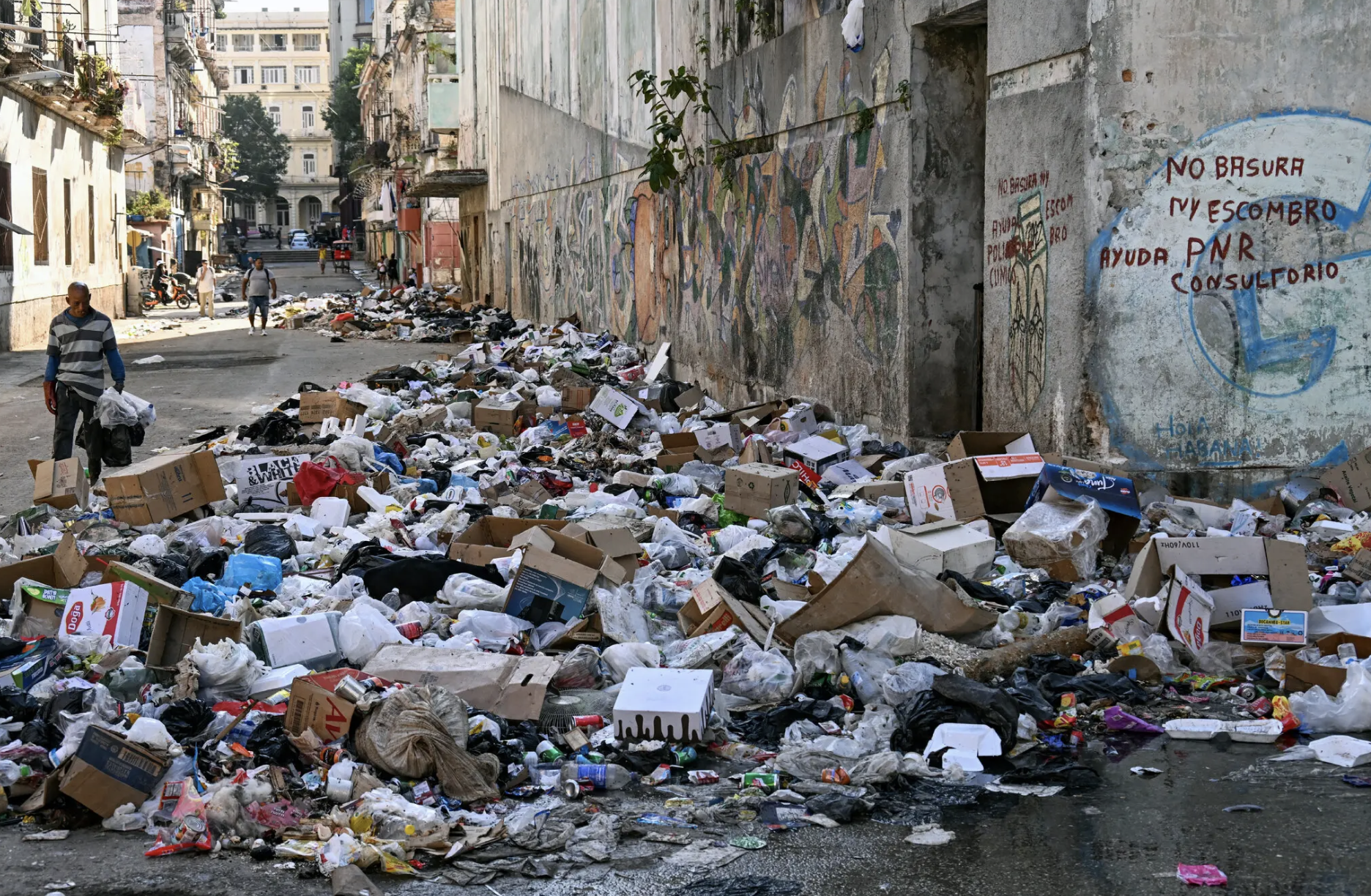
In Cuba, people are struggling with frequent blackouts, shortages of gasoline and cooking gas and dwindling supplies of diesel that power the nation’s water pumps. Trash is piling up, food prices are soaring, schools are canceling classes and hospitals are suspending surgeries.
Here is a picture from the Times of the “garbage piling up”:
What am I missing? Since when are fuels like oil, gasoline, natural gas, and diesel any longer necessary, or even useful or economic, for providing energy to the people? The Times for years has been pounding a relentless drumbeat emphasizing that wind and solar are now the cheapest ways to produce energy, and all sane people are flocking to them as the best sources. For example, from August 17, 2023:
As the planet registers the highest temperatures on record, rising in some places to levels incompatible with human life, governments around the world are pouring trillions of dollars into clean energy to cut the carbon pollution that is broiling the planet. The cost of generating electricity from the sun and wind is falling fast and in many areas is now cheaper than gas, oil or coal. Private investment is flooding into companies that are jockeying for advantage in emerging green industries.
In other words, to eliminate use of fossil fuels all Cuba would have to do would be to slap up a few wind turbines and solar panels, and then it could run its economy on the abundant renewable electricity without need for any of those icky fossil fuels. And saving money too! Cuba actually has a bunch of wind farms. Why doesn’t it just crank them up to provide the power formerly supplied by the fossil fuels?
It seems like the people who are writing these pieces for the Times don’t read their own newspaper.
Meanwhile, let me be the first to congratulate the people of Cuba on being the first to achieve Net Zero.
ROTFLMAO!! First time I’ve seen Francis do comedy, and it’s a zinger!
IS the picture really from Cuba, or is it from NYC?
The picture is from Cuba. They can’t run their garbage trucks. NYC chose the same path so I hope they are happy with their choice.
Plenty of countries in Africa did that long ago.
Wonder if anyone in Cuba knows how to hitch a wagon to horses and mules. Old but effective way to haul out garbage.
My post was sarcasm. I know it’s Cuba, but NYC, under its new Communist leader, is facing the same problems. Perhaps piles of garbage are part of what you get when you adopt Socialism/Communism as your model.
Canada has been carbon negative this whole time lol.
Hummm. Rats roasted over an open flame. I bet the smoke from burning wet cardboard, plastic bottle and other assorted garbage adds a nice flavor. AND they get free medical care with the best hospitals in the world. Why don’t democrats move there?
The Kunstler blog features an opening picture of a horse pulling a car.
That way the people in Cuba can ride in luxury.
(Little known fact—they still use oxen in the tobacco fields.)

This is their standard process for harvesting sugar cane. There are many more means of releasing carbon into the air besides burning fossil fuels, and Cuba systemically uses most of them.
Bee material.
That is what Wheelabrator Technologies does here in NH, MA and many other places. We burn most of our trash here in NH. The only stuff that ends up in land fills is construction waste. Trash like drywall, pressure treated lumber, shingles.
This is primarily because we ran out of land fill space.
All the land fills around here are full. So, the trucking cost to take it to the far away landfills became more that taking it to the incinerator.
Regular mixed trash including all those plastic bottles goes to an incinerator. It still costs more to get rid of mixed trash at the incinerator.
The next largest volume is cardboard(see Amazon). That goes to companies that take the old cardboard and make new cardboard and brown paper bags. You get PAID for the cardboard less the trucking. It is about a break even.
After that is glass. Glass is very recyclable. It is heavy though. So, the trucking to where they take the glass cost more than what you get to dispose of the glass. It is LESS than the cost to get rid of mixed trash though per ton.
Then there is clean mixed paper. Again it is very recyclable. However, you still have to truck it to the place where they turn it back into paper. It costs less to dispose of than mixed trash per ton.
Last recyclables are metals. Steel/tin is sold as scrap. You get paid for it. You make money on it. More than the trucking to the scrap yard. It is a positive cash flow for my town.
Then there is Aluminum. You make money on aluminum. A dumpster of crushed aluminum cans is worth a lot more than the cost of trucking it to where they buy them. Aluminum is the biggest money maker for my town.
The most expensive trash to get rid of is the construction debris. Drywall and other stuff that can not go into the regular mixed trash. This has to go to a special land fill. It costs the most per ton to get rid of. Therefore, my town charges $.10/pound to get rid of it. For example, my 1972 Pella sliding door went into this dumpster. It weighed over 300 pounds. Cost me $30 to throw in the dumpster.
FYI, I was involved in setting up the transfer station for the town I live in. We used to have board at “the dump” on how much money we got paid for scrap metals.
There are some towns that pay an employee to pick out the Aluminum cans that have a deposit on them. Then they bag them up and run them down to MA. To collect the $.05/can.
Try reading the article.
Sheesh.
Decades ago, I saw a documentary about an experimental energy-generating trash burning facility in California. I never heard anything more about it, so I assume it was terminated over environmental concerns (real or imaginary).
When Miami first started recycling with shallow open-top bins, enterprising Cuban refugees would walk down the streets selecting all the aluminum cans to cash in at private metal collectors.
BTW, Connecticut pays 10 cents per can, so there’s a thriving business across CT’s borders.
:-/
When Miami first started recycling with shallow open-top bins, enterprising Cuban refugees would walk down the streets selecting all the aluminum cans to cash in at private metal collectors.
BTW, Connecticut pays 10 cents per can, so there’s a thriving business across CT’s borders.
:-/
Apple’s Formula One (which airs BSkyB) coverage will promote “Net Zero by 2030”.
At one point a compacted 36’ dumpster of aluminum cans was worth about $25K delivered to that container recovery plant that was a minimal($250 haul) away. So, we posted that at the dump to incentivise the residents to at least separate metals from their mixed trash. It saved the residents tax money to run the town. It would take six months to fill up that dumpster.
If you look up Wheelabrator Technologies they operate several incinerators around the country.
They burn the trash, boil water, create stream, turn a turbine and make electricity.
About 3-4% of the electricity generated in New England grid comes from burning trash. More than windmills OR solar panels. Especially at night or in the winter. We never run out if trash to burn.
There are also a few plants up north that burn wood waste. Meaning the tops of trees cut by loggers gets chipped up and blown into vans. Then trucked to these facilities. Then burned.
There are also coogeneration facilities at some sawmills. Where the sawdust and chips are burned to make electricity.
All of these things contribute to feed electricity to the grid. The number one source is burning natural gas(55%) The next is the nuclear plant at Seabrook, NH(22-27%).
hydro is around 8%.
Wind is about 2-3%.
Solar is about the same. Although it more than doubles in the summer.
“NH is the only New England state that does not have a redemption value of liquid containers. This was because there was/is a Bud plant here in Merrimack, NH. They lobbied the state to NOT have a bottle bill. They used to have a container recovery plant right down the street here in Nashua. At the corner of the main drag they would post what they were paying that week.
Now, InBev is closing that brewery.
At one point a compacted 36’ dumpster of aluminum cans was worth about $25K delivered to that container recovery plant that was a minimal($250 haul) away. So, we posted that at the dump to incentivise the residents to at least separate metals from their mixed trash. It saved the residents tax money to run the town. It would take six months to fill up that dumpster.”
.
Thanks for that.
I’ve lived in NH most of my 82 years. That’s a long time to NOT know the whole story.
:)
Disclaimer: Opinions posted on Free Republic are those of the individual posters and do not necessarily represent the opinion of Free Republic or its management. All materials posted herein are protected by copyright law and the exemption for fair use of copyrighted works.