
Posted on 04/04/2025 4:54:30 AM PDT by Red Badger
An asteroid with a once-alarming chance of hitting Earth in 2032 was quickly brought under control by global astronomers, including a leading Finnish team. Its trajectory has been clarified, but a small risk to the Moon remains. Credit: SciTechDaily.com
*******************************************************************
A recently discovered asteroid, 2024 YR4, sparked the first-ever global alert from the International Asteroid Warning Network after it showed a small but real chance of hitting Earth in 2032.
Finnish astronomers and an international team jumped into action, using telescopes from the Canary Islands to NASA’s James Webb Space Telescope to track the object and refine its size, trajectory, and impact risk. Though the danger to Earth has now dropped dramatically, there’s still a small possibility it could strike the Moon, potentially causing debris that threatens satellites and human space activity.
First-Ever Global Alert from IAWN
Asteroid 2024 YR4 was discovered in December 2024 and, just weeks later, became the focus of international attention. On January 29, 2025, it triggered the first-ever alert from the International Asteroid Warning Network (IAWN), following early calculations that estimated a 1.3% chance of impacting Earth on December 22, 2032. Based on its estimated size, between 40 and 90 meters in diameter, the asteroid was assigned a Torino scale rating of 3 out of 10, indicating a potential threat worth close monitoring.
In response, the global astronomy community launched a coordinated observing campaign. Researchers from the University of Helsinki, including postdoctoral scientists Zuri Gray and Grigori Fedorets, have played a leading role, tracking the asteroid continuously since January 30.
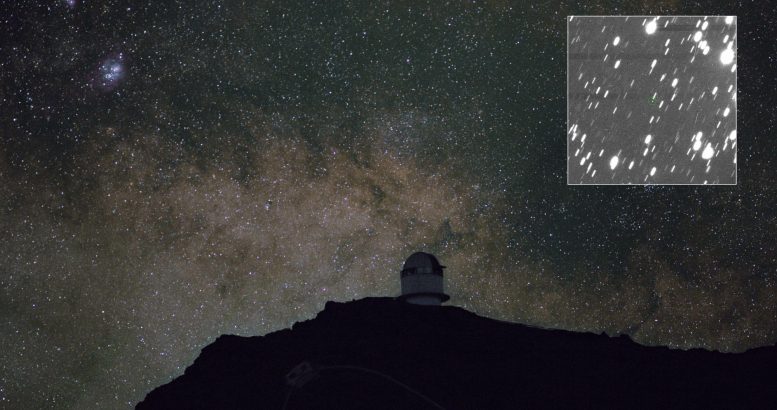
The approaching asteroid was observed using the 2.5-meter Nordic Optical Telescope (NOT) in La Palma, Canary Islands. The image in the top right corner shows the asteroid detected by the telescope in the centre of the green circle. The other bright spots are background stars, smeared due to the movement of the telescope. Credit: Viktoria Pinter, Zuri Gray
*********************************************************************
Tracking from the Canary Islands
They used the 2.5-meter Nordic Optical Telescope (NOT) in La Palma, Canary Islands, a long-standing tool for Finnish astronomers studying near-Earth objects, to precisely measure the asteroid’s position and motion.
“We have been focusing on the asteroid’s precise position and motion, and to analyze its rotation, size, and shape. This information is crucial for better predicting the asteroid’s future trajectory, and ultimately refining its impact probability,” says Gray.
“Our recent observations continue to demonstrate the vital role that NOT plays in planetary defense efforts on a global level,” adds Fedorets.
Lunar Impact Risk Emerges
During mid-February, 2024 YR4’s impact probability peaked at 3%. It is the highest ever probability attained by any asteroid of the size range to pose a significant threat, in the recorded history of asteroid impact risk estimates.
The observations were briefly halted due to the full moon drowning out the asteroid’s faint signal, but the researchers in Finland were the first to obtain new data following the full moon. The observations resulted in a significant drop in the impact probability, which currently stands below 0.001%.
Meanwhile, the latest data and calculations have brought out a new, although smaller risk: there is currently a 4 % chance of the asteroid impacting the Moon instead.
“Should the asteroid impact the Moon, the Earth-Moon system could be clouded with particles detached from the Moon and the asteroid, potentially threatening the human space infrastructure and operations,” explains Academy Professor Karri Muinonen.
James Webb Delivers Crucial Infrared Data
The James Webb Space Telescope observed the asteroid on March 26th. The postdoctoral researcher Eric MacLennan is a key member of the team analyzing the asteroid’s infrared properties. James Webb is currently the only telescope with the capability to measure thermal emission.
“The initial diameter estimate of the asteroid was limited to visible light measurements, which depend on both the size and reflectivity of the surface. However, thermal emission at infrared wavelengths is a direct indicator of the size. Our first attempt to observe the thermal emission on March 8 was not successful, so it was a relief when the images were transmitted back from the telescope,” explains MacLennan.
After hours of work, the team arrived at an estimate: there’s a 95% chance the diameter is 46 – 74 meters. This size determination will help astronomers assess the potential consequences of an impact with the Moon.
Despite the reduced risk, Earth-based and space-based observatories will continue tracking YR4 through April or May 2025, after which it will be unobservable from Earth until its next close approach in 2028.
Nordic Observatories Prove Invaluable
In February, NOT was one of the most fast-acting and accurate data providers in comparison to other similar instruments for the global planetary defense community – a testament to the dedicated long-term work for the telescope by its staff, engineers, students, and scientists from the Nordics.
“We were able to very quickly observe the asteroid and refine the estimates for it. The flexible, high-quality, medium-sized astronomical facilities like the NOT are crucial for rapid follow-up of these type of potentially hazardous asteroids,” says Associate Professor Mikael Granvik.
“We have unique scientific know-how at the University of Helsinki for contributing to planetary defense, encompassing astronomical observations, laboratory measurements, theoretical and numerical research, and characterizing near-Earth object orbits, rotational states, shapes, and surface structure and composition,” summarizes Muinonen for the background of the success.
Space Situational Awareness Expands
In Finland, the governmental responsibility for the risk assessment of near-Earth objects belongs to the National Land Survey, and in the near future the Space Situational Awareness Center, which is currently being established. Monitoring the risks posed by near-Earth objects is one of the key areas of responsibility for the new Space Situational Awareness Center, in addition to the possible risks posed by space weather, space debris, and satellite operations.
“The comprehensive expertise of astronomers at the University of Helsinki in asteroid research is a critical part of the expertise needed at the governmental level to assess the possible impact risks caused by the near-Earth objects for Finland similar to other countries,” summarizes Senior Research Scientist and Academy Research Fellow Anne Virkki.
Reference:
“JWST Observations of Potentially Hazardous Asteroid 2024 YR4”
by A. S. Rivkin, T. Mueller, E. MacLennan, B. Holler, A. Burdanov, J. de Wit, P. Pravec, M. Micheli, M. Devogele, L. Conversi, C. A. Thomas, D. Farnocchia, J. L. Dotson, L. Wheeler, H. Hammel, S. N. Milam, J. de Leon and A. Glantzberg, 1 April 2025, Research Notes of the AAS.
DOI: 10.3847/2515-5172/adc6f0
They were Finnish! Ghat’s how they brought it under control!
This writer is an idiot. The asteroid was certainly not “quickly brought under control by global astronomers.”
Yay, more tektites. Meteor storms will be great. Lessee, that will be towards the end of DJT’s 3rd term, might be a nice cap to the other celebrations..
Too bad it won’t hit a certain Arab city- they could add it to their collection of ONE….
You missed the giant space-spider which had latched onto the spacecraft.
Hitting the moon might, eventually, change our tides...
Also, there is the chance that chunks of the moon could end up hitting the Earth and creating the permanent stench of blue cheese everywhere...
Disclaimer: Opinions posted on Free Republic are those of the individual posters and do not necessarily represent the opinion of Free Republic or its management. All materials posted herein are protected by copyright law and the exemption for fair use of copyrighted works.