
Posted on 02/10/2025 8:05:09 AM PST by Red Badger
La Niña has returned, cooling the Pacific and disrupting global weather. NOAA confirms it’s weak, likely short-lived, and won’t counteract rising global temperatures. Expect storms, droughts, and shifting climate patterns.
La Niña has made a long-awaited return, cooling the Pacific and stirring up global weather patterns.
This natural climate phenomenon, part of the ENSO cycle, strengthens trade winds and brings up deep, cold ocean water, altering temperatures and rainfall worldwide. While NOAA confirmed its presence in early 2025, this La Niña is weaker than past events and may not last long.
La Niña Arrives in the Pacific
After seven months of anticipation, La Niña—the cooler counterpart to El Niño—finally emerged in the eastern Pacific Ocean in early December 2024. However, it may be short-lived. According to NOAA, the Pacific could return to neutral conditions by spring 2025.
La Niña is part of the El Niño-Southern Oscillation (ENSO) cycle and occurs when stronger-than-usual easterly trade winds drive colder, deep ocean water to the surface in the eastern tropical Pacific. This process cools large areas of the ocean near the equator. As these intensified winds push warm surface waters westward toward Asia and Australia, the atmosphere responds, altering moisture levels and shifting global weather patterns.
NOAA Confirms La Niña Conditions
In a report published on January 9, 2025, the NOAA Climate Prediction Center confirmed that La Niña conditions were present. They measured sea surface temperatures 0.7 degrees Celsius (1.3 degrees Fahrenheit) below average in an area of the tropical Pacific, from 170° to 120° West longitude, known as the Niño 3.4 region.
The signature of La Niña is also visible in the central and eastern Pacific Ocean as areas of lower-than-average water levels. That’s because cooler water contracts, lowering sea levels. (Conversely, warmer water expands, raising them.) The map above depicts sea surface height anomalies across the central and eastern Pacific Ocean as observed on January 13, 2025. Shades of blue indicate sea levels that were lower than average, while shades of red indicate areas where the ocean stood higher than normal. Normal sea level conditions appear in white.
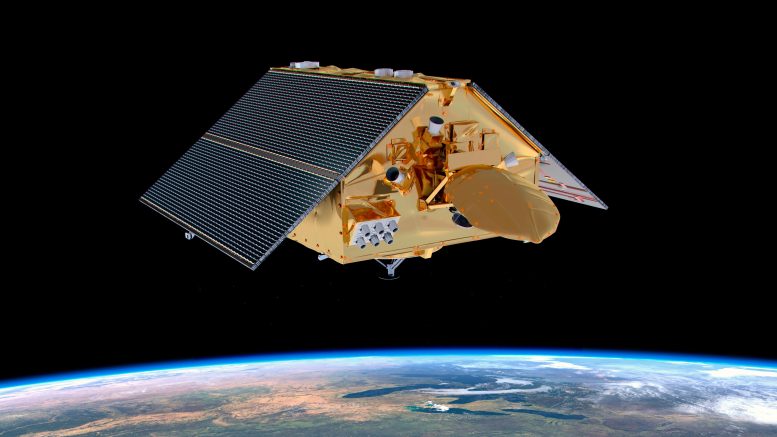
An illustration of the Sentinel-6 Michael Freilich satellite. Credit: NASA/JPL-Caltech
Tracking La Niña from Space
Data for the map were acquired by the Sentinel-6 Michael Freilich satellite and processed by scientists at NASA’s Jet Propulsion Laboratory (JPL). Note that signals related to seasonal cycles and long-term trends have been removed to highlight sea level anomalies associated with ENSO and other short-term natural phenomena.
“Although La Niña is here, it’s not a particularly strong one,” said Josh Willis, an oceanographer and Sentinel-6 Michael Freilich project scientist at JPL. Willis noted that during an especially strong La Niña in 2010-2011, temperatures in the tropical Pacific were about 1.6°C (2.9°F) below average in January 2011, compared to just 0.7°C (1.3°F) below average in January 2025. NOAA forecasts that this La Niña will remain weak and is unlikely to reach -1°C below average—the threshold at which La Niña is considered moderate in strength. Neutral conditions were expected to return in the meteorological spring, between March and May.
Global Weather Disruptions Ahead
La Niña’s coupling with the atmosphere and ocean alters global atmospheric circulation and can cause shifts in the path of mid-latitude jet streams in ways that intensify rainfall in some regions and bring drought to others. In the western Pacific, rainfall can increase over Indonesia and Australia. Clouds and rainfall become more sporadic over the central and eastern Pacific Ocean, which can lead to dry conditions in Brazil, Argentina, and other parts of South America and wetter conditions over Central America. In North America, cooler and stormier conditions often set in across the Pacific Northwest, while weather typically becomes warmer and drier across the southern United States and northern Mexico.
ENSO adds a natural source of year-to-year variability in global temperatures. Because such a wide swath of the Pacific is cold, La Niña tends to keep a lid on the average global surface temperature. But even the cool water in the Pacific does not completely offset long-term warming trends; some of the hottest years on record have coincided with La Niña, such as in 2010 and 2020.
NASA Earth Observatory image by Lauren Dauphin, using modified Copernicus Sentinel data (2025) processed by the European Space Agency and further processed by Josh Willis, and Kevin Marlis/NASA/JPL-Caltech.
I guess the seas won’t rise after all.
They're so quick to add this.
It’s a law..............
It looks like this is bringing a very active weather pattern to the US.
But we need the precipitation here in NH and other parts of the northeast.
This Winter Storm Will Bring A TON Of Snow… - Max Velocity
https://www.youtube.com/watch?v=CqXcGiu9Yuc
This Storm Pattern Is About To Go Into Overdrive... - Ryan Hall, Y’all
https://www.youtube.com/watch?v=MsHsvltuVXQ
“To a liberal, history started at breakfast this morning.” - Ann Coulter...........
‘Global Warming’ is always, ‘Heads I win, Tails you lose’.
The world has been cooling for 3-4 years. Climate Change is a fraud invented by Al Gore and the DNC.
“Disturbing” weather patterns?
You can’t make these people happy... ever.
https://science.gsfc.nasa.gov/sci/bio/emily.s.cassidy
(Note the Pronouns).

“Climate is what you expect. Weather is what you get.” - Robert Heinlein.............
But,but,but,but....
No matter how cold it gets, that don’t mean noffin!
Because NOAA confirms it’s weak, likely short-lived, and won’t counteract rising global temperatures.
So ban oil and modern fertilizer and let the mass starvation reign!
Of course, none of this applies to rich, global elites. They get to decide everyone else's future, without any penalty to themselves.
And RAISE TAXES!........................
Exactly.
The sky is falling! 🐓
So much for my ocean front property plans.
it’s weak, likely short-lived, and won’t counteract rising global temperatures.
Still pushing an agenda....
This is why NOAA is going to get gutted by DOGE.
We need more science and less global warming cult...
Disclaimer: Opinions posted on Free Republic are those of the individual posters and do not necessarily represent the opinion of Free Republic or its management. All materials posted herein are protected by copyright law and the exemption for fair use of copyrighted works.