Posted on 12/11/2024 10:04:27 PM PST by Red Badger
After 60 years of searching, geneticists have finally identified the gene behind the marmalade coloration in domestic cats.
Two independent teams of researchers found any fiery-hued fuzz on our beloved clawed floofs is likely the result of a missing segment of DNA in a non-protein-coding part of the cat's genome.
"It's been a genetic mystery, a conundrum," Stanford University geneticist Greg Barsh told Sara Reardon at Science.
Barsh and his colleagues discovered cat skin cells from which orange fur sprouts express 13 times as much RNA from a gene called Arhgap36, compared with skin cells from cats with no orange hair.
Expecting to find the protein-coding section of the overproductive Arhgap36 gene had mutated, the researchers were surprised to find it was the sequence preceding it that instead contained a deletion, presumably affecting the rest of the gene's expression.
The 5 kilobase deletion was present in every orange cat the researchers examined out of a database of 188 cats, which included 145 orange, 6 calico/tortoishell, and 37 nonorange cats.
One finding didn't come as a surprise. As long predicted, the mutated gene is located on the cat's X chromosome, explaining why the orange color appears so differently between the sexes. Most orange cats are male, while most female cats with some orange fur end up with patchworks of different colors.
Calico Cat
"Taken together, these observations provide strong genetic and genomic evidence that the 5 kb deletion causes sex-linked orange," Barsh and team write in their paper.
Ever since humans first co-habitated with cats nearly 10,000 years ago, it's been a curiosity that a black cat and an orange cat can be parents to an unexpected array of kitten colors. Male kittens from this pairing are mostly either orange or black, as might be expected. But female kittens can have a calico's patchwork of black, orange and white, or a tortoiseshell's marbling of orange scattered through black fur.
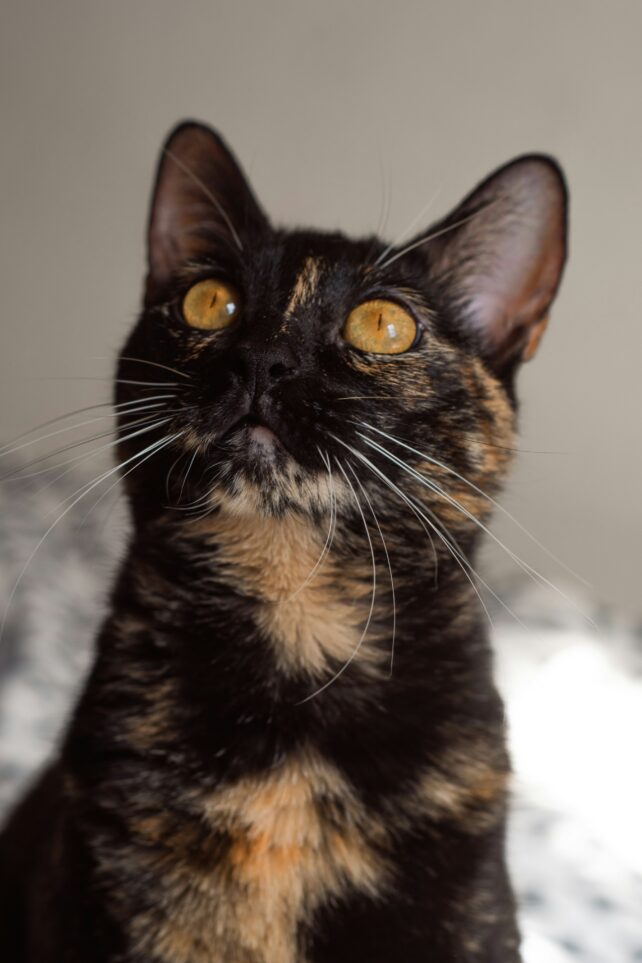
A tortoiseshell cat. (Yosei G/Unsplash)
Both teams confirmed the mutation responsible for orange fur is on the X chromosome, which is why such clear differences in colored patterning can appear between the sexes.
Unlike males that end up with just one copy of this mutation on their solitary X chromosome, females end up with two copies, one on each the X's they receive from each parent.
Mammals randomly inactivate one of the two X chromosomes in each of their cells to avoid expressing an excess of the chromosome's products. This leaves female orange kitties with an active orange mutation in some of their developing skin-cell tissues, right next to neighboring cells in which the X chromosome with the mutated gene is deactivated.
On rare occasions that both X chromosomes carry the mutation, the female grows into furry fireball as ginger as any male.
Orange cats happen to have a hilarious reputation for not being the brightest of their species. Anecdotes aside, such links between kitty coloration and cognition are scientifically unsupported, with no obvious negative consequences from this mutation in health or mental wellbeing.
Arhgap36 is known to cause developmental problems in other animals when it is over- or under-functioning. But it seems that in orange cats, the gene is overexpressed only in developing and mature pigment cells called melanocytes.
"The difference between tortoiseshell and calico cats is the presence of an additional white spotting mutation in calico that affects the ability of developing melanocytes to survive as they migrate away from the neural crest, allowing melanocyte clones that do survive to expand in a larger body region," Barsh and colleagues explain.
The second study, led by Kyushu University geneticist Hidehiro Toh, also identified Arhgap36 as the orange cat fur gene. They found greater expression of this gene suppresses color pigment genes, shifting the dark brown to black eumelanin pigments to the reddish to yellow pheomelanin pigments.
Both papers are now online awaiting peer review on bioRxiv here and here.
https://doi.org/10.1101/2024.11.21.624608
https://doi.org/10.1101/2024.11.19.624036

“Server not found” for all the images.
It looks like you’re outnumbered!🙂
:^)
Those are all so great! I can certainly relate with pic #8. In fact, she’s camped out and snoozing on my recliner right now!🐱
Maybe all ginger cats should have their own breed- TRUMPS!
I just figured they were Irish
No, they just act that way.................
I love me some cat threads, and most of all, Yellow Cat threads!
Hahahahaha...I didn’t notice that pillow! Serendipity!
It reminded me of a picture we took of our Republican Town Committee doing a Trump standout before the election, and there was a “NO LEFT TURN” sign foremost in the picture...completely unintentional!
My wife and I decided that, as long as we have cats, we have to have two of them to occupy each other...and we hope they stay on good terms with each other in the process!
I’m sorry for your loss. Sniff


Oh, adorable! Looks very sweet, too!
I don’t know why that happens sometimes. They continue to show up on my ping page, so they haven’t been blocked by the hosting site.
They continue to show up on my ping page, so they haven’t been blocked by the hosting site.
—
That’s the problem - the FR page loads before the host site replies, so no images show.
Best to do a search for a .jpg of the image you want to post. Takes a bit longer with multiple images, but they will show.
Some host sites have very fast servers so it is not a problem, however, there is no way to tell offhand. Using host sites for images is a common mistake on FR.
Is there another way? I'd love to know -- can you explain?
Example: search for Calico cat. You are in “ALL”. Click “IMAGES”. There should be images of Calico cats. But some may be too small or too large, then use after the link width=50%>
Copy link (right click) paste into <img src=”
if the file type is not .jpeg or .jpg, then chose another image.
Preview before posting.
Love these!
I see what you’re saying, but it won’t work for photo or meme “essays”, since the individual items are created over a span of months or years and are originally posted in a variety of sites, some private and not available on photo seaches. Many of them wouldn’t be accessible online when you want to post them all together to fit a theme.
Secondly, your suggestion to use a percentage instead of a pixel width also wouldn’t work for sizing memes in relation or one another, because some of the originals are greatly larger than others and need to be edited for size so that type size remains readable throughout.
I also find percentage widths very annoying if the reader wants to enlarge a photo to see detail without having to download it to his own hard drive, since using the Control keys will not work for most photos when it is posted as a percentage instead of a fixed pixel width. But thanks for the suggestion.
That is what my Maine Coon cat Dandi does with my plantation shutters. She gotta see her birdies!
Disclaimer: Opinions posted on Free Republic are those of the individual posters and do not necessarily represent the opinion of Free Republic or its management. All materials posted herein are protected by copyright law and the exemption for fair use of copyrighted works.