Posted on 12/05/2024 7:01:30 AM PST by Red Badger
At the close of the 19th century, thousands of spectators gathered in secrecy to watch two heavyweight Irish fighters slug it out for 75 rounds.
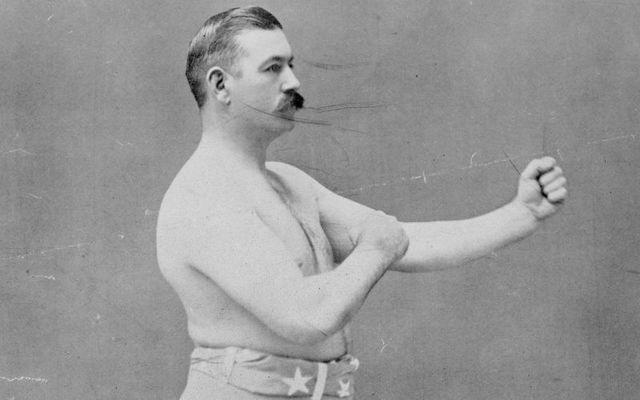
John L. Sullivan, boxing's first modern heavyweight world champion and the first to earn more than $1 million, took on challenger Jake Kilrain in a makeshift boxing ring on a farm in Richburg, Mississippi on July 8, 1889.
Almost 3,000 people secretly traveled to the makeshift venue to watch the fight, paying as much as $15 for ringside tickets.
Fans had traveled under cover of darkness the night before the fight, while their train tickets bore no exact location, simply stating "destination and return". Meanwhile, workers worked under torchlight to erect the makeshift ring in time for the fight.
The reason for the secrecy is clear - bare-knuckle boxing was illegal and Mississippi Governor Robert Lowry had offered a $1,500 reward for the arrest of the two fighters.
The fight was a long time coming.
Sullivan, the son of famine emigrants from County Kerry who grew up in the Boston tenements, was boxing's first superstar and drew large crowds wherever he fought.
Kilrain, meanwhile, learned to fight in the mills outside Boston and had been proclaimed the "next heavyweight hope".
Richard K. Fox, the publisher of the National Police Gazette, took an interest in Kilrain and challenged Sullivan to fight him in 1887.
Fox's paper was one of the first publications to print a sports section similar to tabloid sports sections today and when Sullivan chose to fight Paddy Cardiff instead, Fox claimed that Sullivan had forfeited the fight, making Kilrain the new heavyweight champion.
The newspaper publisher even commissioned a diamond-studded Police Gazette belt and awarded it to Kilrain as a result of Sullivan's decision to duck the fight.
However, Sullivan's financial backers also commissioned a championship belt made with 14-carat gold and 3-carat diamond valued at a whopping $8,000.
It seemed inevitable that the two Irish fighters would eventually fight to unify the two belts, but it would not happen for almost two years.
Sullivan set off on a European tour of Ireland, Scotland, and England in late 1887, taking on 50 exhibition fights and winning most of them with ease. However, Sullivan was a notorious drinker and suffered a major health scare shortly after his return from Europe.
The famous fighter spent six months recovering from liver and kidney failure, while his situation was so severe at one stage that a priest was called to his bedside.
However, he eventually made a full recovery, paving the way for the eagerly-anticipated fight on a Mississippi farm in 100-degree heat.
The fight itself did not disappoint.
Punters had waged more than $500,000 on the outcome of the fight, with most people backing Kilrain due to Sullivan's health scare. However, Sullivan had spent months under the tutelage of fitness expert William Muldoon and was in impeccable shape by the time of his bout with Kilrain.
The secret fight was fought under London Prize Ring Rules, meaning that the fighters did not wear gloves and that rounds only came to an end when a fighter was knocked or thrown to the ground. The fight also had no specific number of rounds.
The first round lasted just 15 seconds. Kilrain, under London Prize Ring Rules, grabbed Sullivan around the neck and hurled him to the ground, bringing the opening round to a premature close.
In contrast, the fourth round lasted 15 minutes.
Kilrain drew blood from Sullivan's ear in the fifth or sixth round, according to reports, but the heavyweight champion soon began to exert his dominance, forcing Kilrain to be carried back to his corner by the 17th round.
With both fighters burned and blistered from fighting under a red-hot sun and with Sullivan dominated the majority of rounds, it is no surprise that Kilrain was near-exhaustion as the fight reached the 70s.
Finally, Kilrain's cornerman Mike Donovan threw in a sponge at the start of the 75th round to signify the end of the fight after a staggering two hours and 16 minutes. Donovan had seen two fighters die in bare-knuckle boxing matches and was keen to avoid a repeat.
Both Kilrain and Sullivan were arrested shortly after the fight, with Kilrain serving a two-month sentence on the farm where the fight took place and Sullivan paying a $500 fine after successfully overturning a one-year prison sentence.
Neither fighter ever fought bare-knuckle again. In fact, there would never be another bare-knuckle title fight in American history.
Sullivan died almost 30 years after the fight on Feb. 2, 1918, in Abingdon, Massachusetts at the age of 59. Kilrain, who was a pallbearer at Sullivan's funeral, died 19 years later in Quincy, Massachusetts at the age of 78.
VIDEO AT LINK...................
Or...
“Two Irishmen walked out of a bar. Yes, it can happen...”
In BKFC they throw far fewer punches than in a prizefighting match because their fists are at greater risk of injury, so they have to be more selective about what to punch and when. They particularly avoid punches to the skull because it's a pretty rigid piece of bone and breaks a lot of hands.
As for "barbarity, it's well less barbarous than MMA because there's much less striking and all the fighting is done on their feet. BKFC fighters do tape their wrists and parts of their hands but the tape can get no closer than one inch to any knuckle, so despite the tape their knuckles are well and truly bare.
The promotion got off to a very slow start because many sports authorities ASS-u-ME-d that bare-knuckle fighting would be barbaric so the only place they could get sanctioned were Cheyenne, Wyoming and Biloxi, Mississippi. Once they'd staged a couple of events and weren't having to drag dead bodies into the alley behind the gym, promoters figured out they were missing out on the gate and more venues started opening up to them. Now just about any place that allows cage fighting also will allow BKFC.
The fighting Irish.
“pretty much all white male audience.”
What the hell are you saying ?
The Irish are well-known for it, but some people just love to fight. I have a cousin (not Irish) who, in our younger days, never missed an opportunity to mix it up (I must add that, when he wasn’t fighting, he was the sweetest, mellowest guy you could imagine). He’s a tall guy, with a long reach and long legs and his father had taught him a form of Brazilian kick-boxing (my dad, who knew his dad, said his dad loved to fight too). Anyway, while he’d be fighting he wouldn’t be mad at all, but would be laughing and smiling all the time. After the fight, he would always be in a good mood with no hard feelings toward the guy he just pummeled.
That may have been the last bare-knuckle prize fight, but not necessarily the best.
In 1853, the “Battle of Boston Corners” started as fight between Yankee Sullivan and John Morrissey and ended as a town-wide brawl and riot that destroyed the Town of Boston Corners:
https://newenglandhistoricalsociety.com/boston-corners-naughty-town-massachusetts-lost-new-york/
we used to do that as kids, but one of us would quit after a few really hard punches- the arm would go numb- and hurt for awhile after-
Disclaimer: Opinions posted on Free Republic are those of the individual posters and do not necessarily represent the opinion of Free Republic or its management. All materials posted herein are protected by copyright law and the exemption for fair use of copyrighted works.