Skip to comments.
Iranian Regime tv Channel One hacked while it was airing Khamenie speech
various
| 10-8-22
Posted on 10/08/2022 1:05:38 PM PDT by nuconvert
Iranian Regime national tv Channel One hacked about an hour ago. During a broadcast of Khamenie speech, a red crosshair appeared over his face and chanting of Women. Life. Freedom. There was writing to the side saying "Rise up. Join us". Also 4 photos at the bottom of the screen of young people killed and additional writing: "The blood of our youth is dropping from your paws".
Also, there was a huge banner in the middle of Tehran highway today that read: We are no longer afraid of you. We will fight.
Also, attempted attack on IRI ambassador in Denmark. Her bodyguard was stabbed. Diplomatic Security intervened before the attacker could stab the ambassador.
TOPICS:
KEYWORDS: basij; deathtothemullahs; denmark; ebrahimrigi; erdogan; iran; iranprotests; iraq; irgc; iri; israel; khameini; khamenei; kurdistan; lebanon; mahsaamini; mullahloversonfr; mullahsmustbekilled; najisharifizindashti; protests; qudsforce; raisi; receptayyiperdogan; shahrammaroufmola; syria; turkey; yemen; zahedi
Navigation: use the links below to view more comments.
first previous 1-20 ... 2,221-2,240, 2,241-2,260, 2,261-2,280 ... 2,401-2,405 next last
NATO Secretary General Mark Rutte on Wednesday defended the United States’ overnight strikes on Iran as “absolutely necessary,” arguing that Washington had to respond forcefully after Tehran allegedly violated a ceasefire by attacking commercial shipping in the Strait of Hormuz, as the latest military escalation triggered retaliatory missile and drone attacks across the Gulf.
The renewed hostilities sparked retaliatory attacks across the Gulf on Wednesday, with Bahrain reporting explosions after air raid sirens sounded and Kuwait confirming its air defense systems were intercepting incoming missiles and drones.
https://www.kurdistan24.net/en/story/924440/nato-chief-says-us-strikes-on-iran-were-absolutely-necessary-as-gulf-tensions-escalate
2,241
posted on
07/07/2026 11:02:20 PM PDT
by
AdmSmith
(GCTGATATGTCTATGATTACTCAT)
Iran’s attack on Saudi & Qatari tankers in the Strait of Hormuz is a coercive tactic to extract concessions from the US. Riyadh & Doha condemned the attacks. But statements alone aren’t enough. Gulf states must confront the Iranian threat collectively & decisively b4 it’s too late.
https://x.com/Ndawsari/status/2074686934744523220
2,242
posted on
07/08/2026 2:03:42 AM PDT
by
AdmSmith
(GCTGATATGTCTATGATTACTCAT)
Khamenei funeral exposes deep political divisions in Iran The funeral processions in Tehran and Qom were overshadowed by hardline supporters chanting slogans against President Masoud Pezeshkian and Foreign Minister Abbas Araghchi, a sign of growing tensions over the government's diplomatic course.
The attacks prompted strong criticism from reformists as well as some conservatives who support parliamentary speaker Mohammad-Bagher Ghalibaf’s cooperation with the government and negotiations with the United States. Conservative journalist Mohammad Mohajeri criticized senior officials, particularly Supreme National Security Council Secretary Mohammad-Bagher Zolghadr and some members of the Supreme National Security Council, for remaining silent. “Their silence is itself creating an even greater sedition.”
The funeral also drew attention for the absence of former presidents Mohammad Khatami and Hassan Rouhani, despite official expectations that the ceremonies would showcase unprecedented national solidarity. Former foreign minister Mohammad-Javad Zarif was also absent, while images showed former president Mahmoud Ahmadinejad attending the public procession. Authorities have not explained whether the former officials chose not to attend or were prevented from doing so.
https://www.iranintl.com/en/202607075663
2,243
posted on
07/08/2026 2:50:29 AM PDT
by
AdmSmith
(GCTGATATGTCTATGATTACTCAT)
Iran Update Special Report, July 8, 2026
Iran is willing to return to a large-scale conflict with the United States if necessary to secure its control over the Strait of Hormuz. Iran's behavior after the latest US strikes indicates that the Iranian regime values control over the strait more than avoiding renewed escalation with the United States. Iran has, in recent weeks, repeatedly attacked commercial shipping vessels that used alternative routes through the strait rather than the Iranian-designated traffic separation scheme.[2] It has conducted these attacks to maintain Iranian control over the Strait of Hormuz through Iranian-dictated traffic lanes. Iran also responded to US strikes against more than 80 targets on July 7 (more on the US strikes below) by attacking US military facilities in Bahrain and Kuwait.[3] The Iranian response caused no casualties.[4] US President Donald Trump has reportedly told his advisers that he will not “resume the war“ unless Iran kills US servicemembers.[5] Iran's willingness to flaunt the ceasefire by attacking shipping and risk US casualties by attacking US bases nonetheless demonstrates that Iran is willing to risk a resumption of large-scale operations.
The Iranian regime's media apparatus has repeatedly emphasized the strategic importance of the strait, and that military action may be necessary to ensure Iran maintains control over the strait. Islamic Revolutionary Guards Corps (IRGC)-affiliated Fars News Agency argued on July 8 that Iran should respond to US actions by disrupting Gulf oil exports, damaging regional energy infrastructure, asserting control over Bab al Mandab, and conducting asymmetric attacks on US forces.[6] Iranian regime's English-language media outlet, Press TV, separately argued on July 8 that Iran would strike “enemy” targets at a minimum two-to-one ratio and close the Strait of Hormuz following any future strike on Iranian territory or interests.[7] Regime-aligned outlets’ rhetoric intends to normalize a broader coercive campaign in the strait and signals that any US effort to challenge Iranian control over the strait can trigger costs against US forces, Gulf states, energy infrastructure, and other regional chokepoints.
The present pattern of US strikes does not appear to be changing Iran's calculus on controlling the Strait of Hormuz. US Central Command (CENTCOM) reported on July 7 that it struck over 80 targets in Iran in response to repeated Iranian attacks on commercial vessels in the strait.[8] CENTCOM stated that it struck coastal radar sites, anti-ship missile capabilities, drone launch sites, command-and-control networks, and more than 60 IRGC fast attack crafts (FAC) near and in the Strait of Hormuz.[9] These strikes aimed to degrade Iran's capability to threaten shipping, lay naval mines, and coordinate maritime operations in the strait, according to CENTCOM. Strikes similar to those conducted by CENTCOM on July 7 have had no visible effect on Iran's ability to threaten shipping, however, and it is unclear when these strikes would have such an effect on Iran's ability to threaten shipping. Iran's strategy relies on its ability to fire small numbers of projectiles into the Strait of Hormuz to hit individual ships. Iran has continued to fire small numbers of projectiles into the Strait of Hormuz, seemingly as it pleases. There is presumably a point at which Iran would be unable to fire small numbers of projectiles into the Strait of Hormuz, but it is impossible to determine when Iran would be unable to fire projectiles without a complete understanding of the number of Iranian systems and launchers available to regime forces. There is similarly a point at which launch crews would be unwilling to fire their systems. It is unlikely, however, that these crews will lose cohesion and refuse to fight now–under relatively insignificant pressure–after having weathered the large-scale strike campaign in March and April. These strikes are certainly not changing Iran's willingness to control the strait, as evidenced by the ongoing Iranian strikes and regime media comments described above.
The Trump administration also revoked Iran's oil waiver in response to Iran's attacks on commercial vessels, which deprives Iran of one of the main economic benefits for the regime under the US-Iran memorandum of understanding (MoU).[10] The effects of the revocation on Iranian strategic calculus remain unclear.
Iran is also almost certainly observing leaks and public comments about the Trump administration's reticence to resume large-scale operations, which will affect the regime's willingness to use force to attempt to secure the strait.
Iran is attempting to coerce Gulf states and others to acquiesce to Iranian control over the Strait of Hormuz after Iran failed to secure recognition of its control over the strait through diplomacy. The recent attacks—including one on a Saudi-flagged tanker and another on a tanker carrying Qatari natural liquid gas (LNG)—support this effort.[12] This effort is designed to alter the meaning of Clause 5 of the MoU. Clause 5 of the US-Iran MoU requires Iran to arrange safe, fee-free commercial passage through the Strait of Hormuz for 60 days and to restore traffic within 30 days after removing technical and military obstacles, including mines.[13] It also requires Iran to discuss the future administration and maritime services of the strait with Oman and other Persian Gulf littoral states under applicable international law.[14] Iranian officials attempted briefly to use diplomacy to secure diplomatic recognition of their control of the strait, including recognition of Iranian-led fee mechanisms. This ultimately failed when the Gulf Cooperation Council (GCC) and United States released a joint statement refusing Iran's demands to control the strait.[15] Iran is now attempting to use force to coerce the Gulf states into recognizing Iranian control.
Iran is attempting to unilaterally impose a vision for the strait's ”arrangements,” which are supposed to be created in dialogue with the Gulf states, not through coercing the Gulf states. Iranian coercion of the Gulf states is an effort to circumvent the intent of Clause 5, which administration officials noted was designed so that Gulf states would moderate Iranian positions about controlling the strait. Parliamentary National Security and Foreign Policy Commission member Alaeddin Boroujerdi stated on July 8 that commercial vessel traffic through the strait must occur under Iranian oversight and management, specifically through the IRGC Navy.[16] Iranian Foreign Affairs Ministry Spokesperson Esmail Baghaei similarly argued that Clause 5 confirmed Iran's responsibility to determine arrangements for safe passage of vessels and that US challenges to those arrangements violated the MoU.[17]
Iran is using the ceasefire to reconstitute its military capabilities, as ISW-CTP has previously assessed.[18] A US official told the Wall Street Journal on July 7 that Iran has restored some military capabilities around the Strait of Hormuz since the April 7 ceasefire, including by moving small, portable radars to replace fixed radar sites destroyed during the war.[19] The official also said Iran has dug out or repaired hundreds of missiles and launchers damaged or buried in US strikes and now has access to more than half of its pre-war missile and launcher stockpile.[20] Iran's reconstitution during the ceasefire likely makes the regime more willing to sustain risk around the strait because Tehran is rebuilding the capabilities it would need if the conflict resumes. The ceasefire gives Iranian forces time to repair launchers, recover missiles, restore command networks, and rebuild the strike capacity that underpins its strategy of attacking shipping in the Strait of Hormuz. Iran's escalation around the strait preserves leverage over shipping and Gulf energy flows while strengthening its position for a potential future conflict.
The Lebanese government announced on July 8 that it will participate in negotiations with the US and Israel in Rome, Italy, on July 15 and 16. The Lebanese government earlier claimed that its participation in negotiations would be contingent on an Israeli withdrawal from “pilot zones” in southern Lebanon.[21] An unspecified diplomatic source told French media on July 8 that Lebanon would only attend the Rome talks if Israeli forces withdrew from the two pilot zones established by the June 26 Trilateral Agreement Framework.[22] The June 26 framework stipulates that Israeli forces will eventually withdraw from their positions in Zawtar el Gharbiyeh and territory surrounding Ghandouriyeh and Froun, Nabtatieh Governorate, after which the Lebanese Armed Forces (LAF) would secure the areas and disarm and dismantle local armed groups.[23] ISW-CTP has not observed any Israel Defense Forces (IDF) withdrawals or Lebanese Armed Forces (LAF) deployments to the pilot zones, which makes it unclear whether Beirut conceded on its reported condition for Lebanese participation in the Rome talks. Lebanese and Israeli officials have previously expressed different opinions over the implementation of the framework. Unspecified sources told Lebanese media on July 6 that the LAF refused to deploy to the pilot zones and disarm Hezbollah in those areas north of the Litani River until Israeli forces withdraw from southern Lebanon, while Israeli officials stated in recent days that the IDF would remain in southern Lebanon until Hezbollah is disarmed.[24]
Iraq Islamic Revolutionary Guards Corps (IRGC) Quds Force Commander Brigadier General Esmail Ghaani will likely meet with Shia Framework leaders and Iranian-backed Iraqi militia leaders during his July 8 visit to attend former Iranian Supreme Leader Ayatollah Ali Khamenei’s funeral in Najaf, Iraq.[25] Ghaani typically meets with Framework and militia leaders when he travels to Iraq. Iraqi media reported that Ghaani met Framework and militia leaders in Iraq in May 2026 to discuss US pressure to disarm the militias.[26]
Some Shia Coordination Framework members may be attempting to limit the scope of Iraqi Prime Minister Ali al Zaydi’s recently launched anti-corruption campaign. Several sources told Saudi media on July 7 that the framework intends to “engineer the prosecution procedures” and make “settlements” with individuals accused of corruption.[27] An informed source also told Iraqi media on July 7 that some unspecified framework members discussed adopting a new process to apprehend individuals accused of corruption that does not involve Iraqi security forces, which is likely a reference to recent Iraqi Counter Terrorism Service (CTS) operations to apprehend corrupt militia leaders.[28] This report comes after unspecified framework leaders refused Zaydi’s request to arrest senior Iranian-backed Iraqi militia leaders involved in corruption, according to Qatari media on July 1.[29] Iraqi authorities, including the CTS, which reports directly to the prime minister, have arrested about 50 people across Iraq since June 28 as part of Zaydi’s anti-corruption campaign.[30] This campaign follows US pressure on Baghdad to dismantle Iranian-backed Iraqi militia-linked financial networks and combat corruption.[31]
https://understandingwar.org/research/middle-east/iran-update-special-report-july-8-2026/
2,244
posted on
07/08/2026 11:18:47 PM PDT
by
AdmSmith
(GCTGATATGTCTATGATTACTCAT)
Sal Mercogliano- What's Going on With Shipping? 08JUL2026: From the Caribbean to Hormuz: The Global Conflict No One is Seeing.
The world's oceans are witnessing a level of conflict not seen in decades. In this episode of What's Going on With Shipping?, we analyze the rapid escalation of maritime warfare across three key regions: the Caribbean, the Black Sea, and the Strait of Hormuz. From the U.S. Southern Command's strikes on narco-vessels to Ukraine's massive drone offensive against the Russian fleet, and the latest Iranian attacks on commercial tankers, we break down why these “out of sight” events have a habit of triggering global crises.
Key Highlights:
⚓Caribbean Operations: A look at Operation Southern Spear and the controversial 66 strikes against suspected narco-terrorist boats.
⚓Black Sea Offensive: Analyzing Ukraine's strike on 21 Russian ships within 72 hours and the shift toward targeting bridge and accommodation areas.
⚓Hormuz Crisis: The breakdown of the U.S.-Iran ceasefire after three commercial tankers were struck by Iranian UAVs and projectiles.
⚓Historical Context: Why maritime incidents—from unrestricted submarine warfare to tanker wars—historically lead to major global declarations of war.
⚓The “Fainting Goat” Effect: How the fear of predators in the shipping lanes causes global trade to lock up and freeze in place.
https://www.youtube.com/watch?v=3P0SdlyEjck
2,245
posted on
07/08/2026 11:21:38 PM PDT
by
AdmSmith
(GCTGATATGTCTATGATTACTCAT)
To: nuconvert
08JUL2026: Bitter infighting fractures Tehran: Inside Iran’s mafia-style internal collapse | Kasra Arabi
Kasra Arabi, Director of IRGC research at United Against Nuclear Iran discusses how the Iranian regime are using information to obscure the true narrative playing out within Iran. With the former Ayatollah and his son nowhere to be seen, the mafia-sate of the Islamic Republic of Iran continues to fight for power.
https://www.youtube.com/watch?v=S9XFs1YwkIo
2,246
posted on
07/08/2026 11:45:49 PM PDT
by
AdmSmith
(GCTGATATGTCTATGATTACTCAT)
To: AdmSmith
IRI shot 8 missiles into Jordan, all intercepted.
US hit about 90 targets in Iran
2,247
posted on
07/09/2026 6:17:52 AM PDT
by
nuconvert
( Warning: Accused of being a radical militarist. Approach with caution.)
To: nuconvert
Who governs Yemen? My latest paper for @XCEPT_Research traces one of Yemen's principal corridors, revealing how competing systems of circulation governance reshape authority, trade, mobility, humanitarian access, and the cost of everyday life.

https://x.com/IbrahimJalalYE/status/2074857914116821443
08JUL2026 Ibrahim Jalal: Yemen's checkpoint war -Fragmented in the south, centralised in the north
Yemen's war is over a decade old, and checkpoints have become one of its most consequential features. Every truck carrying fuel, food or medicine along the country's main corridors must navigate dozens of them, paying levies to an overlapping cast of armed actors - formal, militia-linked, tribal, and rebel. A new working paper by Ibrahim Jalal provides the most comprehensive account yet of how this checkpoint system works, what it costs, and what it reveals about the competing political orders that have carved up the country.
https://pure.diis.dk/ws/files/32203821/DIIS-WP-series-Roadblocks-15-hierarchies.pdf
2,248
posted on
07/09/2026 6:27:33 AM PDT
by
AdmSmith
(GCTGATATGTCTATGATTACTCAT)
Iran Update Special Report, July 9, 2026
Iran is threatening the resumption of large-scale conflict by striking civilian vessels and the Gulf states to try to achieve permanent control over the Strait of Hormuz. Iran has launched numerous strikes targeting commercial vessels and the Gulf states in recent days as part of a broader effort to secure control over the strait despite apparent resistance from the Gulf states.[1] Clause 5 of the US-Iran memorandum of understanding (MoU) requires Iran to discuss the “future administration and maritime services” of the strait with Oman and other Persian Gulf littoral states in line with “applicable international law.”[2] A senior US administration official told the Daily Wire on June 17 that clause 5 was designed with the assumption that Gulf states would moderate Iran's position vis-a-vis the strait through the discussions required by the clause.[3] This assumption did not take into account that Iran could fail to reach an agreement with the Gulf states and resort to using force to impose its desired “future administration” of the strait on these states. Iranian officials initially attempted to frame Iran's post-war approach to the strait's management as part of a new regional security framework that would ultimately benefit the Gulf states.[4] Iranian officials have since become much more hostile toward the Gulf states due to these states’ opposition to Iranian efforts to control the strait.[5] Iranian officials have explicitly stated that Oman and other Gulf states cannot prevent Iran from asserting control over the strait.[6] Iranian Deputy Foreign Affairs Minister for Legal and International Affairs Kazem Gharibabadi stated on June 29 that Iran would implement its “sovereignty and new policy” in the strait even if Iran and Oman failed to reach an agreement on the waterway's future management, for example.[7] Iran's continued attacks on civilian vessels and Gulf states in recent days demonstrate that the Iranian regime prioritizes control of the strait over avoiding renewed large-scale conflict with the United States. Iran's attacks also illustrate that Iran views control over the strait as its primary strategic deterrent and that Iran is unlikely to abandon its efforts to control the strait in response to opposition from the Gulf states.
The United States struck 90 targets across Iran on July 8 to degrade Iran's ability to attack international shipping.[8] Recent US strikes have had no visible effect on Iran's ability to threaten shipping, and it is unclear when these strikes would have an effect on Iran's ability or willingness to threaten shipping. US Central Command (CENTCOM) reported on July 8 that US forces conducted strikes in Iran targeting air defense systems, coastal surveillance assets, missile and drone storage sites, naval capabilities, and military logistics infrastructure along Iran's southern coastline. These strikes were in response to Iranian strikes on civilian vessels in the strait on July 6 and 7.[9] CENTCOM conducted similar strikes on July 7.[10] Geolocated footage shows damage from US strikes to a reported maritime traffic control tower at Chabahar Port, which is on Iran's southeastern border along the Gulf of Oman.[11] Geolocated footage also shows damage to the Islamic Revolutionary Guards Corps (IRGC) Navy Shahid Asarinejad barracks in Shiraz, Fars Province.[12] The United States has repeatedly conducted limited strikes in southern Iran since the MoU came into effect, targeting similar sites as it did on July 8. These targets include radars, communications nodes, and air defense systems.[13] Iran has continued to attack commercial vessels, however, relying on its ability to fire only a small number of projectiles into the strait to hit individual ships and thereby compel commercial vessels to abide by Iran's illegal traffic separation scheme.[14] A member of the Iranian negotiating team, Mehdi Mohammadi, emphasized on July 9 that recent US attacks have not changed Iran's ability or willingness to control the strait.[15]
The United States also struck bridges and railroads used by the Iranian armed forces to transport missiles, drones, weapons components, and other material for military reconstitution, according to US officials speaking to the Wall Street Journal.[16] The United States struck a railway in Golestan Province in northeastern Iran that Iranian media stated was used to transport goods from Russia.[17] IRGC-affiliated outlet Fars News reported that Chinese train traffic along the route has tripled since the United States launched its naval blockade on Iranian ports.[18] Russia and China have helped Iran try to reconstitute its drone and missile programs, such as by providing Iran with drone technology and missile components, respectively.[19]
Iranian forces launched missiles and drones at Bahrain, Kuwait, and a US base in Jordan in response to the US strikes. All of the Iranian projectiles were intercepted.[20] Iran likely calculates that attacks against Gulf states will increase pressure on the United States to avoid further military escalation by threatening US forces and raising the costs for US allies.

Iran also likely calculates that it can use control of the strait as economic leverage to shape US decision-making and deter further US military action. Iranian officials have repeatedly threatened to close the strait in response to US attacks. The IRGC Navy stated on July 9 that continued US military operations would disrupt the strait's “reopening process” and threaten Gulf states’ economic interests.[21] Mohammadi similarly warned that Iran could block the strait quickly if necessary.[22] Vessel traffic has increased since the United States and Iran signed the MoU but has fallen in recent days.[23] Iran likely calculates that it can use the threat of “re-closing” the strait and disrupting global commerce to put economic pressure on the United States and discourage the United States from conducting further military action against Iran. ISW-CTP continues to assess that any arrangement that recognizes Iranian control over the strait would preserve Iran's ability to close the strait at will to advance its strategic objectives.[24]
Some Iranian officials have threatened to change Iran's nuclear doctrine, likely in part to try to deter the United States from conducting further strikes on Iran. Parliamentary National Security and Foreign Policy Commission Spokesperson Ebrahim Rezaei stated on July 8 that Iran may consider changing its nuclear doctrine if the United States launches another “all-out attack.”[25] Rezaei previously stated on July 3 that Israeli officials’ threats to kill Iranian Supreme Leader Mojtaba Khamenei constitute a “valid and compelling reason” to reconsider Iran's nuclear doctrine.[26] Parliamentary Economic Commission member Hossein Samsami separately stated on July 9 that Iran must change its nuclear doctrine because Iran is currently engaged in an “existential war.”[27] Samsami was one of 85 Iranian parliamentarians who implicitly called for Iran to develop intercontinental ballistic missile capabilities in a letter to Mojtaba on May 31.[28] An expert close to the regime also told IRGC-affiliated Fars News on July 9 that repeated US threats against Iran would force the regime to review its defense doctrine, including the “military use of nuclear technology.”[29] Parliamentarians in Iran do not yield significant decision-making authority, but these comments nevertheless reflect discussions among Iranian leaders over how Iran should restore deterrence after Iran's traditional forms of deterrence, such as the Axis of Resistance and the Iranian missile program, have failed to prevent repeated attacks on Iranian territory and senior leaders.
The United States is taking steps to support the implementation of the June 26 Trilateral Framework Agreement in Lebanon. US Ambassador to Lebanon Michel Issa told Lebanese President Joseph Aoun that the United States will send a military delegation to Lebanon “within days” to support the implementation of the agreement during a meeting with Aoun on July 9.[30] Issa also stated that a start date for implementing the agreement's “pilot zones” plan will be determined following the upcoming US-Israel-Lebanon negotiations in Rome, Italy, on July 15 and 16.[31] An unspecified US official told Axios that the Israel Defense Forces (IDF) will begin to withdraw from the two recently announced pilot zones “in a matter of days,” however.[32] Clause two of the agreement's security annex stipulates that Israel and Lebanon will establish the Military Coordination Group for Lebanon to verify disarmament progress in southern Lebanon and operate as an indirect backchannel between the IDF and the Lebanese Armed Forces (LAF).[33] Israeli media reported on June 30 that the IDF postponed its withdrawal from the pilot zones until the United States, Israel, and Lebanon established the coordination group with US military participation in order for the group to vet participating LAF soldiers.[34] This step is intended to prevent Hezbollah from receiving sensitive information from the coordination group.[35]
Hezbollah leaders and Hezbollah-allied politicians have continued to condemn the framework agreement and call for the immediate withdrawal of Israeli forces from Lebanon. Hezbollah Secretary General Naim Qassem rejected the framework and claimed that it only serves Israel's interests in a speech on July 8.[36] Qassem also demanded that the IDF completely withdraw from southern Lebanon and allow the LAF to deploy south of the Litani River.[37] Lebanese media reported that Lebanese Parliament Speaker and Hezbollah ally Nabih Berrih told Issa on July 9 that he seeks an immediate and complete Israeli withdrawal from the pilot zones, while Issa called for a gradual withdrawal from the zones with US oversight.[38]
The Iraqi federal government has agreed to implement unspecified safeguards to prevent Iran and Iranian-backed Iraqi militias from obtaining US dollars from Iraqi currency exchanges and Iraqi federal government salary payments, according to unspecified US and Iraqi officials speaking to the Wall Street Journal on July 8.[39] The US government has resumed US dollar shipments to Iraq in exchange.[40] The Iraqi Central Bank has managed an account at the New York Federal Reserve that has held the Iraqi federal government's oil export revenue in US dollars since 2003.[41] The US Treasury Department initially halted US dollar shipments to Iraq in April 2026 due to concerns about Iranian-backed Iraqi militia attacks during the war and reportedly resumed some payments on June 17 and July 2, excluding payments to Iraqi counterterrorism and Iraqi Security Forces (ISF) training programs.[42] Members of the Popular Mobilization Forces, which is an Iraqi security service that includes many Iranian-backed Iraqi militias that answer to Iran instead of the Iraqi prime minister, receive a salary from the Iraqi federal government.[43]
https://understandingwar.org/research/middle-east/iran-update-special-report-july-9-2026/
2,249
posted on
07/10/2026 12:00:53 AM PDT
by
AdmSmith
(GCTGATATGTCTATGATTACTCAT)
An American fighter jet, most likely launched from the USS Abraham Lincoln aircraft carrier in the northern Arabian Sea, was spotted flying at low altitude over Chabahar in southeastern Iran.
An interesting detail is that the aircraft was flying with all of its navigation lights illuminated despite operating at night. Local fishermen can be heard discussing the aircraft as it passed overhead.
https://x.com/BabakTaghvaee1/status/2075312842358550814
10 s video
2,250
posted on
07/10/2026 12:33:25 AM PDT
by
AdmSmith
(GCTGATATGTCTATGATTACTCAT)
To: AdmSmith
Iran Update Special Report, July 10, 2026
The United States and Iran are to resume talks following US strikes on Iran between July 8 and 9, but Iran's negotiating position and war aims remain unchanged. Iran's negotiating position and war aims include maintaining Iranian control over the Strait of Hormuz, preserving the Iranian nuclear program, and protecting Hezbollah. US President Donald Trump stated on July 10 that the United States agreed to resume talks with Iran at Iran's request, but that the United States now considers the ceasefire to be over.[1] Neither the memorandum of understanding (MoU) nor the recent rounds of talks between the United States and Iran have bridged the gaps on the key issues in the war, which include Iran's control of the strait, Iran's nuclear program, and Israeli operations in Lebanon.[2] Two senior Iranian sources told Reuters on July 8 that the Iranian regime considers its control over the strait to be “important leverage” and that giving up such control would be tantamount to “surrender.”[3] The sources added that Iran will not discuss its nuclear program unless the United States recognizes Iran's control over the strait.[4] Iran has also not provided any specifics about what elements of its nuclear program it is prepared to discuss. Iran has previously also conditioned opening the strait and discussing its nuclear program on the cessation of Israeli operations against Hezbollah in Lebanon.[5]
Iran is attempting to deter the UAE and other Gulf states to prevent them from supporting efforts to end Iranian control of the strait. Likely Gulf states struck unspecified targets in Chabahar, Sistan and Baluchistan Province; Bandar Abbas and Qeshm Island in Hormozgan Province; and Ahvaz, Khuzestan Province, on July 9, according to an open-source intelligence account.[6] It is unclear which Gulf states attacked Iran based on the available information. Iranian officials and analysts have blamed the UAE for allegedly supporting US strikes against Iran, both during recent exchanges of fire between Iran and the United States and during the war.[7] Iranian Parliamentarian and National Security Commission member Esmail Kowsari accused the UAE on July 10 of conducting attacks against Iran and threatened to target the UAE’s maritime, rail, and air transport infrastructure in response.[8] An analyst close to the regime stated on July 10 that Iran should add the UAE to its “target bank” because the UAE is covertly seeking to undermine Iran's control over the strait.[9] The regime likely calculates that it needs to adopt an aggressive approach against the UAE due to the UAE’s military support from the United States and Israel.[10]
The Gulf states are divided over how to respond to Iran's recent attacks. Iran launched strikes against Kuwait, Bahrain, and Qatar on July 9 in response to US strikes on Iran intended to degrade Iran's ability and willingness to control the strait.[11] Israeli media reported on July 10 that the UAE, Bahrain, and Kuwait are demanding stronger decisions against Iran through the Gulf Cooperation Council (GCC), including via an international arrangement for free transit that would be supplemented by an international military initiative to defend the strait.[12] The Israeli media report added that Oman and Qatar, who have both mediated the US-Iran talks, prefer that diplomatic talks continue.[13] Bahrain spearheaded the effort to pass a UN Resolution in March that would have authorized international naval efforts to ensure freedom of navigation in the strait.[14]
The United States and Iraq will reportedly sign an agreement under which the United States will invest in Iraq in return for Iraq curbing Iranian influence in Iraq. The Iraqi Prime Minister Ali al Zaydi will reportedly sign the agreement with the United States during his upcoming visit to Washington, DC, starting on June 15.[15] This report follows Iraqi and regional reports detailing a “June agreement” designed by Zaydi and US Ambassador to Lebanon and Iraq Tom Barrack during their meeting in Baghdad on June 15.[16] The agreement's stipulations reportedly include that the Iraqi federal government will disarm Iranian-backed Iraqi militias and dismantle their financial networks.[17] The United States has urged the Iraqi federal government to pursue such reforms since 2025 but has increased its pressure due to militia involvement during the recent war.[18] The Iraqi federal government has taken some initial steps towards meeting these consistent US demands in recent weeks. Baghdad formed a disarmament committee as part of efforts to restrict weapons to the state in early June, and Iraqi officials have repeatedly stated that the end of September is the deadline for disarmament, which corresponds to when US-led international coalition forces will leave Iraq.[19]
The United States also continues to oppose militia-affiliated figures controlling the Iraqi federal government, amid continued Iraqi negotiations over the remaining Iraqi ministries to be filled. The June agreement reportedly requires Baghdad to remove militia-aligned figures from senior-level government positions.[20] Zaydi formed a government and entered office on May 14, but has not appointed several important ministers, including defense and interior.[21] The United States opposes the appointment of militia-aligned figures to important government roles, which complicates attempts to fill these ministries. Parties like Sadiqoun, which is Iranian-backed Iraqi militia Asaib Ahl al Haq’s political wing and won 27 seats in the 2025 elections, would typically be granted control of a ministry, for example.[22] The United States opposes the allocation of any ministerial portfolio to political parties tied to Iranian-backed Iraqi militias, even if the militias have announced their disarmament.[23] Iraqi political sources told regional media on July 10 that Zaydi’s administration will fill the remaining ministries following Zaydi’s visit to Washington, DC, starting June 15.[24] An unidentified framework leader told Iraqi media on July 8 that no militia member or person who participated in the recent war will receive any “executive position, even at the director-general level” in the Iraqi federal government.[25] Militia penetration into the Iraqi state is still a threat to US interests in Iraq, however, given a June 27 Iraqi media report that unspecified Iraqi political parties with militia wings plan to announce their separation from their affiliated militias as part of a plan to “covertly take [over]” Iraqi state institutions.[26]
Iranian-backed Iraqi militias are reportedly attempting to circumvent the Iraqi federal government's disarmament initiatives. Unidentified framework sources told Iraqi media on July 9 that unidentified militias are handing over “scrap” missiles or inoperable drones to the government but holding onto functional heavy weapons.[27] Asaib Ahl al Haq and Kataib al Imam Ali are the only militias that have publicly announced their willingness to disarm, possibly to gain access to the 35,000 jobs in Iraq's security establishment that Zaydi has reportedly set aside for militia members willing to disarm.[28] Both militias either conducted attacks or directly supported attacks on US and foreign targets in Iraq and the region during the war.[29] Kataib Hezbollah, Harakat Hezbollah al Nujaba, and Kataib Sayyid al Shuhada, all of which were the most kinetically active during the war and are closest to Iran, have continuously refused to disarm.[30] The framework sources said that eight functional ballistic missiles and hundreds of drones are the “sticking point” for disarming the militias.[31] This information is almost certainly incomplete because the Iraqi government has historically lacked accurate information on the number and types of militia weapons due to the covert nature of the militias, including those within the Iranian-backed Popular Mobilization Forces (PMF).[32] The militia attacks during the war also demonstrated the large number of missiles and drones the militias have access to via Iran and smuggling routes in Syria. This report of the militias resisting government pressure to disarm follows reports that Iran has urged its Iraqi partners not to hand their weapons over to the Iraqi state.[33]
It does not follow that Iran and its Iraqi partners will by default openly resist disarmament by deciding to operate their armed wings in the same manner they have in the past. These groups could decide to metamorphose into a new form while retaining their arms and/or influence. ISW-CTP continues to assess, therefore, that any Iraqi federal government attempt to disarm the militias and integrate them into the Iraqi security establishment that does not address the militias’ networks and allegiance to Iran will likely further embed Iranian influence within the Iraqi state.
The United States is increasing its economic pressure on Iran's shadow bank infrastructure, including Iranian Supreme Leader Mojtaba Khamenei’s personal financial network, in response to Iran's renewed attacks on international shipping in the Strait of Hormuz.[34] The United States sanctioned eight individuals and six entities on July 10, including Dubai-based financier Ali Ansari, who oversees assets benefiting Mojtaba Khamenei, other regime elites, and the Islamic Revolutionary Guards Corps (IRGC).[35] The US Treasury Department also sanctioned Ansari-owned Smart Global Limited, three Iranian exchange houses, and two front companies that move or hold billions of dollars annually for sanctioned Iranian banks through shell-company networks.[36]
Hezbollah appears to be deterring the Lebanese government from using force to disarm the group in southern Lebanon. President Joseph Aoun told Lebanese media on July 10 that he plans to discuss the necessity of “cooperating with Hezbollah” to disarm the group during his upcoming meeting with US President Donald Trump on July 21 in Washington, DC.[37] Aoun’s caution is warranted to some degree, given the risks implicit in any violent flare-ups between the government and Hezbollah. But any disarmament plan that relies on cooperating with Hezbollah will almost certainly fail, as Hezbollah will not disarm on its own accord.[38]
Hezbollah is actively attempting to make the Lebanese government more hesitant and cautious as it attempts to disarm the group, likely with the aim of ultimately preventing disarmament outright. Hezbollah leaders and Hezbollah-allied politicians have continued to assert that Hezbollah will remain armed in southern Lebanon and have threatened that attempts by the Lebanese Armed Forces (LAF) to disarm the group would cause civil war.[39] Unspecified sources told Lebanese media on July 6 that the LAF refuses to initiate an “internal confrontation” with Hezbollah because of the risk of starting a civil war with the group and fracturing the LAF.[40]
The Iraqi Supreme Judicial Council, which is headed by Iranian-backed Iraqi militia-linked judge Faiq Zaidan, announced on July 10 that it has developed a legal initiative with Iraqi Prime Minister Ali al Zaydi to reduce legal penalties for individuals facing corruption charges if they voluntarily return stolen public funds.[41] This initiative likely possesses significant accountability and enforcement gaps, however. The initiative appears to be a response to the Iraqi public's dissatisfaction with anti-corruption investigations and their failure to recover stolen funds in recent years.[42] The Supreme Judicial Council said that the initiative will consist of the same legal procedures as a previous anti-corruption amnesty incentive adopted during a major embezzlement trial in 2022.[43] This incentive failed because the suspect fled Iraq and did not return stolen funds, which totaled over $5 billion, after the Iraqi government granted the suspect bail.[44] The initiative also follows a July 7 Saudi media report that members of the Shia Coordination Framework intend to “engineer” corruption trials and issue “settlements” for Iraqi officials facing corruption charges.[45] ISW-CTP assessed on July 8 that some framework members may be attempting to limit the scope of Zaydi’s ongoing anti-corruption campaign.[46]
https://understandingwar.org/research/middle-east/iran-update-special-report-july-10-2026/
2,251
posted on
07/11/2026 2:35:19 AM PDT
by
AdmSmith
(GCTGATATGTCTATGATTACTCAT)
To: nuconvert; BeauBo; blitz128; gleeaikin
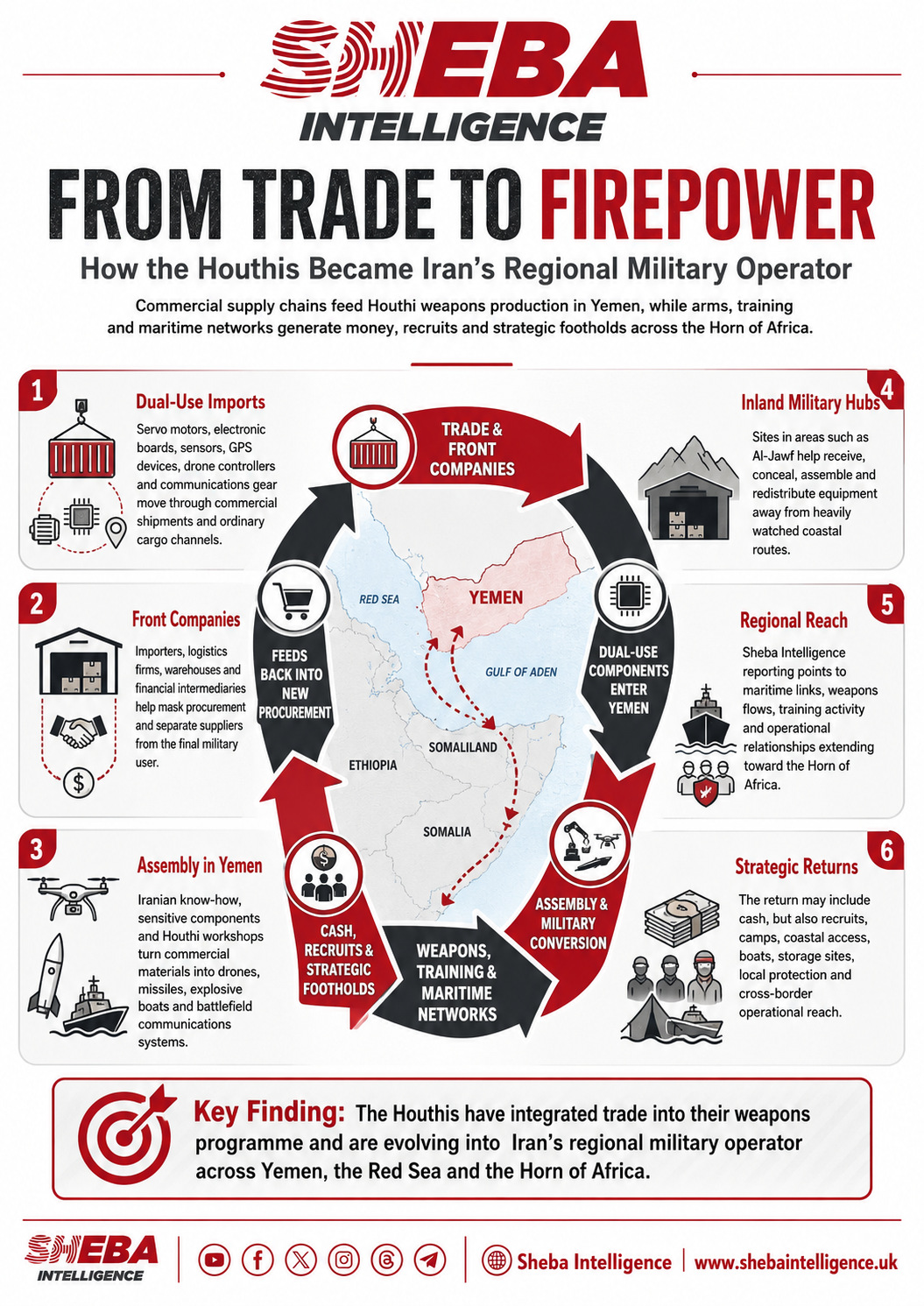
The Houthis no longer rely solely on clandestine shipments of complete Iranian weapons entering Yemen. Evidence reviewed for this investigation shows that the group has incorporated international trade, commercial companies and civilian supply chains into its military procurement system.
The evidence confirms the first central hypothesis of this investigation: trade has become a structural component of the Houthi military apparatus, not merely a cover for individual smuggling operations.
A second pattern is also emerging. The Houthis are using the weapons, expertise and maritime networks developed inside Yemen to build relationships with armed actors and trafficking networks across the Horn of Africa. The returns may include cash, but they may also take the form of recruits, training camps, coastal access, storage sites, boats, local protection and routes that expand the operational reach of both the Houthis and Iran.
This does not yet prove the existence of a fully developed Iranian network of missile bases in Africa. It does show, however, that the Houthis have evolved from a recipient of Iranian support into a regional military operator capable of converting trade into weapons and weapons into cross-border influence. Technical investigations into intercepted Houthi missiles and drones have found combinations of Iranian-origin materials and internationally manufactured commercial components. This suggests a production model in which Iran does not need to deliver every weapon in complete form.
Iran can provide designs, guidance, specialised parts and technical experts. Commercial networks obtain motors, batteries, cameras, processors and industrial materials from international markets. Houthi workshops then assemble, modify and test the final systems inside Yemen.
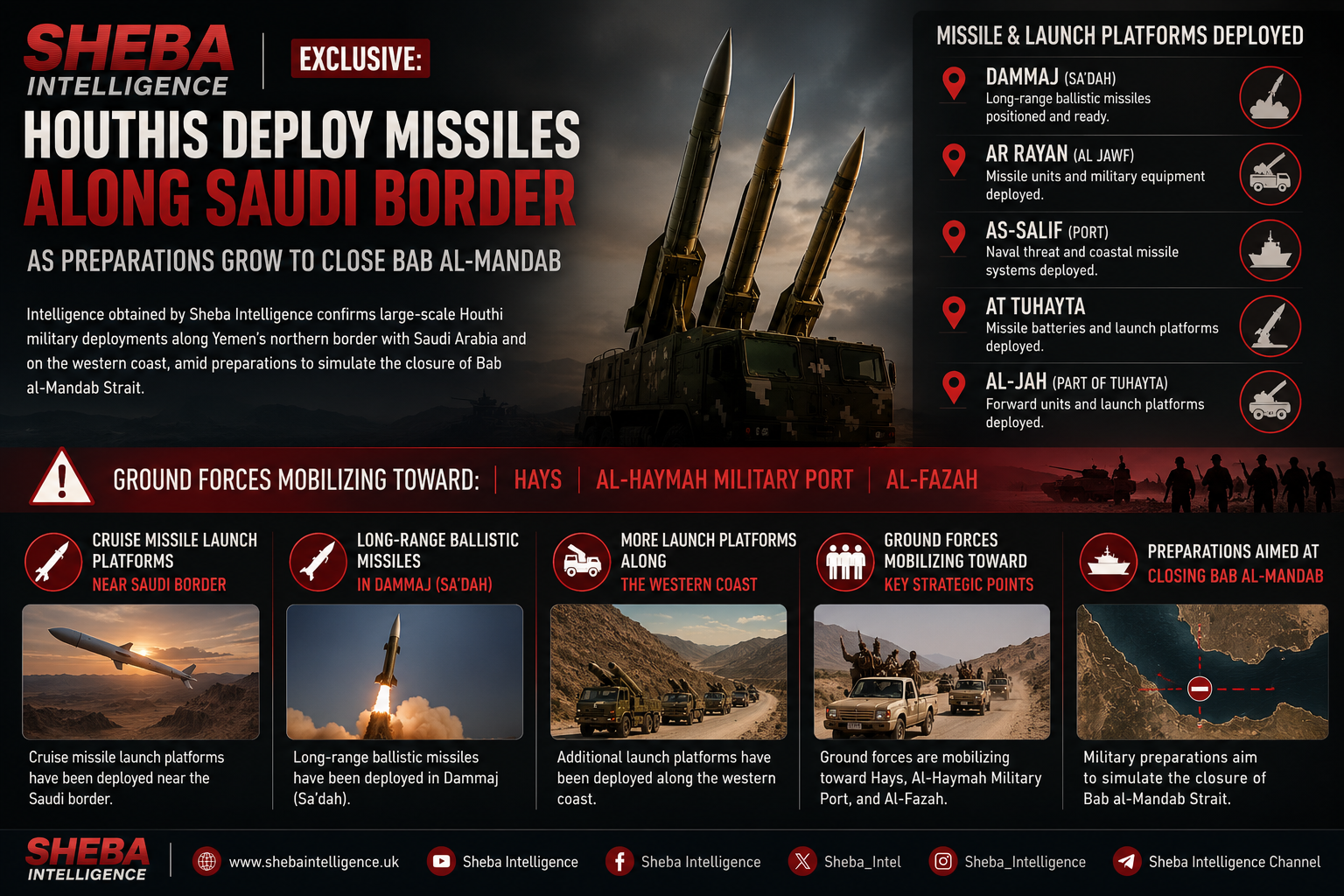
Sheba Intelligence revealed that an IRGC-linked technical cell had assessed the relocation of Houthi missile and drone facilities from Yemen's western coast to mountainous and desert areas, including locations in Al-Jawf. The cell reportedly examined underground facilities, protected storage sites and alternative deployment zones. This indicates that Iranian involvement is not limited to the supply of hardware. It extends to the protection, relocation and operational management of the capabilities produced from imported components.
Sheba Intelligence has reported, citing security sources in Puntland, that Somali piracy networks obtained weapons and GPS navigation equipment through channels connected to the Houthis or their partners. The information does not prove that every pirate group is controlled by the Houthis. It does suggest that weapons and technical equipment may be moving from the Yemeni network toward actors on the African coast.
https://shebaintelligence.uk/from-trade-to-firepower-how-the-houthis-became-irans-regional-military-operator
The clock is ticking—it's time to do something about this as soon as possible.
2,252
posted on
07/11/2026 2:46:46 AM PDT
by
AdmSmith
(GCTGATATGTCTATGATTACTCAT)
2,253
posted on
07/11/2026 2:48:45 AM PDT
by
AdmSmith
(GCTGATATGTCTATGATTACTCAT)
To: AdmSmith; nuconvert; BeauBo; blitz128; adorno; Jonty30
I don’t know if it was Houthis or Yemanis in general, but I read an interesting tidbit in a book about the major eruption of Krakatoa in the 1880s. I think the author was Simon Winchester. One result of this disaster was that Muslims in that area decided their Dutch colonialists had lost “the mandate of heaven” and hence moved to overthrow them. Specifically, Muslims were visiting Yemen after their trips to Saudi Arabia for the annual Hajj celebrating their religion. It seems that Yeman was a center of Islamic fundamentalism and planning for the future, so what is happening there today is definitely not a new development in Islamic aggression for people living there.
2,254
posted on
07/11/2026 10:08:28 AM PDT
by
gleeaikin
(Question Authority: report facts and post their 'links" in your messages.)
To: gleeaikin
Sudan was a troubled region in the late 19th century:
Mohammed Ahmed was a messianic Islamic leader in central and northern Sudan in the final decades of the 19th century. Claiming that Allah had selected him as the true Mahdi, he found fertile political ground in the inhabitants’ resentment engendered by the corruption of and oppression by Egyptian rulers who had long dominated the region. Economic and political problems in Egypt further strengthened the Mahdi’s hand, enabling the Mahdi’s forces and followers to occupy most of the Sudan. In 1883 the Mahdists overwhelmed the Egyptian army of British commander William Hicks, and Great Britain ordered the withdrawal of all Egyptian troops and officials from the Sudan. In 1885, General Gordon famously lost his life in a doomed defence of the capitol, Khartoum, where he had been sent to lead evacuation of Egyptian forces. Though the Mahdi died in 1885, his theocracy continued until 1898, when the British general Kitchener reoccupied the Sudan.
https://www.churchillbookcollector.com/pages/books/008160/richard-a-bermann-winston-s-churchill/the-mahdi-of-allah-the-story-of-the-dervish-mohammed-ahmed
2,255
posted on
07/11/2026 11:52:56 AM PDT
by
AdmSmith
(GCTGATATGTCTATGATTACTCAT)
To: AdmSmith
Iran Update Special Report, July 11, 2026
Iran's relatively pragmatic negotiators are likely trying to preserve negotiations and avoid renewed large-scale conflict with the United States. Top Islamic Revolutionary Guards Corps (IRGC) officers who are close to the supreme leader likely approved efforts to use force to secure Iranian control over the Strait of Hormuz, however. Iranian officials privately told US officials that an “errant” hardline faction that seeks to undermine negotiations is responsible for Iran's recent attacks on commercial vessels in the strait, according to unspecified senior US officials.[1] Iran attacked three commercial vessels using the southern Omani route on July 6 and 7 in order to enforce its control over the strait, which prompted US strikes on Iran.[2] An unspecified US official told Axios on July 10 that Iranian negotiators reached out to the Trump administration and requested that the two sides continue talks after the two days of attacks.[3] The US official claimed that Iran is facing an internal “power struggle.”[4] Iranian regime's English-language media outlet, Press TV, citing a senior Iranian intelligence source, rejected claims that “rogue forces” were operating in the Persian Gulf or that Iran had requested negotiations, however.[5]
Iranian negotiators are likely attempting to preserve talks with the United States by pointing to internal fractures within the regime to explain recent Iranian aggression against civilian ships. Iranian Foreign Minister Abbas Araghchi (who is leading negotiations), Parliament Speaker Mohammad Bagher Ghalibaf, and President Masoud Pezeshkian all support negotiations. The New York Times reported that Pezeshkian, reportedly fearful of the US blockade and the deteriorating economic situation in Iran, implored the supreme leader to accept the MoU despite the supreme leader's concerns and desire to retain control over the Strait of Hormuz.[6] US officials have acknowledged that they assess that the Iranians attacked shipping on July 6 and July 7 once they realized how quickly the strait was slipping out of their control.[7] That the IRGC Navy—which is responsible for attacks in the strait—responded to ensure it could control traffic in the strait indicates that the Iranian chain of command, not an “errant faction,” made a strategic decision to resume attacks.
The recent Iranian attacks on commercial vessels to enforce transit along Iran's own traffic separation scheme are consistent with Vahidi and the IRGC’s strategy throughout the ceasefire.[8] An IRGC-affiliated outlet also contradicted Iranian negotiators‘ reported pleas to resume talks by claiming that no negotiations will take place until the United States make concessions.[9]
The Iranian officials’ characterization of an ”errant faction” does not necessarily imply that Iranian negotiations do not seek to secure Iranian control over the strait, however, given that Iranian regime factions appear to broadly agree that the strait represents critical leverage for Iran.[10] Iranian negotiators, such as Parliament Speaker Mohammad Bagher Ghalibaf and Foreign Affairs Minister Abbas Araghchi, and other relatively more pragmatic regime officials such as Iranian President Masoud Pezeshkian, are likely seeking to preserve talks in order to avoid another large-scale US strike campaign, which would inflict significant economic damage to Iran. The preservation of US-Iran talks also allows Iran more time to militarily reconstitute (see below). The differences between the negotiators and the IRGC are one of immediate tactical means—negotiations or military action—not strategic ends.
The effect of Iranian negotiators blaming an “errant faction“ for attacks in the strait is that it allows the regime to sustain talks and attempt to reap potential economic benefits while the IRGC continues to enforce Iran's control over the strait, however. The Trump administration has directed senior officials, including Vice President JD Vance, Special Envoy to the Middle East Steve Witkoff, and Jared Kushner to continue negotiations.[11] Araghchi traveled to Oman on July 11 to hold talks on safe passage through the strait with Omani officials.[12]
There are major negotiating gaps between Iran and the United States on the Strait of Hormuz and Iran's nuclear program. The United States has demanded that Iran publicly acknowledge that the strait is open to all commercial traffic, end attacks on vessels, and restore maritime arrangements to their pre-war status quo.[13] Iranian officials have consistently rejected any return to the pre-war system and view control over the strait as essential strategic leverage.[14] Iran may agree to end attacks and permit commercial traffic while continuing to require vessels to follow Iranian-designated traffic separation scheme. Iran can also argue that this position is compatible with Clause 5 of the memorandum of understanding, which requires Iran to facilitate safe, charge-free passage for 60 days and calls for talks with Oman and other Persian Gulf littoral states to define the strait's future administration and maritime services.[15] Two senior Iranian sources told Reuters on July 8 that relinquishing its management of the strait would amount to ”surrender” and that Iran would not discuss its nuclear program unless the United States recognized full Iranian management of the strait.[16] US officials told the Wall Street Journal on July 10 that the United States will not conclude a nuclear agreement unless Iran relinquishes its enriched nuclear material.[17] Iranian officials have given no indication that the regime is prepared to surrender this material.
Iran is continuing efforts to protect its nuclear program. The Institute for Science and International Security and CNN reported on July 10 that Iran is continuing efforts in recent weeks to secure the Taleghan 2 facility at the Parchin Military Complex against potential future strikes.[18] The Institute assessed that Iran is building a concrete roof over Taleghan 2 to harden it against strikes.[19] The United States and Israel struck Parchin multiple times and the Taleghan 2 site in particular at least once during the most recent war.[20] The Iranian regime previously used the Taleghan 2 facility to test explosives that are needed to detonate a nuclear device before the regime suspended its nuclear weapons program in 2003.[21]
Iran is also undertaking efforts to reconstitute its drone program during the ceasefire. Acting Iranian Defense Minister Brigadier General Majid Ibn al Reza stated on July 10 that Iranian defense production continued throughout the war and that Iran tripled its drone production capacity during the conflict.[22] Iran retained 50 percent of its drone capabilities after the war, which amounts to thousands of drones, according to sources familiar with US intelligence assessments in May 2026.[23]
Iranian Supreme Leader Mojtaba Khamenei stated on July 11 that Iran must take revenge for the killing of his father, former Supreme Leader Ali Khamenei.[24] He added that this revenge does not depend on his own personal survival and that “every free person around the world“ will take part in achieving it.[25]
https://understandingwar.org/research/middle-east/iran-update-special-report-july-11-2026/
2,256
posted on
07/11/2026 10:56:19 PM PDT
by
AdmSmith
(GCTGATATGTCTATGATTACTCAT)
11JUL2026 The UN on Friday warned that it had ‘lost continuity of knowledge’ of Iran's nuclear facilities since the US and Israel launched the war in February.
Iran reiterated that it will not give UN inspectors access to its nuclear facilities following a UN Security Council meeting on Friday, facing down calls from Western nations to cooperate with the International Atomic Energy Agency (IAEA).
The meeting was called by Bahrain and European countries, and came as fresh strikes between the US and Iran threatened to unravel the interim deal to end the war. In a UN report presented at the briefing, the IAEA reported a “significant deterioration” in its awareness of Iran's nuclear facilities following the US-Israeli attack on Iran.
Iran, backed by Russia and China, argues that the UN Security Council no longer has legal authority to discuss its nuclear programme because the resolution underpinning the 2015 nuclear deal has expired.
https://www.newarab.com/news/iran-refuses-allow-iaea-access-nuclear-facilities
Members voted 11 in favour to 2 against (China, Russian Federation), with 2 abstentions (Pakistan, Somalia), to hold the meeting.
https://press.un.org/en/2026/sc16409.doc.htm
2,257
posted on
07/12/2026 12:27:05 AM PDT
by
AdmSmith
(GCTGATATGTCTATGATTACTCAT)
Iran Update Special Report, July 12, 2026
Iran is refusing any arrangement that undermines Iranian control over the Strait of Hormuz and is using force to maintain its control. Iranian and Omani officials held a meeting in Muscat, Oman, on July 11 to discuss safe passage through the strait.[1] Clause five of the US-Iran memorandum of understanding (MoU) requires Iran to discuss the “future administration and maritime services” of the strait with Oman and other Persian Gulf littoral states in line with “applicable international law.”[2] CNN reported on July 11 that Oman proposed two fully operational corridors: a southern route through Omani territorial waters that would allow unrestricted navigation under pre-war conditions and a northern route through Iranian territorial waters that would require prior Iranian approval but would not include tolls.[3] Iran has repeatedly rejected efforts to establish alternative transit arrangements outside Iranian control, including the International Maritime Organization-Omani safe-route initiative on June 25, because such routes would weaken Iran's ability to manage maritime traffic and use the strait as leverage.[4] Iran's English-language media outlet argued on July 12 that attempts to establish a parallel maritime route or escort vessels through the southern corridor undermine “Iran's security arrangements” and warned that Iran will not tolerate vessels that bypass Iranian authority.[5] Iran rejected the Omani proposal on July 12, and Foreign Affairs Minister Abbas Araghchi could not secure approval for the proposal during the meeting with Omani officials and returned it to Tehran for further internal discussions.[6]

Iran views control over the Strait of Hormuz as a major strategic objective, and its leaders believe that if Iran ends the war without control of the strait, the war would end in a serious strategic defeat. Two senior Iranian sources told Reuters on July 8 that the Iranian regime considers its control over the strait to be “important leverage” and that giving up such control would be tantamount to “surrender.”[7] Senior Iranian officials continue to frame the strait as a matter of sovereignty and regime survival rather than a maritime issue.[8] Supreme Leader Military Adviser and former Islamic Revolutionary Guards Corps (IRGC) Commander Major General Mohsen Rezaei described the strait as “more important than dozens of atomic bombs” on July 12.[9]
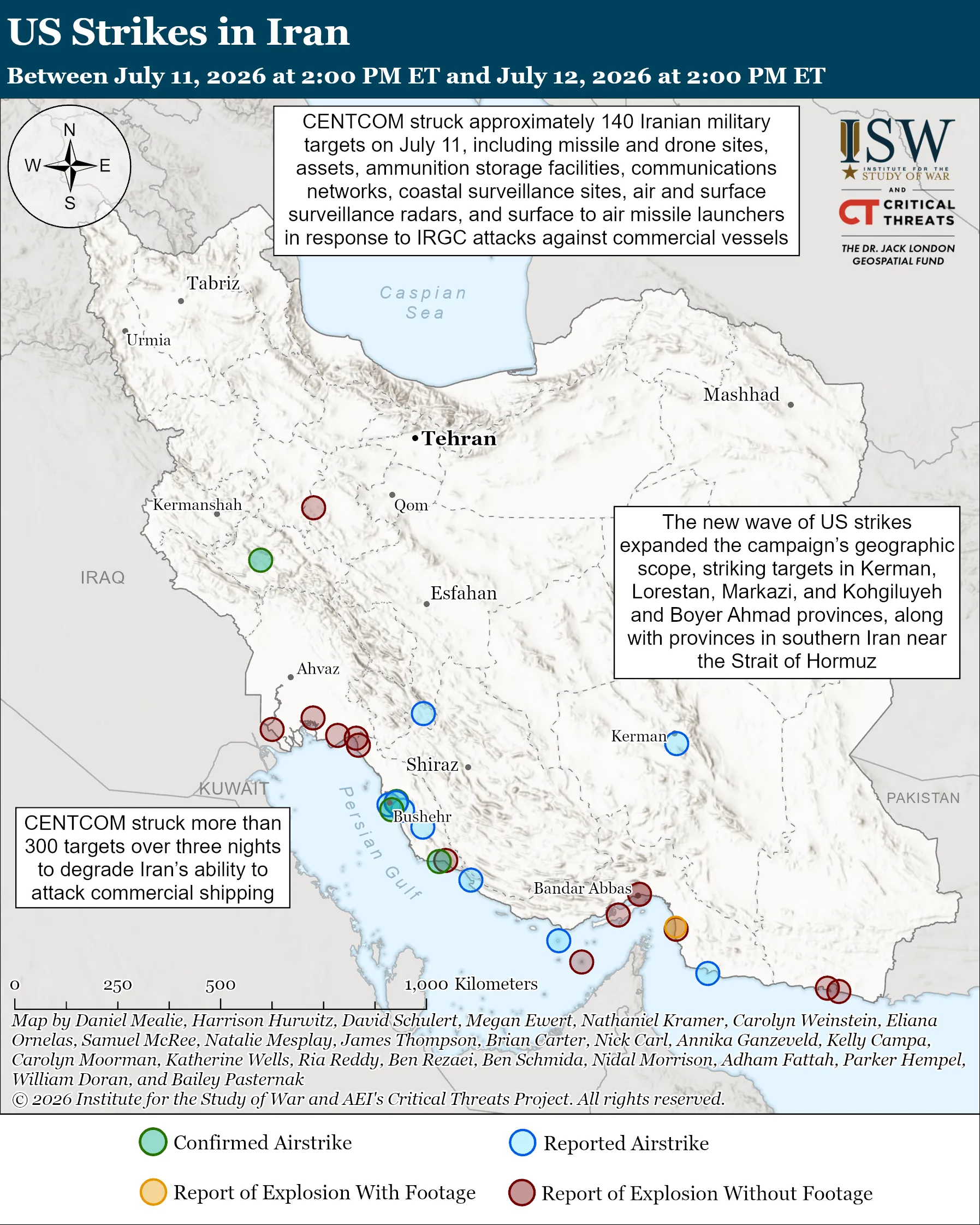
Recent US strikes have attempted to degrade Iran's ability to attack commercial shipping, but it remains unclear when Iran's ability to attack commercial shipping will be degraded sufficiently to prevent individual attacks that disrupt shipping. The strikes have also not yet changed Iran's willingness to use force. The IRGC Navy struck the Cyprus-flagged GFS Galaxy on July 11 with an anti-ship cruise missile and claimed that it struck a second unspecified vessel on July 12, demonstrating that the IRGC Navy remains capable of conducting individual attacks.[10] Even individual attacks can prevent the passage of vessels because the ability to transit the strait is contingent entirely upon the risk calculations of ship captains, owners, and the shipping industry, which are all risk-averse. US Central Command (CENTCOM) struck approximately 140 Iranian military targets, including missile and drone sites, naval capabilities, air and surface-surveillance radars, and surface-to-air missile launchers on July 11 in response to IRGC attacks against commercial vessels.[11] CENTCOM stated that it struck more than 300 targets over three nights to degrade Iran's ability to attack commercial shipping.[12] A US official told Axios on July 12 that the US military also conducted several strikes targeting missile and air defense systems and IRGC fast attack craft at multiple locations around the strait.[13] The July 11 US strikes also targeted central Iran, including Kerman, Lorestan, Markazi, and Kohgiluyeh and Boyer Ahmad provinces.[14] This is a geographic expansion, but only the strikes along the coast will have an immediate tactical effect on Iranian operations. The strikes further inland have not yet affected Iranian willingness to continue attacks into the Strait of Hormuz, though that could change, especially if the strikes are coupled with other efforts.
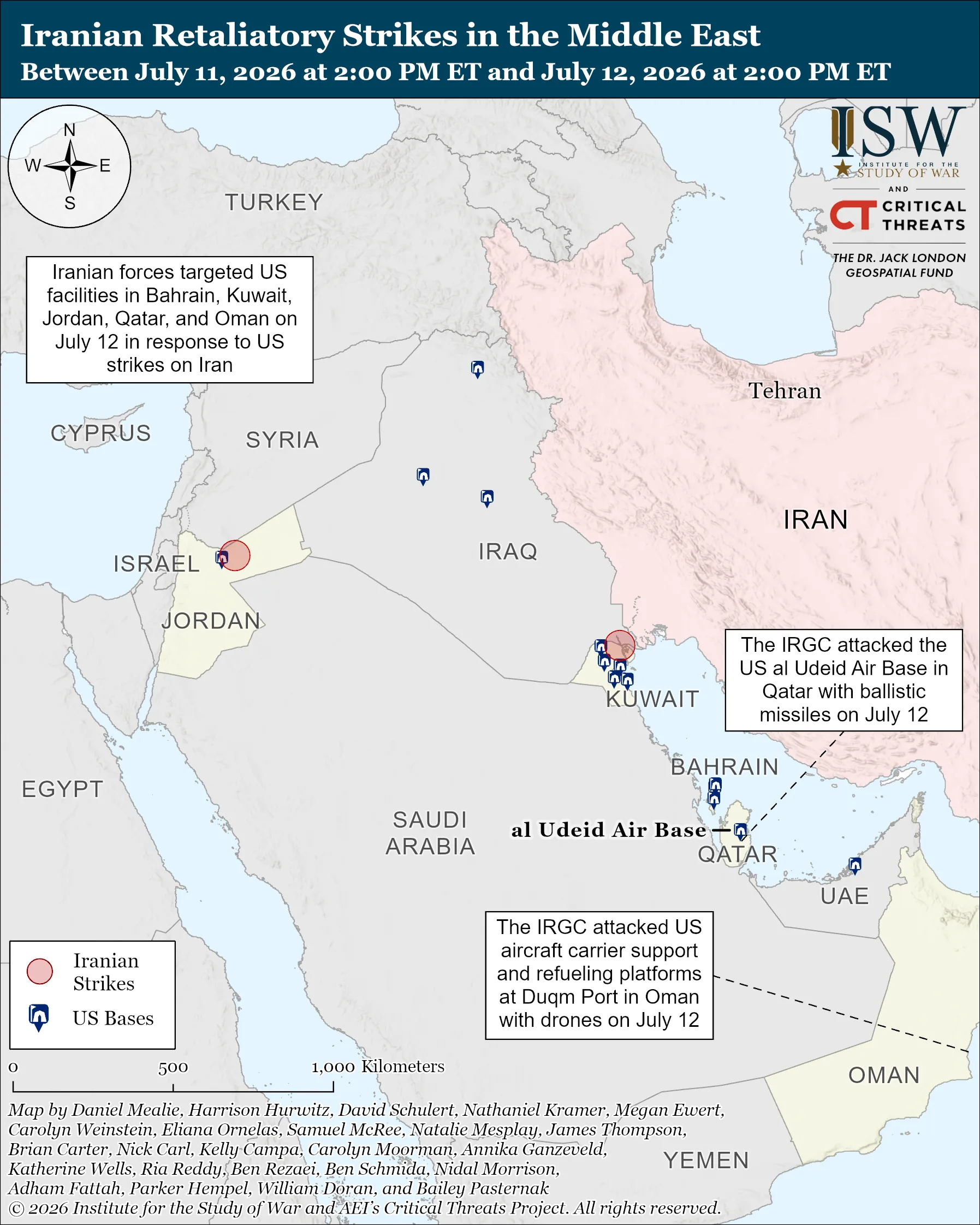
Iran is likely attacking Persian Gulf littoral states to deter them from supporting US- or Gulf-led efforts to limit Iranian control over the strait. Iran fired missiles and drones at US facilities in Bahrain, Kuwait, Jordan, Qatar, and Oman on July 12 in retaliation for the US strikes in Iran on July 11.[15] Iran has repeatedly targeted Bahrain, Kuwait, and Jordan since signing the MOU on June 15 as a means to deter the United States from undermining Iranian control of the strait.[16] Iran has not attacked Qatar since April 8 and only occasionally struck Oman during the war, however.[17] Qatar and Oman are acting as mediators in the ongoing US-Iran talks.[18] Iran claimed to target Al Udeid Airbase in Qatar and US aircraft carrier support and refueling platforms in the Port of Duqm, Oman.[19]
Iran likely attacked Qatar and Oman on July 12 because the regime views their mediation to be aligned with US-led efforts to reopen the strait in the wake of Qatari, Omani, and Iranian talks in Muscat on July 11.[20] Iranian regime-affiliated Nour News blamed Qatar, Oman, and other unspecified Gulf States on July 12 for opening the “southern corridor” through the strait and ignoring “Iran's arrangements.”[21] Iranian officials and media framed Oman in particular as giving in to ”US pressure” in proposing this plan on July 11.[22] This perception is likely intensified by Iran's failure to secure diplomatic recognition of its control over the strait from other Persian Gulf states in recent weeks.[23]Iran is now resorting to using force against Gulf states, likely to deter them from supporting efforts that undermine Iranian efforts to secure recognition of Iran's control over the strait. These attacks presumably also aim to coerce the Gulf states into acquiescing to Iranian control. Iranian officials have explicitly stated that Oman and other Gulf states cannot prevent Iran from asserting control over the strait in recent weeks.[24]
https://understandingwar.org/research/middle-east/iran-update-special-report-july-12-2026/
2,258
posted on
07/12/2026 10:54:42 PM PDT
by
AdmSmith
(GCTGATATGTCTATGATTACTCAT)
2,259
posted on
07/12/2026 11:15:48 PM PDT
by
AdmSmith
(GCTGATATGTCTATGATTACTCAT)
To: nuconvert; BeauBo; blitz128; gleeaikin
...and now the Houthis are getting some kinetic greetings from Saudi: Al-Masirah Net [= Houthies]| Sana’a: On Monday, the Saudi enemy aircraft launched airstrikes targeting Sana’a International Airport.
Al-Masirah TV correspondent in Sana’a reported that the airstrikes affected the airport's take-off and landing runways, noting that the targeting led to damage to the airport's facilities, while no further details have yet been announced about the extent of the losses.
In this context, the official spokesman of the Yemeni Armed Forces, Brigadier General Yahya Saree, confirmed that the Saudi enemy's actions targeting Sana’a International Airport represent a new escalation that ends the de-escalation phase.
https://almasirah.net.ye/post/305548
Sana Airport has been struck. Thick smoke is rising from the area. Meanwhile, a Mahan Air plane belonging to Iran is approaching Sana Airport.

https://x.com/dizak45764/status/2076625644545269808
2,260
posted on
07/13/2026 4:47:41 AM PDT
by
AdmSmith
(GCTGATATGTCTATGATTACTCAT)
Navigation: use the links below to view more comments.
first previous 1-20 ... 2,221-2,240, 2,241-2,260, 2,261-2,280 ... 2,401-2,405 next last
Disclaimer:
Opinions posted on Free Republic are those of the individual
posters and do not necessarily represent the opinion of Free Republic or its
management. All materials posted herein are protected by copyright law and the
exemption for fair use of copyrighted works.
FreeRepublic.com is powered by software copyright 2000-2008 John Robinson