To: AdmSmith
Iran Update Special Report, July 11, 2026
Iran's relatively pragmatic negotiators are likely trying to preserve negotiations and avoid renewed large-scale conflict with the United States. Top Islamic Revolutionary Guards Corps (IRGC) officers who are close to the supreme leader likely approved efforts to use force to secure Iranian control over the Strait of Hormuz, however. Iranian officials privately told US officials that an “errant” hardline faction that seeks to undermine negotiations is responsible for Iran's recent attacks on commercial vessels in the strait, according to unspecified senior US officials.[1] Iran attacked three commercial vessels using the southern Omani route on July 6 and 7 in order to enforce its control over the strait, which prompted US strikes on Iran.[2] An unspecified US official told Axios on July 10 that Iranian negotiators reached out to the Trump administration and requested that the two sides continue talks after the two days of attacks.[3] The US official claimed that Iran is facing an internal “power struggle.”[4] Iranian regime's English-language media outlet, Press TV, citing a senior Iranian intelligence source, rejected claims that “rogue forces” were operating in the Persian Gulf or that Iran had requested negotiations, however.[5]
Iranian negotiators are likely attempting to preserve talks with the United States by pointing to internal fractures within the regime to explain recent Iranian aggression against civilian ships. Iranian Foreign Minister Abbas Araghchi (who is leading negotiations), Parliament Speaker Mohammad Bagher Ghalibaf, and President Masoud Pezeshkian all support negotiations. The New York Times reported that Pezeshkian, reportedly fearful of the US blockade and the deteriorating economic situation in Iran, implored the supreme leader to accept the MoU despite the supreme leader's concerns and desire to retain control over the Strait of Hormuz.[6] US officials have acknowledged that they assess that the Iranians attacked shipping on July 6 and July 7 once they realized how quickly the strait was slipping out of their control.[7] That the IRGC Navy—which is responsible for attacks in the strait—responded to ensure it could control traffic in the strait indicates that the Iranian chain of command, not an “errant faction,” made a strategic decision to resume attacks.
The recent Iranian attacks on commercial vessels to enforce transit along Iran's own traffic separation scheme are consistent with Vahidi and the IRGC’s strategy throughout the ceasefire.[8] An IRGC-affiliated outlet also contradicted Iranian negotiators‘ reported pleas to resume talks by claiming that no negotiations will take place until the United States make concessions.[9]
The Iranian officials’ characterization of an ”errant faction” does not necessarily imply that Iranian negotiations do not seek to secure Iranian control over the strait, however, given that Iranian regime factions appear to broadly agree that the strait represents critical leverage for Iran.[10] Iranian negotiators, such as Parliament Speaker Mohammad Bagher Ghalibaf and Foreign Affairs Minister Abbas Araghchi, and other relatively more pragmatic regime officials such as Iranian President Masoud Pezeshkian, are likely seeking to preserve talks in order to avoid another large-scale US strike campaign, which would inflict significant economic damage to Iran. The preservation of US-Iran talks also allows Iran more time to militarily reconstitute (see below). The differences between the negotiators and the IRGC are one of immediate tactical means—negotiations or military action—not strategic ends.
The effect of Iranian negotiators blaming an “errant faction“ for attacks in the strait is that it allows the regime to sustain talks and attempt to reap potential economic benefits while the IRGC continues to enforce Iran's control over the strait, however. The Trump administration has directed senior officials, including Vice President JD Vance, Special Envoy to the Middle East Steve Witkoff, and Jared Kushner to continue negotiations.[11] Araghchi traveled to Oman on July 11 to hold talks on safe passage through the strait with Omani officials.[12]
There are major negotiating gaps between Iran and the United States on the Strait of Hormuz and Iran's nuclear program. The United States has demanded that Iran publicly acknowledge that the strait is open to all commercial traffic, end attacks on vessels, and restore maritime arrangements to their pre-war status quo.[13] Iranian officials have consistently rejected any return to the pre-war system and view control over the strait as essential strategic leverage.[14] Iran may agree to end attacks and permit commercial traffic while continuing to require vessels to follow Iranian-designated traffic separation scheme. Iran can also argue that this position is compatible with Clause 5 of the memorandum of understanding, which requires Iran to facilitate safe, charge-free passage for 60 days and calls for talks with Oman and other Persian Gulf littoral states to define the strait's future administration and maritime services.[15] Two senior Iranian sources told Reuters on July 8 that relinquishing its management of the strait would amount to ”surrender” and that Iran would not discuss its nuclear program unless the United States recognized full Iranian management of the strait.[16] US officials told the Wall Street Journal on July 10 that the United States will not conclude a nuclear agreement unless Iran relinquishes its enriched nuclear material.[17] Iranian officials have given no indication that the regime is prepared to surrender this material.
Iran is continuing efforts to protect its nuclear program. The Institute for Science and International Security and CNN reported on July 10 that Iran is continuing efforts in recent weeks to secure the Taleghan 2 facility at the Parchin Military Complex against potential future strikes.[18] The Institute assessed that Iran is building a concrete roof over Taleghan 2 to harden it against strikes.[19] The United States and Israel struck Parchin multiple times and the Taleghan 2 site in particular at least once during the most recent war.[20] The Iranian regime previously used the Taleghan 2 facility to test explosives that are needed to detonate a nuclear device before the regime suspended its nuclear weapons program in 2003.[21]
Iran is also undertaking efforts to reconstitute its drone program during the ceasefire. Acting Iranian Defense Minister Brigadier General Majid Ibn al Reza stated on July 10 that Iranian defense production continued throughout the war and that Iran tripled its drone production capacity during the conflict.[22] Iran retained 50 percent of its drone capabilities after the war, which amounts to thousands of drones, according to sources familiar with US intelligence assessments in May 2026.[23]
Iranian Supreme Leader Mojtaba Khamenei stated on July 11 that Iran must take revenge for the killing of his father, former Supreme Leader Ali Khamenei.[24] He added that this revenge does not depend on his own personal survival and that “every free person around the world“ will take part in achieving it.[25]
https://understandingwar.org/research/middle-east/iran-update-special-report-july-11-2026/
2,256 posted on
07/11/2026 10:56:19 PM PDT by
AdmSmith
(GCTGATATGTCTATGATTACTCAT)
11JUL2026 The UN on Friday warned that it had ‘lost continuity of knowledge’ of Iran's nuclear facilities since the US and Israel launched the war in February.
Iran reiterated that it will not give UN inspectors access to its nuclear facilities following a UN Security Council meeting on Friday, facing down calls from Western nations to cooperate with the International Atomic Energy Agency (IAEA).
The meeting was called by Bahrain and European countries, and came as fresh strikes between the US and Iran threatened to unravel the interim deal to end the war. In a UN report presented at the briefing, the IAEA reported a “significant deterioration” in its awareness of Iran's nuclear facilities following the US-Israeli attack on Iran.
Iran, backed by Russia and China, argues that the UN Security Council no longer has legal authority to discuss its nuclear programme because the resolution underpinning the 2015 nuclear deal has expired.
https://www.newarab.com/news/iran-refuses-allow-iaea-access-nuclear-facilities
Members voted 11 in favour to 2 against (China, Russian Federation), with 2 abstentions (Pakistan, Somalia), to hold the meeting.
https://press.un.org/en/2026/sc16409.doc.htm
2,257 posted on
07/12/2026 12:27:05 AM PDT by
AdmSmith
(GCTGATATGTCTATGATTACTCAT)
Iran Update Special Report, July 12, 2026
Iran is refusing any arrangement that undermines Iranian control over the Strait of Hormuz and is using force to maintain its control. Iranian and Omani officials held a meeting in Muscat, Oman, on July 11 to discuss safe passage through the strait.[1] Clause five of the US-Iran memorandum of understanding (MoU) requires Iran to discuss the “future administration and maritime services” of the strait with Oman and other Persian Gulf littoral states in line with “applicable international law.”[2] CNN reported on July 11 that Oman proposed two fully operational corridors: a southern route through Omani territorial waters that would allow unrestricted navigation under pre-war conditions and a northern route through Iranian territorial waters that would require prior Iranian approval but would not include tolls.[3] Iran has repeatedly rejected efforts to establish alternative transit arrangements outside Iranian control, including the International Maritime Organization-Omani safe-route initiative on June 25, because such routes would weaken Iran's ability to manage maritime traffic and use the strait as leverage.[4] Iran's English-language media outlet argued on July 12 that attempts to establish a parallel maritime route or escort vessels through the southern corridor undermine “Iran's security arrangements” and warned that Iran will not tolerate vessels that bypass Iranian authority.[5] Iran rejected the Omani proposal on July 12, and Foreign Affairs Minister Abbas Araghchi could not secure approval for the proposal during the meeting with Omani officials and returned it to Tehran for further internal discussions.[6]

Iran views control over the Strait of Hormuz as a major strategic objective, and its leaders believe that if Iran ends the war without control of the strait, the war would end in a serious strategic defeat. Two senior Iranian sources told Reuters on July 8 that the Iranian regime considers its control over the strait to be “important leverage” and that giving up such control would be tantamount to “surrender.”[7] Senior Iranian officials continue to frame the strait as a matter of sovereignty and regime survival rather than a maritime issue.[8] Supreme Leader Military Adviser and former Islamic Revolutionary Guards Corps (IRGC) Commander Major General Mohsen Rezaei described the strait as “more important than dozens of atomic bombs” on July 12.[9]
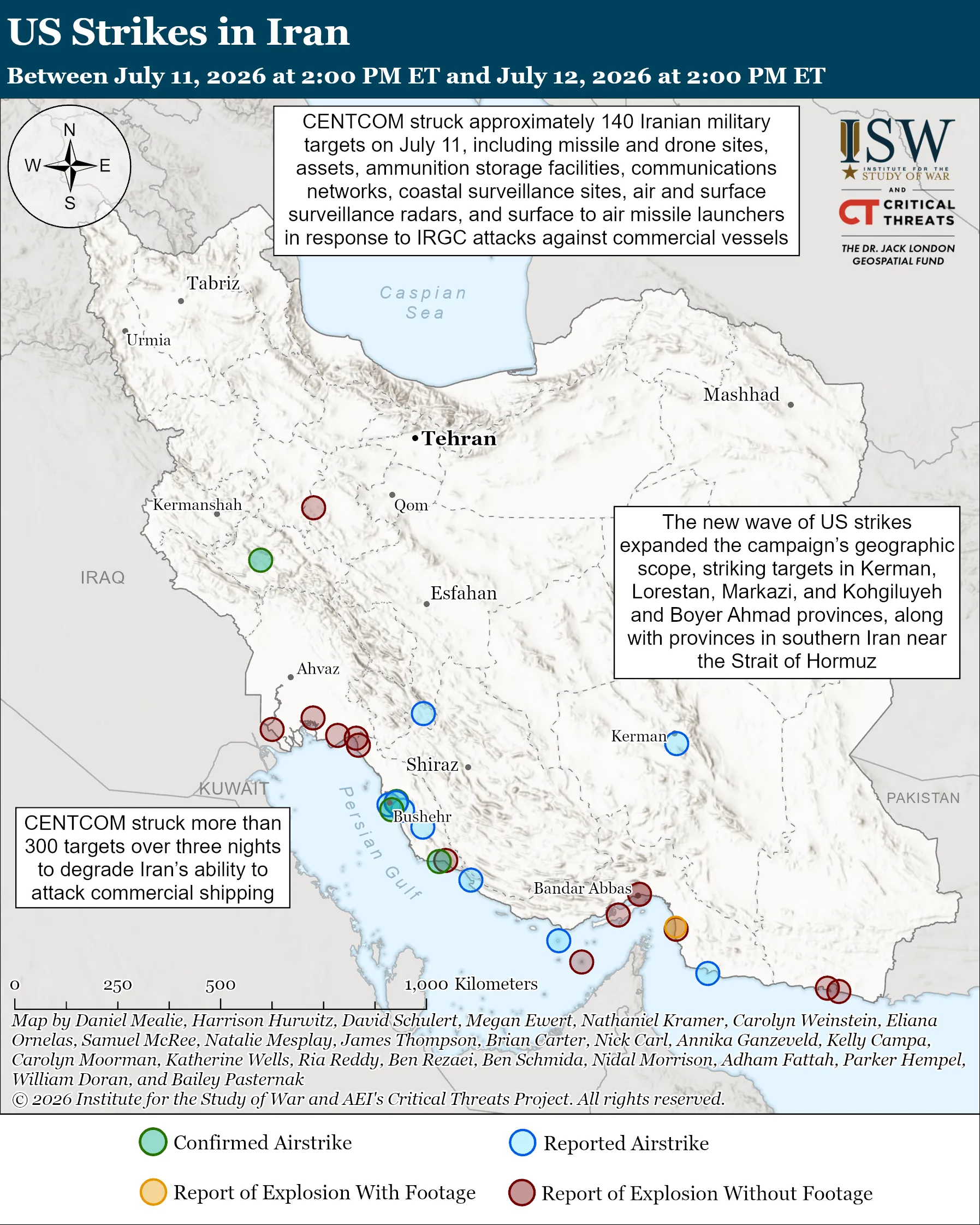
Recent US strikes have attempted to degrade Iran's ability to attack commercial shipping, but it remains unclear when Iran's ability to attack commercial shipping will be degraded sufficiently to prevent individual attacks that disrupt shipping. The strikes have also not yet changed Iran's willingness to use force. The IRGC Navy struck the Cyprus-flagged GFS Galaxy on July 11 with an anti-ship cruise missile and claimed that it struck a second unspecified vessel on July 12, demonstrating that the IRGC Navy remains capable of conducting individual attacks.[10] Even individual attacks can prevent the passage of vessels because the ability to transit the strait is contingent entirely upon the risk calculations of ship captains, owners, and the shipping industry, which are all risk-averse. US Central Command (CENTCOM) struck approximately 140 Iranian military targets, including missile and drone sites, naval capabilities, air and surface-surveillance radars, and surface-to-air missile launchers on July 11 in response to IRGC attacks against commercial vessels.[11] CENTCOM stated that it struck more than 300 targets over three nights to degrade Iran's ability to attack commercial shipping.[12] A US official told Axios on July 12 that the US military also conducted several strikes targeting missile and air defense systems and IRGC fast attack craft at multiple locations around the strait.[13] The July 11 US strikes also targeted central Iran, including Kerman, Lorestan, Markazi, and Kohgiluyeh and Boyer Ahmad provinces.[14] This is a geographic expansion, but only the strikes along the coast will have an immediate tactical effect on Iranian operations. The strikes further inland have not yet affected Iranian willingness to continue attacks into the Strait of Hormuz, though that could change, especially if the strikes are coupled with other efforts.
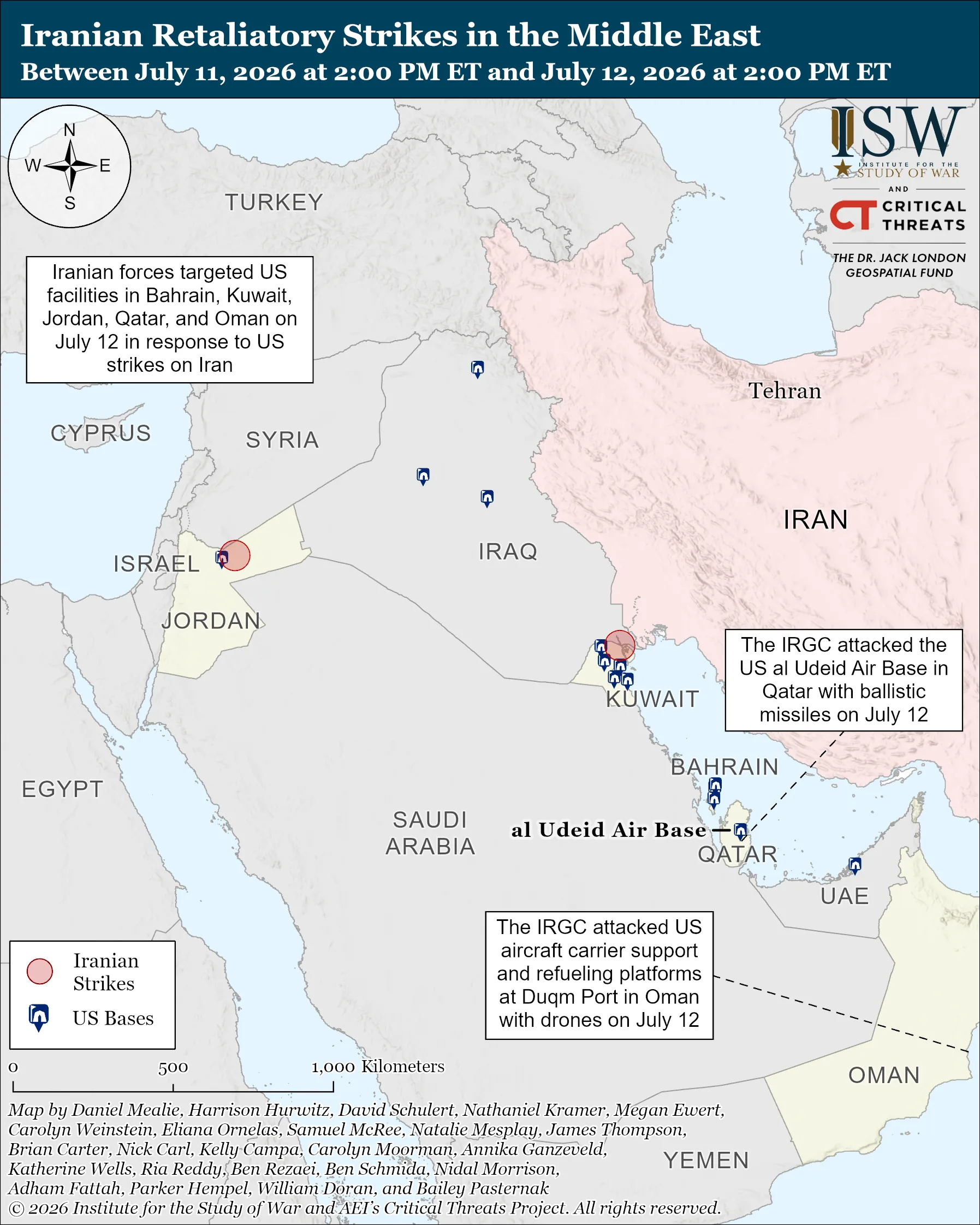
Iran is likely attacking Persian Gulf littoral states to deter them from supporting US- or Gulf-led efforts to limit Iranian control over the strait. Iran fired missiles and drones at US facilities in Bahrain, Kuwait, Jordan, Qatar, and Oman on July 12 in retaliation for the US strikes in Iran on July 11.[15] Iran has repeatedly targeted Bahrain, Kuwait, and Jordan since signing the MOU on June 15 as a means to deter the United States from undermining Iranian control of the strait.[16] Iran has not attacked Qatar since April 8 and only occasionally struck Oman during the war, however.[17] Qatar and Oman are acting as mediators in the ongoing US-Iran talks.[18] Iran claimed to target Al Udeid Airbase in Qatar and US aircraft carrier support and refueling platforms in the Port of Duqm, Oman.[19]
Iran likely attacked Qatar and Oman on July 12 because the regime views their mediation to be aligned with US-led efforts to reopen the strait in the wake of Qatari, Omani, and Iranian talks in Muscat on July 11.[20] Iranian regime-affiliated Nour News blamed Qatar, Oman, and other unspecified Gulf States on July 12 for opening the “southern corridor” through the strait and ignoring “Iran's arrangements.”[21] Iranian officials and media framed Oman in particular as giving in to ”US pressure” in proposing this plan on July 11.[22] This perception is likely intensified by Iran's failure to secure diplomatic recognition of its control over the strait from other Persian Gulf states in recent weeks.[23]Iran is now resorting to using force against Gulf states, likely to deter them from supporting efforts that undermine Iranian efforts to secure recognition of Iran's control over the strait. These attacks presumably also aim to coerce the Gulf states into acquiescing to Iranian control. Iranian officials have explicitly stated that Oman and other Gulf states cannot prevent Iran from asserting control over the strait in recent weeks.[24]
https://understandingwar.org/research/middle-east/iran-update-special-report-july-12-2026/
2,258 posted on
07/12/2026 10:54:42 PM PDT by
AdmSmith
(GCTGATATGTCTATGATTACTCAT)
FreeRepublic.com is powered by software copyright 2000-2008 John Robinson