Skip to comments.
Iranian Regime tv Channel One hacked while it was airing Khamenie speech
various
| 10-8-22
Posted on 10/08/2022 1:05:38 PM PDT by nuconvert
Iranian Regime national tv Channel One hacked about an hour ago. During a broadcast of Khamenie speech, a red crosshair appeared over his face and chanting of Women. Life. Freedom. There was writing to the side saying "Rise up. Join us". Also 4 photos at the bottom of the screen of young people killed and additional writing: "The blood of our youth is dropping from your paws".
Also, there was a huge banner in the middle of Tehran highway today that read: We are no longer afraid of you. We will fight.
Also, attempted attack on IRI ambassador in Denmark. Her bodyguard was stabbed. Diplomatic Security intervened before the attacker could stab the ambassador.
TOPICS:
KEYWORDS: basij; deathtothemullahs; denmark; ebrahimrigi; erdogan; iran; iranprotests; iraq; irgc; iri; israel; khameini; khamenei; kurdistan; lebanon; mahsaamini; mullahloversonfr; mullahsmustbekilled; najisharifizindashti; protests; qudsforce; raisi; receptayyiperdogan; shahrammaroufmola; syria; turkey; yemen; zahedi
Navigation: use the links below to view more comments.
first previous 1-20 ... 2,181-2,200, 2,201-2,220, 2,221-2,240 ... 2,401-2,405 next last
Mohammad Akrami-Nia, the spokesman for the Islamic Republic's army, stated in an interview with “Defa Press” that the Islamic Republic's smart control over the Strait of Hormuz “is not for generating revenue, but rather for preserving and enhancing power in the region,” and added that the recent war has caused the Islamic Republic to realize the geopolitical capacity of this waterway more than ever before.
He also said that the notion that America's enmity with the Islamic Republic began after the revolution is “completely wrong,” and added that America, years before the revolution, overthrew the government of Mohammad Mossadegh in the August 28, 1953 coup.
Akrami-Nia, referring to the Islamic Republic's military capabilities, said that in the final days of the war, new drones were used whose research phases had begun previously and were operationalized during the course of the war.
He also announced that in the field of domestic production and procurement of advanced equipment from “friendly countries,” planning has been done, and the Islamic Republic “will be equipped with more advanced equipment in the coming days.”

https://x.com/IranIntl/status/2071132047096103296
2,201
posted on
06/28/2026 1:05:03 AM PDT
by
AdmSmith
(GCTGATATGTCTATGATTACTCAT)
To: nuconvert
Good news:
When Ali al-Zaidi became Iraq's new PM in May, many assumed he would simply become another Iranian-influenced caretaker in the country's long cycle of corruption and outside influence. Instead, Baghdad woke up today to something almost nobody expected; a sweeping anti-corruption crackdown targeting senior officials, political figures, and billions of dollars in alleged fraud.
It's got them so spooked that many politicians are trying to flee the country. The timing of the crackdown is also significant. Over recent months, Washington has quietly shifted its approach to Iraq and Syria, emphasizing stability, sovereignty, and regional normalization rather than perpetual military involvement. Trump has made that repositioning a central feature of his Middle East policy, with Presidential Special Envoy Tom Barrack playing an increasingly visible role in encouraging internal security, reform, investment, and stronger state institutions across the region.
While today's operation is entirely Iraqi, carried out by Iraq's own Counter Terrorism Service without U.S. military involvement, it unfolds against a backdrop of renewed American support for a stronger, more sovereign Iraqi state. Reports suggest investigations have uncovered up to $50 billion of corruption and fraud, with arrests extending into Parliament, the oil sector, and some of Iraq's most powerful political networks. If true, it would represent the most dramatic anti-corruption operation since the fall of Saddam Hussein.
With Parliament in recess, lawmakers cannot rely on parliamentary immunity, and that window may prove decisive. Among those reportedly caught in the investigation are senior officials connected to Iraq's oil sector, where corruption has drained tens of billions from the country's wealth over two decades. One figure reportedly arrested is Adnan Jamali, General Manager of the North Oil Company, for allegedly issuing fraudulent tenders.
Supporters see it as something Iraq has desperately needed for years: A Prime Minister finally willing to confront the political class.
However, several reported targets are major political rivals, including prominent Sunni figures, which inevitably raises an uncomfortable question: Is this purely an anti-corruption campaign, or is corruption becoming the vehicle for settling political scores?
Iraq's corruption is undeniable. For years, experts have estimated that hundreds of billions of dollars have disappeared through fraudulent contracts, insider networks, and stolen public funds since 2003. Cleaning house is long overdue, but history also offers a warning. Previous campaigns against political opponents deepened sectarian divisions and ultimately weakened national unity.
If this operation is seen as selective justice rather than equal justice, today's victory could become tomorrow's political crisis. Yet there is another possibility: Zaidi may be trying to redefine Iraqi leadership. His government has surprised both regional observers and Washington by pursuing broader engagement, emphasizing Iraqi sovereignty, improving relations with international partners, and signaling a willingness to curb the influence of non-state armed groups. For a leader many initially dismissed as an Iranian-backed placeholder, that represents a remarkable political transformation.

https://x.com/MarioNawfal/status/2071139612282523735
https://en.wikipedia.org/wiki/Ali_al-Zaidi
2,202
posted on
06/28/2026 1:28:34 AM PDT
by
AdmSmith
(GCTGATATGTCTATGATTACTCAT)
To: AdmSmith
Yes. I just read about over 30 Iraqi officials being arrested
2,203
posted on
06/28/2026 5:04:14 AM PDT
by
nuconvert
( Warning: Accused of being a radical militarist. Approach with caution.)
To: nuconvert
2,204
posted on
06/28/2026 11:21:49 AM PDT
by
AdmSmith
(GCTGATATGTCTATGATTACTCAT)
Exclusive: Houthis Plan to Recruit 100,000 Fighters Amid U.S.-Iran Talks and Red Sea Uncertainty 24JUN2926; The information points to a coordinated campaign involving district-level recruitment, tribal mobilization, training programs and military displays near frontlines and border areas. Houthi leaders and security supervisors have reportedly been tasked with overseeing recruitment and training operations across several areas under the group's control.
According to the information, the plan covers areas around Sana’a, Dhamar, Hajjah, Hodeidah and Saada, where new recruits are expected to be trained in valleys, camps and field locations. The group is also seeking to highlight these activities through media coverage and organized field displays.
The mobilization comes amid renewed frontline tensions in Yemen. In recent days, clashes were reported between government-aligned forces and Houthi fighters in Al-Dhalea, while both sides announced casualties in separate incidents. A government soldier was also reported killed in clashes in Taiz, highlighting the fragility of Yemen's relative calm after years of reduced large-scale fighting.
The new information builds on a previous Sheba Intelligence report that examined whether the Houthi mobilization statement reflected calculated escalation or internal strain. The latest details give that assessment a clearer field dimension, linking the mobilization rhetoric to a specific recruitment target, local-level instructions and preparations for new training tracks.
Sheba Intelligence assesses that the plan serves several purposes at once. It allows the Houthis to rebuild manpower reserves, absorb public anger over worsening living conditions in areas under their control, and increase pressure on the internationally recognized Yemeni government and its allies.
The timing also gives the mobilization a wider regional meaning. It comes as U.S.-Iran negotiations continue to shape security calculations in the Middle East, including unresolved questions over sanctions, maritime security and the role of Iran-aligned armed groups.
In this context, the Houthis remain one of Iran's most important pressure points near global maritime routes. Their position along the Red Sea and their ability to threaten Bab al-Mandab and the Gulf of Aden give their mobilization significance beyond Yemen's internal frontlines.
The reported plan does not necessarily mean that a full-scale war is imminent. However, recruiting up to 100,000 fighterswould increase the group's ability to pressure border areas, activate frontlines and sustain a higher level of military readiness if regional negotiations fail or a new escalation unfolds.
For the Yemeni government and its allies, the risk lies in the combination of internal mobilization and regional timing. The Houthis appear to be keeping military options active while using the mobilization campaign to strengthen their bargaining position locally and regionally.
The current mobilization should therefore be read as a warning indicator: a clear recruitment target, field-level instructions, renewed clashes, and a broader message aimed at Yemen's government, its allies and regional actors monitoring Red Sea security.
https://shebaintelligence.uk/exclusive-houthis-plan-to-recruit-100000-fighters-amid-us-iran-talks-and-red-sea-uncertainty
2,205
posted on
06/28/2026 2:04:36 PM PDT
by
AdmSmith
(GCTGATATGTCTATGATTACTCAT)
Iran Update Special Report, June 28, 2026
Iran has continued to attack US forces in the region to try to deter the United States from undermining Iranian efforts to control the Strait of Hormuz. An Iranian drone struck the Panama-flagged M/T Kiku on June 27.[1] US military aircraft targeted Iranian military surveillance infrastructure, communications systems, air defense sites, drone storage facilities, and mine-laying capabilities in response.[2] The Islamic Revolutionary Guards Corps (IRGC) Navy then released a statement that threatened US bases in the region.[3] The IRGC launched drone and ballistic missile attacks targeting the US Fifth Fleet Naval Base in Bahrain and the Ali Al Salem Airbase in Kuwait on June 28.[4] Bahraini air defenses intercepted several projectiles, but the Iranian attack destroyed a residential building, according to Bahrain's Interior Ministry.[5] These strikes are likely intended to deter the United States from continuing to undermine Iranian efforts to control the strait by signaling to the United States that Iran will attack US forces in response to US strikes on Iran that seek to reduce Iran's ability to threaten international shipping. Iranian officials have continued to emphasize after the recent exchange of fire that Iran intends to assert sovereignty over the strait. Iranian Foreign Affairs Minister Abbas Araghchi stated on June 28 that Iran is “solely responsible” for managing the Strait of Hormuz under the US-Iran memorandum of understanding (MoU).[6] The fifth article of the MoU explicitly states that Iran must engage in dialogue with Oman and the Persian Gulf littoral states to determine the “future administration” of the strait.[7] Iranian Artesh Spokesperson Mohammad Akraminia separately stated on June 28 that Iran seeks to use control of the strait to strengthen its regional power, not just to collect tolls.[8] ISW-CTP has previously assessed that Iran is prioritizing securing recognized control over the strait over collecting tolls.[9]
Iran's strikes may also reflect an Iranian effort to dissuade the Gulf states from resisting Iranian control over the strait. Iran may have intended for its strikes to signal to Gulf states that Iran will respond with force to any Gulf opposition to its control of the strait, amid recent Gulf resistance to Iranian management of the waterway. The Gulf Cooperation Council (GCC) and the United States explicitly rejected on June 25 any Iranian attempts to assert control over the strait, including by charging tolls.[10] Omani officials told CNN on June 28 that Oman opposes any mandatory fees or tolls in the Strait of Hormuz, citing international freedom of navigation.[11] Iranian media and officials have adopted a harsher tone toward Gulf countries in recent days, likely in response to these countries’ opposition to Iranian management of the strait. Iran's English-language media outlet published an article on June 26 in which it criticized the Gulf states and claimed that these countries are attempting to “conceal” the reality that Iran has established a new “regional balance” with its control over the strait, for example.[12]
Iran is also threatening to suspend negotiations as part of its efforts to deter the United States from challenging Iranian sovereignty over the strait. The IRGC Navy stated on June 27 that US strikes on Iran violated the ceasefire and “will result in the complete halt of all diplomatic processes.”[13] Iran may calculate that threatening to stop negotiations could alter US decision-making, given that US officials have repeatedly stated that they seek to resolve key nuclear issues with Iran. Iran previously suspended negotiations with the United States prior to the signing of the MoU in order to try to compel the United States to pressure Israel to halt operations against Hezbollah.[14]
The Israeli government confirmed the locations of two “pilot zones” where the Lebanese Armed Forces (LAF) will backfill the Israel Defense Forces (IDF) in southern Lebanon as part of the June 26 trilateral framework agreement.[15] Israeli Prime Minister Benjamin Netanyahu displayed a map of two zones located on opposite banks of the Litani River during a press conference on June 27.[16] The northern pilot zone includes territory surrounding Zawtar el Gharbiyeh, Nabatieh District, and the southern pilot zone includes territory surrounding Ghandouriyeh and Froun, Bint Jbeil District. The June 26 framework agreement's second and third clauses require the LAF to assume responsibility for security in pilot zones after it disarms and dismantles armed groups in those areas.[17] Both of the announced pilot zones lie beyond the IDF’s “anti-tank line,” which would likely reduce the risk of Hezbollah launching attacks on Israeli territory from those zones following the IDF’s withdrawal.[18] Hezbollah has also not conducted major attacks in Froun, Ghandouriyeh, or Zawtar el Gharbiyeh in recent weeks and has instead concentrated operations east of Nabatieh City.[19] An Israeli military correspondent reported on June 27 that the IDF will retain its positions on advantageous terrain surrounding Ali al Taher, Beaufort Castle, and Kfar Tebnit, which the IDF deems necessary for preventing Hezbollah anti-tank guided missile (ATGM) attacks on northern Israel.[20]
Hezbollah has continued to threaten civil war in Lebanon if the Lebanese government attempts to implement the framework agreement as part of an information operation to weaken the government's resolve to disarm Hezbollah. Hezbollah Parliamentarian Hassan Fadlallah warned on June 28 that disillusionment with the Lebanese government would drive civilians to arm and train with Hezbollah and accused the government of inciting civil war.[21] Fadlallah said that Hezbollah's “fingers will remain on the trigger” and that the group possesses the “internal strength” to counter all “conspiracies,” likely referring to the government's intention to disarm Hezbollah.[22] An unspecified Hezbollah source separately told Israeli media on June 28 that the agreement will lead to civil war in Lebanon.[23] These statements are consistent with Hezbollah's recent and long-term efforts to leverage the threat of civil war to deter the LAF from disarming the group.[24] Hezbollah Secretary General Naim Qassem threatened in August 2025 to organize anti-government protests and said that there would be “no life” in Lebanon if the LAF attempted to disarm Hezbollah, for example.[25]
Hezbollah and the Iranian regime continue to assert that the framework agreement violates the Lebanon provision of the US-Iran MoU. Iran may use this claim to further delay nuclear talks with the United States. Fadlallah claimed on June 28 that the framework agreement's true purpose is to undermine the MoU and warned that Iran will not sign any agreement with the United States without a guaranteed Israeli withdrawal from Lebanon.[26] Iranian officials and state media portrayed the agreement as a violation of Lebanese sovereignty and continued to demand a full IDF withdrawal from Lebanon as part of the MoU.[27] ISW-CTP continues to assess that Iran is attempting to condition US-Iran nuclear negotiations on the United States compelling Israel to halt operations against Hezbollah in Lebanon and withdraw from Lebanese territory as part of its efforts to preserve Hezbollah and delay nuclear negotiations.[28]
Hezbollah fighters killed an Israeli officer in Deir Seryan, Marjaayoun District, on June 28 amid continued Israeli strikes on Hezbollah targets in southern Lebanon.[29] The IDF said that Hezbollah fighters killed an IDF officer and wounded a soldier during a small arms engagement in Deir Seryan.[30] The IDF said that its forces later killed the Hezbollah fighters responsible for the attack.[31] The IDF also struck likely Hezbollah targets in Deir Seryan, Baraachit, Froun, and Nabatieh el Fawqa on June 27 and 28, according to Lebanese media.[32] The IDF separately published footage of June 27 of airstrikes that targeted rocket launchers and Hezbollah fighters armed with rocket-propelled grenades (RPG) in Nabatieh City on June 28.[33]
Iraqi media reported on June 28 that unspecified Iraqi political parties with Iranian-backed Iraqi militia wings plan to publicly announce their separation from their affiliated militias in response to US pressure on the Iraqi federal government to reduce Iranian influence in Iraq.[34] This disengagement, however, is reportedly part of an effort by Iranian-backed parties to further entrench themselves in Iraqi state institutions.[35] Multiple sources, including Shia sources and a source close to the Shia Coordination Framework, told Iraqi media that political parties with armed wings are preparing to publicly announce the “removal of military uniforms,” which appears to refer to the separation of armed groups from their affiliated political parties, as part of a plan to “covertly take [over]” Iraqi state institutions.[36] Iraqi media estimated that around 3,000 senior civil servant positions could be redistributed to these political parties after their separation from armed groups.[37] Unspecified sources claimed that the United States’ opposition to militia-linked figures filling positions in the Iraqi federal government would be irrelevant if political parties disengage from their armed wings.[38] The United States has repeatedly opposed militia-affiliated individuals occupying high-level Iraqi federal government positions, even if they are affiliated with a militia that has been disarmed.[39] ISW-CTP has previously assessed that Iranian-backed Iraqi militias Asaib Ahl al Haq and Kataib al Imam Ali, which both have political wings in the Shia Coordination Framework, may have signaled willingness to disarm to reduce US opposition to their participation in the Iraqi government.[40] It is also possible that these militias seek to receive some of the 35,000 jobs in Iraqi security institutions that Iraqi Prime Minister Ali al Zaydi has reportedly proposed to be allocated to militia members who disarm.[41]
Shia sources added to Iraqi media that Iraqi political parties with militia wings devised this plan following Zaydi’s meeting with US Special Envoy to Iraq and Syria Tom Barrack in mid-June, during which Barrack pressured Zaydi to implement several reforms related to reducing Iranian influence in Iraq.[42] A Shia source told Iraqi media on June 28 that Barrack presented Zaydi with a plan for “investment in exchange for arms.”[43] The United States would support US investment in Iraq in exchange for Zaydi’s government limiting Iranian influence in Iraq by disarming the militias, dismantling corrupt financial networks, and removing militia-aligned figures from senior-level government positions.[44] Regional media similarly suggested on June 17 that the United States is conditioning economic support for the Iraqi government on the government meeting the United States’ demands.[45] The Iraqi federal government has taken initial steps to strengthen its anti-money laundering and counter-terrorist financing measures following Barrack's visit, including by replacing the Central Bank of Iraq governor with the head of the bank's anti-money laundering and counter-terrorist financing reform office.[46] Zaydi’s government also began a large crackdown on corruption on June 27 in which Iraqi authorities have already arrested over 45 people throughout Iraq, particularly in Baghdad.[47] A Shia parliamentarian claimed on June 28 that most people who have been arrested are either Sunni or members of former Prime Minister Mohammad Shia al Sudani’s parliamentary coalition but denied that the campaign is a political attack.[48]
https://understandingwar.org/research/middle-east/iran-update-special-report-june-28-2026/
2,206
posted on
06/28/2026 11:18:29 PM PDT
by
AdmSmith
(GCTGATATGTCTATGATTACTCAT)
26JUN2026: Rising Tensions in Yemen Threaten Red Sea Transits
There have been a number of worrying indicators recently that tensions between the Houthis in the north and the Internationally Recognized Government (IRG) of Yemen, based in Aden, are rising.
The general consensus is the Houthi leadership has not wanted to jeopardize progress being made in negotiations with Saudi Arabia, which promise to release substantial financial subsidies that would rescue northern Yemen from its current dire economic situation. A rash of economic protests have broken out in Houthi-controlled areas protesting against hunger and deprivation, emphasizing the need for urgent action to suppress what otherwise could become a threat to the Houthi’s grip on power.
Progress in these talks has evidently not been sufficient for the Houthis, who have now embarked upon an unpopular general mobilization to boost the size of their forces – and to pressure the Saudis with the threat of a resumption of hostilities.
At the same time, the Vice President of the IRG, General Tariq Saleh, has broadcast that he thinks a military clash with the Houthis is inevitable, preparations need to be made, and that compromise with the Houthis (who killed his uncle and tried hard to kill him) is impossible. Also a worry for the Houthis, the IRG has been consolidating its grip on the area it controls in Yemen, now that the UAE-backed Southern Transition Council has been defused as a separatist force. With some inevitable resistance, semi-autonomous militias have been brought under central administration, unifying command and control and improving military effectiveness, and all aided by reinvigorated support from the Saudis.
These developments have not threatened an immediate renewal of attacks on shipping in the Red Sea and Gulf of Aden. But on June 25, the risk of this happening increased. Both AbdulMalik Al Houthi, the Houthi leader, and a leading Houthi spokesman made speeches threatening imminent military action if Saudi Arabia did not concede more in ongoing talks, particularly with regard to what the Houthis say are unpaid salaries worth $13bn, in effect the salary roll of the Houthi rebel movement for the last decade. AbdulMalik Al Houthi also expressed his worries about what he identified as an Israeli presence in Somaliland, increasing the risk that the Houthis might attack targets there across the Gulf of Aden, over the heads of shipping using the Maritime Security Transit Corridor. These threats are evidently a response to growing criticism in Houthi areas of the domestic economic impact of their belligerent external policies.
With a very tenuous peace returning to the Gulf area, a resumption of disruption in the Gulf of Aden would create new challenges for the maritime industry - and commercial opportunities for specific sectors, notably container shipping.
https://maritime-executive.com/article/rising-tensions-in-yemen-threaten-red-sea-transits
2,207
posted on
06/28/2026 11:47:08 PM PDT
by
AdmSmith
(GCTGATATGTCTATGATTACTCAT)
To: nuconvert
Iran Update Special Report, June 29, 2026
Iran and the United States will reportedly hold talks in Doha, Qatar, on June 30 to discuss the implementation of the US-Iran memorandum of understanding (MoU) despite the recent exchange of fire between the United States and Iran. Iran will likely use these talks to try to secure the implementation of provisions in the MoU that help advance Iranian objectives, including the provision about the release of Iranian frozen assets. US President Donald Trump announced on June 29 that Iran requested talks in Doha on June 30.[1] Iranian Deputy Foreign Affairs Minister for Legal and International Affairs Kazem Gharibabadi stated on June 29, prior to Trump's announcement, that no technical talks are currently planned for this week, however.[2] Iranian Foreign Affairs Ministry Spokesperson Esmail Baghaei later stated after Trump's announcement that Iran's current priority is to ensure the implementation of the MoU.[3] Baghaei added that Iran will send a delegation to Doha this week to follow up on the implementation of the MoU, including clause 11, which focuses on the release of Iranian frozen assets. Baghaei denied that Iran will hold any negotiations on a final deal with the United States at any level in the coming days, however.[4] Baghaei claimed that the Iranian delegation's visit to Doha has “nothing to do with” US officials’ trip to Qatar.[5] Baghaei’s remarks suggest that Iran continues to insist on the United States releasing Iran's frozen assets before Iran agrees to discuss nuclear issues. Early access to frozen funds would give Iran immediate economic relief, reduce US leverage in nuclear talks, and provide Iran with funds that it could use to reconstitute its military capabilities and the Axis of Resistance.[6]
Clerics within Iran's Assembly of Experts, including within the body's leadership, appear divided over how the regime should implement the US-Iran MoU and how much latitude Iranian negotiators should have in talks with the United States. The Assembly of Experts is an 88-member clerical body that is responsible for appointing and supervising the Supreme Leader, according to the Iranian constitution.[7] Sixty Assembly members issued a 10-point statement on June 28 in which they warned negotiators not to violate Supreme Leader Mojtaba Khamenei’s red lines.[8] These red lines include solidifying Iranian control over the Strait of Hormuz, securing compensation and the release of Iranian frozen assets, securing sanctions relief, and forcing US troops to withdraw from the region.[9] Mojtaba outlined these Iranian objectives in a statement on June 18.[10] The Assembly of Experts statement also reiterated that Mojtaba barred negotiators from discussing Iran's nuclear program with the United States.[11] The statement notably did not receive unanimous support within the Assembly, even among its Board of Directors, which is highly unusual given the body's seniority and its tendency to present a unified public posture on issues. The Assembly of Experts Secretariat later issued a statement on June 28 clarifying that the statement did not represent the Assembly's official position and that official Assembly statements are only released by the Secretariat, the chairman, or the presidium.[12] The Secretariat added that the Assembly of Experts members who did not sign the statement either opposed the statement or were not informed about it. The chart below displays which Assembly of Experts leaders signed the original statement and which ones did not.
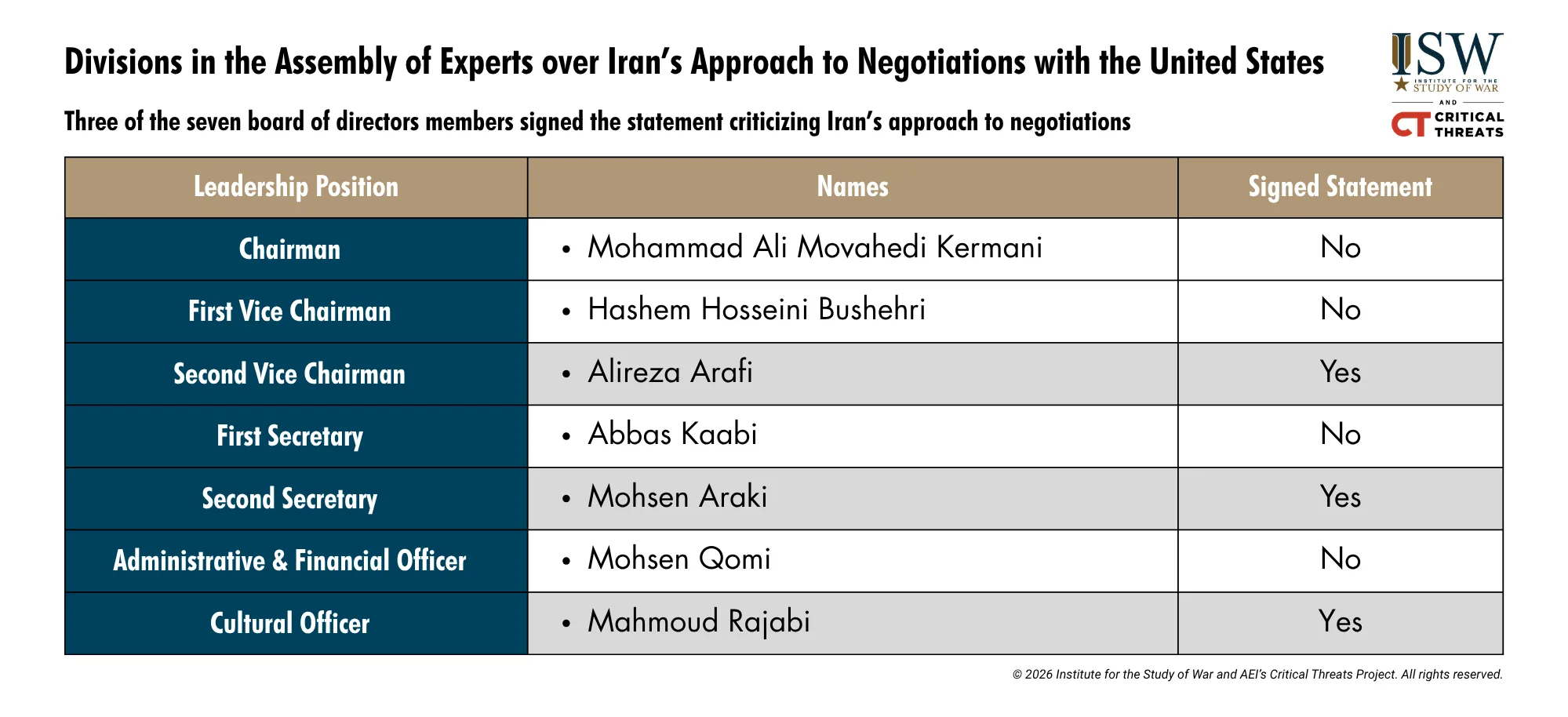
It remains unclear who pushed the group of Assembly members to issue the statement outside the Assembly's normal process. This incident is at least the second incident in recent months that has publicly revealed divisions within the Assembly of Experts. Mojtaba’s selection as Supreme Leader previously divided the Assembly's members, according to anti-regime and Western media. Anti-regime media reported in March that Islamic Revolutionary Guards Corps (IRGC) commanders heavily pressured Assembly of Experts members to appoint Mojtaba as Supreme Leader, but that some Assembly members refused to attend the vote in protest.[13] The New York Times similarly reported in March that IRGC Commander Major General Ahmad Vahidi and former IRGC Commander Major General Mohammad Ali Jafari pushed the Assembly of Experts to select Mojtaba as Supreme Leader after Ali Khamenei’s death.[14]
Iranian President Masoud Pezeshkian separately appears to be trying to build support for the MoU among senior clerics and defend the Iranian negotiating team. Pezeshkian met with several senior Shia clerics in Qom Province on June 28, likely to rally clerical support for the agreement, present the MoU as a source of economic relief, and insulate negotiators from criticism by hardline clerics.[15] Pezeshkian emphasized that the government expects the MoU to create economic openings, including via sanctions relief and the release of Iranian frozen assets.[16] Pezeshkian told Ayatollah Mousa Shobairy Zanjani that the agreement is a major victory, the United States has lifted oil and petrochemical sanctions, and Qatar will soon release $6 billion USD of Iran's $12 billion USD worth of assets currently frozen in Qatar.[17] Pezeshkian’s emphasis on economic relief suggests that he is trying to sell the MoU domestically as a tangible victory to ease public pressure and protect Iranian negotiating members from hardline criticisms, such as from members of the Assembly of Experts (see above).
Iranian officials and media are signaling that Iran will not allow Oman to constrain Iran's effort to establish control over the Strait of Hormuz. IRGC-affiliated Tasnim News Agency argued in an op-ed on June 29 that tying the future management of the strait to Omani consent would harm Iranian interests.[18] Tasnim argued that Oman can participate in and benefit from Iran's control over the strait but cannot determine whether Iran manages the waterway.[19] Tasnim added that the strait is an “existential” issue for Iran but only an “economic” issue for Oman and argued that Iran should not let the United Nations Convention on the Law of the Sea (UNCLOS) or Omani opposition return the strait back to its pre-war status.[20] UNCLOS does not permit states bordering international waterways to restrict transit passage or impose charges for transit.[21] Supreme Leader Adviser Ali Akbar Velayati similarly stated on June 29 that Iran has adopted a “new and decisive approach” to organizing traffic, managing traffic costs, and maintaining the strait, and called this issue strategic and non-negotiable.[22] Velayati also warned Oman against letting external pressure, including from the Gulf countries, damage its relationship with Iran.[23] These comments come as the Omani government has signaled its opposition to Iranian control of the strait, including via a joint Gulf Cooperation Council-US statement on June 25 that explicitly rejected any Iranian attempts to exert control over the strait.[24] The International Maritime Organization (IMO) and Oman also announced a joint effort on June 23 to move hundreds of stranded vessels through the strait through a designated safe route along the Omani coast but later paused this effort on June 26 after Iran attacked a Singapore-flagged cargo ship on June 25.[25] The IMO-Omani route undermines Iranian efforts to control the strait by offering an alternative route to Iran's illegitimate traffic separation scheme, which forces vessels into Iranian territorial waters. Omani Foreign Minister Badr al Busaidi additionally stated that Oman does not support transit fees for passage through the strait during an interview with French media on June 29.[26] Omani officials similarly told CNN on June 27 that Oman opposes “mandatory fees or tolls” in the strait.[27] Busaidi did not rule out “mechanisms related to maritime services,” such as “enhancing navigation safety,” and “combating pollution,” however.[28] Iranian media argued that Busaidi’s comment suggested that Oman would be open to charging fees for maritime services.[29] Iran has consistently sought to impose fees on vessels transiting through the strait as part of its effort to solidify control over the waterway.
An international media correspondent released on June 29 the reported text of the June 26 Israel-Lebanon-United States trilateral framework agreement's security annex, which stipulates the process by which the Lebanese Armed Forces (LAF) will backfill the Israel Defense Forces (IDF) in southern Lebanon.[30] The annex includes a four-stage mechanism for the LAF and IDF to dismantle non-state armed groups in designated “pilot zones” in southern Lebanon.[31] The annex's model for disarming non-state groups in pilot zones closely resembles a “clear-hold-build” counterinsurgency strategy. The agreement's security annex stipulates that security forces will take “legal measures” against armed non-state fighters and destroy all non-state groups’ infrastructure and weapons, which an unspecified third party will verify.[32] LAF units will then hold and establish control over the pilot zones, coinciding with IDF units’ phased withdrawal from the zones, to prevent non-state armed groups from reconstituting in those areas.[33] The Lebanese government will finally begin reconstruction efforts in these areas with international assistance and political oversight.[34] The annex also stipulates that Israel and Lebanon will establish a military deconfliction body to verify disarmament progress in southern Lebanon and operate as an indirect backchannel between the IDF and LAF.[35] It is unclear whether the IDF and LAF will share responsibility for initial clearing operations in the pilot zones.[36] The security annex also does not clarify whether Israel and Lebanon will establish additional pilot zones in the future. Israeli Defense Minister Israel Katz told Israeli journalists on June 29 that the IDF will not “retreat a single millimeter” further from Israeli-held territory in southern Lebanon, except for the two current pilot zones, until Hezbollah is disarmed.[37] An unspecified official separately told Israeli media on June 28 that the annex will enable the IDF to retain its “freedom of action” in Lebanon, although the reported text does not clarify whether the IDF may continue to target Hezbollah in areas where the LAF is operating.[38]
Hezbollah officials and media are attempting to delegitimize the trilateral framework agreement by accusing the Lebanese government of violating Lebanese law and public interests. Hezbollah-affiliated media argued on June 29 that the agreement is invalid because it allegedly violates Lebanese sovereignty, popular consent, and the Lebanese constitution due to the agreement being signed under Israeli military “duress.”[39] Hezbollah officials, including Secretary General Naim Qassem, have made similar statements in recent days, claiming that the agreement and ongoing Lebanese negotiations with Israel constitute acts of “high treason” and violate the constitution, the sensitive sectarian National Pact, and Lebanon's territorial integrity.[40]
Hezbollah is also likely attempting to mobilize non-Shia elements of the Lebanese public to oppose the framework agreement. Hezbollah-affiliated media published statements from Lebanese Sunni religious leaders that denounced the agreement and expressed support for Hezbollah on June 29.[41] Hezbollah may assess that platforming non-Shia opposition to the framework agreement strengthens the group's narrative that the Lebanese government is violating the interests of all Lebanese civilians, rather than exclusively Hezbollah's predominantly Shia support base.[42]
Hezbollah is pursuing multiple lines of effort to oppose the framework agreement and deter the Lebanese government from disarming Hezbollah. Senior Hezbollah officials are conducting an information operation to deter the Lebanese government from disarming Hezbollah by threatening renewed civil war in Lebanon.[43] Hezbollah Parliamentarian Hassan Fadlallah has repeatedly warned that Hezbollah will mobilize mass protests to stop the government from implementing the agreement, for example.[44] Other Hezbollah officials and allies, including Hezbollah Deputy Political Council leader Mahmoud Qamati and Lebanese Parliament Speaker Nabih Berri, have discouraged Hezbollah and Amal Movement supporters from organizing public demonstrations, however.[45] Hezbollah parliamentary bloc leader Mohammad Raad has also attempted to spread disinformation about the agreement's provisions and alleged on June 27 that the agreement is a “cover up” for a permanent Israeli military presence in Lebanon.[46]
The IDF and Hezbollah continued to engage each other on June 28 and 29 in southern Lebanon. The IDF reported that it destroyed a Hezbollah underground tunnel complex under Majdal Zoun, southern Lebanon, on June 28.[47] The IDF reported that the 200-meter-long and 25-meter-deep complex hosted four underground drone launchers and “hundreds” of Hezbollah weapons, including Iranian-produced drones and drone components.[48] Hezbollah fighters previously defended Majdal Zoun against advancing Israeli forces in early June using a variety of weapons, including anti-tank guided missiles (ATGM), improvised explosive devices (IED), mortars, rockets, and rocket-propelled grenades (RPG).[49]
The IDF also reported that it struck three Hezbollah headquarters on June 28 near Maifadoun and Nabatieh in southern Lebanon.[50] The IDF reported on June 29 that an explosion “seriously injured” an Israeli reserve soldier near Arnoun in Nabatieh Governorate, southern Lebanon.[51] The IDF stated that it is investigating the cause of the incident.[52]
US CENTCOM Commander Admiral Brad Cooper met with Lebanese President Joseph Aoun and Lebanese Armed Forces (LAF) Commander General Rodolphe Haykal in Beirut on June 29 to discuss preparations to implement the June 26 trilateral framework agreement.[53] Lebanese media reported that Cooper visited Lebanon to oversee the initial stages of the LAF’s deployment to the two “pilot zones” that Israel and Lebanon agreed on in the framework agreement.[54]
Iraqi authorities arrested around 50 people on June 28 as part of an Iraqi federal government anti-corruption campaign that is expected to last at least six months.[55] Iraqi Prime Minister Ali al Zaydi said during a cabinet meeting on June 28 that the arrests were the “first phase” of the Iraqi government's efforts to recover public funds.[56] An informed source told Iraqi media on June 28 that the current phase of the anti-corruption campaign is expected to last 72 hours.[57] Iraqi authorities, including the Counter Terrorism Service, arrested individuals in multiple areas of Baghdad as well as in Maysan, Babil, Diyala, and Salah al Din provinces and Iraqi Kurdistan.[58] Iraqi authorities closed the Green Zone, which houses the Iraqi parliament, the US Embassy, and several other government buildings, on June 28 to conduct arrests but reopened it on June 29.[59] Iraqi media reported that the arrested individuals include senior officials, political leaders, former and current government agents, company owners who launder funds to political leaders, brokers, and intermediaries.[60] The highest-profile arrested figure was Sunni Azm Alliance head Muthanna al Samarrai.[61] Central Anti-Corruption Criminal Court Judge Diaa Jaafar told Iraqi media that the Iraqi government's investigation of former Ministry of Oil Undersecretary for Refining Affairs Adnan al Jumaili implicated many parliamentarians whom Iraqi authorities arrested on June 28.[62] Iraqi authorities arrested Jumaili in May 2026 and have seized more than $74 million USD since his arrest, according to Iraq's Supreme Judicial Council.[63]
These arrests follow US pressure on the Iraqi federal government to dismantle Iranian-backed Iraqi militia-linked financial networks and combat corruption. The US Government has reportedly conditioned US financial support to Zaydi’s government on Zaydi’s progress in meeting these US demands.[64] The Iraqi federal government has taken initial steps to strengthen its anti-money laundering and counter-terrorist financing measures in recent weeks, including by replacing the Central Bank of Iraq governor with the head of the bank's anti-money laundering and counter-terrorist financing reform office and establishing a government oversight body.[65] Zaydi may have also facilitated these arrests to demonstrate his political prowess, given his lack of previous government experience before assuming the premiership, or to undermine his political opponents. A Shia parliamentarian and an Iraq analyst noted on June 28 and 29 that most of the individuals who were arrested are either Sunni or members of former Prime Minister Mohammad Shia al Sudani’s coalition.[66]
Iraqi Federal Government Spokesperson Haider al Aboudi announced on June 29 that Zaydi has set September 30 as the final deadline for Iraqi citizens and armed groups to surrender their weapons to Iraqi authorities.[67] Aboudi stated that any weapons not handed over to the state by this deadline will be considered “irregular weapons.”[68] Iranian-backed Iraqi militias, such as Harakat Hezbollah al Nujaba, have continuously asserted that the government's efforts to restrict arms to the state do not apply to the militias.[69] Zaydi said on June 24 that “resistance groups,” which refers to Iranian-backed Iraqi militias, will not need to remain armed after US-led international coalition forces leave Iraq at the end of September, however.[70] US-led international coalition forces left federal Iraq in January 2026 and are currently based in Iraqi Kurdistan.[71] Zaydi also said in an interview with regional media on June 29 that the Iraqi federal government will announce a “National Sovereignty Conference” by the end of the year to solidify the Iraqi state's exclusive right to use force.[72]
The Iraqi federal government's lack of accurate information on the number and types of weaponry in Iraq will make it difficult to determine the progress of the government's efforts to restrict arms to the state. The Interior Ministry (MoI) announced on April 20 that it had established 864 weapon registration offices across Iraq, and that more than 310,000 firearm registration applications have been submitted.[73] The MoI also announced that the National Arms Bank, which the Iraqi federal government reportedly created to track all government-owned weapons in December 2025, has received over 5.8 million firearms.[74] An unidentified senior Iraqi military official told al Araby al Jadeed on June 29 that the Iraqi federal government has not yet received any “advanced” weaponry, such as drones or long-range missiles, despite a government program to buy medium and heavy weapons from Iraqi citizens and armed groups.[75] Iran has provided its partners in Iraq with drones and missiles for years, which militias used to strike US and foreign targets in Iraq and the region during the recent war.[76] Iraqi media noted that the federal government lacks accurate information on the number, and likely the types, of weapons in the country. It is therefore difficult to determine what proportion of the total number of weapons in Iraq the MoI’s numbers represent.[77] The Iranian-backed Popular Mobilization Forces, which includes many Iranian-backed Iraqi militias, operate with limited government oversight, for example.[78] Many Iraqi militias, including Harakat Hezbollah al Nujaba, Kataib Sayyid al Shuhada, and Kataib Hezbollah, have also continuously refused to disarm.[79]
https://understandingwar.org/research/middle-east/iran-update-special-report-june-29-2026/
2,208
posted on
06/29/2026 10:33:32 PM PDT
by
AdmSmith
(GCTGATATGTCTATGATTACTCAT)
24JUN2026: The Terrifying Truth About What's Happening In Iran | Kasra Aarabi In this episode of The Brink, Andrew and Jake are joined by Iran expert Kasra Aarabi to examine the state of the Iranian regime after the recent conflict with Israel and the United States, and to ask whether the Islamic Republic is weaker than it appears. Drawing on sources inside Iran and years of research into the Islamic Revolutionary Guard Corps, Kasra explains the internal power struggles unfolding within the regime, the growing influence of younger and more radical elements of the IRGC, and why the battle for succession after Ayatollah Khamenei could reshape the future of the Islamic Republic.
The conversation explores the regime's ideology, its nuclear ambitions, and the role of the IRGC in projecting Iranian power across the Middle East. We discuss the recent negotiations with the Trump administration, the future of Hezbollah, and why Tehran believes time is on its side despite suffering significant military setbacks. Kasra also examines the relationship between Iran and regional actors such as Qatar, Pakistan, and Turkey, the wider geopolitical implications of the conflict, and the growing tensions between Washington, Jerusalem, and European capitals.
Finally, we turn to the Iranian people. Kasra explains why many Iranians continue to oppose the regime despite years of repression, why protest movements remain a serious threat to the Islamic Republic, and whether the current moment could mark the beginning of the end for one of the world's most entrenched authoritarian systems.
00:00 Introduction
03:42 Who Really Controls Iran Now?
08:30 The Islamic Republic Is A Mafia State
12:10 Purges Are Coming To Iran's Regime
14:43 Has The Regime Become More Extreme?
15:30 The Radicalisation Of The IRGC
20:35 The Rise Of Iran's Hardline Next Generation
21:54 Mahdism, Apocalypse & The IRGC Worldview
25:47 What Does Iran Actually Want From A Deal?
30:39 How Tehran Plans To Split Trump And Netanyahu
33:04 Iran's Nuclear Strategy: Delay, Delay, Delay
36:32 Why The Regime Fears Donald Trump
42:11 Does Iran Have Any Real Allies Left?
46:45 What Do Ordinary Iranians Think?
49:50 Why Many Iranians Still Trust Trump?
https://www.youtube.com/watch?v=khusaI_Vtlg
2,209
posted on
06/29/2026 10:56:20 PM PDT
by
AdmSmith
(GCTGATATGTCTATGATTACTCAT)
2,210
posted on
06/29/2026 11:37:56 PM PDT
by
AdmSmith
(GCTGATATGTCTATGATTACTCAT)
Told Reuters that Hezbollah’s dismantlement was something that would never happen and the deal in effect legitimised an open-ended Israeli military presence.
Nothing will happen. Israel won’t withdraw, and Hezbollah won’t dismantle. Israeli prime minister has no domestic political space to withdraw while Hezbollah is still armed and northern Israeli communities remain displaced.
A narrower pact focused on Hezbollah’s pullout from south of the Litani River, an expanded Lebanese army deployment and an extension of state authority, would have stood a better chance of success.
https://x.com/citrinowicz/status/2071718062387036343
Israel’s goal should not be to exploit the weakness of the Lebanese government. The more Israel acts in this way, the more it will reduce the chances of the Lebanese government acting against Hezbollah and even promoting its disarmament.
Israel should act to strengthen the Lebanese government, even if that means a more significant withdrawal from the security zone. However, as emerges from the leaks, it seems that the government’s real goal is to gain legitimacy for the continued presence of IDF forces in the security zone. The implication is preserving friction with Hezbollah, instead of creating conditions that would allow the Lebanese government to strengthen its control over the south of the country.
https://x.com/citrinowicz/status/2071549750344659273
2,211
posted on
06/29/2026 11:43:11 PM PDT
by
AdmSmith
(GCTGATATGTCTATGATTACTCAT)
Sal Mercogliano- What's Going on With Shipping? 29 Jun 2026: Shipping Rackets and Sea Mines: The New Normal in Hormuz after 17 Weeks
In this episode of What's Going no With Shipping?, we hit week 17 of the ongoing crisis in the Strait of Hormuz. Despite talk of ceasefires and memorandums of understanding, the reality on the water remains volatile. We dive into the latest vessel attacks, the surge in Iranian oil exports, and the growing complexity of navigating these vital shipping lanes. From the “racket” of new transit fees to the threat of 80+ sea mines, we break down why a return to “normal” is still far on the horizon.
Key Highlights
⚓Fragile Ceasefire: Recent attacks on the container ship Ever Lovely and the tanker Kiki highlight the instability of the current US-Iran pause in strikes.
⚓Iranian Oil Surge: Following a US Treasury waiver, unsanctioned Iranian crude is flowing freely even as other shipping faces continued disruption.
⚓Transit “Rackets”: Discussion on the new Persian Gulf Strait Authority (PGSA) and potential coordination between Iran and Oman to impose new fees and insurance requirements.
⚓The Mine Threat: The IMO estimates at least 80 mines are currently in Hormuz shipping lanes, complicating the return of commercial traffic to the central corridor.
⚓Escalating Costs: Cargo rates for tankers in the region have spiked significantly, with some benchmarks reaching nearly nine times their normal value.
https://www.youtube.com/watch?v=r0EvQgLcjMw
2,212
posted on
06/30/2026 4:02:43 AM PDT
by
AdmSmith
(GCTGATATGTCTATGATTACTCAT)
Iran Update Special Report, June 30, 2026
Iranian officials are simultaneously employing diplomatic outreach and military coercion to pressure regional states to support a new “regional security mechanism,” likely to advance Iran's long-standing objective of expelling the United States from the Middle East. Iran has long sought to convince Gulf and other regional states to remove US military forces from their territory by claiming that the presence of US forces in their territory threatens their security.[1] Iran intensified this campaign during and after the recent US-Israel-Iran war. Iranian officials have repeatedly framed regional security as the responsibility of regional states rather than external powers, referring to the United States. Iranian Foreign Affairs Minister Abbas Araghchi emphasized the importance of establishing a regional security framework led by regional countries instead of foreign powers during a meeting with Iraqi National Security Adviser Qassem al Aboudi on June 28.[2] Araghchi also emphasized Iran's willingness to cooperate with Gulf states to establish such a mechanism.[3] Acting Iranian Defense and Armed Forces Logistics Minister Seyed Majid Ibn al Reza similarly called Gulf security an “endogenous matter” that regional states should manage themselves during a phone call with Qatari Deputy Prime Minister Saoud bin Abdulrahman al Thani on June 30.[4] Iran is likely using this proposed regional security mechanism to encourage Gulf states to distance themselves from the United States in exchange for cooperation with Iran. Iran may be offering economic cooperation, guarantees against Iranian attacks, and access to the Strait of Hormuz in exchange for Gulf support for key Iranian demands, including the removal of US forces from the region and recognition of Iran's control over the strait. Iran's use of the strait as a bargaining tool further corroborates ISW-CTP’s ongoing assessment that Iran views control over the Strait of Hormuz as leverage it can use to extract concessions from other states. Iran has reinforced these diplomatic efforts with military threats and attacks on the Gulf states. Iran's recent strikes against Bahrain and Kuwait may have sought, at least in part, to signal to the Gulf states that Iran may respond with force to Gulf opposition to Iranian control over the strait.[5] Iran also likely conducted these attacks to try to frame the United States as an unreliable security guarantor as part of its broader campaign to drive a wedge between the United States and its Gulf partners.
Iranian officials continue to signal that Iran intends to maintain long-term control over the Strait of Hormuz despite apparent resistance from Gulf states. Iranian officials have repeatedly described the strait as a strategic tool.[6] The US-Iran memorandum of understanding's (MoU) fifth clause states that Iran will work with Oman to “define the future administration and maritime services in the Strait of Hormuz” in consultation with other Persian Gulf littoral states.[7] Iranian officials have emphasized that Oman and other Gulf states cannot prevent Iran from asserting control over the strait, however.[8] Iranian Deputy Foreign Affairs Minister for Legal and International Affairs Kazem Gharibabadi stated on June 29 that Iran would implement its “sovereignty and new policy” in the strait even if Iran and Oman failed to reach an agreement on the waterway's future management.[9] Armed Forces General Staff-run outlet Defa Press similarly argued on June 30 that the strait is a “completely internal” matter that should not depend on the positions of regional states, including Oman.[10] These statements come amid Gulf opposition to Iranian control over the strait, including the publication of a Gulf Cooperation Council-US statement on June 25 that explicitly rejected any Iranian attempts to exert control over the strait.[11]
Iran and Oman appear to have at least some disagreements over the strait's management, but any arrangement, regardless of fees, that recognizes Iranian control over the strait would be extremely problematic to US and Gulf interests as well as global commerce. An Iranian official and an unspecified regional diplomat told the New York Times on June 30 that Oman recently presented the United States with a proposal under which shipping companies would pay service fees to transit through the strait.[12] The regional diplomat stated that the fees would be voluntary, but the Iranian official claimed they would be mandatory, which suggests that Iran and Oman disagree on this issue.[13] Iran has repeatedly signaled its intent to impose transit fees as part of its broader effort to consolidate control over the waterway.[14] Omani Foreign Minister Badr al Busaidi stated on June 29 that Oman does not support transit fees but did not rule out “mechanisms related to maritime services,” such as “enhancing navigation safety,” and “combating pollution.”[15] Iran would likely attempt to assert sovereignty over the strait regardless of whether service fees for vessels were voluntary or mandatory. Iran could reward compliant shipping companies under a voluntary fee system by granting them priority transit through the strait. A senior Iranian official told CNN on April 18 that vessels that pay “security fees” and comply with Islamic Revolutionary Guards Corps (IRGC) protocols would receive priority transit through the Strait of Hormuz, while vessels that refused would face delays, for example.[16] Recognition of Iran's authority over the strait, regardless of fees or not, would preserve Iran's ability to selectively restrict maritime traffic and disrupt international markets whenever it serves Iranian interests.
US-Iran Negotiations
Iran announced that it will send a delegation to Doha, Qatar, on July 1 to discuss the implementation of the US-Iran MoU, but Iran continues to reject direct talks with the US delegation in Qatar and any discussion of its nuclear program.[17] A senior Qatari official said that US Special Envoy to the Middle East Steve Witkoff and Jared Kushner met with Qatari officials in Doha on June 30 but added that there are currently no high-level US-Iran meetings scheduled.[18] Iranian Foreign Affairs Ministry Spokesperson Esmail Baghaei stated on June 30 that the Iranian delegation will not meet with US officials but will meet with Qatari officials in Doha to discuss MoU clauses, including the release of frozen Iranian assets.[19] ISW-CTP continues to assess that Iran will likely use these talks to try to secure the implementation of provisions in the MoU that help advance Iranian objectives, including the provision about the release of Iranian frozen assets.[20] Iran has insisted on the United States releasing Iran's frozen assets and implementing other provisions in the MoU before Iran agrees to discuss nuclear issues. Iranian officials, including Supreme Leader Mojtaba Khamenei, have not signaled any willingness to meet key US demands on Iran's nuclear program, which include addressing the status of Iran's highly enriched uranium stockpile and ability to enrich uranium on Iranian soil.[21]
ISW-CTP has observed a slight increase in Kurdish anti-regime activity along Iran's northwestern border. It is possible that this activity is a response to Iranian internal security operations. Regime media reported on June 26 that an unspecified number of unidentified fighters killed two Iranian Law Enforcement Command (LEC) officers and injured two others in Baneh, Kurdistan Province.[22] Regime media also reported on June 30 that “terrorists” killed two Iranian security personnel in Paveh, Kermanshah Province, on June 29.[23] A Norway-based human rights organization claimed that a newly formed armed group called “Xori Hiwa,” or Sun of Hope, claimed the attack in Paveh and that the group targeted IRGC personnel responsible for suppressing protests during the 2022-2023 Mahsa Amini protest wave.[24] Regime media separately reported on June 30 that the Kurdistan Free Life Party (PJAK) claimed that it killed four IRGC Ground Forces Hamzeh Seyyed ol Shohada Operational Base personnel in the vicinity of Mahabad and Piranshahr, West Azerbaijan Province.[25] This recent uptick in attacks could be a response to regime efforts to enhance internal security on Iran's northwestern border. The regime has historically accused Kurdish armed groups of inciting anti-regime unrest in Iran. Armed Forces General Staff (AFGS)-run media reported on June 20 that the regime is closely monitoring fighters in Kurdistan, West Azerbaijan, and Kermanshah provinces and has replaced “purely defensive reactions” with an “active deterrence” doctrine.[26]
US Central Command (CENTCOM) will reportedly deploy ground forces to Israel and Lebanon to monitor compliance with the Trilateral Framework Agreement.[27] CENTCOM’s on-the-ground presence would likely enable the United States to more quickly identify and address potential Israeli or Hezbollah ceasefire violations and thereby limit Iran's potential advantage in the recently established “deconfliction cell.” A US official told the Washington Post on June 29 that the United States will deploy ground forces to both Lebanon and Israel to monitor the implementation of the Trilateral Framework Agreement.[28] The official stated that the presence of US forces on the ground will enable US political leadership to engage with Lebanon and Israel and pressure both sides to uphold the agreement.[29] The official did not specify the scale or specific locations or timeframe of US deployments to Israel and Lebanon, however. ISW-CTP previously assessed that Iran would have an advantage in CENTCOM’s proposed “deconfliction cell” because the IRGC’s on-the-ground presence in Lebanon would enable Iran to more readily identify and report alleged ceasefire violations to the “deconfliction cell” and influence the narrative about those violations.[30] Israel is notably not part of the “deconfliction cell” and therefore would have to report ceasefire violations through the United States.[31] CENTCOM’s reported ground forces deployment to monitor the Trilateral Framework Agreement, if implemented, would likely reduce Iran's advantage in the “deconfliction cell.” The presence of US military forces in Lebanon and Israel would almost certainly reduce the time it would take for US policymakers to receive tactical monitoring information and limit Iran's current on-the-ground advantage.[32] CENTCOM representatives would also presumably be able to investigate and verify ceasefire violations with both the Israel Defense Forces (IDF) and Lebanese Armed Forces, which would reduce Iran's ability to influence the narrative over incidents in the “deconfliction cell.”[33]
The IDF continued to strike and engage Hezbollah fighters in southern Lebanon on June 29 and 30. Lebanese media reported that the IDF conducted two airstrikes on June 29 targeting likely Hezbollah positions near Qantara and Deir Seryan, Marjaayoun District.[34] Lebanese media reported that the IDF later struck another site near Touline, Marjaayoun District, on June 30.[35] Hezbollah fighters previously killed an IDF officer and wounded a soldier during a small arms engagement in Deir Seryan on June 28.[36] Israeli Prime Minister Benjamin Netanyahu reiterated on June 30 that Israeli forces will not withdraw from southern Lebanon until Hezbollah disarms.[37] Netanyahu also called on the IDF to act against Hezbollah threats in southern Lebanon.[38]
https://understandingwar.org/research/middle-east/iran-update-special-report-june-30-2026/
2,213
posted on
07/01/2026 4:46:16 AM PDT
by
AdmSmith
(GCTGATATGTCTATGATTACTCAT)
Iran Update Special Report, July 1, 2026
Iran is pushing the United States to unfreeze a significant amount of Iranian financial assets and acknowledge Iranian control of the Strait of Hormuz as part of the United States-Iran memorandum of understanding (MoU). Doing so would leave Iran in a significantly stronger strategic position and could support its military reconstitution efforts. Iranian officials told Reuters that the Iranian delegation's talks with Qatari officials in Doha on July 1 would focus on unfreezing $6 billion worth of Iranian financial assets and obtaining US recognition of Iranian sovereignty over the Strait of Hormuz.[1] The Iranian-Qatari meetings followed Qatari officials’ meetings with US Special Envoy to the Middle East Steve Witkoff and Jared Kushner in Doha on June 30 to establish the US negotiating position.[2] Iranian Deputy Foreign Affairs Minister for Legal and International Affairs Kazem Gharibabadi confirmed on July 1 that the talks in Doha aimed to accelerate the implementation of the ceasefire in Lebanon, lift the US blockade on Iran, and release Iranian frozen assets.[3] Gharibabadi noted that the United States and Iran have formed specialized working groups to monitor the MoU implementation but that these working groups have not yet started talks.[4] Gharibabadi later claimed that Iranian and Qatari officials reached an agreement to unfreeze 6 billion US dollars’ worth of Iranian financial assets to purchase and provide goods needed by Iran.[5] US and Qatari officials have yet to confirm Gharibabadi’s specific claim, but a US official denied that the United States had agreed to unfreeze Iranian funds to Israeli media on July 1.[6] US Vice President JD Vance stated on June 22 that Iran would use unfrozen assets to purchase US agricultural products, following quadrilateral Iran-US-Qatar-Pakistan talks in Switzerland on June 21.[7] Iranian media subsequently denied that Iran agreed to purchase US agricultural products, however.[8] A US official told Axios on July 1 that Witkoff and Kushner attempted to convince the Iranian side that their demand for tolls in the strait could disrupt the whole MoU and that a diplomatic agreement would financially benefit Iran more than collecting tolls.[9] The US official did not comment on recognizing Iran's claims of sovereignty over the strait. Iranian Parliament Speaker and Iran's negotiating delegation head Mohammad Bagher Ghalibaf highlighted how Iran intended to voice its concerns over the United States’ implementation of the MoU, including the demands for the US to fulfill Iran's stipulations, at the Doha talks in an interview on June 30.[10] Ghalibaf also said that Iran did not plan to conduct actual negotiations in Doha.[11]
Ghalibaf’s June 30 interview appears to be part of an effort to build intra-regime support for the MoU amid domestic backlash from the anti-negotiation camp. Ghalibaf argued that Iran will continue to collect fees from vessels transiting the Strait of Hormuz, implicitly arguing that the MoU supports Iranian claims of sovereignty over the strait.[12] Ghalibaf claimed that the MoU stipulates that Iran will retrieve half of its 24 billion US dollars’ worth of frozen financial assets and that the Iranian Central Bank will use these funds “to purchase any goods it needs, at any price, and in any currency in the world.”[13] Islamic Revolutionary Guards Corps (IRGC) Commander Major General Ahmad Vahidi, who likely wields dominant influence over Iranian decision-making at the moment, has considered using the funds for military spending, according to mediators speaking to the New York Times on June 13.[14] Ghalibaf underlined in the interview the economic benefits of the MoU so far, including the lifting of the US naval blockade, which has allowed Iran to export over 40 million barrels of oil at a price 20 percent higher than before the war.[15]
The Pezeshkian administration has likewise tried to present Iranian leadership as unified in support of the MoU. Iranian President Masoud Pezeshkian emphasized that his administration has followed Supreme Leader Mojtaba Khamenei’s guidance and is aligned with the Iranian armed forces, implicitly referring to the IRGC and Vahidi, in a meeting with the Islamic Propaganda Coordination Council on July 1.[16] Vice President for Executive Affairs Mohammad Jafar Ghaem Panah, an adviser to Pezeshkian, separately published the names of 11 of the 12 Supreme National Security Council members who voted for the MoU on June 30, which included ultra-hardline political leader Saeed Jalili.[17] Ghaem Panah likely published this list to appeal to the ultra-hardline camp, which has been the most critical of negotiations so far.[18] Hardline regime elements still appear concerned that the negotiating delegation may cross Supreme Leader Mojtaba’s red lines, however. Sixty of 88 Assembly of Experts members, responsible for appointing and supervising the Supreme Leader, went so far as to issue a warning to negotiators not to violate Mojtaba’s “red lines,” in a 10-point statement on June 28.[19]
Iranian officials are openly discussing expanding their missile ranges beyond the long-held 2,000-kilometer limit. A senior political adviser to former Supreme Leader Ali Khamenei, Brigadier General Rasoul Sanaei Rad, said on July 1 that Ali Khamenei had previously issued “phased” guidance to increase missile range and then improve missile accuracy.[20] An Iranian Parliamentary National Security and Foreign Policy Committee member similarly said in October 2025 that Ali Khamenei had lifted all restrictions on Iran's missile ranges and that Iran would expand its missile program “wherever it sees fit.”[21] Iran's known longest-range missiles are the Emad, Sejjil, and Shahab-3, which all have a reported range of 2,000 kilometers.[22] Iran may seek to develop missiles that can reach more distant US positions after its failed attempt to strike a US military base in Diego Garcia. Iran fired two ballistic missiles targeting the base in March 2026, which is located approximately 3,700 kilometers from Iran's southern border.[23] The attack marked the furthest-ever attempted Iranian missile strike, but one of the missiles failed in flight, and US forces intercepted the other.[24] Eighty-five Iranian parliamentarians also implicitly called for the development of intercontinental ballistic missile capabilities in a letter to Supreme Leader Mojtaba Khamenei on May 31.[25] The parliamentarians stated that Parliament will support Iran's military forces and defense industry until Iranian missiles can reach the United States.[26]
The Israel Defense Forces (IDF) has reportedly postponed its withdrawal from “pilot zones” in southern Lebanon until the IDF and Lebanese Armed Forces (LAF) establish a coordination mechanism and the LAF initiates efforts to disarm Hezbollah in the pilot zones, as required under the Trilateral Framework Agreement's Security Annex.[27] Israeli media reported on June 29 that the IDF has postponed its withdrawal from the two pilot zones, surrounding Zawtar el Gharbiyeh, Nabatieh District, and territory surrounding Ghandouriyeh and Froun, Bint Jbeil District, until a “joint monitoring mechanism” is established between the IDF and LAF.[28] Israel and Lebanon agreed on June 26 in the Trilateral Framework Agreement's Security Annex to a four-stage mechanism for the IDF and LAF to dismantle non-state armed groups in designated pilot zones in southern Lebanon.[29] The Annex's model for disarming non-state groups in pilot zones closely resembles a “clear-hold-build” counterinsurgency strategy.[30] The Annex stipulates that Israel and Lebanon will establish the Military Coordination Group for Lebanon (MCG4L) to verify disarmament progress in southern Lebanon and operate as an indirect backchannel between the IDF and LAF.[31] Israeli sources said that the United States will vet the LAF soldiers who will participate in the MCG4L to ensure that Hezbollah does not receive sensitive information and that the MCG4L will operate as a “virtual [IDF-LAF] command center.”[32] Israeli security sources told Israeli media that there is currently no timetable for IDF withdrawal from the pilot zones and that the withdrawal “must be carried out properly.”[33] Israeli officials have repeatedly emphasized in recent days that the IDF will remain deployed to its security zone in southern Lebanon until Hezbollah is disarmed and no longer poses a threat to Israel.[34]
Unspecified Iraqi Shia Coordination Framework leaders refused Iraqi Prime Minister Ali al Zaydi’s request to arrest senior Iranian-backed Iraqi militia leaders as part of his recently launched anti-corruption campaign, according to Qatari media on July 1.[35] An unspecified source claimed that several framework leaders fear “security tensions” if the Iraqi federal government arrests senior militia leaders.[36] This report comes as Iraqi media reported on July 1 that the Iraqi government has not arrested any Iranian-backed Iraqi militia-affiliated figures despite their known ties to corrupt officials.[37] Iraqi authorities reportedly issued an arrest warrant for a prominent unspecified militia-affiliated official, however.[38] Iraqi Kurdish and Saudi media reported on June 30 that Hussein Moanes, a member of Iranian-backed Iraqi militia Kataib Hezbollah's political wing, fled Iraq to an unknown country.[39] Zaydi’s anti-corruption campaign follows US pressure on Baghdad to dismantle Iranian-backed Iraqi militia-linked financial networks and combat corruption.[40]
https://understandingwar.org/research/middle-east/iran-update-special-report-july-1-2026/
2,214
posted on
07/02/2026 12:17:35 AM PDT
by
AdmSmith
(GCTGATATGTCTATGATTACTCAT)
To: nuconvert
Iraq Anti Corruption Raid Sparks Shock After Massive Seizure 🇮🇶
Reports from Iraq say an anti corruption operation uncovered $57 million in cash, 27 kilograms of gold, and luxury items including gold underwear at the home of MP Hind al-Abbasi. Local media also reported dozens of detentions involving officials and bureaucrats as the investigation expands.
The reported details have drawn huge attention online because of their scale, though some of the more sensational claims are still being circulated mainly through regional media and have not yet been fully detailed in official public statements.

https://x.com/finance_streets/status/2072005073815622139
2,215
posted on
07/02/2026 12:19:31 AM PDT
by
AdmSmith
(GCTGATATGTCTATGATTACTCAT)
Mixed estimates of the amount of money recovered from corruption between hundreds of millions and billions of dollars
The government is moving to deposit the recovered funds from corruption files in a special account supervised by the Ministry of Finance, in preparation for using them to support public spending and finance service and investment priorities, while the final estimates of the size of these funds are still undecided. The Prime Minister’s Financial Advisor, Mazhar Mohamed Saleh, said in an interview with Al-Mada that the recovery of funds related to corruption files will be reflected on the public budget through two tracks: the first is the introduction of cash revenues to the budget within the other revenues section, and the second is to stop the bleeding of corruption and reduce the cost of public spending, which gives the public finances a dual effect represented by new flows and cutting waste.
For his part, economic affairs specialist Haider al-Sheikh told Al-Mada that the prime minister has directed the Minister of Finance to open a special account to deposit the money recovered from those accused of corruption and manipulators of public funds. He predicted that the recovered cash will exceed $500 million, and will reach a value of about $1 billion after the confiscation of movable and immovable assets, real estate and property.
He stressed that the recovered funds, even if they reach $1 billion, will not be enough to address the fiscal deficit, because Iraq needs about $50 billion to fill the budget deficit, while the government needs about 8 trillion dinars a month to secure the salaries of public sector workers.
https://almadapaper.net/441685/
2,216
posted on
07/02/2026 12:23:08 AM PDT
by
AdmSmith
(GCTGATATGTCTATGATTACTCAT)
Iran Update Special Report, July 2, 2026
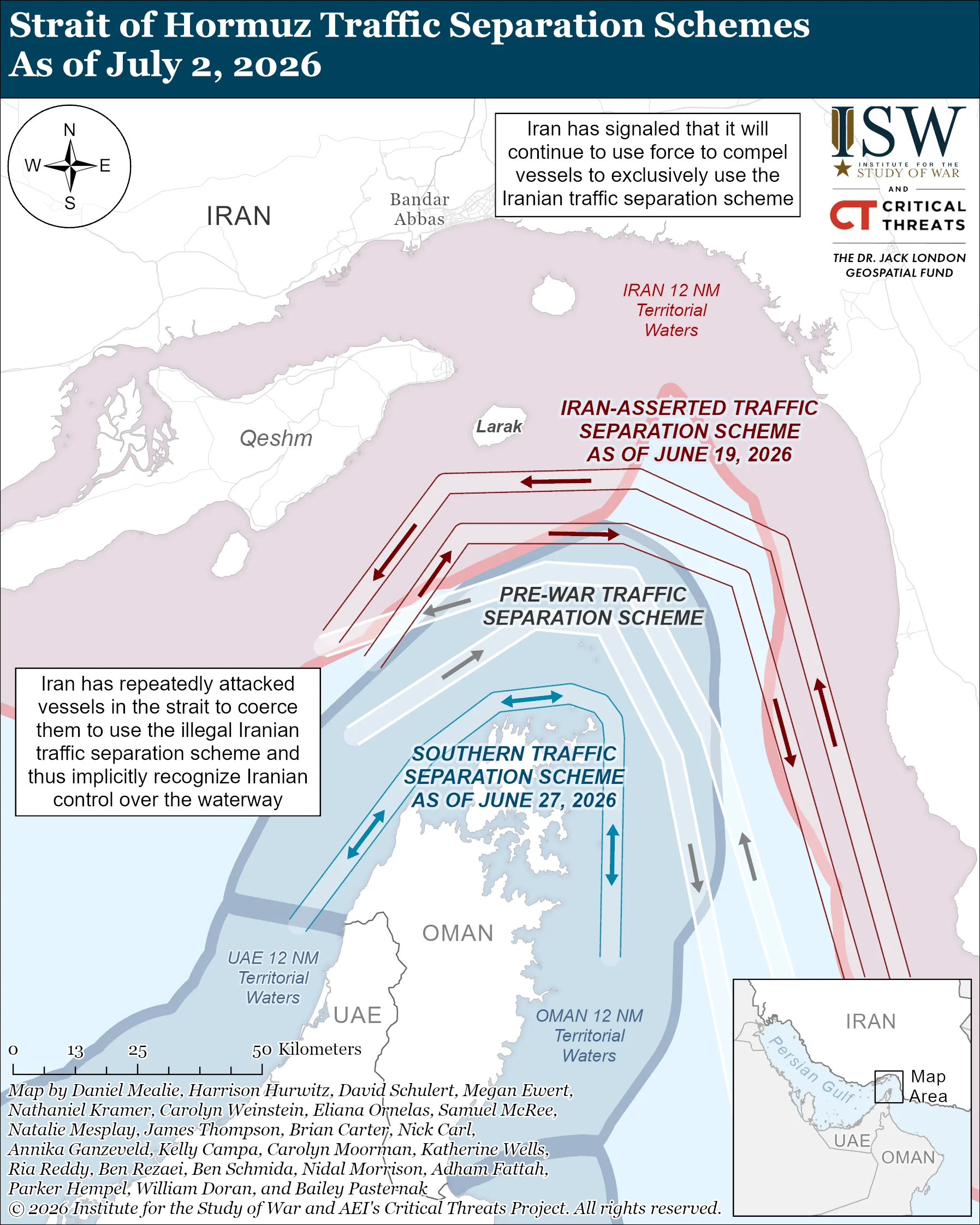
Iran has signaled that it will continue to use force to compel vessels to exclusively use the Iranian traffic separation scheme in the Strait of Hormuz as part of the broader Iranian effort to assert its claimed control of the strait. Iran's top operational military headquarters, the Khatam ol Anbia Central Headquarters, warned on July 2 that Iran will deliver a “decisive and swift” response to any US interference in Iranian efforts to manage the strait.[1] The statement added that all oil tankers and commercial vessels must use the Iranian-designated route for safe passage and warned that the armed forces will respond to any vessel that uses an alternative route.[2] Iran has repeatedly attacked vessels in the strait to coerce them to use the illegal Iranian traffic separation scheme and thus implicitly recognize Iranian control over the waterway.[3] Iranian Deputy Foreign Affairs Minister for Legal and International Affairs Kazem Gharibabadi said on July 2 that the strait is under Iranian control, not that of US Central Command (CENTCOM), after CENTCOM hosted a regional security meeting in Bahrain with military commanders from Gulf and other regional states.[4] The meeting in Bahrain comes amid Gulf opposition to Iranian control over the strait.[5] Iran is meanwhile conducting a concerted diplomatic and military effort in response to the apparent resistance from Gulf countries to try to deter any international efforts to restore maritime traffic outside Iranian control.[6] Iran recently attacked commercial vessels in the strait after the International Maritime Organization (IMO) and Oman announced a new route on June 23 to move hundreds of stranded vessels through the strait through a designated safe route along the Omani coast, for example.[7]
Iranian forces may have launched an effort against Kurdish militancy around the Iran-Iraq border. Iranian forces conducted missile and drone attacks targeting Kurdish militias around Erbil and Sulaymaniyah in Iraqi Kurdistan on July 2.[8] The Islamic Revolutionary Guards Corps (IRGC) Ground Forces Hamzeh Seyyed ol Shohada Operational Base separately announced on July 2 that it ambushed a Democratic Party of Iranian Kurdistan (PDKI)-affiliated cell that entered Iran through the northwestern border and killed five of its members near Piranshahr, West Azerbaijan Province.[9] The IRGC claimed that the group carried improvised explosive devices.[10] Kurdistan Free Life Party (PJAK) separately confirmed on June 30 that the IRGC killed four of its members during clashes with IRGC Ground Forces Hamzeh Seyyed ol Shohada Operational Base personnel near Mahabad and Piranshahr in West Azerbaijan Province.[11] Unspecified armed individuals separately killed two IRGC personnel and injured two others in Paveh, Kermanshah Province, on June 30.[12] These operations come after Armed Forces General Staff-run outlet Defa Press stated on June 20 that the regime is closely monitoring fighters in Kurdistan, West Azerbaijan, and Kermanshah provinces and has replaced “purely defensive reactions” with an “active deterrence” doctrine.[13]
A group of Iranian parliamentarians, largely comprised of individuals aligned with the ultra-hardline Paydari (Stability) Front, released a statement endorsing a different statement from some Assembly of Experts members that implicitly criticized the US-Iran memorandum of understanding (MoU) and US-Iran negotiations.[14] Iranian media reported on July 2 that a group of at least 84 parliamentarians issued a statement endorsing the recent statement by some Assembly of Experts members on June 28.[15] Sixty Assembly members issued a 10-point statement on June 28 in which they warned negotiators not to violate Supreme Leader Mojtaba Khamenei’s red lines.[16] The Assembly of Experts Secretariat later clarified that the June 28 statement did not represent the Assembly's official position.[17] The statement from the parliamentarians echoes the Assembly members’ hardline demands, which include solidifying Iranian control over the Strait of Hormuz, securing frozen assets and sanctions relief, forcing a US withdrawal from the region, and not discussing Iran's nuclear program in talks with the United States.[18] The Assembly of Experts and parliamentarians’ statement reflects ongoing divisions within the regime between pro-negotiation factions that appear more willing to preserve negotiations and the MoU and anti-negotiation factions who continue to push maximalist and uncompromising positions.
The Israel Defense Forces (IDF) has reportedly improved its ability to detect hostile first-person view (FPV) drones in northern Israel and southern Lebanon.[19] An unnamed senior IDF official told Israeli media on July 2 that IDF advancements in radar, artificial intelligence, and communication links to warning systems have reduced vulnerability to FPV drone attacks in southern Lebanon by 10 percent.[20] It is unclear how the official defines vulnerability to FPV drones, however. The official also said that drone warnings reach Israeli forces in southern Lebanon “within a few seconds,” giving soldiers more time to find cover or attempt to neutralize the drone.[21] The IDF reportedly began examining FPV drone countermeasures for its forces in southern Lebanon in April 2026.[22] Hezbollah has conducted increasingly sophisticated FPV drone attacks on Israeli forces in northern Israel and southern Lebanon since March 2026, including “swarm” attacks and nighttime attacks with FPV drones equipped with thermal cameras.[23]
The IDF continued to strike Hezbollah fighters and clear Hezbollah infrastructure in southern Lebanon on July 2. The IDF reported on July 2 that its forces killed a Hezbollah fighter who emerged from an underground facility near Ali al Taher, Nabatieh Governorate.[24] The IDF reported on June 26 that its forces took “complete control” of Ali al Taher, which reportedly hosts one of Hezbollah's largest underground command-and-control facilities.[25] Approximately 30 Hezbollah fighters remain in the facility, according to Israeli media.[26] Lebanese media reported on July 2 that the IDF conducted a one-way attack drone strike near Yater, Nabatieh Governate.[27] The IDF also reported on July 2 that it recently seized two Hezbollah weapons caches in Nabatieh Governate that contained rockets, mortars, improvised explosive devices, and other weapons.[28]
The United States has resumed some dollar shipments to Iraq, according to Iraqi federal government spokesperson Haider al Aboudi and a financial adviser to Iraqi Prime Minister Ali al Zaydi speaking to the New York Times.[29] Qatari media previously reported on June 17 that the United States recently delivered two shipments of US dollars to the Iraqi Central Bank, which coincided with US Special Envoy Tom Barrack's visit to Baghdad.[30] The US dollar shipments were the first sent to Iraq since the US Treasury Department halted such shipments in April 2026 due to concerns about Iranian-backed Iraqi militia attacks during the war.[31] The Iraqi Central Bank has managed an account at the New York Federal Reserve that has held the Iraqi government's oil export revenue in US dollars since 2003.[32] The resumption of US dollar shipments comes after Zaydi launched an anti-corruption campaign on June 28 targeting dozens of senior Iraqi officials following US pressure on the Iraqi government to disarm Iranian-backed Iraqi militias, dismantle their financial networks, and combat corruption.[33] The United States reportedly conditioned economic support, likely including dollar shipments, for Zaydi’s government on the Iraqi government's ability to meet US demands.[34]
An unnamed Iraqi official told the New York Times that the United States has not resumed its funding for Iraqi security services, however.[35] The United States suspended its funding for some counterterrorism and Iraqi Security Forces (ISF) training programs in April 2026 to pressure the Iraqi federal government to “dismantle” the militias.[36]
https://understandingwar.org/research/middle-east/iran-update-special-report-july-2-2026/
2,217
posted on
07/03/2026 3:10:25 AM PDT
by
AdmSmith
(GCTGATATGTCTATGATTACTCAT)
To: nuconvert
Mohammad Bagher Ghalibaf, the Speaker of Parliament, stated during a meeting with Khalil Hamdan, a senior member of Hezbollah in Lebanon, at the ceremony marking the start of the burial of Ali Khamenei and his family members that one of the most important concerns of the Islamic Republic in the agreement with America was the resistance front, particularly Lebanon.
He added that, due to the insistence of the Islamic Republic, clauses related to Lebanon were included in this agreement. Ghalibaf also said: The “blood vengeance” for Ali Khamenei is “freeing all Muslims from the oppression and tyranny of America and Israel.”
https://x.com/IranIntl/status/2072974446818697530
2,218
posted on
07/03/2026 3:13:59 AM PDT
by
AdmSmith
(GCTGATATGTCTATGATTACTCAT)
🚨🇮🇷 Iranian media has published photos of Revolutionary Guards Commander
Ahmad Vahidi in Tehran standing before the body of the late Supreme Leader Ali Khamenei.
This marks Vahidi’s first public appearance since Operation “Lion's Roar” began in February. Currently serving as Deputy Chief of Staff of the Armed Forces, the former Minister of Defense is subject to an Interpol Red Notice for his role in the 1994 AMIA bombing in Buenos Aires, which killed 85 people and injured over 300.

https://x.com/c14english/status/2072979815271928105
2,219
posted on
07/03/2026 3:30:14 AM PDT
by
AdmSmith
(GCTGATATGTCTATGATTACTCAT)
2,220
posted on
07/03/2026 3:55:55 AM PDT
by
AdmSmith
(GCTGATATGTCTATGATTACTCAT)
Navigation: use the links below to view more comments.
first previous 1-20 ... 2,181-2,200, 2,201-2,220, 2,221-2,240 ... 2,401-2,405 next last
Disclaimer:
Opinions posted on Free Republic are those of the individual
posters and do not necessarily represent the opinion of Free Republic or its
management. All materials posted herein are protected by copyright law and the
exemption for fair use of copyrighted works.
FreeRepublic.com is powered by software copyright 2000-2008 John Robinson