Iran Update Special Report, July 1, 2026
Iran is pushing the United States to unfreeze a significant amount of Iranian financial assets and acknowledge Iranian control of the Strait of Hormuz as part of the United States-Iran memorandum of understanding (MoU). Doing so would leave Iran in a significantly stronger strategic position and could support its military reconstitution efforts. Iranian officials told Reuters that the Iranian delegation's talks with Qatari officials in Doha on July 1 would focus on unfreezing $6 billion worth of Iranian financial assets and obtaining US recognition of Iranian sovereignty over the Strait of Hormuz.[1] The Iranian-Qatari meetings followed Qatari officials’ meetings with US Special Envoy to the Middle East Steve Witkoff and Jared Kushner in Doha on June 30 to establish the US negotiating position.[2] Iranian Deputy Foreign Affairs Minister for Legal and International Affairs Kazem Gharibabadi confirmed on July 1 that the talks in Doha aimed to accelerate the implementation of the ceasefire in Lebanon, lift the US blockade on Iran, and release Iranian frozen assets.[3] Gharibabadi noted that the United States and Iran have formed specialized working groups to monitor the MoU implementation but that these working groups have not yet started talks.[4] Gharibabadi later claimed that Iranian and Qatari officials reached an agreement to unfreeze 6 billion US dollars’ worth of Iranian financial assets to purchase and provide goods needed by Iran.[5] US and Qatari officials have yet to confirm Gharibabadi’s specific claim, but a US official denied that the United States had agreed to unfreeze Iranian funds to Israeli media on July 1.[6] US Vice President JD Vance stated on June 22 that Iran would use unfrozen assets to purchase US agricultural products, following quadrilateral Iran-US-Qatar-Pakistan talks in Switzerland on June 21.[7] Iranian media subsequently denied that Iran agreed to purchase US agricultural products, however.[8] A US official told Axios on July 1 that Witkoff and Kushner attempted to convince the Iranian side that their demand for tolls in the strait could disrupt the whole MoU and that a diplomatic agreement would financially benefit Iran more than collecting tolls.[9] The US official did not comment on recognizing Iran's claims of sovereignty over the strait. Iranian Parliament Speaker and Iran's negotiating delegation head Mohammad Bagher Ghalibaf highlighted how Iran intended to voice its concerns over the United States’ implementation of the MoU, including the demands for the US to fulfill Iran's stipulations, at the Doha talks in an interview on June 30.[10] Ghalibaf also said that Iran did not plan to conduct actual negotiations in Doha.[11]
Ghalibaf’s June 30 interview appears to be part of an effort to build intra-regime support for the MoU amid domestic backlash from the anti-negotiation camp. Ghalibaf argued that Iran will continue to collect fees from vessels transiting the Strait of Hormuz, implicitly arguing that the MoU supports Iranian claims of sovereignty over the strait.[12] Ghalibaf claimed that the MoU stipulates that Iran will retrieve half of its 24 billion US dollars’ worth of frozen financial assets and that the Iranian Central Bank will use these funds “to purchase any goods it needs, at any price, and in any currency in the world.”[13] Islamic Revolutionary Guards Corps (IRGC) Commander Major General Ahmad Vahidi, who likely wields dominant influence over Iranian decision-making at the moment, has considered using the funds for military spending, according to mediators speaking to the New York Times on June 13.[14] Ghalibaf underlined in the interview the economic benefits of the MoU so far, including the lifting of the US naval blockade, which has allowed Iran to export over 40 million barrels of oil at a price 20 percent higher than before the war.[15]
The Pezeshkian administration has likewise tried to present Iranian leadership as unified in support of the MoU. Iranian President Masoud Pezeshkian emphasized that his administration has followed Supreme Leader Mojtaba Khamenei’s guidance and is aligned with the Iranian armed forces, implicitly referring to the IRGC and Vahidi, in a meeting with the Islamic Propaganda Coordination Council on July 1.[16] Vice President for Executive Affairs Mohammad Jafar Ghaem Panah, an adviser to Pezeshkian, separately published the names of 11 of the 12 Supreme National Security Council members who voted for the MoU on June 30, which included ultra-hardline political leader Saeed Jalili.[17] Ghaem Panah likely published this list to appeal to the ultra-hardline camp, which has been the most critical of negotiations so far.[18] Hardline regime elements still appear concerned that the negotiating delegation may cross Supreme Leader Mojtaba’s red lines, however. Sixty of 88 Assembly of Experts members, responsible for appointing and supervising the Supreme Leader, went so far as to issue a warning to negotiators not to violate Mojtaba’s “red lines,” in a 10-point statement on June 28.[19]
Iranian officials are openly discussing expanding their missile ranges beyond the long-held 2,000-kilometer limit. A senior political adviser to former Supreme Leader Ali Khamenei, Brigadier General Rasoul Sanaei Rad, said on July 1 that Ali Khamenei had previously issued “phased” guidance to increase missile range and then improve missile accuracy.[20] An Iranian Parliamentary National Security and Foreign Policy Committee member similarly said in October 2025 that Ali Khamenei had lifted all restrictions on Iran's missile ranges and that Iran would expand its missile program “wherever it sees fit.”[21] Iran's known longest-range missiles are the Emad, Sejjil, and Shahab-3, which all have a reported range of 2,000 kilometers.[22] Iran may seek to develop missiles that can reach more distant US positions after its failed attempt to strike a US military base in Diego Garcia. Iran fired two ballistic missiles targeting the base in March 2026, which is located approximately 3,700 kilometers from Iran's southern border.[23] The attack marked the furthest-ever attempted Iranian missile strike, but one of the missiles failed in flight, and US forces intercepted the other.[24] Eighty-five Iranian parliamentarians also implicitly called for the development of intercontinental ballistic missile capabilities in a letter to Supreme Leader Mojtaba Khamenei on May 31.[25] The parliamentarians stated that Parliament will support Iran's military forces and defense industry until Iranian missiles can reach the United States.[26]
The Israel Defense Forces (IDF) has reportedly postponed its withdrawal from “pilot zones” in southern Lebanon until the IDF and Lebanese Armed Forces (LAF) establish a coordination mechanism and the LAF initiates efforts to disarm Hezbollah in the pilot zones, as required under the Trilateral Framework Agreement's Security Annex.[27] Israeli media reported on June 29 that the IDF has postponed its withdrawal from the two pilot zones, surrounding Zawtar el Gharbiyeh, Nabatieh District, and territory surrounding Ghandouriyeh and Froun, Bint Jbeil District, until a “joint monitoring mechanism” is established between the IDF and LAF.[28] Israel and Lebanon agreed on June 26 in the Trilateral Framework Agreement's Security Annex to a four-stage mechanism for the IDF and LAF to dismantle non-state armed groups in designated pilot zones in southern Lebanon.[29] The Annex's model for disarming non-state groups in pilot zones closely resembles a “clear-hold-build” counterinsurgency strategy.[30] The Annex stipulates that Israel and Lebanon will establish the Military Coordination Group for Lebanon (MCG4L) to verify disarmament progress in southern Lebanon and operate as an indirect backchannel between the IDF and LAF.[31] Israeli sources said that the United States will vet the LAF soldiers who will participate in the MCG4L to ensure that Hezbollah does not receive sensitive information and that the MCG4L will operate as a “virtual [IDF-LAF] command center.”[32] Israeli security sources told Israeli media that there is currently no timetable for IDF withdrawal from the pilot zones and that the withdrawal “must be carried out properly.”[33] Israeli officials have repeatedly emphasized in recent days that the IDF will remain deployed to its security zone in southern Lebanon until Hezbollah is disarmed and no longer poses a threat to Israel.[34]
Unspecified Iraqi Shia Coordination Framework leaders refused Iraqi Prime Minister Ali al Zaydi’s request to arrest senior Iranian-backed Iraqi militia leaders as part of his recently launched anti-corruption campaign, according to Qatari media on July 1.[35] An unspecified source claimed that several framework leaders fear “security tensions” if the Iraqi federal government arrests senior militia leaders.[36] This report comes as Iraqi media reported on July 1 that the Iraqi government has not arrested any Iranian-backed Iraqi militia-affiliated figures despite their known ties to corrupt officials.[37] Iraqi authorities reportedly issued an arrest warrant for a prominent unspecified militia-affiliated official, however.[38] Iraqi Kurdish and Saudi media reported on June 30 that Hussein Moanes, a member of Iranian-backed Iraqi militia Kataib Hezbollah's political wing, fled Iraq to an unknown country.[39] Zaydi’s anti-corruption campaign follows US pressure on Baghdad to dismantle Iranian-backed Iraqi militia-linked financial networks and combat corruption.[40]
https://understandingwar.org/research/middle-east/iran-update-special-report-july-1-2026/
2,214 posted on
07/02/2026 12:17:35 AM PDT by
AdmSmith
(GCTGATATGTCTATGATTACTCAT)
To: nuconvert
Iraq Anti Corruption Raid Sparks Shock After Massive Seizure 🇮🇶
Reports from Iraq say an anti corruption operation uncovered $57 million in cash, 27 kilograms of gold, and luxury items including gold underwear at the home of MP Hind al-Abbasi. Local media also reported dozens of detentions involving officials and bureaucrats as the investigation expands.
The reported details have drawn huge attention online because of their scale, though some of the more sensational claims are still being circulated mainly through regional media and have not yet been fully detailed in official public statements.

https://x.com/finance_streets/status/2072005073815622139
2,215 posted on
07/02/2026 12:19:31 AM PDT by
AdmSmith
(GCTGATATGTCTATGATTACTCAT)
Iran Update Special Report, July 2, 2026
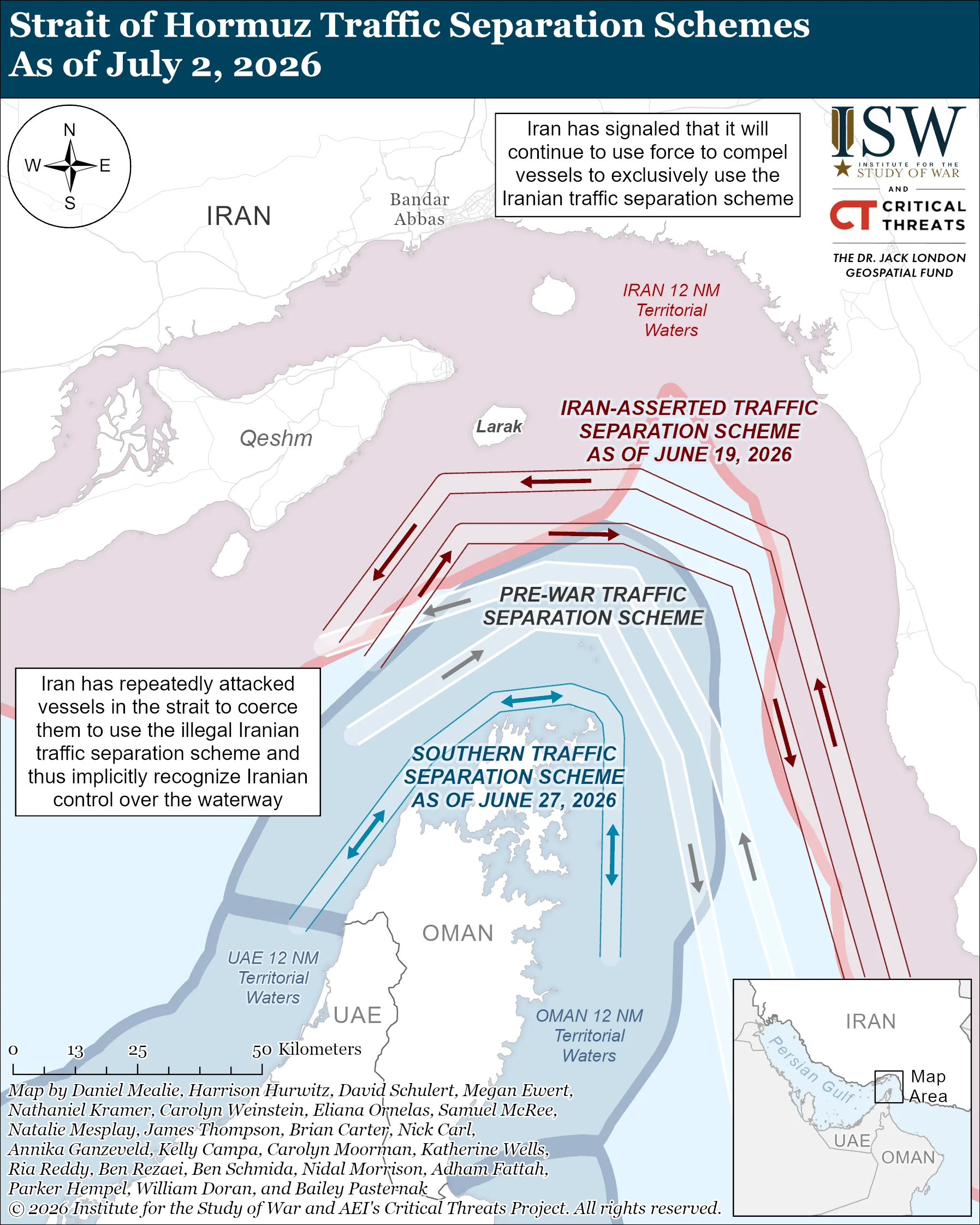
Iran has signaled that it will continue to use force to compel vessels to exclusively use the Iranian traffic separation scheme in the Strait of Hormuz as part of the broader Iranian effort to assert its claimed control of the strait. Iran's top operational military headquarters, the Khatam ol Anbia Central Headquarters, warned on July 2 that Iran will deliver a “decisive and swift” response to any US interference in Iranian efforts to manage the strait.[1] The statement added that all oil tankers and commercial vessels must use the Iranian-designated route for safe passage and warned that the armed forces will respond to any vessel that uses an alternative route.[2] Iran has repeatedly attacked vessels in the strait to coerce them to use the illegal Iranian traffic separation scheme and thus implicitly recognize Iranian control over the waterway.[3] Iranian Deputy Foreign Affairs Minister for Legal and International Affairs Kazem Gharibabadi said on July 2 that the strait is under Iranian control, not that of US Central Command (CENTCOM), after CENTCOM hosted a regional security meeting in Bahrain with military commanders from Gulf and other regional states.[4] The meeting in Bahrain comes amid Gulf opposition to Iranian control over the strait.[5] Iran is meanwhile conducting a concerted diplomatic and military effort in response to the apparent resistance from Gulf countries to try to deter any international efforts to restore maritime traffic outside Iranian control.[6] Iran recently attacked commercial vessels in the strait after the International Maritime Organization (IMO) and Oman announced a new route on June 23 to move hundreds of stranded vessels through the strait through a designated safe route along the Omani coast, for example.[7]
Iranian forces may have launched an effort against Kurdish militancy around the Iran-Iraq border. Iranian forces conducted missile and drone attacks targeting Kurdish militias around Erbil and Sulaymaniyah in Iraqi Kurdistan on July 2.[8] The Islamic Revolutionary Guards Corps (IRGC) Ground Forces Hamzeh Seyyed ol Shohada Operational Base separately announced on July 2 that it ambushed a Democratic Party of Iranian Kurdistan (PDKI)-affiliated cell that entered Iran through the northwestern border and killed five of its members near Piranshahr, West Azerbaijan Province.[9] The IRGC claimed that the group carried improvised explosive devices.[10] Kurdistan Free Life Party (PJAK) separately confirmed on June 30 that the IRGC killed four of its members during clashes with IRGC Ground Forces Hamzeh Seyyed ol Shohada Operational Base personnel near Mahabad and Piranshahr in West Azerbaijan Province.[11] Unspecified armed individuals separately killed two IRGC personnel and injured two others in Paveh, Kermanshah Province, on June 30.[12] These operations come after Armed Forces General Staff-run outlet Defa Press stated on June 20 that the regime is closely monitoring fighters in Kurdistan, West Azerbaijan, and Kermanshah provinces and has replaced “purely defensive reactions” with an “active deterrence” doctrine.[13]
A group of Iranian parliamentarians, largely comprised of individuals aligned with the ultra-hardline Paydari (Stability) Front, released a statement endorsing a different statement from some Assembly of Experts members that implicitly criticized the US-Iran memorandum of understanding (MoU) and US-Iran negotiations.[14] Iranian media reported on July 2 that a group of at least 84 parliamentarians issued a statement endorsing the recent statement by some Assembly of Experts members on June 28.[15] Sixty Assembly members issued a 10-point statement on June 28 in which they warned negotiators not to violate Supreme Leader Mojtaba Khamenei’s red lines.[16] The Assembly of Experts Secretariat later clarified that the June 28 statement did not represent the Assembly's official position.[17] The statement from the parliamentarians echoes the Assembly members’ hardline demands, which include solidifying Iranian control over the Strait of Hormuz, securing frozen assets and sanctions relief, forcing a US withdrawal from the region, and not discussing Iran's nuclear program in talks with the United States.[18] The Assembly of Experts and parliamentarians’ statement reflects ongoing divisions within the regime between pro-negotiation factions that appear more willing to preserve negotiations and the MoU and anti-negotiation factions who continue to push maximalist and uncompromising positions.
The Israel Defense Forces (IDF) has reportedly improved its ability to detect hostile first-person view (FPV) drones in northern Israel and southern Lebanon.[19] An unnamed senior IDF official told Israeli media on July 2 that IDF advancements in radar, artificial intelligence, and communication links to warning systems have reduced vulnerability to FPV drone attacks in southern Lebanon by 10 percent.[20] It is unclear how the official defines vulnerability to FPV drones, however. The official also said that drone warnings reach Israeli forces in southern Lebanon “within a few seconds,” giving soldiers more time to find cover or attempt to neutralize the drone.[21] The IDF reportedly began examining FPV drone countermeasures for its forces in southern Lebanon in April 2026.[22] Hezbollah has conducted increasingly sophisticated FPV drone attacks on Israeli forces in northern Israel and southern Lebanon since March 2026, including “swarm” attacks and nighttime attacks with FPV drones equipped with thermal cameras.[23]
The IDF continued to strike Hezbollah fighters and clear Hezbollah infrastructure in southern Lebanon on July 2. The IDF reported on July 2 that its forces killed a Hezbollah fighter who emerged from an underground facility near Ali al Taher, Nabatieh Governorate.[24] The IDF reported on June 26 that its forces took “complete control” of Ali al Taher, which reportedly hosts one of Hezbollah's largest underground command-and-control facilities.[25] Approximately 30 Hezbollah fighters remain in the facility, according to Israeli media.[26] Lebanese media reported on July 2 that the IDF conducted a one-way attack drone strike near Yater, Nabatieh Governate.[27] The IDF also reported on July 2 that it recently seized two Hezbollah weapons caches in Nabatieh Governate that contained rockets, mortars, improvised explosive devices, and other weapons.[28]
The United States has resumed some dollar shipments to Iraq, according to Iraqi federal government spokesperson Haider al Aboudi and a financial adviser to Iraqi Prime Minister Ali al Zaydi speaking to the New York Times.[29] Qatari media previously reported on June 17 that the United States recently delivered two shipments of US dollars to the Iraqi Central Bank, which coincided with US Special Envoy Tom Barrack's visit to Baghdad.[30] The US dollar shipments were the first sent to Iraq since the US Treasury Department halted such shipments in April 2026 due to concerns about Iranian-backed Iraqi militia attacks during the war.[31] The Iraqi Central Bank has managed an account at the New York Federal Reserve that has held the Iraqi government's oil export revenue in US dollars since 2003.[32] The resumption of US dollar shipments comes after Zaydi launched an anti-corruption campaign on June 28 targeting dozens of senior Iraqi officials following US pressure on the Iraqi government to disarm Iranian-backed Iraqi militias, dismantle their financial networks, and combat corruption.[33] The United States reportedly conditioned economic support, likely including dollar shipments, for Zaydi’s government on the Iraqi government's ability to meet US demands.[34]
An unnamed Iraqi official told the New York Times that the United States has not resumed its funding for Iraqi security services, however.[35] The United States suspended its funding for some counterterrorism and Iraqi Security Forces (ISF) training programs in April 2026 to pressure the Iraqi federal government to “dismantle” the militias.[36]
https://understandingwar.org/research/middle-east/iran-update-special-report-july-2-2026/
2,217 posted on
07/03/2026 3:10:25 AM PDT by
AdmSmith
(GCTGATATGTCTATGATTACTCAT)
FreeRepublic.com is powered by software copyright 2000-2008 John Robinson