Skip to comments.
Iranian Regime tv Channel One hacked while it was airing Khamenie speech
various
| 10-8-22
Posted on 10/08/2022 1:05:38 PM PDT by nuconvert
Iranian Regime national tv Channel One hacked about an hour ago. During a broadcast of Khamenie speech, a red crosshair appeared over his face and chanting of Women. Life. Freedom. There was writing to the side saying "Rise up. Join us". Also 4 photos at the bottom of the screen of young people killed and additional writing: "The blood of our youth is dropping from your paws".
Also, there was a huge banner in the middle of Tehran highway today that read: We are no longer afraid of you. We will fight.
Also, attempted attack on IRI ambassador in Denmark. Her bodyguard was stabbed. Diplomatic Security intervened before the attacker could stab the ambassador.
TOPICS:
KEYWORDS: basij; deathtothemullahs; denmark; ebrahimrigi; erdogan; iran; iranprotests; iraq; irgc; iri; israel; khameini; khamenei; kurdistan; lebanon; mahsaamini; mullahloversonfr; mullahsmustbekilled; najisharifizindashti; protests; qudsforce; raisi; receptayyiperdogan; shahrammaroufmola; syria; turkey; yemen; zahedi
Navigation: use the links below to view more comments.
first previous 1-20 ... 2,141-2,160, 2,161-2,180, 2,181-2,200 ... 2,401-2,406 next last
To: PIF
2,161
posted on
06/15/2026 4:22:34 AM PDT
by
central_va
(I won't be reconstructed and I do not give a damn)
To: central_va
How can the truth be abuse? you must be really gone.
2,162
posted on
06/15/2026 4:39:45 AM PDT
by
PIF
(They came for me and mine ... now its your turn)
Comment #2,163 Removed by Moderator
To: AdmSmith
2,164
posted on
06/15/2026 6:52:16 AM PDT
by
nuconvert
( Warning: Accused of being a radical militarist. Approach with caution.)
To: nuconvert
Diplomatic officials confirm Washington secretly authorized Doha to transfer funds to Tehran in exchange for freedom of navigation in the Strait of Hormuz and immunity from attacks. The dual policy was intended to curb global energy prices, and served as the basis for the memorandum of understanding being forged with the leadership of the Revolutionary Guards. While oversight of the financial spigot was watered down and handed to the Qataris, talks in Washington stalled over a bitter dispute surrounding the issue of uranium enrichment.
https://www.israelhayom.com/2026/06/15/trump-secretly-approved-qatar-iran-cash-deal/
2,165
posted on
06/15/2026 9:11:53 AM PDT
by
AdmSmith
(GCTGATATGTCTATGATTACTCAT)
To: AdmSmith
I don’t know how biased the source is.
But this, if true, makes me sick...
“In addition, the US demand that any unfreezing of funds be designated for civilian purposes only and placed under tight oversight has been watered down, and oversight of the billions is expected to be handled by Qatar alone.”
2,166
posted on
06/15/2026 12:23:16 PM PDT
by
nuconvert
( Warning: Accused of being a radical militarist. Approach with caution.)
To: nuconvert
Iran Update Special Report, June 15, 2026
US and Iranian sources have expressed diverging interpretations of some key aspects of the recent US-Iran agreement. The full text of the agreement has not yet been published, which makes it difficult to ascertain which interpretations of the agreement are accurate. The United States and Iran reached an agreement on June 14 to end the war and are expected to formally sign the agreement in Geneva on June 19.[1] The agreement reportedly calls for a ceasefire on all fronts, requires Iran to “open” the Strait of Hormuz, and requires the United States to lift its naval blockade on Iranian ports.[2] US and Iranian officials have stated that additional negotiations, including discussions over Iran's nuclear program, will occur during the 60 days following the agreement's signing.[3] US Vice President JD Vance stated on June 15 that the United States expects the strait to be open “in a toll-free way for the long term.”[4] Islamic Revolutionary Guards Corps (IRGC)-affiliated media, by contrast, reported on June 15 that Iran will pause imposing “fees” on vessels transiting through the strait for the next 60 days but intends to resume charging vessels “service fees” after the 60-day period.[5] Iranian officials have also continued to signal their intent to jointly manage the strait with Oman.[6] US officials have also denied Iranian claims that the agreement will immediately release a portion of Iran's frozen assets and lift some sanctions. US officials, including US President Donald Trump and Vice President JD Vance, have instead insisted that sanctions relief and the release of Iranian assets are dependent on Iran's implementation of the agreement.[7] IRGC-affiliated media argued that Iran must “strictly implement its interpretation” of the agreement and disregard the United States’ “nonsense interpretations,” which further highlights the apparent divergence between Iran and the United States’ understandings of the deal.[8] These diverging interpretations of key provisions in the agreement will likely complicate the implementation of the agreement and the next phase of negotiations.
Iran's interpretation of the agreement's provisions about the Strait of Hormuz would constitute a significant strategic victory for Iran if its interpretation becomes the recognized reality. Iranian Foreign Affairs Ministry Spokesperson Esmail Baghaei stated on June 15 that Iran and Oman will manage traffic through the strait, provide maritime “services,” and collect related fees.[9] IRGC-affiliated media similarly claimed that the text of the US-Iran agreement was revised to emphasize Iranian and Omani sovereignty over the international waterway.[10] Iranian reports that Iran intends to resume “fee” collection in some capacity are consistent with repeated Iranian claims that these charges are “service fees” rather than transit tolls and therefore do not violate a “toll-free” arrangement.[11] Imposing tolls is one mechanism through which Iran exercises authority over the strait, but ISW-CTP previously assessed that Iran likely prioritizes securing recognized sovereignty over the strait over imposing a toll scheme in the strait.[12] The Iranian regime defines an “open” strait as one that remains under Iranian management, which conflicts with US and global commercial interests. Iranian officials have repeatedly identified control of the strait as a core strategic objective and a central pillar of Iran's long-term deterrence posture.[13] ISW-CTP previously assessed that Iran likely views control over the strait as essential to restoring deterrence against the United States and Israel following the degradation of its other deterrent capabilities.[14] Any agreement that permits Iran to retain any form of authority over the strait, regardless of whether it imposes tolls or not, would allow Iran to reimpose restrictions in the international waterway at its discretion. Such authority would give Iran significant leverage over global commerce, which Iran could use to extract concessions and advance its strategic objectives.
The reopening of the Strait of Hormuz depends on the risk calculus of shipping companies and ship captains. Continued Iranian threats against commercial shipping may have a negative impact on the willingness of companies and captains to resume transiting through the strait. Trump stated on June 15 that vessels have begun transiting through the strait via the “southern highway,” almost certainly referring to the internationally recognized traffic separation scheme.[15] Shipping companies will likely remain reluctant to resume normal operations, at least for the time being, due to the ongoing risk of Iranian attacks and naval mines, however. The IRGC Navy announced on June 15 that it has not issued transit permits over the past 96 hours and emphasized that the strait remains closed to all vessels.[16] The IRGC Navy reportedly warned ships not to approach areas under Iranian control “until further notice,” which is an implicit threat to attack vessels that attempt to transit through the strait without Iranian permission.[17] These threats are part of a broader Iranian effort since March 2026 to use force to deter vessels from transiting the strait without Iranian authorization.[18] Iran's mine-laying activities and threats to mine the strait are also a key component of this effort. Reuters, citing shippers in Asia and Europe, reported that shipping companies intend to resume navigation only after authorities fully confirm the safety of the waterway.[19] Reuters, citing Western maritime security services, added that mine-clearing operations could take 40 to 50 days.[20] Trump stated on June 14 that mine-removal operations will begin after the agreement is signed on June 19.[21] Iranian officials and media have not commented publicly on potential mine-clearing efforts.
Hezbollah has signaled that it will adhere to the Lebanon ceasefire outlined in the US-Iran agreement and suggested that the group views the agreement as a precursor for Israel's withdrawal from Lebanon.[22] Hezbollah issued a statement on June 15 in which it congratulated Iran for reaching an agreement with the United States that includes “a comprehensive ceasefire across all fronts, including Lebanon.”[23] A Hezbollah official told Reuters on June 15 that the group has ceased offensive operations since the US-Iran deal was announced and that Hezbollah's compliance with the ceasefire is linked to Israel's adherence to it.[24] ISW-CTP has not observed any Hezbollah attacks on northern Israel since the United States and Iran announced the agreement. Hezbollah also implied in its statement that the US-Iran agreement sets conditions for an IDF withdrawal from southern Lebanon, stating that the agreement “is a prelude to completing the liberation” of Lebanon.[25] Hezbollah has repeatedly demanded a full IDF withdrawal from Lebanon as part of any comprehensive ceasefire agreement.[26] Iranian media similarly implied on June 15 that an IDF withdrawal from southern Lebanon is part of the US-Iran agreement.[27] The Hezbollah official speaking to Reuters added that Hezbollah rejects IDF “freedom of movement” in Lebanon, which further illustrates Hezbollah's maximalist demand for an IDF withdrawal.[28] A senior US official told an Israeli reporter on June 15 that “an Israeli withdrawal from southern Lebanon is not a condition for reaching an agreement with Iran,” however.[29] Israel does not appear to be a party to this agreement, which complicates the clause that calls for a ceasefire in Lebanon.[30]
Israeli officials have stated that the IDF will continue to operate in Lebanon to degrade Hezbollah. Hezbollah and Iran could make their implementation of the US-Iran agreement contingent upon the cessation of Israeli operations against Hezbollah in order to push Israel to halt these operations. Israeli Defense Minister Israel Katz said on June 15 that Israel will maintain an indefinite IDF presence in security zones in Lebanon, Syria, and the Gaza Strip in order to maintain Israel's security.[31] Katz added that the IDF’s establishment of security zones in southern Lebanon is “among the IDF’s greatest achievements” in the war and emphasized that Israel ”oppose[s] an IDF withdrawal from Lebanon, despite all the existing pressures and those that will still come.”[32] A US official separately told an Israeli journalist that Israel has the right to respond to any Hezbollah attack.[33] Lebanese media reported that the IDF continued to strike targets in southern Lebanon as recently as the morning of June 15.[34] There are also conflicting reports on whether the IDF has continued ground operations in southern Lebanon. Two IDF soldiers in southern Lebanon told an Israeli journalist on June 15 that all IDF activity has ceased since the announcement of the US-Iran agreement.[35] Lebanese sources continue to report IDF movements and advances, including in towns beyond the ”Yellow Line,” however.[36] Iran recently linked US-Iran negotiations to the Lebanon issue in order to pressure the United States to push Israel to halt operations against Hezbollah.[37] Iran could similarly seek to make its implementation of the US-Iran agreement contingent upon Israel agreeing to a ”comprehensive ceasefire” in Lebanon.
Supporters of the US-Iran agreement within the Iranian regime continue to attempt to build a consensus around the US-Iran agreement amid criticism from the regime's anti-negotiations camp, led by the ultrahardline Paydari (Stability) Front. Iranian President Masoud Pezeshkian and Parliament Speaker Mohammad Bagher Ghalibaf continued to defend Iran's decision to sign the agreement and repeated their calls for Iranians to maintain unity and national cohesion.[38] Pezeshkian stated on June 15 that “nearly all” Iranian parliamentarians support the agreement and emphasized that the agreement was signed under the “guidance” of Supreme Leader Mojtaba Khamenei.[39] Pezeshkian’s comment comes amid criticisms from some Paydari Front members toward Iran's negotiating team and the US-Iran agreement. A Paydari Front parliamentarian criticized the agreement's reportedly vague timeline for the release of Iranian assets, for example..[40]
https://understandingwar.org/research/middle-east/iran-update-special-report-june-15-2026/
2,167
posted on
06/15/2026 11:42:19 PM PDT
by
AdmSmith
(GCTGATATGTCTATGATTACTCAT)
To: AdmSmith

According to the sources, smuggling networks operating between Yemen, the Horn of Africa and the Red Sea have facilitated a series of negotiations between representatives of the armed group in Yemen and Sudanese armed actors. The most recent meeting, held last week, reportedly discussed a new mechanism and emerging routes for arms smuggling across the Red Sea.
The sources said the Houthis rely on smuggling networks with ties and influence in Yemen and the Horn of Africa, and use islands near Eritrea as temporary storage sites for weapons and components used in ammunition production. These sites are also believed to be used for assembling parts of drones and missiles.
Sheba Intelligence has also obtained the names of four Houthi military commanders believed to be involved in managing or coordinating arms-smuggling operations toward Sudan. The full details of the roles attributed to these commanders could not be independently verified.
The information comes as Sudan witnesses a sharp increase in the use of drones by the warring parties. The UN Deputy High Commissioner for Human Rights recently warned before the UN Human Rights Council of the growing use of drones in Sudan’s conflict, saying that more than 1,000 civilians were killed in drone strikes between January and May 2026. That figure accounted for around 80 percent of recorded civilian deaths during the period.
The emerging picture suggests that Sudan’s war is no longer confined to conventional frontlines. It is increasingly linked to the movement of low-cost military technology through regional smuggling networks, compounding risks to civilians, infrastructure and security across the Red Sea and the Horn of Africa.
Observers say the transfer of drone-related expertise and technology to non-state armed groups in Sudan could mark a more dangerous phase in the conflict, especially if such capabilities are combined with flexible smuggling routes, temporary storage hubs and cross-border networks that are difficult to monitor or disrupt.
These developments are deepening concerns that the Red Sea could become a dual-use corridor: not only for conventional commercial and military supply chains, but also for the trafficking of low-cost military technologies capable of reshaping the balance of power inside fragile conflict zones, with Sudan at the forefront.
https://shebaintelligence.uk/exclusive-houthis-transfer-iranian-technology-to-armed-groups-in-sudan
2,168
posted on
06/15/2026 11:48:39 PM PDT
by
AdmSmith
(GCTGATATGTCTATGATTACTCAT)
To: nuconvert
Iran Update Special Report, June 16, 2026
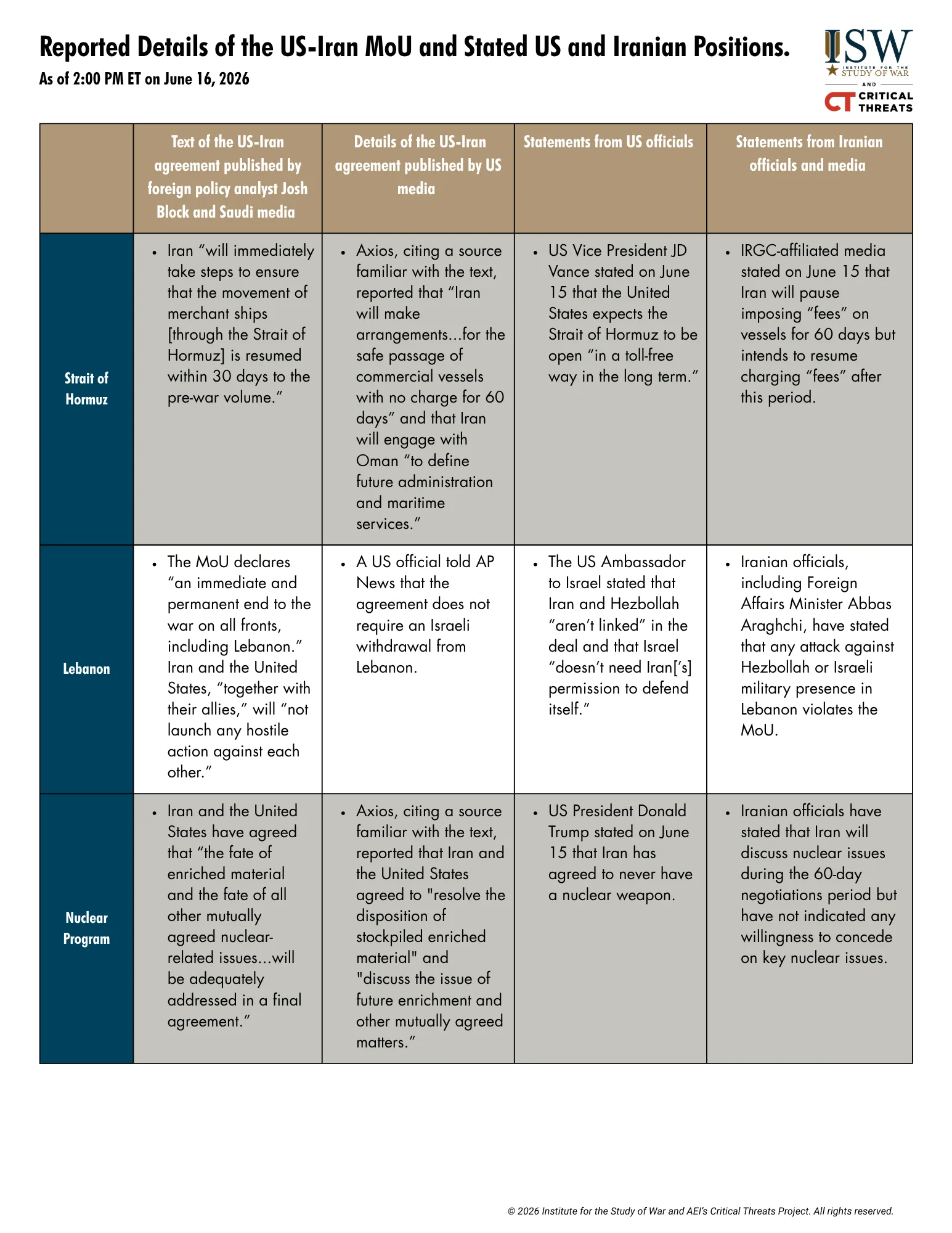
Multiple sources published what appears to be the text of the US-Iran agreement. Neither the United States nor Iran has officially published the text of the agreement at this time. The leaked text of the agreement, if accurate, indicates that Iran has emerged from the conflict in a stronger strategic position, however. Foreign policy analyst Josh Block and Saudi media published an identical version of the US-Iran memorandum of understanding (MoU) on June 16, detailing all 14 clauses of the agreement that the United States and Iran are set to sign in Switzerland on June 19.[1] The text declares that Iran and the United States will conduct further negotiations for 60 days upon signing the MoU, but notes that this negotiation period is “extendable by mutual consent.”[2] Western media outlets such as the Wall Street Journal and Axios corroborated several clauses of the agreement published by Block and Saudi media.
The MoU reportedly grants Iran significant economic relief, which Iran would likely use to try to reconstitute its missile, drone, and nuclear programs, as well as the Axis of Resistance. Block, Saudi media, and the Wall Street Journal reported that the United States will lift its blockade on Iranian ports and waive sanctions on Iranian oil exports and “related services” immediately upon signing the MoU.[3] Axios, citing a source familiar with the text, reported that the United States will “gradually” lift its blockade within 30 days of signing the MoU.[4] Iranian regime outlet Mehr News estimated on June 16 that Iran could generate up to $10 billion USD from just 60 days of oil exports.[5] Iran would likely use immediate economic relief to try to reconstitute its military capabilities, the Axis of Resistance, and its nuclear program. Arab mediators told the Wall Street Journal on June 13 that IRGC Commander Major General Ahmad Vahidi, whom ISW-CTP assesses as dominating regime decision-making, has insisted that Iran's frozen assets should not be “barred from military spending.”[6] Iranian Foreign Affairs Ministry Spokesperson Esmail Baghaei similarly stated in May that Iran would use assets released under a potential agreement with the United States to advance its defense and military sectors, including Iran's missile and drone programs.[7]
The MoU states that Iran could receive further economic relief by fulfilling its commitments in the MoU and reaching a final agreement that addresses key nuclear issues. ISW-CTP has not observed any indications that Iranian decision-makers are willing to make concessions on the nuclear issues that would be included in a final agreement, however. Block and Saudi media reported that the United States will release “frozen or restricted” funds and assets “in light of the progress of negotiations towards a final agreement.”[8] US Vice President JD Vance clarified to ABC News on June 15 that the release of frozen assets is contingent upon Iran taking “verified steps” to eliminate its highly enriched uranium (HEU) stockpile.[9] The United States, “together with its regional partners,” will also commit to forming a “rehabilitation and economic development” plan worth at least $300 billion USD, according to the text published by Block, Saudi media, and several Western outlets.[10] An Iranian outlet affiliated with Supreme Leader Military Adviser Mohsen Rezaei similarly reported that the MoU requires the United States and its allies to present a reconstruction plan worth at least $300 billion USD to Iran.[11] US President Donald Trump denied that the United States would give Iran $300 million USD.[12] The economic development plan is contingent upon the United States and Iran reaching a final nuclear agreement that addresses Iran's HEU stockpile and ability to enrich uranium on Iranian soil, but key Iranian decision-makers, such as Vahidi, have not signaled any willingness to concede on these issues. The current MoU reiterates Iran's commitment not to produce a nuclear weapon. Iranian officials have historically insisted that Iran does not seek to produce a nuclear weapon, but the regime has nevertheless developed in recent years the latent capability to develop a nuclear weapon if it decides to do so.
Iran will likely try to exploit the agreement's seemingly ambiguous language about the Strait of Hormuz to try to enforce its control over shipping through the strait. The MoU stipulates that Iran “will immediately take steps to ensure that the movement of merchant ships [through the strait] is resumed within 30 days to the pre-war volume,” according to Block, Saudi media, and several Western outlets.[13] Iran is expected to remove “technical obstacles” and naval mines from the strait during the 30-day period.[14] The text published by Block and Saudi media does not explicitly bar Iran from “managing” the strait, and Iran could therefore continue to insist on vessels using its illegal traffic separation scheme in Iranian territorial waters and paying “fees” to the IRGC Navy.[15] The MoU text also states that the United States and Iran will “respect each other's sovereignty and territorial integrity” and “refrain from interfering in each other's internal affairs.”[16] The Iranian regime has repeatedly claimed that it and Oman control the Strait of Hormuz as territorial waters. Iran could also try to argue that its “management” of the strait is an Iranian internal affair. The MoU text published by Block and Saudi media also does not mention whether Iran can charge tolls, despite President Trump stating on June 14 that vessels can pass through the strait “toll-free.”[17] Some versions of the agreement published in Western media on June 16 do mention that Iran will not charge tolls for 60 days and that Iran will work with Oman to “define future administration and maritime services” in the strait, however.[18] IRGC-affiliated media stated on June 15 that Iran will pause charging “fees” for 60 days but intends to resume charging “fees” after that period.[19] Iranian officials have consistently claimed that Iran is charging “service fees” as opposed to tolls in the Strait of Hormuz, and therefore that vessels are able to transit through the strait “toll-free.”
The Iranian regime is interpreting the clause in the agreement about a ceasefire “on all fronts” as a requirement for Israel to cease operations against Hezbollah and withdraw from Lebanon. This interpretation is part of a broader Iranian effort to preserve Hezbollah by trying to secure Israel's capitulation in Lebanon. Block and Saudi media reported that the MoU states that Iran and the United States, along with their allies, agree to “an immediate and permanent end to the war on all fronts, including Lebanon” and commit to “not launch any hostile action against each other.”[20] Iranian officials and media have argued that any Israeli attack against Hezbollah or Israeli military presence in Lebanon constitutes a violation of the MoU.[21] Israel does not appear to be a signatory to the MoU and continues to operate against Hezbollah in southern Lebanon, however. The Israel Defense Forces (IDF)continued to launch airstrikes against Hezbollah targets in response to Hezbollah attacks on Israeli forces in southern Israel.[22]
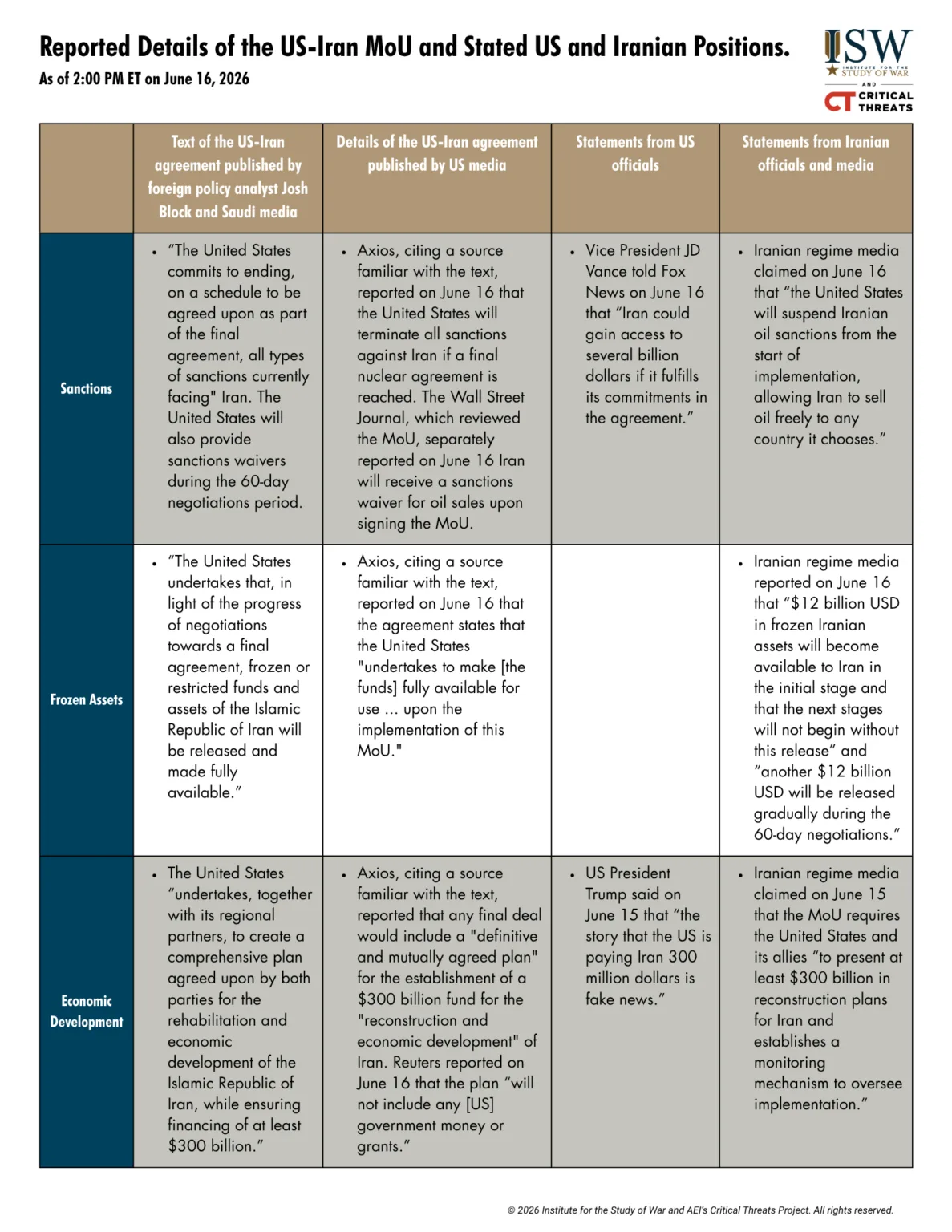
The reported MoU terms also indicate that Iran structured the agreement in a way to try to limit the United States’ ability to impose renewed pressure on Iran during the 60-day negotiations period and thereby make it more challenging for the United States to extract concessions from Iran during the negotiations. Block and Saudi media reported that the MoU states that“Iran and the United States agree that, pending a final agreement, they will maintain the status quo: Iran will maintain the status quo on its nuclear program, and the United States will not impose new sanctions on Iran or strengthen its forces in the region.” This clause prevents the United States from applying additional economic or military pressure on Iran over the next 60 days and therefore limits the United States’ leverage over Iran in nuclear negotiations. Iran may calculate that this clause will make it more difficult for the United States to force Iran to soften its red lines on the issues of HEU and uranium enrichment.
Iranian officials and media are largely framing the US-Iran MoU as an Iranian victory that codifies Iran's military achievements. The Iranian regime's English-language media outlet, Press TV, argued on June 16 that the MoU is not simply a ceasefire, but rather represents the “political codification of a battlefield reality.”[23] Press TV argued that Iran views the Strait of Hormuz and the Axis of Resistance as two of its most important tools of deterrence that it can use to ensure “compliance with future agreements.”[24] IRGC Quds Force Commander Brigadier General Esmail Ghaani separately praised Iran's negotiating team for linking negotiations with the United States to Israel's operations against Hezbollah in Lebanon.[25] Ghaani additionally praised the Axis of Resistance for its involvement in the war, claiming that Hezbollah is “unstoppable” and that Israel is closer to “collapse” than it was before the war.[26]
Iraqi Prime Minister Ali al Zaydi and US Special Envoy for Iraq and Syria Tom Barrack released a joint statement on June 16 that outlined a shared vision for the “complete disarmament and disbandment of [Iraqi] armed groups.” Zaydi and Barrack released the statement after meeting in Baghdad on June 15.[27] The statement comes amid the Iraqi federal government's efforts to restrict weapons to the state.[28] The United States has increasingly pressured the Iraqi federal government in recent months to decrease Iranian influence in Iraq, including through militia disarmament, due to militia attacks against US and foreign targets in Iraq and the region during the war.[29] Zaydi is expected to meet with US President Donald Trump in Washington, DC, in July.[30]
Popular Mobilization Commission (PMC) Chairman Faleh al Fayyadh replaced the Saraya al Salam-affiliated Popular Mobilization Forces (PMF) Samarra Operations Command commander with an Asaib Ahl al Haq member on June 16.[31] The PMF is an Iraqi state security service that includes many Iranian-backed Iraqi militias that answer to Iran instead of the Iraqi prime minister.[32] The Popular Mobilization Commission is officially responsible for ensuring that PMF brigades answer to the prime minister.[33] Shia Nationalist Movement leader Muqtada al Sadr announced the dissolution of Saraya al Salam on May 27 and the full integration of the militia's members into the Iraqi state.[34] Samarra City holds religious significance for Iraqi Shia and Sadr-aligned forces, including Saraya al Salam, have maintained control and influence in the area for years.[35] Iraqi media reported on June 16 that Sadr directly ordered Saraya al Salam forces to accept the PMC’s decision.[36] Saraya al Salam announced on June 16 that its forces will remain in Samarra City until the “security file” has been legally transferred to the state, but confirmed the group's separation from Sadr's Shia Nationalist Movement and full integration into the Iraqi state.[37] The replacement of a Saraya al Salam-affiliated commander with an Asaib Ahl al Haq member is particularly notable given the long-standing tensions between these two groups. Asaib Ahl al Haq head Qais al Khazali formed Asaib Ahl al Haq as a splinter group from Sadr's Mahdi Army, which preceded Saraya al Salam, in the years following the 2003 US invasion of Iraq.[38] Forces from Saraya al Salam and Asaib Ahl al Haq clash sporadically in southern Iraq.[39]
https://understandingwar.org/research/middle-east/iran-update-special-report-june-16-2026/
2,169
posted on
06/17/2026 12:09:08 AM PDT
by
AdmSmith
(GCTGATATGTCTATGATTACTCAT)
Sal Mercogliano- What’s Going on With Shipping?
17JUN2026 Sal Mercogliano dives into the growing confusion surrounding the Strait of Hormuz. While political announcements suggest a breakthrough and an immediate end to the naval blockade, the reality on the water—tracked by AIS data and maritime insurance rates—tells a different story.
In this episode, we break down:
⚓Rhetoric vs. Reality: Why the recent political announcements may be jeopardizing the lives of merchant mariners.
⚓The AIS Data: A deep dive into current traffic patterns, showing who is “running dark” and why the Omani channel is the preferred route for those avoiding the Iranian “toll booth.”
⚓The Economic Explosion: Analyzing the hypothetical $412,888 per day tanker rates and what they mean for global energy costs.
⚓War Risk Insurance: How underwriters are reacting to the “fragile stabilization” and what a $5 billion potential loss event looks like for the industry.
⚓The Long-Term Impact: Why the “Great Blue Commons” is under threat and how the cost of geopolitical uncertainty is being added to every barrel of oil.
https://www.youtube.com/watch?v=MgfuFo7jaEE
2,170
posted on
06/17/2026 12:14:19 AM PDT
by
AdmSmith
(GCTGATATGTCTATGATTACTCAT)
To: AdmSmith
Trump today...If they don’t behave, we’re going back to dropping bombs right on their head.
I read the Josh Block version a day or 2 ago. There are some vague proposals/conditions.
Thanks for posting . Supposedly there was an agreement with the UN not to post the actual agreement ahead of time.
2,171
posted on
06/17/2026 4:16:33 AM PDT
by
nuconvert
( Warning: Accused of being a radical militarist. Approach with caution.)
Iran Update Special Report, June 17, 2026
The United States and Iran signed the memorandum of understanding (MoU) on June 17.[1] Iran is claiming that the final MoU text satisfies some of its key war aims related to Lebanon and the Strait of Hormuz.[2] US officials briefed US media, including the New York Times, CNN, Axios, and others, on the contents of the MoU before Iran and the United States signed it.[3] The final MoU is basically unchanged from the version provided to Bloomberg on June 16, except for text changes in clauses one and five that Iran reportedly requested.[4] Islamic Revolutionary Guards Corps (IRGC)-affiliated Fars News reported on June 15 that Iran had earlier secured important changes to the draft MoU.[5] These changes included the addition of the phrase “guaranteeing sovereignty and respect for the territorial integrity of Lebanon” to the first clause, references to a joint Iranian-Omani maritime services administration in the Strait of Hormuz to the fifth clause, and an addition that the MoU would bar fee collection in the strait for 60 days, also in the fifth clause.[6] All three of these changes are reflected in the version briefed to US media but not in the earlier version leaked to Bloomberg (changes highlighted below in bold).[7] IRGC-affiliated Tasnim News Agency noted on June 17—before the signing and the briefing to US media—that Bloomberg’s reported text was inaccurate and had “numerous flaws” related to Lebanon and the Strait of Hormuz.[8]
Clause 1: “The United States of America and the Islamic Republic of Iran and their allies in the current war by signing this MoU declare the immediate and permanent termination of military operations on all fronts, including in Lebanon, and undertake from now on not to initiate any war or any military operation against each other, and to refrain [from] the threat or use of force against each other and ensuring the territorial integrity and sovereignty of Lebanon. The final deal will confirm the permanent termination of the war on all fronts, including in Lebanon, and other provisions of this paragraph.”[9]
Clause 5: “Upon the signing of this MoU, the Islamic Republic of Iran will make arrangements using its best efforts for the safe passage of commercial vessels with no charge for 60 days only from the Persian Gulf to the Sea of Oman, and vice versa. The traffic of commercial vessels will immediately start, and considering the need for removing the technical and military obstacles and demining by the Islamic Republic of Iran, will be instated within 30 days. The Islamic Republic of Iran will conduct dialogue with the Sultanate of Oman to define the future administration and maritime services in the Strait of Hormuz, in discussion with other Persian Gulf littoral states in line with the applicable international law and the sovereign rights of coastal states of the Strait of Hormuz.”[10]
Top Iranian officials are using these changes to imply that they have satisfied their key war aims of controlling the Strait of Hormuz and preserving Hezbollah. Iranian First Vice President Mohammad Reza Aref said that Iran would retain control over the Strait of Hormuz and that vessels transiting the waterway should pay service fees for safe navigation of the strait.[11] Iran continues to be the only threat against commercial shipping in the strait. Aref said that the Strait of Hormuz “belongs to Iran” and that its management will remain Iran's responsibility.[12] Clause 5 indicates that Iran would need to negotiate with the Gulf Arab states to ensure its management of the strait, however, and it remains unlikely that the Gulf Arab states would acquiesce to Iranian demands without Iranian coercion.[13] The fact that Iran can negotiate the status of an international waterway is nonetheless an erosion of long-established international law and norms enshrined in the UN Convention on the Law of the Sea (UNCLOS).[14]
Iran also appears to believe that the MoU requires Israel to withdraw from Lebanon, which would help preserve Hezbollah. A Hezbollah source told Emirati media on June 16 that Iran told Hezbollah that the withdrawal of Israeli troops from Lebanon is included in the US-Iran MoU and is expected to occur over a phased 60-day period.[15] The source added that the withdrawal of Israeli troops from Lebanon now depends on Israel, because Israel is not a party to the MoU and remains in Lebanon.[16] A Lebanese political source told Emirati media on June 16 that Lebanon has received “no official guarantees” over an Israeli withdrawal and has not yet discussed the issue with US officials, which is at odds with Iranian claims that the MoU clearly requires Israel to withdraw from Lebanon.[17] This demonstrates the degree of ambiguity inherent in this MoU and suggests that the United States and Iran have divergent views of the agreed-upon text.
Iran is already taking positive action regarding Lebanon and the Strait of Hormuz to enforce its interpretation of the MoU’s terms. Iran threatened retaliation against Israel if Israeli operations in Lebanon continue. The Khatam ol Anbia Central Headquarters characterized continued Israeli operations in southern Lebanon as “ceasefire violations” on June 16 and warned that Israel should expect a “harsh [Iranian] response” if the IDF does not cease its operations in southern Lebanon.[18] These threats are designed to force the United States to pressure Israel to end its operations in southern Lebanon to preserve the agreement. Iran is also continuing to maintain its ”management” of the Strait of Hormuz by demanding vessels adhere to IRGC requirements and threatening those that do not. Iranian media reported that vessels are still waiting for IRGC approval to move through the strait.[19] An unspecified US official told NBC on June 16 that the US military has intercepted drones that the IRGC has fired toward commercial ships in the Strait of Hormuz every night since the MoU’s announcement on June 14.[20]
The Iranian factions that secured and approved the deal are trying to sell the agreement, which appears somewhat politically sensitive in Tehran. ISW-CTP continues to assess that IRGC Commander Major General Ahmad Vahidi and his inner circle are predominant in Iranian policymaking, but others—including pro-negotiations figures like Parliament Speaker Mohammad Bagher Ghalibaf and Foreign Affairs Minister Abbas Araghchi—were also deeply involved in negotiations. Some Iranian parliamentarians and regime-linked media have criticized the agreement, however. Parliamentary National Security and Foreign Policy Commission spokesperson Ebrahim Rezaei described the MoU as “imbalanced” and said that it did not observe all of the regime's red lines[21] Rezaei also rejected accusations that critics of the MoU[22] Hardline media outlet Kayhan separately wrote on June 17 that the [23] Kayhan criticized Iranian officials for withholding the text from the Iranian public and said Parliament must prevent the “secret implementation” of a document that Parliament does not know[24] The figures opposing the agreement are not particularly influential in Tehran, but they do represent a regime faction that Iranian leaders may find it necessary to placate, especially if the promised economic dividends fail to come to fruition.
Iranian media is also using potential, early economic benefits that Iran would receive under the MoU to argue that Iran secured tangible and irreversible benefits without abandoning its core demands. Iranian media have highlighted meetings and discussions with Russian and Chinese counterparts and heavily publicized Iranian oil tankers crossing or approaching the blockade line.[25] Islamic Development Organization (IDO)-affiliated outlet Mehr News Agency reported on June 16 that the MoU gives Iran “cash” benefits, including access to part of its frozen assets, a suspension of oil sanctions, and free access to oil revenue.[26] Mehr estimated that Iran could earn up to $10 billion USD from 60 days of oil sales and that Iran's total revenue during this period could exceed $30 billion USD.[27] This messaging suggests that the regime may be using ambiguity over Lebanon and the Strait, alongside early economic benefits, to frame the MoU as a victory and manage domestic criticism.
Iran will likely use renewed economic access under the MoU to reconstitute members of the Axis of Resistance, particularly Hezbollah, during the 60-day negotiation period. Iran has already told Hezbollah that Iran will increase its funding as soon as possible once the United States unfreezes Iranian assets.[28] Israel badly degraded Hezbollah during the October 7 War.[29] The collapse of the Assad regime in Syria made Hezbollah's resupply more difficult, and Iran's competing priorities—including rebuilding its own assets without any financial relief after June 2025—made funding the reconstitution of Hezbollah and other Axis members relatively more challenging.[30] Iran did provide Hezbollah with roughly $1 billion USD between the 2024 war and the 2026 war, but relaxing sanctions and providing Iran with greater access to revenue will provide Iran with more money it can choose to provide to Hezbollah.[31] Clause 11 of the MoU, as reported by Bloomberg, states that the United States may unfreeze Iranian assets in response to “progress of negotiations towards a final agreement.”[32] Lebanese and regional sources told Reuters on June 17 that Iran has promised Hezbollah that it will increase the group's funding ”as soon as possible,” once the United States unfreezes Iranian assets as a part of the MoU.[33] The degree to which Axis of Resistance factions remain contained or weakened after the last nearly three years of war is in large part contingent on how much funding Iran can provide to them.
The United States reportedly conditioned economic support for Iraqi Prime Minister Ali al Zaydi’s government on its ability to meet several conditions, including disarming Iranian-backed Iraqi militias and dismantling their financial networks.[34] Iraqi government sources told regional media on June 17 that the United States recently delivered two shipments of an unspecified amount of US dollars to the Central Bank of Iraq, which coincided with US Special Envoy Tom Barrack‘s visit to Baghdad.[35] The sources described the shipments as ”economic cover” for Zaydi’s government that is ”contingent“ on Iraq meeting US conditions.[36] These cash shipments were the first the United States has sent to Iraq since the US Treasury Department halted shipments of US dollars in April 2026 due to concerns about militia attacks during the war.[37] The Central Bank of Iraq has managed an account at the New York Federal Reserve on behalf of the Iraqi Finance Ministry since 2003 that holds the Iraqi federal government's revenue from oil exports in US dollars.[38] Oil revenue accounts for about 90 percent of the Iraqi state's budget.[39] Sources also told Iraqi media on June 17 that US Special Envoy Tom Barrack also threatened “unlimited options,” which could refer to US sanctions or future cessations of US dollar transfers to Iraq, if Zaydi fails to meet US conditions.[40]
The United States demanded the removal of Popular Mobilization Forces (PMF) leaders associated with Iranian-backed Iraqi militias before integrating the PMF into official Iraqi security institutions, according to political sources speaking to Iraqi media on June 17.[41] The PMF is an Iraqi state security service that currently operates separately from the Iraqi security establishment and includes many Iranian-backed Iraqi militias that answer to Iran instead of the Iraqi prime minister.[42] Many Iranian-backed Iraqi militia commanders simultaneously command official PMF Brigades.[43] The Iraqi federal government has recently taken initial steps to disarm the militias, including receiving files and data on Iranian-backed Iraqi militia Kataib al Imam Ali's assets and forming a joint disarmament committee with representation from the PMF, Kataib al Imam Ali, and Asaib Ahl al Haq.[44] Both Kataib al Imam Ali and Asaib al Haq have indicated their interest in disarmament, in order to possibly lessen US opposition to their participation in the next Iraqi government. It is also possible that these militias seek to receive some of the 35,000 jobs that jobs in Iraqi security institutions that Zaydi has reportedly proposed to be allocated to militia members who disarm.[45] ISW-CTP continues to assess that any Iraqi federal government attempt to disarm the militias and integrate them into the Iraqi security establishment that does not address the militias’ networks and allegiance to Iran will likely further embed Iranian influence within the Iraqi state.[46]
Political sources also told Iraqi media on June 17 that Barrack demanded that the Iraqi government dismantle Iraqi militia-associated financial networks.[47] Iraqi media added that the United States demanded the closure of at least 10 banks accused of dollar smuggling and money laundering.[48] The US Treasury Department sanctioned several Iraqi bank executives in 2025 for exploiting their position to launder money and generate revenue for Iranian-backed Iraqi militias.[49] The US and Iraq have also banned several Iraqi banks from engaging in US dollar transactions since 2022 for laundering money for the IRGC Quds Force and Iranian-backed Iraqi militias.[50]
The Israel Defense Forces (IDF) and Hezbollah have continued to engage one another in southern Lebanon, in spite of the US-Iran MoU. The IDF continued to strike Hezbollah targets in southern Lebanon on June 17.[51] ISW-CTP has observed a notable decline, however, in reported IDF airstrikes since June 14, when the US and Iran came to an agreement to end the war.[52] The number of strikes fell from 51 strikes on June 14-15 to 10 strikes on June 16-17.[53] Hezbollah has not claimed an attack against Israeli forces since June 15, but the IDF reported on June 17 that Hezbollah has continued to conduct rocket and drone attacks targeting Israeli forces in southern Lebanon.[54] The IDF reported on June 17 that two Hezbollah drone attacks injured five Israeli soldiers in southern Lebanon, for example.[55] ISW-CTP has not observed any claimed or reported Hezbollah attacks targeting northern Israel since June 14, however. Israeli media reported on June 16 that the IDF will continue its operations ”as normal” south of the IDF’s Yellow Line, and Israeli officials have repeatedly emphasized that Israeli forces will remain in southern Lebanon.[56] Israeli forces have also continued to advance beyond the Yellow Line in order to combat Hezbollah. Lebanese media and OSINT accounts published footage of an IDF armored column advancing into Haddatha, Bint Jbeil District, on June 17.[57] Hezbollah previously defended against an IDF assault on Haddatha on May 19 and 20.[58]
Hezbollah, Iranian officials, and Iranian media continued to claim on June 17 that the US-Iran agreement requires Israel to cease operations against Hezbollah and ultimately withdraw from southern Lebanon (see topline text above).[59]
https://understandingwar.org/research/middle-east/iran-update-special-report-june-16-2026-2/
2,172
posted on
06/17/2026 11:21:36 PM PDT
by
AdmSmith
(GCTGATATGTCTATGATTACTCAT)
Sal Mercogliano- What’s Going on With Shipping?
In this June 17, 2026, update of What’s Going on With Shipping, Sal Mercogliano analyzes the latest developments in the Strait of Hormuz as five Iranian-flagged vessels, including three NITC tankers carrying approximately 5 million barrels of oil, appear to have breached the U.S.-enforced blockade.
We break down the recent Joint Maritime Information Center (JMIC) advisory, which downgraded the regional threat level to “Substantial” following news of a potential U.S.-Iran memorandum of understanding scheduled for signing on June 19. Despite this, the U.S. Navy maintains that the blockade remains active. Using MarineTraffic AIS data, we track the movement of these vessels into the Arabian Sea and discuss the tactical implications of their current positions.
We also examine the International Energy Agency’s (IEA) latest report on the long-term impact of this crisis on global oil demand and the significant challenges remaining before shipping can return to pre-war levels.
In this episode:
⚓Threat Level Update: Why the JMIC downgraded the risk in the Gulf.
⚓The “Peace Deal”: Details on the upcoming signing in Switzerland and its impact on oil sanctions.
⚓Running the Blockade: Tracking the five Iranian ships currently in international waters.
⚓Oil Market Fallout: Analysis of the IEA’s June report and the 1.1 million barrel-per-day demand drop.
⚓Commercial Reality: Why a deal doesn’t mean an immediate return to “normal” shipping.
https://www.youtube.com/watch?v=CMbYOJuAueI
2,173
posted on
06/17/2026 11:29:14 PM PDT
by
AdmSmith
(GCTGATATGTCTATGATTACTCAT)
2,174
posted on
06/17/2026 11:33:25 PM PDT
by
AdmSmith
(GCTGATATGTCTATGATTACTCAT)
09MAR2026: Iran's ‘Mosaic Defense’ Strategy: Decentralization as Resilience Factor On March 1, as Operation Epic Fury was well underway, Iranian Foreign Minister Seyed Abbas Araghchi succinctly described Iran's defense strategy in a post on X: “We've had two decades to study defeats of the U.S. military to our immediate east and west. We've incorporated lessons accordingly. Bombings in our capital have no impact on our ability to conduct war. Decentralized Mosaic Defense enables us to decide when—and how—war will end.” Two key pillars of Iran's strategy are put forth here: first, observing and adapting to U.S. military weaknesses, and second, complete decentralization of its command and control to ensure resilience and continuity in the event of decapitation strikes.
The decentralized defense strategy referred to here by Araghchi, dubbed ‘mosaic defense,’ seeks to neutralize the impact of U.S. or Israeli strikes that target its leadership or command-and-control and ensure continuity in the face of any decapitation strike. Araghchi’s statement also hints at its reliance on attrition. This aligns with Tehran’s broader strategy of asymmetric escalation that has been noted since the start of Tehran’s retaliatory strikes, entirely reliant on exhausting U.S., Israeli, and allied defensive resources. Sometimes referred to as ‘salami slicing’ tactics, this approach extends to Iran's goal to bleed the U.S. and Israel economically, in an effort to bring the war home to their respective populations and ensure that the war remains unpopular domestically for Tehran’s foes.
This three-pronged defense doctrine evolved further in 2005, when the Islamic Revolutionary Guard Corps (IRGC), under the supervision of General Mohammad Jafari, announced its model of ‘mosaic defense’ – essentially a decentralized command-and-control system. In an analysis by Dr. Michael Connall, an Iranian military culture expert, this strategy led directly to the restructuring of the IRGC command and control architecture into a system of 31 separate commands, which could launch an insurgency in the case of an invasion and which would make any attempt at degrading Iran's defense exceedingly difficult. According to Connall, this doctrine was derived from careful observations of the limits of U.S. military operations in Iraq, Afghanistan, and the Balkans. In these conflicts, decapitation strikes on highly-centralized regimes often happened rapidly and tilted the battlefield in Washington's favor within weeks.
The strategy of ‘mosaic defense’ allows region-bound semi-autonomous IRGC units to call upon Basji forces during times of crisis, thereby enabling a multi-level defense strategy that is highly efficient at responding to emerging threats and largely unfazed by decapitation strikes. Every unit effectively has a full ‘military’ to its disposal, with its own intelligence capabilities, weapons stockpile, and command-and-control. All four pillars of Iran's defense doctrine – asymmetry, proxies, missiles, and ‘mosaic’ decentralization - have featured prominently in Iran's strategy to survive the U.S.-Israeli campaign.
The ‘mosaic defense’ approach was apparent from the first retaliatory attacks by Tehran in the aftermath of Operation Epic Fury. In a statement by Araghchi, strikes against Oman were attributed to a mistake by autonomous units who could not be directly reached, hinting at the continued structure of semi-autonomous units operating with limited communication from the top down. Araghchi stated, “Our military units are now, in fact, independent and somewhat isolated, and they are acting based on general instructions given to them in advance.” This likely complicates any ground invasion or ground combat options the U.S. or Israel may seek to conduct in the future if continued airstrikes do not yield the desired results. So far, decentralization seems to have worked: strikes, while not at the same tempo as the beginning of the war, continue as Israel and the U.S. take out leaders and clerics.
https://thesoufancenter.org/intelbrief-2026-march-9a/
2,175
posted on
06/18/2026 12:07:04 AM PDT
by
AdmSmith
(GCTGATATGTCTATGATTACTCAT)
To: AdmSmith
2,176
posted on
06/18/2026 7:50:55 AM PDT
by
PIF
(They came for me and mine ... now its your turn)
To: AdmSmith
2,177
posted on
06/18/2026 11:31:32 AM PDT
by
PIF
(They came for me and mine ... now its your turn)
Iran Update Special Report, June 18, 2026
Islamic Revolutionary Guards Corps (IRGC)-affiliated media has made Iranian implementation of the US-Iran agreement, particularly provisions concerning the Strait of Hormuz, contingent on an end to Israeli operations against Hezbollah in Lebanon. Iran is likely connecting these two clauses to compel the United States to pressure Israel to cease operations in Lebanon. Iranian and Hezbollah-affiliated actors have suggested that the memorandum of understanding (MoU) requires both a cessation of Israeli military operations in Lebanon and a complete Israeli withdrawal from Lebanese territory.[1] Iran reportedly pushed to add language guaranteeing the “sovereignty and territorial integrity of Lebanon” to the agreement's opening clause, likely to strengthen its longstanding maximalist objective of securing an Israeli withdrawal from Lebanon.[2] IRGC-affiliated Tasnim News Agency explicitly linked implementation of the agreement to developments in Lebanon, arguing that Iran should keep the Strait of Hormuz closed as long as Israel continues operations there.[3] Tasnim further warned that Iran could suspend future negotiations, reimpose restrictions in the strait, halt the reopening process, or respond militarily to Israeli actions if the MoU is not fully implemented.[4] These articles follow claims by senior Iranian officials and bodies, including the Khatam ol Anbiya Central Headquarters and the IRGC, that Israeli operations in Lebanon violate the MoU.[5]
Hezbollah has twice initiated military operations against Israel since 2023 and entered wars without provocation. Hezbollah began attacking Israel on October 8, 2023, to support Hamas after it attacked Israel in the October 7 attack. Hezbollah again attacked Israel on March 1, 2026, to support Iran after US-Israeli operations began against Iran. Hezbollah seriously affects northern Israeli security, and its attacks have displaced Israeli citizens there. Israel is not a signatory to the MoU, even though the signatories added language that implied that Israel and Hezbollah were signatories. The MoU says that “the United States of America and the Islamic Republic of Iran and their allies in the current war are signing this MoU.”[6] Iran's threats to collapse the agreement unless Israel ceases operations and withdraws from Lebanon likely reflect a deliberate effort to compel the United States to pressure Israel to end operations. Iran has surely observed reports in Western media that President Donald Trump prioritizes preserving the deal and has pressured Israeli Prime Minister Benjamin Netanyahu to limit military operations in Lebanon.[7]
The Israel Defense Forces (IDF) has continued operations against Hezbollah in southern Lebanon, despite Iranian insistence that Israel must halt its campaign in Lebanon as part of the MoU. The IDF stated on June 18 that it will remain deployed within the 10-kilometer-deep IDF “security zone” in southern Lebanon to remove Hezbollah threats to Israeli forces in southern Lebanon and Israeli residents in northern Israel.[8] Two Israeli officials told Reuters on June 18 that Israel recently held talks with the United States to discuss US approval for continued IDF presence in southern Lebanon.[9] Israeli media reported on June 18 that Israeli Prime Minister Benjamin Netanyahu told US President Donald Trump during a phone call that Israel will not leave southern Lebanon “as long as Israel's security needs require it.”[10] Trump stated in a social media post on June 18 that the United States expects a complete ceasefire on all fronts, including in Lebanon between Hezbollah and Israel.[11] Hezbollah, Iranian officials, and Iranian media have continued to claim that the US-Iran agreement requires Israel to cease operations against Hezbollah and ultimately withdraw from southern Lebanon.[12] Both sides have continued to engage one another in southern Lebanon, including beyond the Yellow Line.[13]
Iran, under the current MoU, retains the ability to use the Strait of Hormuz as a tool to secure concessions and advance its strategic objectives. Iranian officials have repeatedly identified control over the strait as a core strategic objective and a key component of Iran's long-term deterrence posture. Recognized control over the strait grants Iran substantial leverage over global trade, which it can use to extract political and economic concessions at its discretion. The US-Iran MoU requires Iran to “make arrangements using its best efforts for the safe passage of commercial vessels with no charge for 60 days only,” but notes that Iran will negotiate a joint Iranian-Omani management scheme with Oman and the other Gulf Arab states.[14] Iranian officials have continued to emphasize that an “open” strait is one subject to joint Iranian-Omani management and will attempt to achieve joint Iranian-Omani management, possibly by coercing the Gulf Arab states.[15] Recent Iranian threats to keep the strait closed unless Israel ends operations in Lebanon further demonstrate the regime's willingness to use the waterway as a strategic source of leverage (see above).
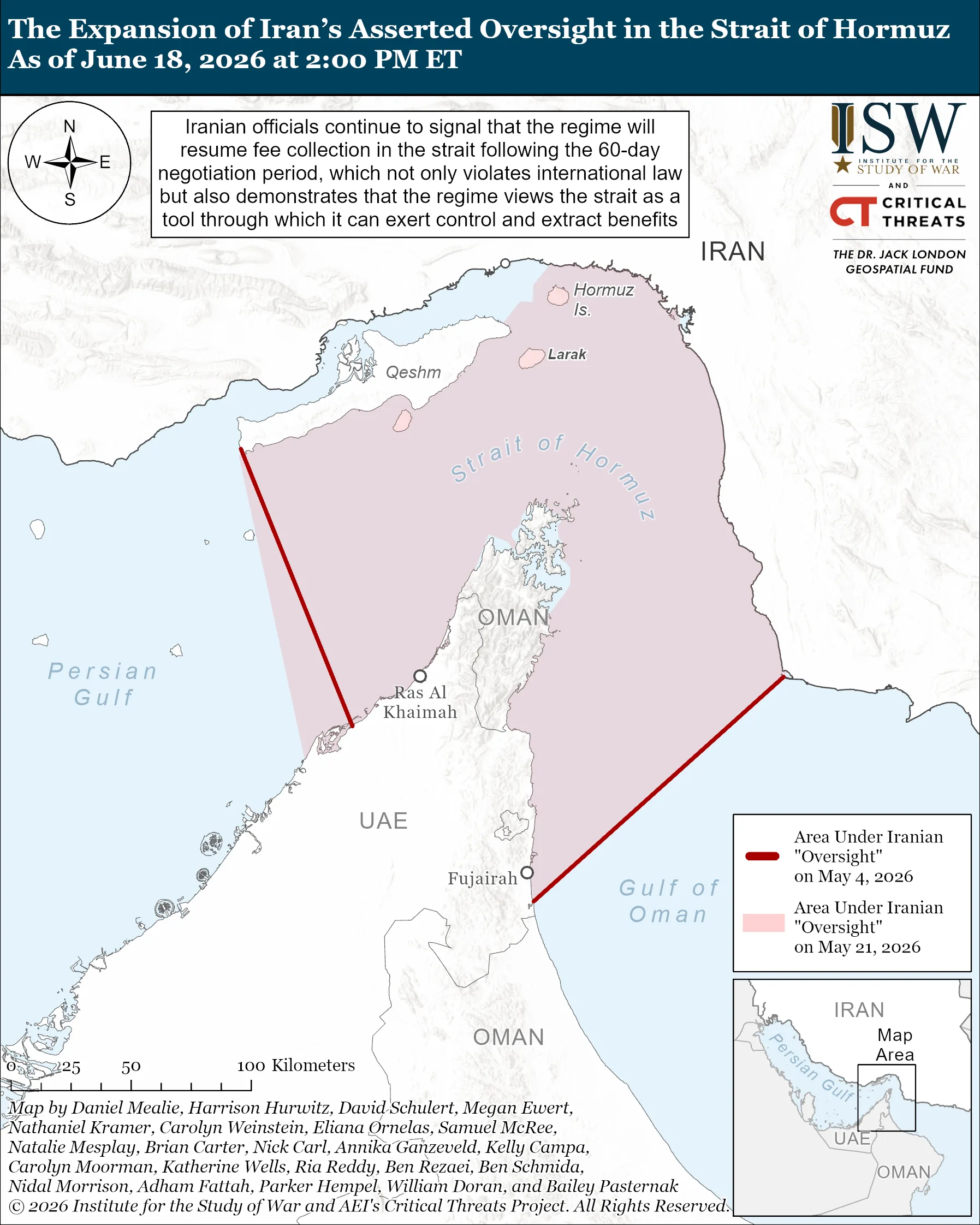
Iranian officials continue to signal that the regime will charge “fees” in the long-term for vessels that want to transit the strait, which is part of the broader Iranian effort to maintain long-term control over the strait. The MoU allows for a resumption of fee collection after 60 days. Iranian parliamentarian Saeed Ajorlou stated on June 18 that the agreement only prohibits Iran from charging fees during the initial 60-day period, according to clause 5, and implied that the regime may resume “fee” collection afterward.[16] IRGC-affiliated similarly stated on June 15 that Iran would suspend fees for 60 days but intends to reinstate them once that period ends.[17] Iranian officials have consistently characterized these charges as “service fees” rather than transit tolls, arguing that vessels therefore continue to have “toll-free” passage. The United Nations Convention on the Law of the Sea (UNCLOS) does not permit states bordering international straits to restrict transit passage or impose charges for the right to transit, however.[18] The Strait of Hormuz is an international strait, not territorial waters, and Article 26 of UNCLOS–which permits fees in territorial waters–therefore does not apply. The regime's explicit intention to charge “fees” over the long term not only violates international law but also demonstrates that the regime views the strait as a tool through which it can exert control and extract benefits. Iran's efforts to charge fees come at a time when Iran faces severe economic challenges and needs resources to rebuild its military and defense sectors following the war.
Iranian Supreme Leader Mojtaba Khamenei appears to be trying to avoid responsibility for the US-Iran MoU. Mojtaba released a written statement on June 18 regarding the US-Iran MoU.[19] Mojtaba stated that he authorized the MoU but emphasized that he had “a different opinion in principle.”[20] He added that Iranian President Masoud Pezeshkian and the Supreme National Security Council (SNSC), of which Pezeshkian is chairman, are responsible for protecting Iran‘s interests and preserving the Axis of Resistance. Placing responsibility with the president is almost certainly an effort to evade responsibility for any possible failures that may result from the MoU or the negotiation process.[21] The SNSC is Iran's highest national security and foreign policy decision-making body.[22] Mojtaba added that Pezeshkian told him that Iran will not submit if the United States makes “excessive demands.”[23] Mojtaba also highlighted that future in-person negotiations will not mean that Iran accepts the “enemy's” view.[24] Mojtaba’s statement comes after CTP-ISW previously assessed that Iranian regime factions have competed over the scope and aims of negotiations.[25] Mojtaba’s emphasis that Pezeshkian and the SNSC hold responsibility for the MoU appears to be a reaction to domestic pushback against the deal and part of a broader regime effort to manage internal concerns about the MoU’s implementation.
https://understandingwar.org/research/middle-east/iran-update-special-report-june-18-2026/
2,178
posted on
06/19/2026 1:16:42 AM PDT
by
AdmSmith
(GCTGATATGTCTATGATTACTCAT)
To: AdmSmith
2,179
posted on
06/19/2026 6:57:48 AM PDT
by
PIF
(They came for me and mine ... now its your turn)
To: nuconvert; PIF
2,180
posted on
06/19/2026 10:18:31 AM PDT
by
AdmSmith
(GCTGATATGTCTATGATTACTCAT)
Navigation: use the links below to view more comments.
first previous 1-20 ... 2,141-2,160, 2,161-2,180, 2,181-2,200 ... 2,401-2,406 next last
Disclaimer:
Opinions posted on Free Republic are those of the individual
posters and do not necessarily represent the opinion of Free Republic or its
management. All materials posted herein are protected by copyright law and the
exemption for fair use of copyrighted works.
FreeRepublic.com is powered by software copyright 2000-2008 John Robinson


