To: nuconvert
Iran Update Special Report, June 15, 2026
US and Iranian sources have expressed diverging interpretations of some key aspects of the recent US-Iran agreement. The full text of the agreement has not yet been published, which makes it difficult to ascertain which interpretations of the agreement are accurate. The United States and Iran reached an agreement on June 14 to end the war and are expected to formally sign the agreement in Geneva on June 19.[1] The agreement reportedly calls for a ceasefire on all fronts, requires Iran to “open” the Strait of Hormuz, and requires the United States to lift its naval blockade on Iranian ports.[2] US and Iranian officials have stated that additional negotiations, including discussions over Iran's nuclear program, will occur during the 60 days following the agreement's signing.[3] US Vice President JD Vance stated on June 15 that the United States expects the strait to be open “in a toll-free way for the long term.”[4] Islamic Revolutionary Guards Corps (IRGC)-affiliated media, by contrast, reported on June 15 that Iran will pause imposing “fees” on vessels transiting through the strait for the next 60 days but intends to resume charging vessels “service fees” after the 60-day period.[5] Iranian officials have also continued to signal their intent to jointly manage the strait with Oman.[6] US officials have also denied Iranian claims that the agreement will immediately release a portion of Iran's frozen assets and lift some sanctions. US officials, including US President Donald Trump and Vice President JD Vance, have instead insisted that sanctions relief and the release of Iranian assets are dependent on Iran's implementation of the agreement.[7] IRGC-affiliated media argued that Iran must “strictly implement its interpretation” of the agreement and disregard the United States’ “nonsense interpretations,” which further highlights the apparent divergence between Iran and the United States’ understandings of the deal.[8] These diverging interpretations of key provisions in the agreement will likely complicate the implementation of the agreement and the next phase of negotiations.
Iran's interpretation of the agreement's provisions about the Strait of Hormuz would constitute a significant strategic victory for Iran if its interpretation becomes the recognized reality. Iranian Foreign Affairs Ministry Spokesperson Esmail Baghaei stated on June 15 that Iran and Oman will manage traffic through the strait, provide maritime “services,” and collect related fees.[9] IRGC-affiliated media similarly claimed that the text of the US-Iran agreement was revised to emphasize Iranian and Omani sovereignty over the international waterway.[10] Iranian reports that Iran intends to resume “fee” collection in some capacity are consistent with repeated Iranian claims that these charges are “service fees” rather than transit tolls and therefore do not violate a “toll-free” arrangement.[11] Imposing tolls is one mechanism through which Iran exercises authority over the strait, but ISW-CTP previously assessed that Iran likely prioritizes securing recognized sovereignty over the strait over imposing a toll scheme in the strait.[12] The Iranian regime defines an “open” strait as one that remains under Iranian management, which conflicts with US and global commercial interests. Iranian officials have repeatedly identified control of the strait as a core strategic objective and a central pillar of Iran's long-term deterrence posture.[13] ISW-CTP previously assessed that Iran likely views control over the strait as essential to restoring deterrence against the United States and Israel following the degradation of its other deterrent capabilities.[14] Any agreement that permits Iran to retain any form of authority over the strait, regardless of whether it imposes tolls or not, would allow Iran to reimpose restrictions in the international waterway at its discretion. Such authority would give Iran significant leverage over global commerce, which Iran could use to extract concessions and advance its strategic objectives.
The reopening of the Strait of Hormuz depends on the risk calculus of shipping companies and ship captains. Continued Iranian threats against commercial shipping may have a negative impact on the willingness of companies and captains to resume transiting through the strait. Trump stated on June 15 that vessels have begun transiting through the strait via the “southern highway,” almost certainly referring to the internationally recognized traffic separation scheme.[15] Shipping companies will likely remain reluctant to resume normal operations, at least for the time being, due to the ongoing risk of Iranian attacks and naval mines, however. The IRGC Navy announced on June 15 that it has not issued transit permits over the past 96 hours and emphasized that the strait remains closed to all vessels.[16] The IRGC Navy reportedly warned ships not to approach areas under Iranian control “until further notice,” which is an implicit threat to attack vessels that attempt to transit through the strait without Iranian permission.[17] These threats are part of a broader Iranian effort since March 2026 to use force to deter vessels from transiting the strait without Iranian authorization.[18] Iran's mine-laying activities and threats to mine the strait are also a key component of this effort. Reuters, citing shippers in Asia and Europe, reported that shipping companies intend to resume navigation only after authorities fully confirm the safety of the waterway.[19] Reuters, citing Western maritime security services, added that mine-clearing operations could take 40 to 50 days.[20] Trump stated on June 14 that mine-removal operations will begin after the agreement is signed on June 19.[21] Iranian officials and media have not commented publicly on potential mine-clearing efforts.
Hezbollah has signaled that it will adhere to the Lebanon ceasefire outlined in the US-Iran agreement and suggested that the group views the agreement as a precursor for Israel's withdrawal from Lebanon.[22] Hezbollah issued a statement on June 15 in which it congratulated Iran for reaching an agreement with the United States that includes “a comprehensive ceasefire across all fronts, including Lebanon.”[23] A Hezbollah official told Reuters on June 15 that the group has ceased offensive operations since the US-Iran deal was announced and that Hezbollah's compliance with the ceasefire is linked to Israel's adherence to it.[24] ISW-CTP has not observed any Hezbollah attacks on northern Israel since the United States and Iran announced the agreement. Hezbollah also implied in its statement that the US-Iran agreement sets conditions for an IDF withdrawal from southern Lebanon, stating that the agreement “is a prelude to completing the liberation” of Lebanon.[25] Hezbollah has repeatedly demanded a full IDF withdrawal from Lebanon as part of any comprehensive ceasefire agreement.[26] Iranian media similarly implied on June 15 that an IDF withdrawal from southern Lebanon is part of the US-Iran agreement.[27] The Hezbollah official speaking to Reuters added that Hezbollah rejects IDF “freedom of movement” in Lebanon, which further illustrates Hezbollah's maximalist demand for an IDF withdrawal.[28] A senior US official told an Israeli reporter on June 15 that “an Israeli withdrawal from southern Lebanon is not a condition for reaching an agreement with Iran,” however.[29] Israel does not appear to be a party to this agreement, which complicates the clause that calls for a ceasefire in Lebanon.[30]
Israeli officials have stated that the IDF will continue to operate in Lebanon to degrade Hezbollah. Hezbollah and Iran could make their implementation of the US-Iran agreement contingent upon the cessation of Israeli operations against Hezbollah in order to push Israel to halt these operations. Israeli Defense Minister Israel Katz said on June 15 that Israel will maintain an indefinite IDF presence in security zones in Lebanon, Syria, and the Gaza Strip in order to maintain Israel's security.[31] Katz added that the IDF’s establishment of security zones in southern Lebanon is “among the IDF’s greatest achievements” in the war and emphasized that Israel ”oppose[s] an IDF withdrawal from Lebanon, despite all the existing pressures and those that will still come.”[32] A US official separately told an Israeli journalist that Israel has the right to respond to any Hezbollah attack.[33] Lebanese media reported that the IDF continued to strike targets in southern Lebanon as recently as the morning of June 15.[34] There are also conflicting reports on whether the IDF has continued ground operations in southern Lebanon. Two IDF soldiers in southern Lebanon told an Israeli journalist on June 15 that all IDF activity has ceased since the announcement of the US-Iran agreement.[35] Lebanese sources continue to report IDF movements and advances, including in towns beyond the ”Yellow Line,” however.[36] Iran recently linked US-Iran negotiations to the Lebanon issue in order to pressure the United States to push Israel to halt operations against Hezbollah.[37] Iran could similarly seek to make its implementation of the US-Iran agreement contingent upon Israel agreeing to a ”comprehensive ceasefire” in Lebanon.
Supporters of the US-Iran agreement within the Iranian regime continue to attempt to build a consensus around the US-Iran agreement amid criticism from the regime's anti-negotiations camp, led by the ultrahardline Paydari (Stability) Front. Iranian President Masoud Pezeshkian and Parliament Speaker Mohammad Bagher Ghalibaf continued to defend Iran's decision to sign the agreement and repeated their calls for Iranians to maintain unity and national cohesion.[38] Pezeshkian stated on June 15 that “nearly all” Iranian parliamentarians support the agreement and emphasized that the agreement was signed under the “guidance” of Supreme Leader Mojtaba Khamenei.[39] Pezeshkian’s comment comes amid criticisms from some Paydari Front members toward Iran's negotiating team and the US-Iran agreement. A Paydari Front parliamentarian criticized the agreement's reportedly vague timeline for the release of Iranian assets, for example..[40]
https://understandingwar.org/research/middle-east/iran-update-special-report-june-15-2026/
2,167 posted on
06/15/2026 11:42:19 PM PDT by
AdmSmith
(GCTGATATGTCTATGATTACTCAT)
To: AdmSmith

According to the sources, smuggling networks operating between Yemen, the Horn of Africa and the Red Sea have facilitated a series of negotiations between representatives of the armed group in Yemen and Sudanese armed actors. The most recent meeting, held last week, reportedly discussed a new mechanism and emerging routes for arms smuggling across the Red Sea.
The sources said the Houthis rely on smuggling networks with ties and influence in Yemen and the Horn of Africa, and use islands near Eritrea as temporary storage sites for weapons and components used in ammunition production. These sites are also believed to be used for assembling parts of drones and missiles.
Sheba Intelligence has also obtained the names of four Houthi military commanders believed to be involved in managing or coordinating arms-smuggling operations toward Sudan. The full details of the roles attributed to these commanders could not be independently verified.
The information comes as Sudan witnesses a sharp increase in the use of drones by the warring parties. The UN Deputy High Commissioner for Human Rights recently warned before the UN Human Rights Council of the growing use of drones in Sudan’s conflict, saying that more than 1,000 civilians were killed in drone strikes between January and May 2026. That figure accounted for around 80 percent of recorded civilian deaths during the period.
The emerging picture suggests that Sudan’s war is no longer confined to conventional frontlines. It is increasingly linked to the movement of low-cost military technology through regional smuggling networks, compounding risks to civilians, infrastructure and security across the Red Sea and the Horn of Africa.
Observers say the transfer of drone-related expertise and technology to non-state armed groups in Sudan could mark a more dangerous phase in the conflict, especially if such capabilities are combined with flexible smuggling routes, temporary storage hubs and cross-border networks that are difficult to monitor or disrupt.
These developments are deepening concerns that the Red Sea could become a dual-use corridor: not only for conventional commercial and military supply chains, but also for the trafficking of low-cost military technologies capable of reshaping the balance of power inside fragile conflict zones, with Sudan at the forefront.
https://shebaintelligence.uk/exclusive-houthis-transfer-iranian-technology-to-armed-groups-in-sudan2,168 posted on
06/15/2026 11:48:39 PM PDT by
AdmSmith
(GCTGATATGTCTATGATTACTCAT)
To: nuconvert
Iran Update Special Report, June 16, 2026
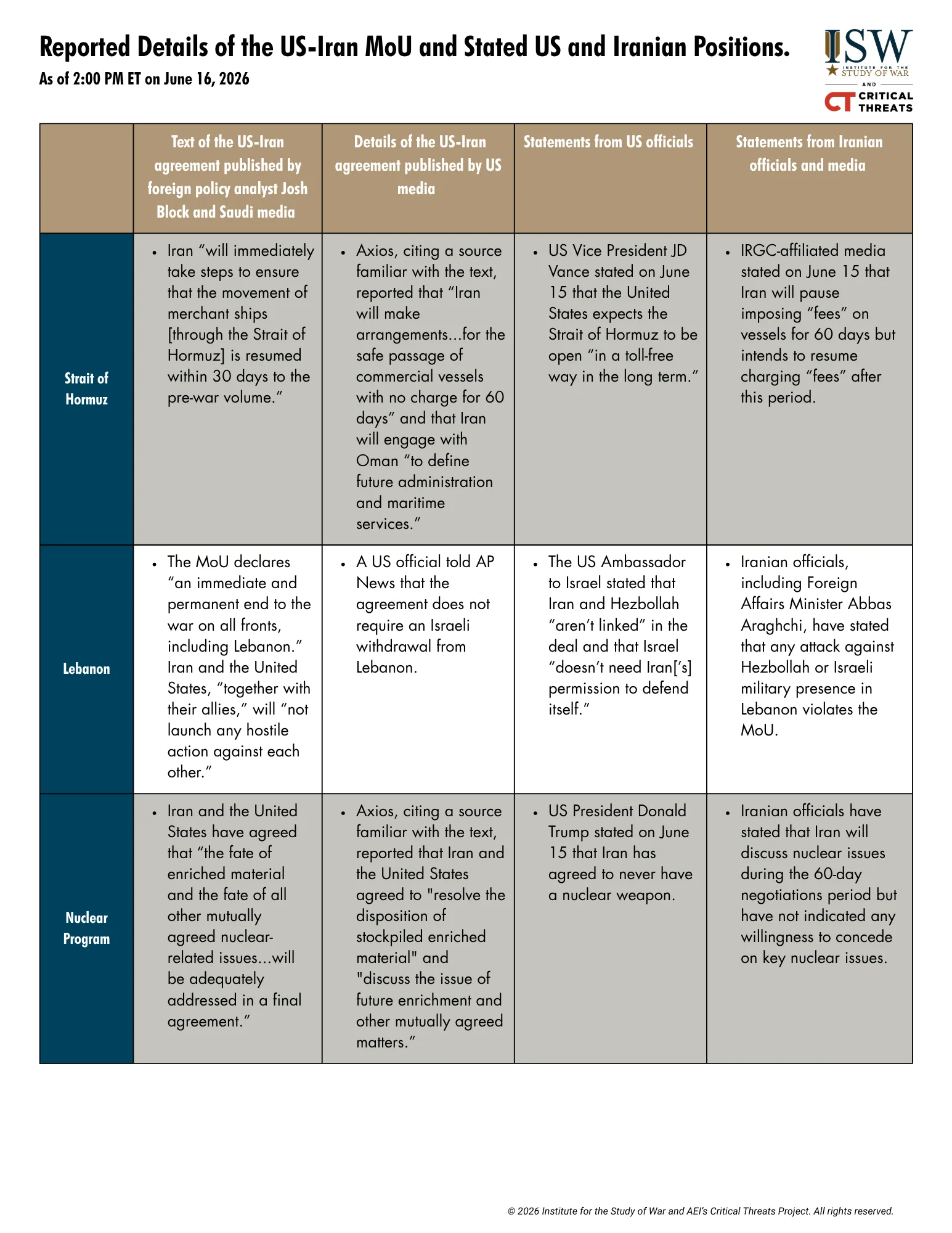
Multiple sources published what appears to be the text of the US-Iran agreement. Neither the United States nor Iran has officially published the text of the agreement at this time. The leaked text of the agreement, if accurate, indicates that Iran has emerged from the conflict in a stronger strategic position, however. Foreign policy analyst Josh Block and Saudi media published an identical version of the US-Iran memorandum of understanding (MoU) on June 16, detailing all 14 clauses of the agreement that the United States and Iran are set to sign in Switzerland on June 19.[1] The text declares that Iran and the United States will conduct further negotiations for 60 days upon signing the MoU, but notes that this negotiation period is “extendable by mutual consent.”[2] Western media outlets such as the Wall Street Journal and Axios corroborated several clauses of the agreement published by Block and Saudi media.
The MoU reportedly grants Iran significant economic relief, which Iran would likely use to try to reconstitute its missile, drone, and nuclear programs, as well as the Axis of Resistance. Block, Saudi media, and the Wall Street Journal reported that the United States will lift its blockade on Iranian ports and waive sanctions on Iranian oil exports and “related services” immediately upon signing the MoU.[3] Axios, citing a source familiar with the text, reported that the United States will “gradually” lift its blockade within 30 days of signing the MoU.[4] Iranian regime outlet Mehr News estimated on June 16 that Iran could generate up to $10 billion USD from just 60 days of oil exports.[5] Iran would likely use immediate economic relief to try to reconstitute its military capabilities, the Axis of Resistance, and its nuclear program. Arab mediators told the Wall Street Journal on June 13 that IRGC Commander Major General Ahmad Vahidi, whom ISW-CTP assesses as dominating regime decision-making, has insisted that Iran's frozen assets should not be “barred from military spending.”[6] Iranian Foreign Affairs Ministry Spokesperson Esmail Baghaei similarly stated in May that Iran would use assets released under a potential agreement with the United States to advance its defense and military sectors, including Iran's missile and drone programs.[7]
The MoU states that Iran could receive further economic relief by fulfilling its commitments in the MoU and reaching a final agreement that addresses key nuclear issues. ISW-CTP has not observed any indications that Iranian decision-makers are willing to make concessions on the nuclear issues that would be included in a final agreement, however. Block and Saudi media reported that the United States will release “frozen or restricted” funds and assets “in light of the progress of negotiations towards a final agreement.”[8] US Vice President JD Vance clarified to ABC News on June 15 that the release of frozen assets is contingent upon Iran taking “verified steps” to eliminate its highly enriched uranium (HEU) stockpile.[9] The United States, “together with its regional partners,” will also commit to forming a “rehabilitation and economic development” plan worth at least $300 billion USD, according to the text published by Block, Saudi media, and several Western outlets.[10] An Iranian outlet affiliated with Supreme Leader Military Adviser Mohsen Rezaei similarly reported that the MoU requires the United States and its allies to present a reconstruction plan worth at least $300 billion USD to Iran.[11] US President Donald Trump denied that the United States would give Iran $300 million USD.[12] The economic development plan is contingent upon the United States and Iran reaching a final nuclear agreement that addresses Iran's HEU stockpile and ability to enrich uranium on Iranian soil, but key Iranian decision-makers, such as Vahidi, have not signaled any willingness to concede on these issues. The current MoU reiterates Iran's commitment not to produce a nuclear weapon. Iranian officials have historically insisted that Iran does not seek to produce a nuclear weapon, but the regime has nevertheless developed in recent years the latent capability to develop a nuclear weapon if it decides to do so.
Iran will likely try to exploit the agreement's seemingly ambiguous language about the Strait of Hormuz to try to enforce its control over shipping through the strait. The MoU stipulates that Iran “will immediately take steps to ensure that the movement of merchant ships [through the strait] is resumed within 30 days to the pre-war volume,” according to Block, Saudi media, and several Western outlets.[13] Iran is expected to remove “technical obstacles” and naval mines from the strait during the 30-day period.[14] The text published by Block and Saudi media does not explicitly bar Iran from “managing” the strait, and Iran could therefore continue to insist on vessels using its illegal traffic separation scheme in Iranian territorial waters and paying “fees” to the IRGC Navy.[15] The MoU text also states that the United States and Iran will “respect each other's sovereignty and territorial integrity” and “refrain from interfering in each other's internal affairs.”[16] The Iranian regime has repeatedly claimed that it and Oman control the Strait of Hormuz as territorial waters. Iran could also try to argue that its “management” of the strait is an Iranian internal affair. The MoU text published by Block and Saudi media also does not mention whether Iran can charge tolls, despite President Trump stating on June 14 that vessels can pass through the strait “toll-free.”[17] Some versions of the agreement published in Western media on June 16 do mention that Iran will not charge tolls for 60 days and that Iran will work with Oman to “define future administration and maritime services” in the strait, however.[18] IRGC-affiliated media stated on June 15 that Iran will pause charging “fees” for 60 days but intends to resume charging “fees” after that period.[19] Iranian officials have consistently claimed that Iran is charging “service fees” as opposed to tolls in the Strait of Hormuz, and therefore that vessels are able to transit through the strait “toll-free.”
The Iranian regime is interpreting the clause in the agreement about a ceasefire “on all fronts” as a requirement for Israel to cease operations against Hezbollah and withdraw from Lebanon. This interpretation is part of a broader Iranian effort to preserve Hezbollah by trying to secure Israel's capitulation in Lebanon. Block and Saudi media reported that the MoU states that Iran and the United States, along with their allies, agree to “an immediate and permanent end to the war on all fronts, including Lebanon” and commit to “not launch any hostile action against each other.”[20] Iranian officials and media have argued that any Israeli attack against Hezbollah or Israeli military presence in Lebanon constitutes a violation of the MoU.[21] Israel does not appear to be a signatory to the MoU and continues to operate against Hezbollah in southern Lebanon, however. The Israel Defense Forces (IDF)continued to launch airstrikes against Hezbollah targets in response to Hezbollah attacks on Israeli forces in southern Israel.[22]
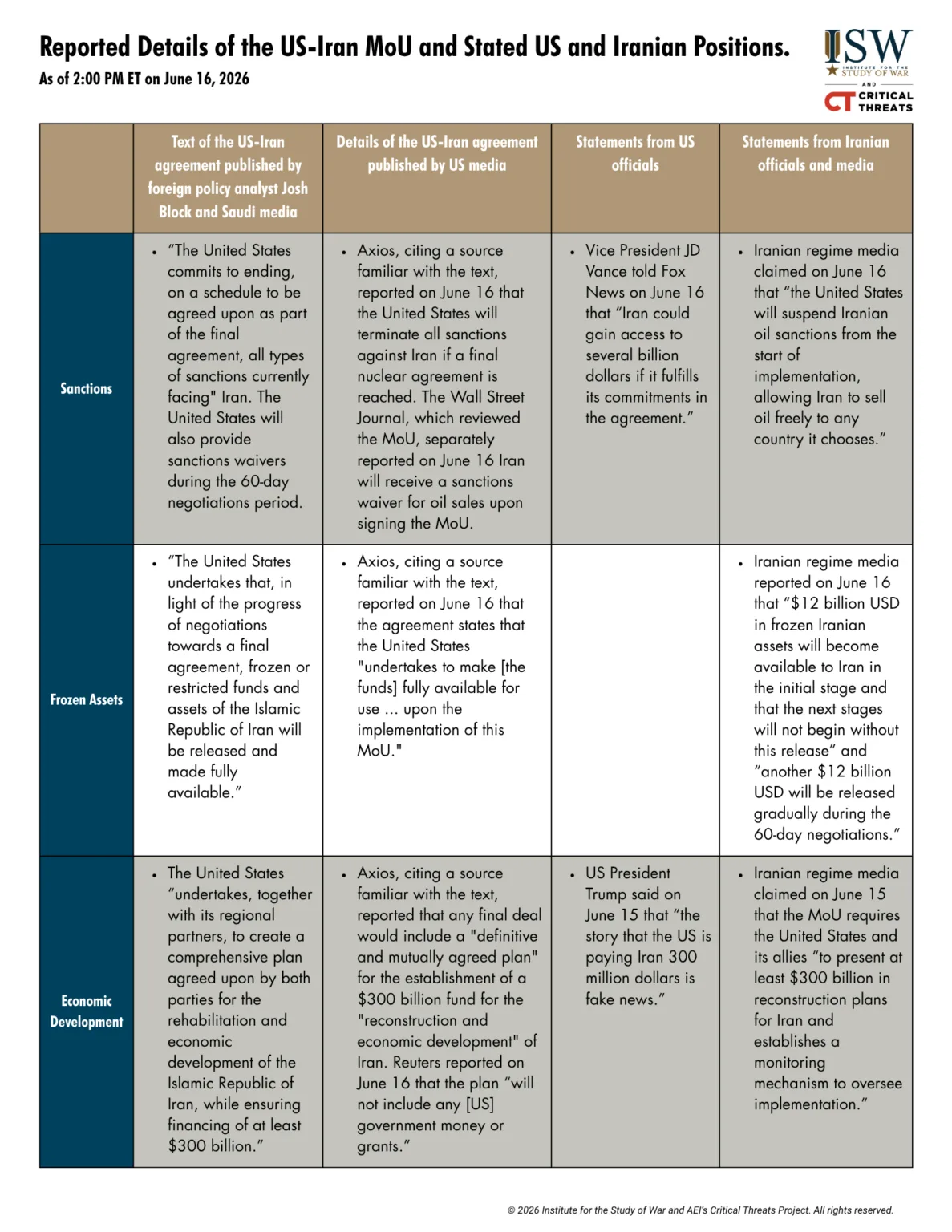
The reported MoU terms also indicate that Iran structured the agreement in a way to try to limit the United States’ ability to impose renewed pressure on Iran during the 60-day negotiations period and thereby make it more challenging for the United States to extract concessions from Iran during the negotiations. Block and Saudi media reported that the MoU states that“Iran and the United States agree that, pending a final agreement, they will maintain the status quo: Iran will maintain the status quo on its nuclear program, and the United States will not impose new sanctions on Iran or strengthen its forces in the region.” This clause prevents the United States from applying additional economic or military pressure on Iran over the next 60 days and therefore limits the United States’ leverage over Iran in nuclear negotiations. Iran may calculate that this clause will make it more difficult for the United States to force Iran to soften its red lines on the issues of HEU and uranium enrichment.
Iranian officials and media are largely framing the US-Iran MoU as an Iranian victory that codifies Iran's military achievements. The Iranian regime's English-language media outlet, Press TV, argued on June 16 that the MoU is not simply a ceasefire, but rather represents the “political codification of a battlefield reality.”[23] Press TV argued that Iran views the Strait of Hormuz and the Axis of Resistance as two of its most important tools of deterrence that it can use to ensure “compliance with future agreements.”[24] IRGC Quds Force Commander Brigadier General Esmail Ghaani separately praised Iran's negotiating team for linking negotiations with the United States to Israel's operations against Hezbollah in Lebanon.[25] Ghaani additionally praised the Axis of Resistance for its involvement in the war, claiming that Hezbollah is “unstoppable” and that Israel is closer to “collapse” than it was before the war.[26]
Iraqi Prime Minister Ali al Zaydi and US Special Envoy for Iraq and Syria Tom Barrack released a joint statement on June 16 that outlined a shared vision for the “complete disarmament and disbandment of [Iraqi] armed groups.” Zaydi and Barrack released the statement after meeting in Baghdad on June 15.[27] The statement comes amid the Iraqi federal government's efforts to restrict weapons to the state.[28] The United States has increasingly pressured the Iraqi federal government in recent months to decrease Iranian influence in Iraq, including through militia disarmament, due to militia attacks against US and foreign targets in Iraq and the region during the war.[29] Zaydi is expected to meet with US President Donald Trump in Washington, DC, in July.[30]
Popular Mobilization Commission (PMC) Chairman Faleh al Fayyadh replaced the Saraya al Salam-affiliated Popular Mobilization Forces (PMF) Samarra Operations Command commander with an Asaib Ahl al Haq member on June 16.[31] The PMF is an Iraqi state security service that includes many Iranian-backed Iraqi militias that answer to Iran instead of the Iraqi prime minister.[32] The Popular Mobilization Commission is officially responsible for ensuring that PMF brigades answer to the prime minister.[33] Shia Nationalist Movement leader Muqtada al Sadr announced the dissolution of Saraya al Salam on May 27 and the full integration of the militia's members into the Iraqi state.[34] Samarra City holds religious significance for Iraqi Shia and Sadr-aligned forces, including Saraya al Salam, have maintained control and influence in the area for years.[35] Iraqi media reported on June 16 that Sadr directly ordered Saraya al Salam forces to accept the PMC’s decision.[36] Saraya al Salam announced on June 16 that its forces will remain in Samarra City until the “security file” has been legally transferred to the state, but confirmed the group's separation from Sadr's Shia Nationalist Movement and full integration into the Iraqi state.[37] The replacement of a Saraya al Salam-affiliated commander with an Asaib Ahl al Haq member is particularly notable given the long-standing tensions between these two groups. Asaib Ahl al Haq head Qais al Khazali formed Asaib Ahl al Haq as a splinter group from Sadr's Mahdi Army, which preceded Saraya al Salam, in the years following the 2003 US invasion of Iraq.[38] Forces from Saraya al Salam and Asaib Ahl al Haq clash sporadically in southern Iraq.[39]
https://understandingwar.org/research/middle-east/iran-update-special-report-june-16-2026/
2,169 posted on
06/17/2026 12:09:08 AM PDT by
AdmSmith
(GCTGATATGTCTATGATTACTCAT)
FreeRepublic.com is powered by software copyright 2000-2008 John Robinson