Skip to comments.
Iranian Regime tv Channel One hacked while it was airing Khamenie speech
various
| 10-8-22
Posted on 10/08/2022 1:05:38 PM PDT by nuconvert
Iranian Regime national tv Channel One hacked about an hour ago. During a broadcast of Khamenie speech, a red crosshair appeared over his face and chanting of Women. Life. Freedom. There was writing to the side saying "Rise up. Join us". Also 4 photos at the bottom of the screen of young people killed and additional writing: "The blood of our youth is dropping from your paws".
Also, there was a huge banner in the middle of Tehran highway today that read: We are no longer afraid of you. We will fight.
Also, attempted attack on IRI ambassador in Denmark. Her bodyguard was stabbed. Diplomatic Security intervened before the attacker could stab the ambassador.
TOPICS:
KEYWORDS: basij; deathtothemullahs; denmark; ebrahimrigi; erdogan; iran; iranprotests; iraq; irgc; iri; israel; khameini; khamenei; kurdistan; lebanon; mahsaamini; mullahloversonfr; mullahsmustbekilled; najisharifizindashti; protests; qudsforce; raisi; receptayyiperdogan; shahrammaroufmola; syria; turkey; yemen; zahedi
Navigation: use the links below to view more comments.
first previous 1-20 ... 1,981-2,000, 2,001-2,020, 2,021-2,040 ... 2,461-2,478 next last
Iran Update Special Report, May 7, 2026
US Central Command (CENTCOM) announced on May 7 that US forces “eliminated inbound threats” and struck Iranian military facilities responsible for attacks on US forces after Iran targeted US naval assets in and around the Strait of Hormuz.[1] CENTCOM stated that the United States “does not seek escalation.” CENTCOM reported that Iranian forces launched multiple missiles, drones, and fast attack craft at US naval assets, including the USS Truxtun, USS Rafael Peralta, and USS Mason, while the vessels were transiting the strait. CENTCOM confirmed that the munitions did not hit any US assets. US forces subsequently struck Iranian military targets responsible for the attacks, including missile and drone launch sites, command-and-control centers, and intelligence, surveillance, and reconnaissance sites. A senior US official told Fox News that US forces struck Bahman Port on Qeshm Island, an unspecified target in Bandar Abbas, Hormozgan Province, and the Bandar Kargan naval checkpoint, also in Hormozgan Province.[2] The official added that the strikes do not indicate a resumption of the war.[3]
Iranian media claimed that Iran fired missiles at US warships south of Chabahar Port after US forces targeted two Iranian vessels near Jask, Hormozgan Province, and Fujairah Port in the United Arab Emirates (UAE).[4] Khatam ol Anbia Central Headquarters Spokesperson Ebrahim Zolfaghari warned Emirati civilians to “stay away from oil and military centers” following the attacks.[5] The recent strikes follow a series of Iranian attacks against the UAE on May 4 and 5, including a strike on the Fujairah Petroleum Industrial Zone, a key port that the UAE uses to bypass the strait.[6] ISW-CTP will continue to monitor this situation and provide further analysis in its May 8 morning thread on X.
The United States and Iran remain divided over key issues, particularly issues related to Iran's nuclear program and Iranian efforts to assert sovereignty over the Strait of Hormuz. The Wall Street Journal, citing senior US officials, reported on May 6 that the US Government has seven main demands.[7] These demands include the dismantlement of Fordow, the Esfahan Nuclear Technology Center, and Natanz, a ban on underground nuclear activities, on-demand inspections, a 20-year moratorium on enrichment, an Iranian commitment not to seek a nuclear weapon, the removal of all enriched nuclear material from Iran, and the reopening of the Strait of Hormuz.[8] Iranian officials continue to reject many of these demands, however.[9] Parliamentary National Security and Foreign Policy Commission Vice Chairman Behnam Saeedi stated on May 7 that Iran's red lines include enrichment, the Strait of Hormuz, complete sanctions relief, and the release of frozen Iranian assets.[10] Saeedi added that negotiations will fail if the United States does not accept Iran's “right” to enrichment.[11] Unspecified individuals familiar with the matter told the Wall Street Journal on May 6 that key issues, including the length of any enrichment moratorium, the possible removal of Iran's HEU from Iran, and Iran's assertion of sovereignty over the Strait of Hormuz, “remain unresolved and are expected to complicate any talks.”[12]
Iran's highly enriched uranium (HEU) stockpile and enrichment activities continue to be some of the main obstacles to a deal. Israeli media reported on May 6 that US President Donald Trump insists on the removal of Iran's HEU stockpile from Iran and will not sign an agreement that does not address that demand.[13] Armed Forces General Staff (AFGS)-run Defa Press rejected on May 7 both diluting and handing over Iran's HEU, stating that diluting uranium is equivalent to handing over uranium to “the enemy.”[14] Three Iranian officials similarly told the New York Times on May 7 that talks with the United States remain stalled over US demands that Iran commit in advance to hand over its HEU stockpile, close the Fordow, Natanz, and Esfahan nuclear facilities, and suspend enrichment for 20 years.[15] The officials stated that Iran has instead proposed diluting “some” of its HEU stockpile, transferring the remainder to a third country, possibly Russia, and suspending enrichment for 10 to 15 years.[16] Iranian officials also appear divided over how much the regime should concede on the nuclear file.[17] ISW-CTP previously assessed that Islamic Revolutionary Guards Corps (IRGC) Commander Major General Ahmad Vahidi, who has not publicly indicated any willingness to concede on these nuclear issues, is currently the main decisionmaker in the regime..[18]
Iran is increasingly attempting to formalize recognition of its sovereignty over the Strait of Hormuz in a way that would fundamentally remake regional and global maritime norms in a manner extremely detrimental to US interests. Iran recently designed and implemented a new system under which vessels receive transit regulations and instructions by email and must comply with Iranian procedures to obtain authorization for passage through the strait.[19] CNN reviewed a “Vessel Information Declaration” form on May 7, which was issued by Iran's Persian Gulf Strait Authority, that requires vessels to provide extensive ownership, nationality, and crew information before being granted permission to transit through the strait.[20] Iranian parliamentarians stated that vessels cannot pass through the strait without accepting Iranian sovereignty over the strait and argued that the United States must submit to Iran's “new legal regime” in the waterway.[21] Supreme Leader Military Adviser Major General Mohsen Rezaei told Hezbollah-affiliated Al Mayadeen on May 6 that Iran has two main objectives in the Strait of Hormuz: “security” and trade.[22] Rezaei argued that Iran must control and manage the strait because the United States and Israel used the strait and the Persian Gulf to attack Iran during the war.[23] Iranian officials’ statements indicate that Iran is trying to secure long-term recognition of its control over strait transit.
Iranian regime media highlighted a meeting between Iranian Supreme Leader Mojtaba Khamenei and President Masoud Pezeshkian, likely to display unity amid reports of divisions within the regime. Iranian state media reported on May 7 that Pezeshkian met with Mojtaba for nearly two and a half hours but did not provide details about what Mojtaba and Pezeshkian discussed.[24] Pezeshkian stated after the meeting that Mojtaba’s “behavior can naturally be a model for the country's management and administrative system.”[25] This meeting comes after anti-regime media reported on May 5 that Pezeshkian was “angry” with IRGC Commander Major General Ahmad Vahidi’s decision to attack the United Arab Emirates (UAE).[26] Pezeshkian reportedly sought an emergency meeting with Mojtaba to ask him to stop the IRGC’s attacks on the UAE and to prevent their reoccurrence.[27] The fact that Iranian media and Mojtaba’s office have not provided details about what Mojtaba and Pezeshkian discussed suggests that Pezeshkian did not convince Mojtaba to alter the regime's current policies. ISW-CTP continues to assess that Vahidi is the regime's primary decisionmaker. Israeli media reported on April 19 that Vahidi is the only Iranian official with direct access to Mojtaba and is serving as a conduit for relaying key decisions to other regime officials.[28] Anti-regime media previously reported on April 1 that Pezeshkian had repeatedly tried to contact Mojtaba, but that a “military council” formed by Vahidi had prevented Pezeshkian from contacting Mojtaba.[29]
Iranian-backed Badr Organization head Hadi al Ameri has reportedly formed a committee with Iraqi Prime Minister-designate Ali al Zaidi and caretaker Prime Minister Mohammad Shia al Sudani to develop a plan to disarm Iranian-backed Iraqi militias.[45] US-funded Arabic media reported on May 5 that the Shia Coordination Framework, which is a loose coalition of Shia political parties, compelled the three officials to convene and develop an “implementable” plan to restrict arms to the Iraqi government.[46] Ameri met with Zaidi on May 7 to discuss government formation and the need for unity among “national political forces.”[47] An unnamed Shia Coordination Framework source claimed that several Iranian-backed Iraqi militias, including Asaib Ahl al Haq and the Imam Ali Brigades, have expressed support for the disarmament initiative if it incorporates the militias’ unspecified conditions for disarmament.[48] An unnamed Iraqi National Security Council official stated that Iranian-backed Iraqi militias Kataib Hezbollah and Harakat Hezbollah al Nujaba have rejected disarmament.[49] Harakat Hezbollah al Nujaba leader Akram al Kaabi rejected militia disarmament on May 6 and called the group's weapons a “red line.”[50]
https://understandingwar.org/research/middle-east/iran-update-special-report-may-7-2026/
2,001
posted on
05/07/2026 10:14:14 PM PDT
by
AdmSmith
(GCTGATATGTCTATGATTACTCAT)
2,002
posted on
05/07/2026 10:16:16 PM PDT
by
AdmSmith
(GCTGATATGTCTATGATTACTCAT)
While the Pakistan Air Force is protecting Saudi Arabia’s airspace against the threats posed by Iranian drones and cruise missiles, the Egyptian Air Force is doing the same for the UAE. Today, President of Egypt appeared together with Egyptian Air Force DM/EM fighters deployed to the UAE, which are responsible for protecting the country against possible threats posed by Iranian one-way attack drones.
https://x.com/BabakTaghvaee1/status/2052452493872021814
Saudi Arabia and Kuwait have restored access for U.S. military aircraft to use Prince Sultan and Ali Al-Salem Air Bases, allowing the United States to resume Project Freedom aimed at restoring access yl Hormuz Strait by enabling commercial shipping to safely pass through the strategic waterway.
Earlier, Saudi Arabia and Kuwait had restricted access for U.S. military aircraft to these air bases and denied overflight permissions through their airspace in what appeared to be an attempt to sabotage Project Freedom and avoid direct confrontation with Iran. However, the situation has now changed.
https://x.com/BabakTaghvaee1/status/2052451728063115354
It has now become clear that Project Freedom for opening of Hormuz Strait by President Trump failed largely because Saudi Arabia and Kuwait denied airspace overflight permission and base access to U.S. military aircraft involved in the operation. Both countries were dissatisfied with the actions of the United Arab Emirates and viewed the operation aimed at reopening normal trade as an attempt to rescue the UAE’s economy rather than a mission serving broader regional stability and security interests.
https://x.com/BabakTaghvaee1/status/2052255901126390225
The UAE has joined the US, Bahrain, Kuwait, Saudi Arabia and Qatar in urging the United Nations to adopt a draft resolution to halt the mining of the Strait of Hormuz alongside ongoing Iranian attacks.
The draft condemns Iran’s alleged violations of the current ceasefire and its “actions and threats aimed at closing, obstructing, tolling” freedom of navigation through the strait.
The resolution demands that Iran immediately cease attacks, disclose the locations of any sea mines, end illegal tolls and interference with lawful navigation, establish humanitarian corridors for food, fertilizer, and essential goods, and not impede clearance operations.
The new text was drafted by the US and Bahrain, with support from Saudi Arabia, the UAE, Kuwait and Qatar.
https://www.arnnewscentre.ae/news/uae/uae-joins-five-nations-to-urge-adoption-of-un-resolution-on-maritime-security/
2,003
posted on
05/08/2026 1:26:22 AM PDT
by
AdmSmith
(GCTGATATGTCTATGATTACTCAT)
To: AdmSmith; nuconvert; Jonty30; BeauBo; blitz128; USA-FRANCE; MalPearce; Political Junkie Too; ...
“Rezaei argued that Iran must control and manage the strait because the United States and Israel used the strait and the Persian Gulf to attack Iran during the war.”
This quote from an ISW report has to be one of the most absurd demands to come out of any war. It is right up there with Putin’s demands for Ukraine to accept Russia’s claim for ALL of several partially occupied Oblasts in Ukraine, plus several where Russian troops maintain NO presence whatsoever. By this reasoning, the US should claim all the North Atlantic between the US and the UK because Britain attacked us by that route in the War of 1812 when we were a functional independent country.
I wonder how many of these new guys will be additional subjects of Israeli attention in the immediate future. Iran’s Parliament head saw Mullah approved Iran leader, the former grand Mullah’s son Mojtaba, in an emergency meeting to ask him to stop the IRGC’s attacks on the UAE. However, no agreement was reached to approve that request. ISW remains convinced IRGC Commander Major General Ahmad Vahidi continues to be the supreme decision maker in Iran. If Israel does not act, how many of the other Middle East countries subject to ongoing attacks will allow them to continue?
2,004
posted on
05/08/2026 9:54:43 AM PDT
by
gleeaikin
(Question Authority: report facts and post their links" in your messages.)
To: AdmSmith; nuconvert; dennisw; blitz128
Yesterday I saw my new Iranian/US Citizen friend again and gained some new information. He still has indirect contact with relatives in Iran and picks up other important information. When I mentioned how sad it was that some civilian structures and people are being hit by our forces, he responded that their feeling is “burn it to the ground, leave only ashes,” just eliminate the Mullahs and IRGC.
I saw a recent article at the Search box when I entered IRAN. This was about the beating to death of someone who had in their possession one of the portable Starlink devices. Hconfirmed that there are Freedom lovers with this equipment, but they have it at risk to their lives. All are hoping the US does not loose focus, or trust Pakistan’s good attentions. He also confirmed the use of foreign fighters who did not mind murdering protesters. Unfortunately he had to leave soon before I could ask other questions.
2,005
posted on
05/08/2026 11:38:46 AM PDT
by
gleeaikin
(Question Authority: report facts and post their links" in your messages.)
Interesting
The Wrong Ships for the Wrong Job
Nick Wade
The United States is not winning the Iran war. It is not going to win it. I have been making that argument since the opening strikes in February, and each development since has added a layer to the same underlying case.
https://nickwade.substack.com/p/the-wrong-ships-for-the-wrong-job
2,006
posted on
05/08/2026 1:44:20 PM PDT
by
AdmSmith
(GCTGATATGTCTATGATTACTCAT)
To: AdmSmith
At one point, Nick Wade argues that the US needs a battleship to make things effective.
2,007
posted on
05/08/2026 2:23:39 PM PDT
by
PIF
(They came for me and mine ... now its your turn)
To: AdmSmith; BeauBo; dennisw; blitz128; nuconvert
2,008
posted on
05/08/2026 7:52:31 PM PDT
by
gleeaikin
(Question Authority: report facts and post their links" in your messages.)
Iran Update Special Report, May 8, 2026
Iranian officials continue to frame control over the Strait of Hormuz as a key strategic interest and a critical component of long-term Iranian deterrence. Iran likely views control over the strait as essential to restoring deterrence against the United States and Israel following the degradation of its other forms of deterrence. Supreme Leader adviser Mohammad Mokhber stated in an interview with Iranian media that Iran's position in the strait is similar to the strategic value of a nuclear weapon.[1] Mokhber’s role as an adviser to the supreme leader suggests that his statements, at least in part, reflect the regime's thinking at the highest levels. Mokhber argued that control over a major economic chokepoint gives Iran the ability to affect the global economy “with one decision.”[2] He added that Iran “will not lose the strait under any circumstances.”[3] Mokhber’s statements are consistent with CTP-ISW’s assessment that Iran's principal positive strategic objective at this time is to secure recognition of its sovereignty over the strait.[4] Mokhber’s characterization of the strait and his comparison between the strait and Iran's nuclear program also reflect the regime's evolving concept of deterrence. Iran appears to seek to use the strait as a future deterrent because its historical pillars of deterrence—including its missile and drone capabilities, proxy network, and air defense systems—have proven unable to deter major US or Israeli attack in June 2025 and Spring 2026. Iranian leaders may assess that the severe degradation of their traditional forms of deterrence requires Iran to assign greater strategic significance to the strait. Iran's growing reliance on the strait suggests that the regime may not concede over control of the strait in negotiations, which is consistent with CTP-ISW’s ongoing assessment that some senior Iranian officials, including Islamic Revolutionary Guards Corps (IRGC) Commander Brigadier General Ahmad Vahidi who is currently driving decision-making within the regime, may prefer renewed confrontation over compromise if negotiations require Iran to relinquish control over the strait.[5]
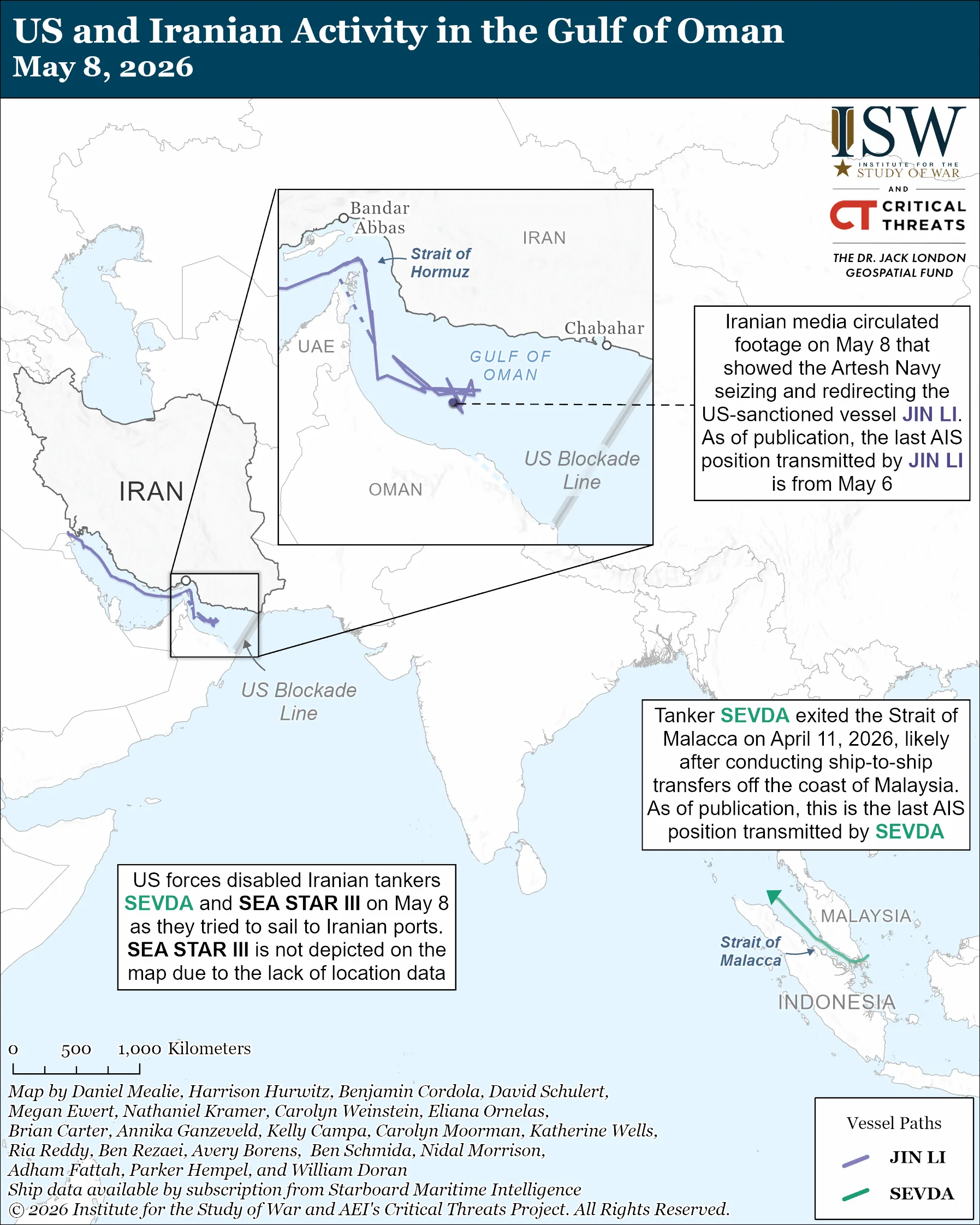
Iran has continued to try to demonstrate its control over the Strait of Hormuz in order to sustain high global oil prices and pressure the United States into concessions. Iranian media circulated footage on May 8 that showed the Artesh Navy seizing and redirecting the vessel JIN LI in the Gulf of Oman.[6] The US Treasury sanctioned JIN LI (aka OCEAN KOI) in February 2026 for transporting millions of barrels of Iranian petroleum products since May 2025.[7] The vessel has operated as part of Iran's shadow fleet since at least 2020.[8] A Chinese company, Ocean Kudos Shipping Company Limited, owns the vessel and is also sanctioned for its involvement in the shipment of Iranian petroleum products.[9] JIN LI previously traveled multiple times between Basra, Iraq, and Fujairah Port in the United Arab Emirates, and most recently was idling near Fujairah, but maritime data suggests that the vessel has spoofed its location.[10] It remains unclear whether the vessel was actively involved in Iran's shadow fleet at the time of its seizure. Iranian media accused the vessel of disrupting Iranian oil exports and undermining Iranian national interests; however, this suggests that JIN LI may have attempted to transit the strait without coordination with the Iranian Armed Forces.[11] Iranian officials have repeatedly threatened to respond to vessels that transit the strait without such coordination.[12] Iran likely uses vessel seizures to reinforce perceptions that it controls access through the strait. These seizures increase risks for commercial shipping and contribute to higher global oil prices.
The United States and Iran remain divided over key issues, particularly Iran's nuclear program, the status of Iran's highly enriched uranium (HEU) stockpile, and Iranian efforts to assert sovereignty over the Strait of Hormuz. Iranian Foreign Affairs Ministry Spokesperson Esmail Baghaei stated on May 8 that Iran is still reviewing the recent US proposal and will respond once Iran reaches a final decision.[13] Baghaei also stated on May 7 that Iran has decided to pursue negotiations in a “new format” through Pakistan and added that Iranian decisionmakers chose not to enter nuclear talks “for the time being.”[14] US President Donald Trump warned on May 8 that the United States could conduct renewed attacks if Iran does not quickly accept a deal.[15] Secretary of State Marco Rubio stated on May 8 that the United States expects an Iranian response soon and hopes it could begin a “serious process of negotiation.”[16] Iranian officials continue to signal unwillingness to compromise on core issues, particularly enrichment activities and Iranian control over the Strait of Hormuz, however.[17] Iran's delayed response likely reflects continued internal disagreements and the apparent unwillingness of hardline actors, particularly IRGC Commander Major General Ahmad Vahidi and his allies, to make major concessions on core issues.[18]
The United States has continued efforts to maintain an effective naval blockade against Iran as Iran continues to assert long-term sovereignty over the Strait of Hormuz. US Central Command (CENTCOM) announced on May 8 that US naval forces have redirected 57 vessels since the blockade began on April 13.[19] CENTCOM also reported that US forces disabled two Iranian tankers, Sea Star III and Sevda, on May 8 after both vessels attempted to enter an Iranian port along the Gulf of Oman.[20] Iran would have presumably used the tankers to expand its floating oil storage capacity as the US blockade continues to strain the regime's ability to store crude oil. Iran has already reactivated older tankers and repurposed empty vessels as temporary offshore oil storage to alleviate some of the mounting pressure on onshore facilities.[21] CENTCOM also stated on May 8 that US naval forces are currently preventing more than 70 tankers from entering or departing Iranian ports as part of the blockade.[22] These vessels collectively can hold more than 166 million barrels of Iranian oil, worth at least $13 billion USD.
Iran has continued to escalate rhetorically and militarily against the United Arab Emirates (UAE) amid Iranian attempts to portray the UAE as a hostile state supporting US and Israeli operations against Iran. Iran likely also seeks to demonstrate that continued US military actions against Iran will generate direct security and economic costs for Gulf states cooperating with the United States. Iranian Parliament National Security and Foreign Policy Committee member Ali Khezrian stated on May 8 that Iran now considers the UAE a “hostile base” rather than a neighbor and claimed that the UAE helped facilitate attacks against Iran during the war.[23] Supreme Leader Advisor Mohammad Mokhber stated on May 8 that the UAE “has been punished” and “will be punished more.”[24] Iran has recently conducted a series of attacks against the UAE that likely seek, in part, to isolate the UAE from other Gulf states and drive a wedge between the UAE and the United States and Israel in response to the UAE’s strengthening cooperation with both countries.[25] The UAE Defense Ministry stated on May 8 that Emirati air defenses intercepted two Iranian ballistic missiles and three drones targeting the UAE.[26]
Confidential Russian documents, seen by The Economist, revealed a Russian proposal to offer Iran several thousand drones and training for Iranian drone operators, which raises concerns about the proliferation of fiber-optic drone technology to Iran and its regional proxies.[27] The proposal offers Iran 5,000 short-range fiber-optic drones, an unspecified number of longer-range satellite-guided drones equipped with Starlink terminals, and training for Iranian personnel to operate both systems.[28] The Economist stated that it could not confirm whether Russian officials have presented the proposal to Iran yet. The documents are undated, but The Economist assessed that they likely originated during the first six weeks of the war when US officials were reportedly considering a possible ground operation in Iran. One diagram in the documents depicts Russian-trained Iranian drone operators attacking an amphibious landing force through coordinated drone swarms launched from concealed positions in response to a US operation to reopen the Strait of Hormuz or seize Kharg Island. Fiber-optic drones have limited utility in a maritime environment and have not been used at scale over the ocean in Ukraine. The documents do not specify which drone systems Iranian operators would use, but fiber-optic first-person view (FPV) drones have limited utility against commercial shipping unless operators specifically target vessel crews.[29] The limited utility is in part because fiber-optic FPV drones operating 55 kilometers from Iran's shore in the Strait of Hormuz would have a limited warhead size due to the amount of fiber optic cable they could carry, even if fiber optic FPV drones could be made to operate over the Strait of Hormuz's maritime environment. The limited warhead would have challenges generating functional kills on tankers by targeting the rudder or other systems. The fiber-optic drones would instead most likely support attacks against land targets, including amphibious vehicles and landing craft approaching the shore. The longer-range satellite-guided drones, however, could support maritime operations such as attacks on vessels. Reports of this proposal follow reports that Russia supplied Iran with satellite imagery of US bases and modified Shahed drones during the recent war.[30]
The reported Russian proposal further illustrates concerns about the proliferation of fiber-optic drones to Iranian proxy groups, some of which have already demonstrated the ability to employ these systems against US and allied targets. Iranian-backed Iraqi militias and Lebanese Hezbollah have both used fiber-optic first-person view (FPV) drones during the current conflict.[31] Likely Iranian-backed Iraqi militias conducted two fiber-optic drone attacks on Kuwaiti border posts in April 2026.[32] CTP-ISW previously assessed that Russia most likely transferred fiber-optic drone technology to Iran, which Iran then disseminated to Axis of Resistance groups, including Iraqi militias.[33] Hezbollah has conducted several fiber-optic FPV drone attacks against Israeli forces and positions in northern Israel and southern Lebanon since March 2026.[34] Hezbollah is likely assembling at least some of its fiber-optic drones in Lebanon based on photos of seized drone components, the relative ease of acquiring the necessary equipment to do so, and reported Israeli assessments in April that Hezbollah is assembling these drones domestically rather than receiving pre-assembled drones from Iran.[35] Israeli officials told The Economist that the IRGC has supplied Hezbollah with these fiber-optic drones, however.[36] It is unclear if this is an updated Israeli assessment, but it is possible that Iran has supplied Hezbollah with at least some of the fiber-optic drones that the group has used in recent attacks against Israel. Russia's reported willingness to provide Iran with fiber-optic drones could accelerate the spread of such advanced drone technology across Iran's regional proxy network and increase the threat that these groups pose to US and allied forces and interests.
The Institute for Science and International Security assessed on May 7 that US and Israeli airstrikes in 2026 targeted Iranian nuclear weaponization sites, following June 2025 strikes that disabled enrichment infrastructure.[37] Both strikes together increased the time and uncertainty for Iran to build a nuclear weapon using its existing uranium stockpiles, according to the institute.[38]
Read the report:
https://understandingwar.org/research/middle-east/iran-update-special-report-may-8-2026/
2,009
posted on
05/09/2026 12:57:20 AM PDT
by
AdmSmith
(GCTGATATGTCTATGATTACTCAT)
To: PIF
Yes, he described the technology of the 1980s: Operation Earnest Will – the US convoy escort mission through the Gulf in 1987-88 – established what it actually requires: three to four dedicated escort vessels, with a supporting force behind them including a battleship, a carrier with F-14 and F/A-18 aircraft, and AWACS coverage.
2,010
posted on
05/09/2026 1:00:52 AM PDT
by
AdmSmith
(GCTGATATGTCTATGATTACTCAT)
Iran Update Special Report, May 9, 2026
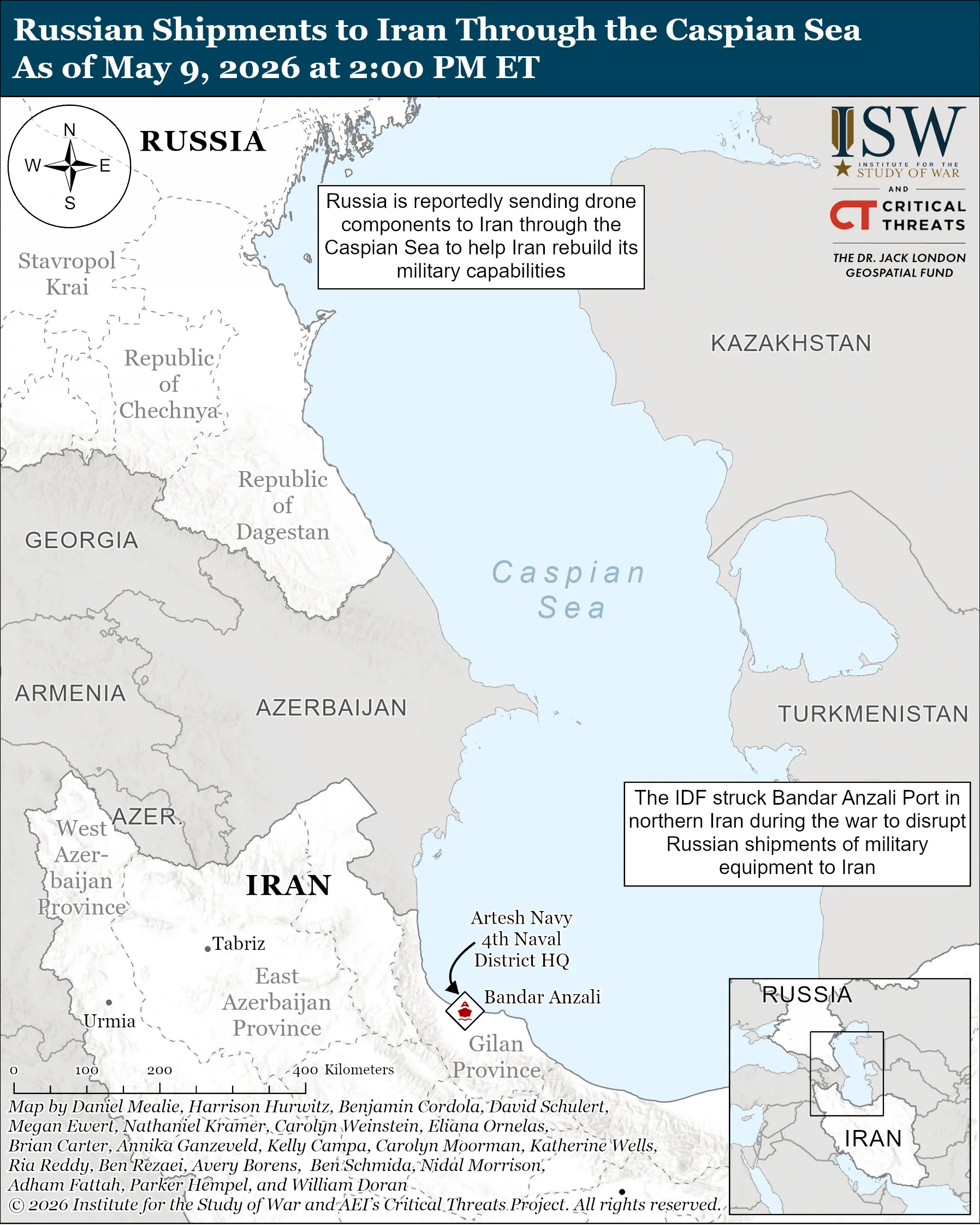
Russia is supporting Iranian efforts to rebuild Iran's military capabilities during the ceasefire period. The New York Times, citing US officials, reported that Russia is sending drone components to Iran via the Caspian Sea to help Iran rebuild its offensive capabilities following the war.[1] Iran and Russia have historically used the Caspian Sea to trade non-military and military goods. The Israel Defense Forces (IDF) struck Bandar Anzali Port along the Caspian Sea during the war to disrupt Russian shipments of military equipment, including Shahed drones, artillery shells, and other ammunition, to Iran.[2] This report comes amid reports that Russia proposed giving Iran 5,000 short-range fiber-optic drones and an unspecified number of longer-range satellite-guided drones equipped with Starlink terminals. There is no evidence that the drone components Russia is providing to Iran during the ceasefire are related to fiber-optic or first-person view drones, however. Russian shipments of drone components to Iran support Iran's broader effort to restore its missile and drone capabilities ahead of a potential resumption of conflict with the United States and Israel. Iran is attempting to recover weapons systems and launchers that it hid underground or that were buried under debris due to US and Israeli airstrikes.[3] Iran would likely use weapons systems and launchers that it retrieves to resume retaliatory attacks against US forces and regional countries if conflict resumes.
Russia and the People's Republic of China (PRC) also supported Iranian attacks on US bases during the war. The US State Department sanctioned four entities on May 8, including several Chinese companies, for providing satellite imagery to Iran to support Iranian attacks against US forces in the region during the war.[4] The sanctioned entities include Earth Eye and Chang Guand Satellite Technology, which are both based in the PRC and supplied Iran with satellite imagery of US and allied military facilities in the region.[5] Western media previously reported that Iran used an Earth Eye TEE-01B reconnaissance satellite that it acquired from the PRC in 2024 to target US military assets and bases across the Middle East during the war.[6] Russia similarly provided Iran with satellite imagery of US facilities and Shahed drones to support Iranian attacks during the war.[7]
The United States continues to target the PRC's support for the Iranian armed forces. The US Treasury Department sanctioned 10 individuals and companies on May 8, including several entities based in the PRC and Hong Kong, for supporting Iranian efforts to procure weapons components and raw materials used to produce drones and ballistic missiles.[8] It is unclear whether these entities have attempted to provide Iran with weapons components and raw materials during the ceasefire period. The PRC previously supported Iranian efforts to rebuild its ballistic missile program after the June 2025 Israel-Iran War by supplying sodium perchlorate, which is a chemical precursor for solid missile propellant, to Iran.[9]
Satellite imagery shows a possible large oil spill near Kharg Island in the Persian Gulf, but the cause of the possible oil spill remains unknown.[14] The New York Times, citing satellite imagery, reported on May 8 that there appears to be a large oil slick near Kharg Island.[15] Orbital EOS, which is a global oil spill monitoring service, told the New York Times that the possible spill covered more than 20 square miles on May 6 and that more than 3,000 barrels of oil may have been released.[16] The cause of the spill remains unclear, but energy experts told the New York Times that Iran's recent decision to store large volumes of crude oil in tanker vessels increases the risk of spills.[17] Iran has increasingly stored oil in tanker vessels due to the US naval blockade on Iranian ports, which has prevented Iran from exporting oil. Experts added that a rupture in the aging Abuzar oil field–Kharg Island undersea pipeline could be another possible cause, citing repeated leaks in recent years, including a breach in October 2024.[18] An Israeli OSINT analyst separately assessed that the slick was likely the result of an unspecified malfunction or Iran washing materials out of oil tanks.[19] Commercially available satellite imagery from May 9 shows that the spill has flowed southwards and dissipated significantly.
https://understandingwar.org/research/middle-east/iran-update-special-report-may-9-2026/
2,011
posted on
05/09/2026 11:43:37 PM PDT
by
AdmSmith
(GCTGATATGTCTATGATTACTCAT)
Known as “Jebhe-ye Paydari” – or the Endurance Front – its members are often described by observers as “Super Revolutionaries” who view themselves as guardians of the values of the 1979 revolution that overthrew the pro-Western Shah before imposing an authoritarian regime rooted in Shia Islamist ideology.
“They view resistance against the United States and Israel as an eternal fight,” Hamidreza Azizi, a visiting fellow at the German Institute for International and Security Affairs, told CNN. “They believe in a Shia state that needs to continue until the end of times and are quite fanatic when it comes to that religious ideology.”
“They (the US) realized that killing our leaders, commanders, and loved ones costs them nothing,” an article criticizing the talks in Raja News, which represents the Paydari Front, said. “They understood that even if they martyr our Imam (Ali Khamenei), there are still groups here willing to negotiate, shake hands with (Steve) Witkoff, (JD) Vance, and (Jared) Kushner, and smile at the killers of our martyred Imam.”
The faction is viewed as so radical that even hardliners within Iran’s conservative establishment see it as fringe. Still, “Jebhe-ye Paydari” are embedded in some of Iran’s most influential centers of power and the group boasts senior figures in Iranian media, top politicians who were once leading presidential candidates, and religious authorities who have wielded influence over past supreme leaders. It’s unclear how much support it commands, but one of its most prominent figures – former national security chief Saeed Jalili – garnered 13 million votes in the 2021 elections, finishing second.
Seven parliamentarians [see below] affiliated with the group have refused to sign a statement endorsing the negotiating team, according to Iranian media. One lawmaker affiliated with the group, Mahmoud Nabavian, was on Iran’s negotiating team in Islamabad last month but then publicly declared that negotiating over the country’s nuclear program was a “strategic mistake.” He later called for the removal of Foreign Minister Abbas Araghchi from the team. The current spiritual leader is Ayatollah Mahdi Mirbaqiri, a highly influential senior cleric who was once seen as a possible candidate for Supreme Leader. He harbors “apocalyptic views,” Azizi said, and wants to hasten the end of times by encouraging “widespread fighting” and a “comprehensive clash” with the West, according to an interview he gave state media in 2019.
https://edition.cnn.com/2026/05/09/middleeast/iran-conflict-politics-hardline-intl
1. Mahmoud Nabavian
2. Mohammad Taghi Naghdali
3. Mortaza Aghataherani
4. Amir Hossein Sabeti
5. Hamid Rezaei
6. RouholLAH Izvakhoh
7. Maysam Zahourian
https://t.me/entekhab_ir/363369
2,012
posted on
05/10/2026 12:26:22 AM PDT
by
AdmSmith
(GCTGATATGTCTATGATTACTCAT)
Iran does not know how to cash in on its victories at the right time
From the closure of the Strait of Hormuz to the aborted talks in Islamabad, the 2026 crisis reproduces a forty-year-old pattern: that of a regime structurally incapable of converting real leverage into a political outcome, prisoner of an ideological logic that transforms every tactical advantage into a dead end.
“During the Iran-Iraq war in May 1982, after the liberation of Khorramshahr, Khomeini also refused to concede a victory that had already been won. He chooses ideology over strategic interest. The conflict lasted six more years. »
In May 1982, after the liberation of Khorramshahr, Iran was in a position of strength. Iraq is proposing an immediate ceasefire with withdrawal to international borders. Saddam offers reparations. Khamenei and Mousavi are arguing for a deal. Khomeini refused. He launched the slogan: “The road to Jerusalem passes through Karbala” and transformed a victorious defensive war into an offensive ideological crusade with no real military horizon. The result: six more years, a million dead and wounded, and a capitulation wrested in 1988 that Khomeini himself described as a “cup of poison”.
The lesson has not been learned. Or rather: it could not be, because the inability to accept victory at the right time is not a miscalculation, it is a characteristic of the ideological system. The Islamic Republic operates according to a logic where confrontation is an end in itself, where “not giving in” is worth more than a measurable political gain, and where the rhetoric of permanent resistance systematically neutralizes the value of the successes achieved.
In addition to this structural pathology, in 2026, there is an unprecedented factor: the physical elimination of the Supreme Leader has decapitated the only arbitration function capable of deciding between rival factions. His presumed successor, Mojtaba Khamenei, has neither the legitimacy nor the authority to impose a costly de-escalation. The result is predictable: each opening is followed by a closure, each agreement by a questioning.
The US naval blockade of Iranian ports, in force since 13 April, is accelerating an economic suffocation that has already begun. The superimposition of the American blockade on the Iranian closure of the strait creates a devastating scissor effect: oil exports are blocked, stocks are accumulating on the island of Kharg to the point of saturating storage capacities, and the regime could soon be forced to interrupt crude production itself, a decision with technically disastrous consequences on the production fields. Each day of the status quo represents an estimated loss of more than $400 million for the Iranian economy, of which the Revolutionary Guards, the main beneficiaries of oil rents, are on the front line. For the Iranian population, it is a real-time asphyxiation.
The pragmatic voices within the regime, those who would have the lucidity to capitalize on the show of force in Hormuz to negotiate a way out of the crisis on the nuclear and sanctions issues, seem to have definitively lost their grip to the ideological bloc of the Revolutionary Guards. It is this internal defeat, more than external pressure, that condemns the regime to strategic immobility.
In 1988, Khomeini drank his cup of poison because he had no other way out. The question may no longer be whether the Islamic Republic can take its victories. But how many more deferred defeats it can afford, before her own strategic choices catch up with it for good.
https://atlantico.fr/article/decryptage/l-iran-ne-sait-pas-encaisser-ses-victoires-au-bon-moment
2,013
posted on
05/10/2026 1:06:52 AM PDT
by
AdmSmith
(GCTGATATGTCTATGATTACTCAT)
2,014
posted on
05/10/2026 1:10:11 AM PDT
by
AdmSmith
(GCTGATATGTCTATGATTACTCAT)
2,015
posted on
05/10/2026 1:28:23 AM PDT
by
AdmSmith
(GCTGATATGTCTATGATTACTCAT)
Hamidreza Azizi:
‘
After the 12-Day War of June 2025 inflicted significant losses on the Islamic Republic, Ayatollah Ali Khamenei made changes to the IRGC leadership and appointed Mohammad Pakpour as its commander in chief, with Vahidi as the deputy commander, a position he held until Pakpour’s killing in an Israeli airstrike on Feb. 28. Now at the helm, Vahidi represents another facet of the new power structure in Iran. Unlike Ghalibaf, he has never sought to soften or obscure his identity as a man of the security establishment.
But Vahidi’s influence has its limits. He carries serious weight among the more hardline factions of the IRGC and the broader security establishment, yet he is not a figure who can easily command the full loyalty of the establishment as a whole, let alone Artesh, the regular army, or the civilian bureaucracy. He must, therefore, work alongside Ghalibaf. Vahidi supplies the command structure with military resolve; Ghalibaf offers it political integration. Their roles are not interchangeable, but under wartime conditions, each makes the other more useful.
Beyond the individual personalities, the most important institution coordinating Iran’s security and foreign policy priorities amid the war is the Supreme National Security Council. The council used to be led by Ali Larijani, the formidable political operator and confidant of Ali Khamenei, who was killed in an Israeli strike in March. His replacement, Mohammad Bagher Zolghadr, personifies another shift in the Iranian system’s center of gravity, away from political management and toward security-bureaucratic coordination. Zolghadr is the connective tissue of the system, a figure whose role is to ensure that the political, judicial, military, and security arms of the Islamic Republic remain in alignment with one another.
he Aerospace Force has emerged as the most consequential branch of the IRGC, and its commander, Majid Mousavi, has risen through the power networks of the Islamic Republic as a central figure. Mousavi and his Aerospace Force are now crucial to Iran’s projection of deterrence. Within Iran, he is regarded as more willing than his predecessors to expand the use of missiles beyond strictly military targets. More than any other figure, his influence shapes the military tempo and the scope of escalation.
Meanwhile, wars demand complex machinery. The organization responsible for coordinating and managing operations between the IRGC and the regular Iranian army in wartime is known as the Khatam al-Anbiya Central Headquarters. The man who runs it, and who completes the operational layer of this command structure, is Ali Abdollahi, an officer whose career spans the IRGC, the national police, the Interior Ministry, and the logistics and operational coordination bureaucracies that hold a wartime state together. He does not make strategy. He makes strategy work.
Ensuring that the security framework is fit for purpose also means keeping a lid on domestic opposition amid the war—a job that now falls to Gholam-Hossein Mohseni-Ejei, the head of the country’s judiciary. To achieve his goals, he has been using Iran’s sprawling, politically weaponized legal system to prosecute protesters and dissidents, issue warnings against dissent, threaten harsher wartime punishments, and increasingly execute prisoners.
full text https://time.com/article/2026/05/06/irans-new-leaders/
https://x.com/HamidRezaAz
2,016
posted on
05/10/2026 3:29:32 AM PDT
by
AdmSmith
(GCTGATATGTCTATGATTACTCAT)
To: AdmSmith; BeauBo; blitz128; PIF; SpeedyInTexas; nuconvert; Jonty30; dennisw; ETCM; GBA; ...
This report on the inability of Iran’s current leaders to develop a winning strategy or peace negotiations is special. Understanding this internal fight is the exact reason why we must never allow these leaders to continue in their will to have a nuclear bomb capability. In addition, true conservative thinkers must realize the importance of spreading this realization beyond its current ideological borders. Pennsylvania’s representative in Congress has apparently realized some of this.
We must now do our best to communicate with Democrats the importance of this struggle for a truly peaceful outcome in Iran. Leaving Iran, unmolested, in the hands of these fanatical ideologues can ultimately be our own downfall. We must not let this kind of absolutist thinking keep us from finding allies where they can do all of us some good. The risk of change as the result of November’s elections is real. How many non conservatives elected will have the clear understanding of this very real danger to our future. We must do all we can to educate others as to the true danger of an unchanged Iran situation. This comment #2,013 must be condensed accurately and then widely circulated in letters to the editor, op eds, popular internet sites, etc. Few now realized the true nature of the danger we all face.
2,017
posted on
05/10/2026 11:08:42 AM PDT
by
gleeaikin
(Question Authority: report facts and post their links" in your messages.)
To: AdmSmith; BeauBo; dennisw; All
Your comment #2,016 expands on some of the problems I emphasized in my previous comment. The Israeli and our successes in decapitating the leadership, has in fact created added dangers. It appears some of the top leadership recently killed was actually more politically capable than the people who have now replaced them. Successfully Politics includes the ability to yield where necessary to achieve success. If these replacements have their way in “Peace” negotiations, the resulting Iran will be even MORE dangerous than it was before. Thus it is even more important the public supporting both our political parties be educated on the dangers inherent in making peace with these more highly fanatic new leaders.
2,018
posted on
05/10/2026 11:24:46 AM PDT
by
gleeaikin
(Question Authority: report facts and post their links" in your messages.)
To: nuconvert
Really good. Short and to the point.

To: nuconvert
Aww, Samir is not amused...

Navigation: use the links below to view more comments.
first previous 1-20 ... 1,981-2,000, 2,001-2,020, 2,021-2,040 ... 2,461-2,478 next last
Disclaimer:
Opinions posted on Free Republic are those of the individual
posters and do not necessarily represent the opinion of Free Republic or its
management. All materials posted herein are protected by copyright law and the
exemption for fair use of copyrighted works.
FreeRepublic.com is powered by software copyright 2000-2008 John Robinson