Iranian officials continue to frame control over the Strait of Hormuz as a key strategic interest and a critical component of long-term Iranian deterrence. Iran likely views control over the strait as essential to restoring deterrence against the United States and Israel following the degradation of its other forms of deterrence. Supreme Leader adviser Mohammad Mokhber stated in an interview with Iranian media that Iran's position in the strait is similar to the strategic value of a nuclear weapon.[1] Mokhber’s role as an adviser to the supreme leader suggests that his statements, at least in part, reflect the regime's thinking at the highest levels. Mokhber argued that control over a major economic chokepoint gives Iran the ability to affect the global economy “with one decision.”[2] He added that Iran “will not lose the strait under any circumstances.”[3] Mokhber’s statements are consistent with CTP-ISW’s assessment that Iran's principal positive strategic objective at this time is to secure recognition of its sovereignty over the strait.[4] Mokhber’s characterization of the strait and his comparison between the strait and Iran's nuclear program also reflect the regime's evolving concept of deterrence. Iran appears to seek to use the strait as a future deterrent because its historical pillars of deterrence—including its missile and drone capabilities, proxy network, and air defense systems—have proven unable to deter major US or Israeli attack in June 2025 and Spring 2026. Iranian leaders may assess that the severe degradation of their traditional forms of deterrence requires Iran to assign greater strategic significance to the strait. Iran's growing reliance on the strait suggests that the regime may not concede over control of the strait in negotiations, which is consistent with CTP-ISW’s ongoing assessment that some senior Iranian officials, including Islamic Revolutionary Guards Corps (IRGC) Commander Brigadier General Ahmad Vahidi who is currently driving decision-making within the regime, may prefer renewed confrontation over compromise if negotiations require Iran to relinquish control over the strait.[5]
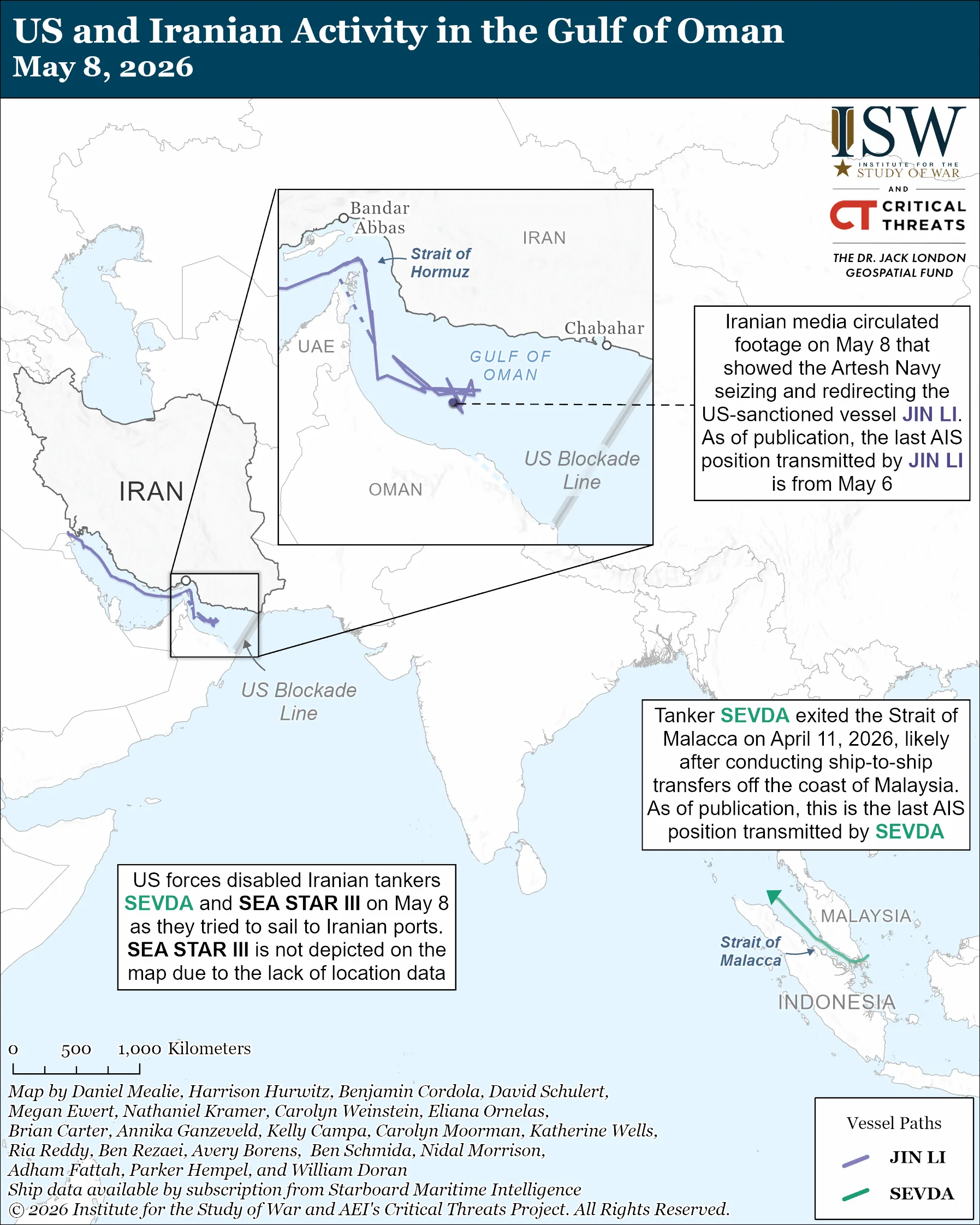
Iran has continued to try to demonstrate its control over the Strait of Hormuz in order to sustain high global oil prices and pressure the United States into concessions. Iranian media circulated footage on May 8 that showed the Artesh Navy seizing and redirecting the vessel JIN LI in the Gulf of Oman.[6] The US Treasury sanctioned JIN LI (aka OCEAN KOI) in February 2026 for transporting millions of barrels of Iranian petroleum products since May 2025.[7] The vessel has operated as part of Iran's shadow fleet since at least 2020.[8] A Chinese company, Ocean Kudos Shipping Company Limited, owns the vessel and is also sanctioned for its involvement in the shipment of Iranian petroleum products.[9] JIN LI previously traveled multiple times between Basra, Iraq, and Fujairah Port in the United Arab Emirates, and most recently was idling near Fujairah, but maritime data suggests that the vessel has spoofed its location.[10] It remains unclear whether the vessel was actively involved in Iran's shadow fleet at the time of its seizure. Iranian media accused the vessel of disrupting Iranian oil exports and undermining Iranian national interests; however, this suggests that JIN LI may have attempted to transit the strait without coordination with the Iranian Armed Forces.[11] Iranian officials have repeatedly threatened to respond to vessels that transit the strait without such coordination.[12] Iran likely uses vessel seizures to reinforce perceptions that it controls access through the strait. These seizures increase risks for commercial shipping and contribute to higher global oil prices.
The United States and Iran remain divided over key issues, particularly Iran's nuclear program, the status of Iran's highly enriched uranium (HEU) stockpile, and Iranian efforts to assert sovereignty over the Strait of Hormuz. Iranian Foreign Affairs Ministry Spokesperson Esmail Baghaei stated on May 8 that Iran is still reviewing the recent US proposal and will respond once Iran reaches a final decision.[13] Baghaei also stated on May 7 that Iran has decided to pursue negotiations in a “new format” through Pakistan and added that Iranian decisionmakers chose not to enter nuclear talks “for the time being.”[14] US President Donald Trump warned on May 8 that the United States could conduct renewed attacks if Iran does not quickly accept a deal.[15] Secretary of State Marco Rubio stated on May 8 that the United States expects an Iranian response soon and hopes it could begin a “serious process of negotiation.”[16] Iranian officials continue to signal unwillingness to compromise on core issues, particularly enrichment activities and Iranian control over the Strait of Hormuz, however.[17] Iran's delayed response likely reflects continued internal disagreements and the apparent unwillingness of hardline actors, particularly IRGC Commander Major General Ahmad Vahidi and his allies, to make major concessions on core issues.[18]
The United States has continued efforts to maintain an effective naval blockade against Iran as Iran continues to assert long-term sovereignty over the Strait of Hormuz. US Central Command (CENTCOM) announced on May 8 that US naval forces have redirected 57 vessels since the blockade began on April 13.[19] CENTCOM also reported that US forces disabled two Iranian tankers, Sea Star III and Sevda, on May 8 after both vessels attempted to enter an Iranian port along the Gulf of Oman.[20] Iran would have presumably used the tankers to expand its floating oil storage capacity as the US blockade continues to strain the regime's ability to store crude oil. Iran has already reactivated older tankers and repurposed empty vessels as temporary offshore oil storage to alleviate some of the mounting pressure on onshore facilities.[21] CENTCOM also stated on May 8 that US naval forces are currently preventing more than 70 tankers from entering or departing Iranian ports as part of the blockade.[22] These vessels collectively can hold more than 166 million barrels of Iranian oil, worth at least $13 billion USD.
Iran has continued to escalate rhetorically and militarily against the United Arab Emirates (UAE) amid Iranian attempts to portray the UAE as a hostile state supporting US and Israeli operations against Iran. Iran likely also seeks to demonstrate that continued US military actions against Iran will generate direct security and economic costs for Gulf states cooperating with the United States. Iranian Parliament National Security and Foreign Policy Committee member Ali Khezrian stated on May 8 that Iran now considers the UAE a “hostile base” rather than a neighbor and claimed that the UAE helped facilitate attacks against Iran during the war.[23] Supreme Leader Advisor Mohammad Mokhber stated on May 8 that the UAE “has been punished” and “will be punished more.”[24] Iran has recently conducted a series of attacks against the UAE that likely seek, in part, to isolate the UAE from other Gulf states and drive a wedge between the UAE and the United States and Israel in response to the UAE’s strengthening cooperation with both countries.[25] The UAE Defense Ministry stated on May 8 that Emirati air defenses intercepted two Iranian ballistic missiles and three drones targeting the UAE.[26]
Confidential Russian documents, seen by The Economist, revealed a Russian proposal to offer Iran several thousand drones and training for Iranian drone operators, which raises concerns about the proliferation of fiber-optic drone technology to Iran and its regional proxies.[27] The proposal offers Iran 5,000 short-range fiber-optic drones, an unspecified number of longer-range satellite-guided drones equipped with Starlink terminals, and training for Iranian personnel to operate both systems.[28] The Economist stated that it could not confirm whether Russian officials have presented the proposal to Iran yet. The documents are undated, but The Economist assessed that they likely originated during the first six weeks of the war when US officials were reportedly considering a possible ground operation in Iran. One diagram in the documents depicts Russian-trained Iranian drone operators attacking an amphibious landing force through coordinated drone swarms launched from concealed positions in response to a US operation to reopen the Strait of Hormuz or seize Kharg Island. Fiber-optic drones have limited utility in a maritime environment and have not been used at scale over the ocean in Ukraine. The documents do not specify which drone systems Iranian operators would use, but fiber-optic first-person view (FPV) drones have limited utility against commercial shipping unless operators specifically target vessel crews.[29] The limited utility is in part because fiber-optic FPV drones operating 55 kilometers from Iran's shore in the Strait of Hormuz would have a limited warhead size due to the amount of fiber optic cable they could carry, even if fiber optic FPV drones could be made to operate over the Strait of Hormuz's maritime environment. The limited warhead would have challenges generating functional kills on tankers by targeting the rudder or other systems. The fiber-optic drones would instead most likely support attacks against land targets, including amphibious vehicles and landing craft approaching the shore. The longer-range satellite-guided drones, however, could support maritime operations such as attacks on vessels. Reports of this proposal follow reports that Russia supplied Iran with satellite imagery of US bases and modified Shahed drones during the recent war.[30]
The reported Russian proposal further illustrates concerns about the proliferation of fiber-optic drones to Iranian proxy groups, some of which have already demonstrated the ability to employ these systems against US and allied targets. Iranian-backed Iraqi militias and Lebanese Hezbollah have both used fiber-optic first-person view (FPV) drones during the current conflict.[31] Likely Iranian-backed Iraqi militias conducted two fiber-optic drone attacks on Kuwaiti border posts in April 2026.[32] CTP-ISW previously assessed that Russia most likely transferred fiber-optic drone technology to Iran, which Iran then disseminated to Axis of Resistance groups, including Iraqi militias.[33] Hezbollah has conducted several fiber-optic FPV drone attacks against Israeli forces and positions in northern Israel and southern Lebanon since March 2026.[34] Hezbollah is likely assembling at least some of its fiber-optic drones in Lebanon based on photos of seized drone components, the relative ease of acquiring the necessary equipment to do so, and reported Israeli assessments in April that Hezbollah is assembling these drones domestically rather than receiving pre-assembled drones from Iran.[35] Israeli officials told The Economist that the IRGC has supplied Hezbollah with these fiber-optic drones, however.[36] It is unclear if this is an updated Israeli assessment, but it is possible that Iran has supplied Hezbollah with at least some of the fiber-optic drones that the group has used in recent attacks against Israel. Russia's reported willingness to provide Iran with fiber-optic drones could accelerate the spread of such advanced drone technology across Iran's regional proxy network and increase the threat that these groups pose to US and allied forces and interests.
The Institute for Science and International Security assessed on May 7 that US and Israeli airstrikes in 2026 targeted Iranian nuclear weaponization sites, following June 2025 strikes that disabled enrichment infrastructure.[37] Both strikes together increased the time and uncertainty for Iran to build a nuclear weapon using its existing uranium stockpiles, according to the institute.[38]
Read the report:
https://understandingwar.org/research/middle-east/iran-update-special-report-may-8-2026/