Iran Update Special Report, May 9, 2026
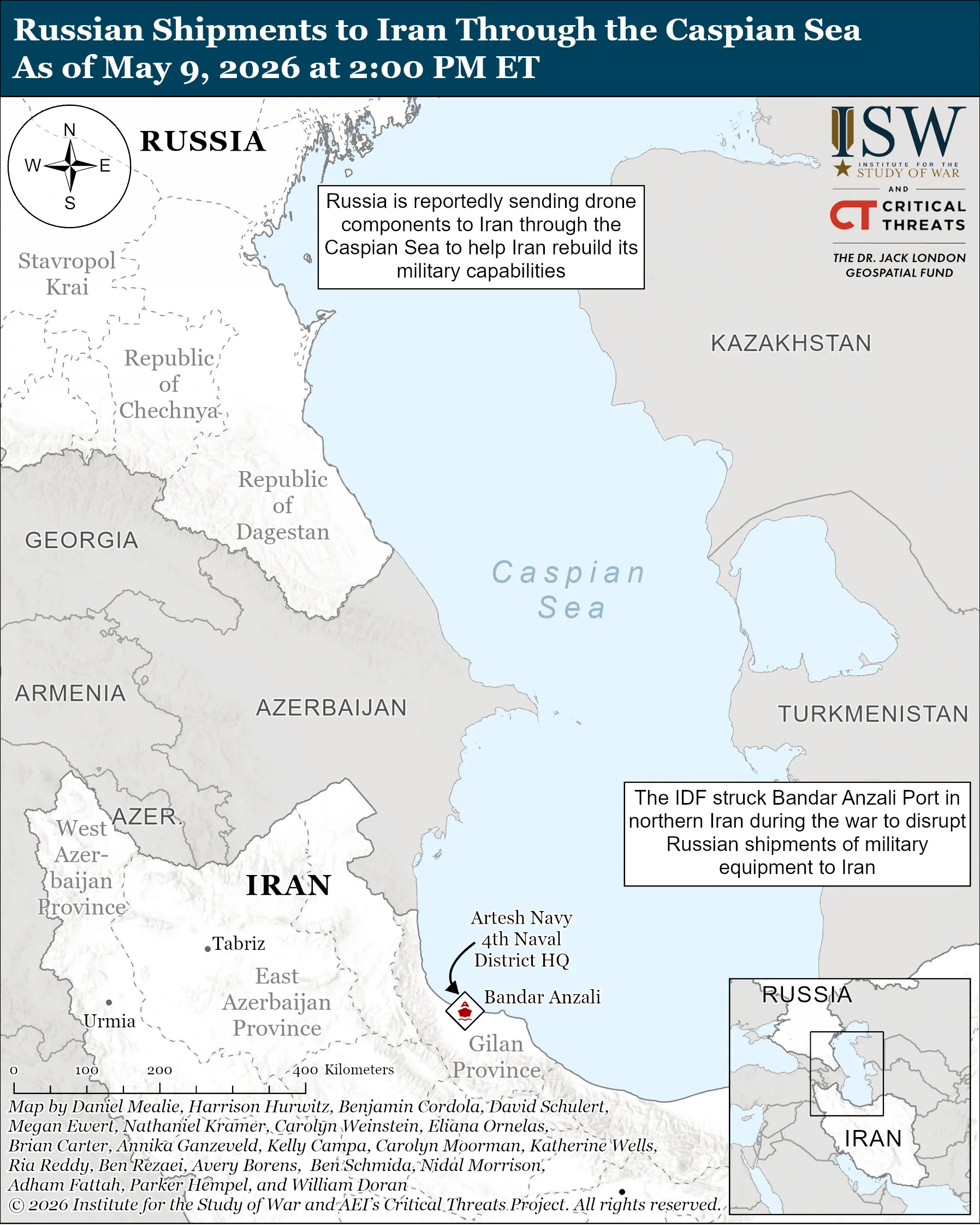
Russia is supporting Iranian efforts to rebuild Iran's military capabilities during the ceasefire period. The New York Times, citing US officials, reported that Russia is sending drone components to Iran via the Caspian Sea to help Iran rebuild its offensive capabilities following the war.[1] Iran and Russia have historically used the Caspian Sea to trade non-military and military goods. The Israel Defense Forces (IDF) struck Bandar Anzali Port along the Caspian Sea during the war to disrupt Russian shipments of military equipment, including Shahed drones, artillery shells, and other ammunition, to Iran.[2] This report comes amid reports that Russia proposed giving Iran 5,000 short-range fiber-optic drones and an unspecified number of longer-range satellite-guided drones equipped with Starlink terminals. There is no evidence that the drone components Russia is providing to Iran during the ceasefire are related to fiber-optic or first-person view drones, however. Russian shipments of drone components to Iran support Iran's broader effort to restore its missile and drone capabilities ahead of a potential resumption of conflict with the United States and Israel. Iran is attempting to recover weapons systems and launchers that it hid underground or that were buried under debris due to US and Israeli airstrikes.[3] Iran would likely use weapons systems and launchers that it retrieves to resume retaliatory attacks against US forces and regional countries if conflict resumes.
Russia and the People's Republic of China (PRC) also supported Iranian attacks on US bases during the war. The US State Department sanctioned four entities on May 8, including several Chinese companies, for providing satellite imagery to Iran to support Iranian attacks against US forces in the region during the war.[4] The sanctioned entities include Earth Eye and Chang Guand Satellite Technology, which are both based in the PRC and supplied Iran with satellite imagery of US and allied military facilities in the region.[5] Western media previously reported that Iran used an Earth Eye TEE-01B reconnaissance satellite that it acquired from the PRC in 2024 to target US military assets and bases across the Middle East during the war.[6] Russia similarly provided Iran with satellite imagery of US facilities and Shahed drones to support Iranian attacks during the war.[7]
The United States continues to target the PRC's support for the Iranian armed forces. The US Treasury Department sanctioned 10 individuals and companies on May 8, including several entities based in the PRC and Hong Kong, for supporting Iranian efforts to procure weapons components and raw materials used to produce drones and ballistic missiles.[8] It is unclear whether these entities have attempted to provide Iran with weapons components and raw materials during the ceasefire period. The PRC previously supported Iranian efforts to rebuild its ballistic missile program after the June 2025 Israel-Iran War by supplying sodium perchlorate, which is a chemical precursor for solid missile propellant, to Iran.[9]
Satellite imagery shows a possible large oil spill near Kharg Island in the Persian Gulf, but the cause of the possible oil spill remains unknown.[14] The New York Times, citing satellite imagery, reported on May 8 that there appears to be a large oil slick near Kharg Island.[15] Orbital EOS, which is a global oil spill monitoring service, told the New York Times that the possible spill covered more than 20 square miles on May 6 and that more than 3,000 barrels of oil may have been released.[16] The cause of the spill remains unclear, but energy experts told the New York Times that Iran's recent decision to store large volumes of crude oil in tanker vessels increases the risk of spills.[17] Iran has increasingly stored oil in tanker vessels due to the US naval blockade on Iranian ports, which has prevented Iran from exporting oil. Experts added that a rupture in the aging Abuzar oil field–Kharg Island undersea pipeline could be another possible cause, citing repeated leaks in recent years, including a breach in October 2024.[18] An Israeli OSINT analyst separately assessed that the slick was likely the result of an unspecified malfunction or Iran washing materials out of oil tanks.[19] Commercially available satellite imagery from May 9 shows that the spill has flowed southwards and dissipated significantly.
https://understandingwar.org/research/middle-east/iran-update-special-report-may-9-2026/
2,011 posted on
05/09/2026 11:43:37 PM PDT by
AdmSmith
(GCTGATATGTCTATGATTACTCAT)
Known as “Jebhe-ye Paydari” – or the Endurance Front – its members are often described by observers as “Super Revolutionaries” who view themselves as guardians of the values of the 1979 revolution that overthrew the pro-Western Shah before imposing an authoritarian regime rooted in Shia Islamist ideology.
“They view resistance against the United States and Israel as an eternal fight,” Hamidreza Azizi, a visiting fellow at the German Institute for International and Security Affairs, told CNN. “They believe in a Shia state that needs to continue until the end of times and are quite fanatic when it comes to that religious ideology.”
“They (the US) realized that killing our leaders, commanders, and loved ones costs them nothing,” an article criticizing the talks in Raja News, which represents the Paydari Front, said. “They understood that even if they martyr our Imam (Ali Khamenei), there are still groups here willing to negotiate, shake hands with (Steve) Witkoff, (JD) Vance, and (Jared) Kushner, and smile at the killers of our martyred Imam.”
The faction is viewed as so radical that even hardliners within Iran’s conservative establishment see it as fringe. Still, “Jebhe-ye Paydari” are embedded in some of Iran’s most influential centers of power and the group boasts senior figures in Iranian media, top politicians who were once leading presidential candidates, and religious authorities who have wielded influence over past supreme leaders. It’s unclear how much support it commands, but one of its most prominent figures – former national security chief Saeed Jalili – garnered 13 million votes in the 2021 elections, finishing second.
Seven parliamentarians [see below] affiliated with the group have refused to sign a statement endorsing the negotiating team, according to Iranian media. One lawmaker affiliated with the group, Mahmoud Nabavian, was on Iran’s negotiating team in Islamabad last month but then publicly declared that negotiating over the country’s nuclear program was a “strategic mistake.” He later called for the removal of Foreign Minister Abbas Araghchi from the team. The current spiritual leader is Ayatollah Mahdi Mirbaqiri, a highly influential senior cleric who was once seen as a possible candidate for Supreme Leader. He harbors “apocalyptic views,” Azizi said, and wants to hasten the end of times by encouraging “widespread fighting” and a “comprehensive clash” with the West, according to an interview he gave state media in 2019.
https://edition.cnn.com/2026/05/09/middleeast/iran-conflict-politics-hardline-intl
1. Mahmoud Nabavian
2. Mohammad Taghi Naghdali
3. Mortaza Aghataherani
4. Amir Hossein Sabeti
5. Hamid Rezaei
6. RouholLAH Izvakhoh
7. Maysam Zahourian
https://t.me/entekhab_ir/363369
2,012 posted on
05/10/2026 12:26:22 AM PDT by
AdmSmith
(GCTGATATGTCTATGATTACTCAT)
Iran Update Special Report, May 10, 2026
US President Donald Trump stated on May 10 that Iran's latest counterproposal is “totally unacceptable.”[1] Iranian regime media reported on May 10 that the regime had sent its counterproposal to the United States via Pakistani mediators.[2] Individuals familiar with Iran's counterproposal told the Wall Street Journal on May 10 that Iran's counterproposal calls for an end to the war, the “gradual opening of the Strait of Hormuz,” and the lifting of the United States’ naval blockade on Iranian ports.[3] The United States and Iran would conduct nuclear negotiations over a 30-day period, according to the counterproposal.[4] The individuals speaking to the Wall Street Journal stated that Iran offered to dilute some of its highly enriched uranium (HEU) stockpile and transfer the rest to a third country, but stipulated that Iran must receive guarantees that it would be able to retrieve its transferred HEU if negotiations fail or the United States exits the agreement.[5] Iran also offered to halt uranium enrichment for an unspecified period shorter than 20 years and refused to dismantle its nuclear facilities.[6] This counterproposal bears similarities to Iran's previous proposals, in which Iran has sought to end the war and address the Strait of Hormuz issue before engaging in nuclear negotiations with the United States.[7] US President Donald Trump has insisted that Iran must hand over its HEU stockpile and permanently suspend uranium enrichment.[8] President Trump posted on Truth Social on May 10 that Iran has been “playing games” with the United States and has been delaying negotiations.[9] Israeli media reported on May 10 that Trump will call Israeli Prime Minister Benjamin Netanyahu today, presumably to discuss Iran's response.[10]
Iran likely conducted attacks against a commercial vessel and some Gulf countries on May 10. These attacks may be intended to sustain high oil prices and thereby impose economic pressure on the United States in order to compel the United States to make concessions in negotiations. United Kingdom Maritime Trade Operations (UKMTO) reported on May 10 that an unspecified projectile struck the SAFESEA NEHA bulk carrier near the coast of Doha, Qatar.[11] The Emirati and Kuwaiti defense ministries separately reported on May 10 that their air defenses intercepted Iranian drones.[12] Iran has not claimed responsibility for these attacks, but the timing of the attacks is notable given that they correspond with Iran sending its counterproposal to the United States. Iran may have calculated that these attacks would sustain high oil prices. CTP-ISW previously assessed that some elements of the Iranian regime may calculate that Iran can impose sufficient economic pressure on the United States, including by keeping global oil prices high, to coerce the United States to make concessions.[13]
Iran is attempting to coerce countries into lifting economic pressure on Iran in order to be able to transit through the Strait of Hormuz. Artesh Spokesperson Brigadier General Mohammad Akraminia warned on May 10 that vessels belonging to countries that have sanctioned Iran will “face problems” if they attempt to pass through the strait.[14] Akraminia’s warning comes after Iran's “Persian Gulf Strait Authority” sent an email on May 6 to shipping companies with vessels in the Persian Gulf stipulating that vessels belonging to countries that have sanctioned Iran will not be allowed to transit through the strait.[15] This stipulation effectively requires countries that have sanctioned Iran to lift sanctions before their vessels can pass through the strait. Iran is also attempting to generate revenue by imposing a toll scheme in the strait. The email from the ”Persian Gulf Strait Authority” also demanded that vessels must pay the body in Iranian rials and gain issuances of guarantees from Iranian banks in order to ensure safe passage through the strait, which would force any country that wishes for its vessels to transit through the strait to violate US sanctions.[16] Iranian Supreme Leader Mojtaba Khamenei likely referred to Iran's toll scheme in a written statement on April 30, in which he emphasized that Iran would reap “economic gains” from its “new management” of the strait.[17]
Iranian media has publicized meetings between Supreme Leader Mojtaba Khamenei and senior Iranian officials in recent days, likely to portray Mojtaba as an active decision-maker in the regime amid reports that Mojtaba has been marginalized. Iranian media reported on May 10 that Khatam ol Anbia Central Headquarters Commander Ali Abdollahi Aliabadi met with Mojtaba to brief him on the status and readiness of Iran's armed forces.[18] Mojtaba reportedly gave Aliabadi orders and “guiding measures” for future Iranian military operations. The Khatam ol Anbia Central Headquarters is responsible for joint and wartime operations. Iranian President Masoud Pezeshkian previously accused Aliabadi and IRGC Commander Major General Ahmad Vahidi of “acting unilaterally” and “driving escalation” during the war.[19] This report comes after Iranian state media reported on May 7 that Pezeshkian had met with Mojtaba for nearly two and a half hours.[20] The publicization of two meetings between Mojtaba and senior Iranian officials within the span of several days may be meant to counter reports that Mojtaba has largely been sidelined by the IRGC and is not playing a central role in regime decision-making.[21]
The Israel Defense Forces (IDF) reportedly established a clandestine military outpost in the Iraqi desert to support its air campaign against Iran, according to unspecified individuals familiar with the matter speaking to the Wall Street Journal on May 9.[22] Israeli and Western media reported that the IDF deployed commando units and search-and-rescue teams to the outpost before the start of the war on February 28 to recover Israeli pilots if Iranian forces shot down Israeli fighter jets.[23] The outpost also reportedly served as a logistical hub for the Israeli Air Force.[24] One source told the Wall Street Journal that the IDF conducted airstrikes targeting members of the Iraqi Security Forces (ISF) to prevent them from approaching the outpost.[25] An Iraqi security source told Saudi media on May 10 that the United States advised Iraqi military personnel not to approach the area where the IDF had established the outpost for “security reasons.”[26] This report comes after Iraqi media reported on March 3 that the ISF had sent troops to investigate local reports that unspecified forces had landed in Anbar Province.[27] The Iraqi Joint Operations Command (JOC) confirmed on March 4 that unspecified forces conducted an airstrike and fired at the responding troops, killing one Iraqi soldier, injuring two others, and damaging two ISF vehicles.[28] The JOC stated on May 10 that the ISF did not find any troops or military equipment during search operations in the Iraqi desert, however.[29]
IRGC Quds Force Commander Brigadier General Esmail Ghaani met with Shia Coordination Framework leaders and unspecified Iranian-backed Iraqi militia commanders to discuss government formation during a visit to Baghdad, according to an informed source speaking to Iraqi media on May 10.[30] The source claimed that the Iranian regime has “reservations” about the Shia Coordination Framework's nomination of Ali al Zaydi as prime minister designate due to US support for Zaydi.[31] Iraqi media reported on May 9 that Zaydi is leading a committee formed by the Shia Coordination Framework to oversee the implementation of “mechanisms” to disarm Iranian-backed Iraqi militias.[32] The committee is reportedly close to finalizing a disarmament plan.[33] US President Donald Trump congratulated Zaydi on his nomination on April 30.[34]
https://understandingwar.org/research/middle-east/iran-update-special-report-may-10-2026/
2,023 posted on
05/10/2026 9:37:11 PM PDT by
AdmSmith
(GCTGATATGTCTATGATTACTCAT)
FreeRepublic.com is powered by software copyright 2000-2008 John Robinson