Skip to comments.
Iranian Regime tv Channel One hacked while it was airing Khamenie speech
various
| 10-8-22
Posted on 10/08/2022 1:05:38 PM PDT by nuconvert
Iranian Regime national tv Channel One hacked about an hour ago. During a broadcast of Khamenie speech, a red crosshair appeared over his face and chanting of Women. Life. Freedom. There was writing to the side saying "Rise up. Join us". Also 4 photos at the bottom of the screen of young people killed and additional writing: "The blood of our youth is dropping from your paws".
Also, there was a huge banner in the middle of Tehran highway today that read: We are no longer afraid of you. We will fight.
Also, attempted attack on IRI ambassador in Denmark. Her bodyguard was stabbed. Diplomatic Security intervened before the attacker could stab the ambassador.
TOPICS:
KEYWORDS: basij; deathtothemullahs; denmark; ebrahimrigi; erdogan; iran; iranprotests; iraq; irgc; iri; israel; khameini; khamenei; kurdistan; lebanon; mahsaamini; mullahloversonfr; mullahsmustbekilled; najisharifizindashti; protests; qudsforce; raisi; receptayyiperdogan; shahrammaroufmola; syria; turkey; yemen; zahedi
Navigation: use the links below to view more comments.
first previous 1-20 ... 1,841-1,860, 1,861-1,880, 1,881-1,900 ... 2,461-2,478 next last
To: nuconvert; gleeaikin; blitz128; BeauBo; PIF; ETCM; SpeedyInTexas; bert; GBA; dennisw
09FEB2026 Report Century International: From Smugglers to Supply Chains: How Yemen's Houthi Movement Became a Global Threat A major part of the secret to the Houthis’ resilience is the fact that the group increasingly assembles and manufactures arms in Yemen, utilizing a diffuse supply network that stretches across the Indian Ocean and beyond. Plans conceived in Tehran and northern Yemen are farmed out to operatives, contractors, and subcontractors to implement. Weapons, components, and raw materials are shipped to the Houthis from multiple sources, taking looping routes on sea and land, sometimes overshooting Yemen and doubling back. When parts finally arrive in Houthi territory on the boats of smugglers or regular tradespeople—some of whom may have no idea they are carrying anything illicit—the Houthis are able to assemble them into a formidable arsenal.
With assistance from the Quds Force (the external arm of Iran's Islamic Revolutionary Guards Corps, or IRGC), and other actors from the Axis of Resistance, the Houthis oversee a growing domestic military-industrial complex inside Yemen. The group is able to build and deploy weapons systems, including long-range drones, using imported parts and raw materials. While the Iranian supply of some key systems and components is critical to the Houthis’ capabilities, the group's arms program is increasingly backstopped by a hybrid, global supply chain serviced by a web of participants—including tribally connected smugglers across Yemen and businessmen working from export hubs in eastern China.
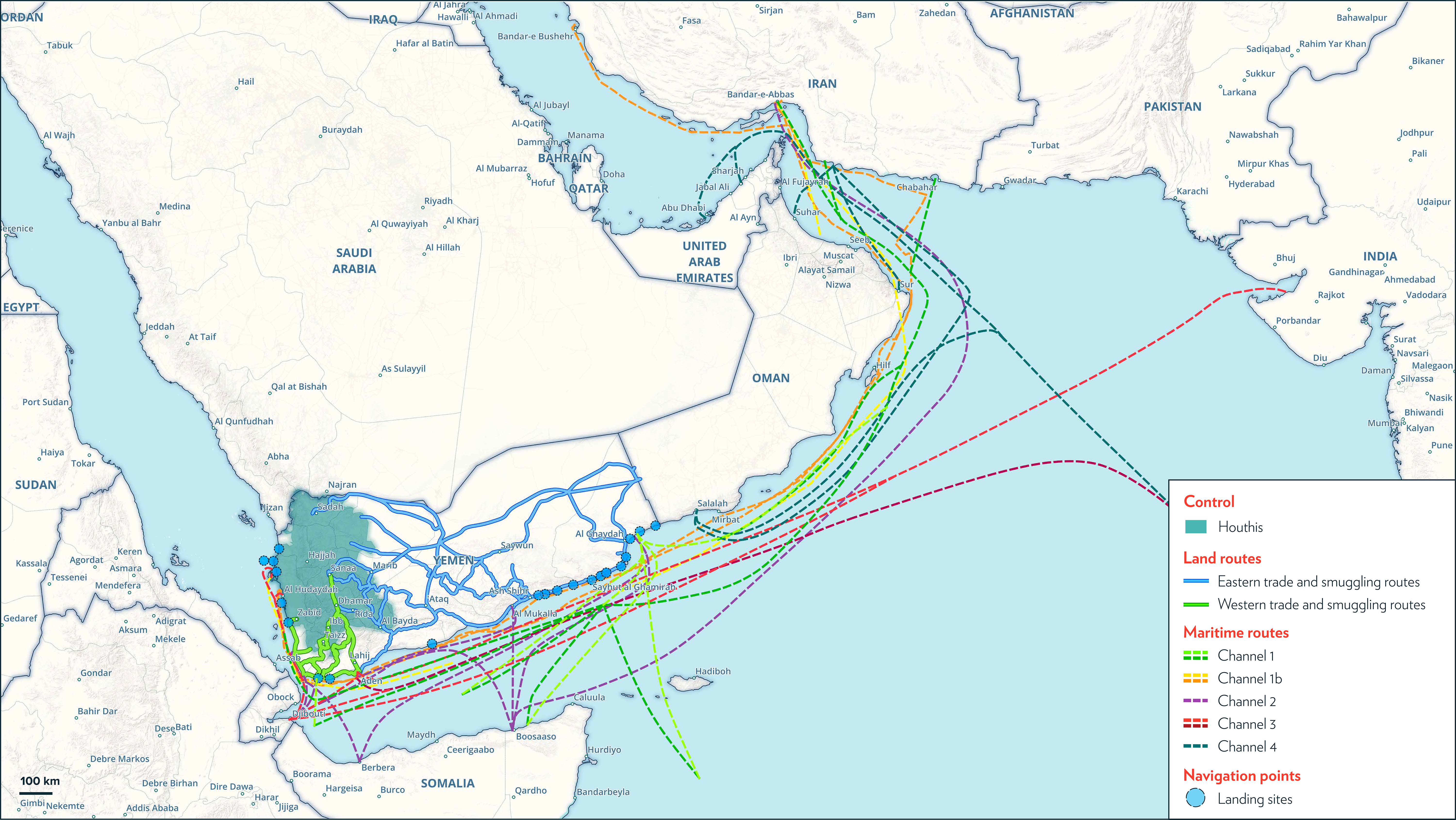
Efforts to disrupt the Houthi arms program face three self-imposed limitations: fragmented, contested lines of authority; mismatched and often discordant local, regional, and international priorities; and widespread resource limitations. These problems manifest themselves at every level: International maritime operations are narrowly focused on direct transfers from Iran. Regional powers Saudi Arabia and the Emirates are increasingly at loggerheads over Yemen. Yemen's security forces, which rely on Riyadh and Abu Dhabi for support, often struggle with unpaid salaries, along with limited and often disputed authority. These problems have led to infighting among their ranks and deep capacity constraints.
Another issue is the United States’ decision to essentially stop making Yemen policy. Following a brief military confrontation with the Houthis and a subsequent truce (the terms of which were never made public), some U.S. officials say that the Trump administration believes that the Houthis capitulated under pressure and no longer represent a threat. This assessment rests on the optimistic assumption that the U.S.–Houthi truce, the FTO designation, and the threat of Israeli airstrikes will keep the Houthis in check without sustained American engagement.
Ansar Allah, or Partisans of God, are a religious, political, and military movement. They are colloquially known as the Houthis, for their founding family, whose current leader, Abdul-Malik al-Houthi, took control of the group after his brother, Hussein al-Houthi, was killed during fighting with government forces in 2004.
In 2014, the Houthis seized control of Sana’a, Yemen's capital, after a decade of warfare with the government in the country's remote north. Their efforts to consolidate their coup in late 2014 and early 2015 sparked a civil war, with Saudi Arabia and the Emirates intervening militarily on behalf of Yemen's internationally recognized government. Over the course of a decade of conflict, the Houthis cemented their control over Yemen's northwest and built an increasingly repressive, religiously ideological quasi-state.
In December 2025 and January 2026, a territorial dispute between Saudi- and Emirati-backed factions ended with Saudi Arabia launching airstrikes to push back forces aligned with Abu Dhabi.
The Houthis have also built a huge stock of landmines, which allow them to defend large swaths of territory with relatively small numbers of men. They assemble, manufacture, and deploy landmines and improvised explosive devices (IEDs) in vast quantities.
Since 2020, the shift has been even more dramatic: in 2024 and 2025, more than 80 percent of items seized en route to the Houthis were materials for use in arms manufacturing, rather than complete systems. These seizures also show how the Houthis have diversified their supply chains. In total, 35 percent of all items documented between 2021 and 2025 originated in China—primarily components and raw materials—compared to 21 percent for Iran, the next largest source of arms and materials. Analysis of the inner workings of missiles and other weapons either recovered after attacks or during interdictions shows that other components and raw materials were sourced globally, from India, Germany, the Netherlands, South Korea, Switzerland, the United States, Thailand, Vietnam, and a number of other countries.
The direct Iran–Yemen supply channel is the busiest and still most important in the supply chain. It is used to deliver the widest, and most critical, range of items: small arms, ammunition, drones, missiles, and drone and missile components.
A second supply channel leverages maritime networks connecting Yemen and the Horn of Africa, particularly Djibouti and Somalia. Items trafficked through this channel include missiles, aerial drone and missile components and other equipment from Iran, internationally procured light weapons and precursor chemicals for explosives and missile propellant, and specialized items like landmine detonators.
International commercial shipping, most importantly containerized cargo from China, is also used to deliver critical items to the Houthis via a third channel directly linking Yemeni ports with international markets. Materials and components transported this way include precursor chemicals, aerial drone parts, and telecommunications equipment.
More recently, international container traffic has also been able to enter Houthi-controlled ports. In 2023, as part of a broader effort to negotiate Riyadh's exit from the war, Saudi Arabia paused a ban on container ships entering Red Sea ports. Since then, a growing number of container ships have been offloaded at the Houthi-controlled Red Sea ports of Hodeidah and Salif after UN inspection in Djibouti. Yemeni businessmen and intelligence sources claimed these shipments include cameras and guidance systems for Houthi weapons systems, concealed in shipments of licit items or marked as generic “industrial equipment.”
As a senior Yemeni military officer based in the al-Abr district of Hadramawt said in August 2024:
Whenever we come across a shipment, we get lots of calls and pressure from certain influential people. This is mainly from tribal leaders or individuals we coordinated with for the fight against AQAP and the Houthis, so they are very valuable to us, to the point that we have to listen to them. . . . We don't arrest anyone for most shipments because of the rescue network. The Houthis use smugglers that are well connected and integrated, and have been chosen from big families, such as sons of sheikhs, and we live under their mercy. We are not a large army—we have limited resources and must maintain relationships with tribes.
Well-informed local, regional, and Western officials describe a supply chain management system built around a small group of senior Houthi officials; and a similarly small group of Quds Force and Hezbollah operatives, based in both Yemen and Iran. In Yemen, the Quds Force and Hezbollah operatives work closely with their Houthi counterparts to plan domestic, regional, and international military-industrial strategies.
Also between 2018 and 2023, a number of mainly Iran-flagged commercial vessels regularly weighed anchor near the two spy ships. Of these, eleven of the most active in waters near the two spy ships were once registered as part of the Islamic Republic of Iran Shipping Lines (IRISL), an Iranian shipping firm that Western countries have repeatedly sanctioned for activities related to Iran's arms program. The vessels followed a consistent pattern: departing Iran, loitering near the Behshad or Saviz, proceeding via the Suez Canal to Latakia, Syria, and then continuing to European ports (principally Valencia and Antwerp), before returning via the same route. UK media reporting from March 2024, citing Israeli intelligence, claimed that some of the vessels involved were transporting arms bound for Hezbollah.
Mismatched priorities in Abu Dhabi and Riyadh have undermined military and security reforms and coordination among forces aligned with the Presidential Leadership Council since the body's formation. Yemeni government and military officials claim that both the Emirates and Saudi Arabia halted payments to the Yemeni army and some armed factions after the UN brokered a truce and the Presidential Leadership Council was formed in 2022. They allege that the Gulf states stopped these payments in part to pressure the government into sustaining the pause in hostilities and to engage in a peace process with the Houthis. Combined with a Houthi oil export embargo, which the group enforces by firing ballistic missiles at Yemeni government-controlled export terminals, the alleged nonpayment by Saudi Arabia and the Emirates meant that military and security salaries went unpaid for months at a time. There is no joint intelligence or analysis entity that coordinates across Presidential Leadership Council members and is capable of analyzing interdiction and other data. This state of affairs may change after the infighting of December 2025 and January 2026, if Saudi Arabia takes full control of managing anti-Houthi forces, as appeared to be the case at the time of writing.
The group's Red Sea campaign was halted by the Gaza ceasefire. But its regional ambitions and ideological fervor will continue—along with its ability to strike targets thousands of kilometers away. It will be a matter of time before the Houthis find a new pretext to launch cross-border attacks. The Houthis’ high profile has also allegedly attracted the interest of Moscow, and may have created entry points among militant groups in Somalia and other parts of East Africa (as a forthcoming Century International report will discuss in more detail).
The current U.S. posture on Yemen is unlikely to generate the kind of leadership described by the former U.S. official. Yet the more the Houthis are able to maintain their trajectory toward large-scale arms manufacturing, the more of a threat they will become to the region—and other Yemenis.
Read the report:
https://tcf.org/content/report/from-smugglers-to-supply-chains-how-yemens-houthi-movement-became-a-global-threat/
Take them out!
1,861
posted on
03/29/2026 2:37:44 AM PDT
by
AdmSmith
(GCTGATATGTCTATGATTACTCAT)
To: AdmSmith
Iran is going to be left defenseless for a long time from any foreigners who want to invade. How is a different new regime supposed to repel anyone and survive? What is to prevent the Houthis from moving in?
Or anyone else, for that matter.
1,862
posted on
03/29/2026 4:19:19 AM PDT
by
nuconvert
( Warning: Accused of being a radical militarist. Approach with caution.)
To: AdmSmith
U.S. officials say that the Trump administration believes that the Houthis capitulated under pressure and no longer represent a threat.
—
That was after they were introduced to the junior firm of S. Hornet & Lightning. Now they will meet they larger firm of Buff, Bone & Spirit.
1,863
posted on
03/29/2026 5:01:22 AM PDT
by
PIF
(They came for me and mine ... now its your turn)
What's Going on With Shipping Sal Mercogliano
29MAR2026 The Week Four recap of the events transpiring in the Strait of Hormuz and Persian Gulf covers issues including the latest update from the Joint Maritime Information Center; the major news stories as featured in gCaptain; the latest passages over the past 48 hours via Marine Traffic; and how may the United States used the newly arrived Marines in the area.
https://www.youtube.com/watch?v=qarj88_tsAg
1,864
posted on
03/29/2026 6:02:21 AM PDT
by
AdmSmith
(GCTGATATGTCTATGATTACTCAT)
To: nuconvert
Iran is going to be left defenseless for a long time from any foreigners who want to invade. How is a different new regime supposed to repel anyone and survive? What is to prevent the Houthis from moving in? Or anyone else, for that matter.
Plans regarding the Houthis are likely being updated. As of now, the coalition does not intend to support changes to the country’s borders, according to their statements.
1,865
posted on
03/29/2026 6:10:17 AM PDT
by
AdmSmith
(GCTGATATGTCTATGATTACTCAT)
To: AdmSmith
“Iran is going to be left defenseless for a long time from any foreigners who want to invade. How is a different new regime supposed to repel anyone and survive?”
The borders don’t have to change. Anyone could walk in and destabilize a new government.
1,866
posted on
03/29/2026 6:26:52 AM PDT
by
nuconvert
( Warning: Accused of being a radical militarist. Approach with caution.)
To: nuconvert
After Khamenei by William Usher
01MAR2026 Five Scenarios for Iran and How Washington Can Shape Iran’s Post-Conflict Future
Scenario One: The Iron Fist — IRGC Consolidation Behind a Clerical Façade
Scenario Two: The Fracture — Institutional Fragmentation and Competing Power Centers
Scenario Three: The Deal — Pragmatic Retrenchment and Negotiated Accommodation
Scenario Four: The Uprising — Popular Revolution and Regime Collapse
Scenario Five: The Quagmire — Protracted Conflict and State Erosion
The outcome he currently considers most likely is a combination of one and five.
https://williamusher.substack.com/p/after-khamenei
26MAR2026: The View from Tehran by William Usher
How Iran Reads This War, and What Washington Can Do About It
Nearly a month into Operation Epic Fury, the United States and Iran are not fighting the same war. Washington is fighting a war of compellence—the object is to inflict enough pain that Tehran calculates the cost of continued resistance exceeds the cost of concession. Tehran is fighting a war of endurance—the object is to survive long enough, and impose enough reciprocal cost, that Washington concludes a negotiated exit is preferable to an open-ended campaign. These are not variations on a shared strategic logic. They are different wars, running on different clocks, toward different definitions of what winning means. And until one side’s theory of the conflict breaks down under the weight of reality, there is no obvious mechanism by which this ends.
Rarely do people know when they’re conquered. Iran’s current leadership, shaped by the formative experience of an eight-year war they did not win cleanly and did not concede freely, is not reading this conflict the way Washington is hoping. They believe they are not losing, that their leverage over the global economy is real and durable, and that the political cost of conceding is higher than the military cost of continuing.
https://substack.com/home/post/p-192374093
1,867
posted on
03/29/2026 8:25:08 AM PDT
by
AdmSmith
(GCTGATATGTCTATGATTACTCAT)
1,868
posted on
03/29/2026 12:12:52 PM PDT
by
AdmSmith
(GCTGATATGTCTATGATTACTCAT)
Iran Update Special Report, March 29, 2026
The Washington Post reported on March 29 that the combined force has struck four key Iranian ballistic missile production facilities and 29 missile launch bases since the start of the war.[1] ISW-CTP has similarly recorded strikes on over 20 missile bases during the war.[2] The Washington Post assessed that combined force airstrikes have caused “severe damage” to the Khojir, Shahroud, Parchin, and Hakimiyeh missile production facilities.[3] Four experts told the Washington Post that the damage to these facilities has “most likely halted Iran's ability to produce short-range and medium-range ballistic missiles until [the] facilities can be rebuilt.”[4]
The combined force has inflicted the following specific damage to the Khojir, Shahroud, Parchin, and Hakimiyeh sites:
Khojir Military Complex (Tehran Province): TheWashington Post, citing satellite imagery from March 24, reported that the combined force has destroyed at least 88 structures at the Khojir Military Complex.[5] ISW-CTP observed reports of strikes on the Khojir Military Complex on March 3.[6] The Khojir complex is a research, development, and manufacturing facility for solid- and liquid-fuel missiles. An analyst at the James Martin Center for Nonproliferation Studies assessed on March 6 that the combined force had struck mixing and casting buildings at the Khojir complex.[7] The IDF also confirmed on March 29 that it struck a facility at Khojir that produced unspecified “critical components” for the “assembly and operationalization” of missiles.[8] The IDF noted that the facility was only one of two facilities in Iran that produced such components.[9]
Shahroud Military Complex (Semnan Province): The Washington Post, citing satellite imagery, reported that the combined force has damaged or destroyed at least 28 structures at the Shahroud Military Complex.[10] The combined force has struck the Shahroud Military Complex multiple times during the war.[11] An analyst at the James Martin Center for Nonproliferation Studies identified on March 7 that the Israel Defense Forces (IDF) had damaged a mixing building, casting building, and “warhead production line” at the facility.[12] The IDF struck buildings at the Shahroud Military Facility during the June 2025 Israel-Iran War that had previously housed planetary mixers.[13] Planetary mixers are essential for producing ballistic missile solid fuel. The IDF previously destroyed 12 Iranian planetary mixers, likely including mixers at Shahroud, during its October 2024 strikes on Iran.[14] Satellite imagery published by the Associated Press in September 2025 showed that Iran had started repairing damaged mixer buildings at Shahroud.[15] An Israeli analyst separately published satellite imagery on March 19 that shows that the combined force struck a launch pad at the Shahroud Military Complex between March 11 and 19.[16]
Parchin Military Complex (Tehran Province): The Washington Post, citing satellite imagery from March 12, reported that the combined force has struck 12 structures at the Parchin Military Complex.[17] ISW-CTP has observed numerous reports of strikes on the Parchin Military Complex, including on March 3, March 7, March 12, March 26, and March 28.[18] The Institute for Science and International Security assessed on March 6 that combined force airstrikes caused “significant damage” to solid rocket propellant motor production facilities at Parchin.[19] The combined force also struck the Taleghan 2 site at Parchin on March 12.[20] The Iranian regime previously used the Taleghan 2 facility to test explosives that are needed to detonate a nuclear device before the regime suspended its nuclear weapons program in 2003.[21]
Hakimiyeh Military Complex (Tehran Province): The Washington Post, citing satellite imagery from March 14, reported that the combined force has struck 19 structures at the Hakimiyeh Military Complex.[22] The Washington Post noted that the Hakimiyeh Military Complex contains facilities that produce liquid propellant and missile launchers.[23] The IDF issued an evacuation warning for the Hakimiyeh Industrial Zone in northwestern Tehran on March 3.[24]
The Washington Post also reported that the combined force has struck at least 29 missile launch bases thus far.[25] The Washington Post highlighted damage to the following two bases:
Khorgu Missile Base (Hormozgan Province): The Washington Post, citing satellite imagery from March 9, reported that the combined force has destroyed 15 facilities and struck two tunnel entrances at the Khorgu Missile Base.[26] The Washington Post assessed that the combined force has struck this base at least twice during the war. Two OSINT accounts previously published satellite imagery from March 18 that showed damage to multiple munition bunkers and multiple support buildings at the Khorgu Missile Base.[27]
Imam Ali Missile Base (Lorestan Province): An imagery analyst at the security intelligence firm Janes told the Washington Post that the combined force has struck nine aboveground structures and at least two tunnel entrances at the Imam Ali Missile Base.[28] The combined force has struck the Imam Ali Missile Base several times during the war, including with bunker buster munitions.[29] The Imam Ali Missile Base is home to the IRGC Aerospace Force al Hadid 7th Missile Brigade and al Tawhid 23rd Missile Brigade.[30] The base reportedly stores Shahab-3 ballistic missiles, which have a range of between 800 and 1,300 kilometers.[31] OSINT accounts circulated footage on March 27 of a funeral for an IRGC Aerospace Force commander who reportedly died in combined force airstrikes targeting the Imam Ali Missile Base.[32]
Senior Islamic Revolutionary Guards Corps (IRGC) officials continue to dismiss Iranian President Masoud Pezeshkian’s concerns about Iran's economic conditions amid Iran's war with the United States and Israel. Anti-regime media reported on March 28 that there is a deepening rift between Pezeshkian and IRGC Commander Brigadier General Ahmad Vahidi over the regime's actions during the war and the war's mounting economic and social costs, citing unspecified informed sources.[33] Pezeshkian reportedly warned that the IRGC’s attacks on regional countries are exacerbating economic damage, cautioning that Iran's economy could collapse within three to four weeks if Iran does not reach a ceasefire with the United States and Israel.[34] This report is consistent with a March 16 report that Pezeshkian voiced concerns over the war's impact on the Iranian economy but that an IRGC official dismissed Pezeshkian’s concerns.[35] Pezeshkian has also reportedly demanded “the restoration of executive and managerial authorities” to the government, but Vahidi has rejected this demand, according to the March 28 anti-regime media report.[36] The regime's poor management of the economy, which includes rampant corruption and IRGC control over broad swaths of the economy, has long hurt the Iranian economy and recently triggered the December 2025-January 2026 anti-regime protests.[37] The current conflict will likely further deteriorate Iran's economic conditions.[38] The combined force conducted airstrikes on several Iranian steel factories on March 27 and 28, which an Israeli military correspondent assessed are “expected to cause major damage” to the Iranian economy.[39] The conflict and regime-imposed internet shutdown have also had negative consequences for the private sector.[40] A restaurant owner in Tehran told a BBC Persian reporter on March 28 that “many businesses are completely shut down now.”[41] The restaurant owner added that they think they can only keep their business open “for one month maximum.”[42] The regime continues to promote the concept of a “resistance economy” without implementing tangible reforms in an attempt to reassure the Iranian population.[43] The regime's emphasis on the “resistance economy” is disconnected from the reality that the Iranian population faces, however.
The Iranian regime appears to be appealing to nationalist sentiments to recruit members of the Iranian population to help the regime maintain internal security.[44] The Wall Street Journal reported on March 29 that Iran has launched a recruitment campaign called “Janfada,” or “Sacrificing Life,” to recruit volunteers to fight US forces in the event of a US ground operation in Iran, citing a text message sent to Iranian mobile users.[45] The name of this campaign suggests that the regime seeks to appeal to nationalist sentiments by calling on Iranians to sacrifice their lives for Iran. The name of the campaign notably echoes a popular Iranian protest slogan, although it is unclear whether the regime intentionally mirrored the language of this slogan.[46] The Wall Street Journal report separately noted that security forces set up checkpoints in Esfahan City and surrounding towns on March 28.[47]
Russia continues to help Iran conduct attacks across the Middle East. Ukrainian President Volodymyr Zelensky said that Russia is providing Iran with satellite imagery of US military assets in the region.[48] Zelensky told NBC News that Russian satellites captured images of Prince Sultan Airbase near Riyadh, Saudi Arabia, on March 20, 23, and 25.[49] Iran struck the base on March 27, injuring several US service members and damaging aircraft.[50] Zelensky’s statement follows reports that Russia has supplied Iran with satellite imagery and Shahed drones since the war began.[51] Zelensky also said that Russia took satellite imagery of the US-UK base in Diego Garcia on March 24 as well as the Incirlik Airbase in Turkey, Al Udeid Airbase in Qatar, and the Shaybah oil and gas field in Saudi Arabia on March 26.[52] Russian efforts to take images of these sites indicate that Russia is helping Iran attack not only US assets but also Turkish and British assets. Iran has attacked all of these sites since the war began.[53]Iran continues to coerce vessels to comply with its new rules for transiting the Strait of Hormuz. Pakistani Foreign Affairs Minister Ishaq Dar stated on March 28 that Iran agreed to allow 20 additional Pakistani ships to pass through the strait.[54] He stated that two ships will transit the strait each day. Iran has allowed some Pakistani oil tankers and other vessels to pass safely through an Iranian-approved route around Larak Island.[55] Iran has required some vessels to pay a transit fee.[56] An OSINT analyst assessed on March 28 that IRGC Navy fast attack craft are patrolling the area between Larak Island and Qeshm Island in the Persian Gulf and are likely serving as “toll collectors.”[57]
https://understandingwar.org/research/middle-east/iran-update-special-report-march-29-2026/
1,869
posted on
03/29/2026 11:59:13 PM PDT
by
AdmSmith
(GCTGATATGTCTATGATTACTCAT)
30MAR2026 H I Sutton Short Guide To Iran’s Naval Mines In The Strait Of Hormuz
Learn the types of naval mines which Iran has, and why some are harder to sweep than others. Unscripted and unedited, just a real person sharing knowledge.
https://www.youtube.com/watch?v=TMXSDUj-dms
1,870
posted on
03/30/2026 9:23:38 AM PDT
by
AdmSmith
(GCTGATATGTCTATGATTACTCAT)
To: nuconvert; BeauBo; gleeaikin
30MAR2026:RFU News
Ukraine has dispatched more than 200 specialists in counter-Shahed drone defense to the UAE, Qatar, Saudi Arabia, and Kuwait, and Ukrainian President Zelensky noted that they have already delivered concrete results by providing both expertise and operational support, successfully starting to intercept Shahed drones in the area, limiting Iran’s advantage in using cheap drones to overload local air defenses.
Once deployed, Ukrainian specialists were shocked by how air defense operations are conducted in many units.
https://www.youtube.com/watch?v=rCpUCgH0ZKQ
1,871
posted on
03/30/2026 11:21:37 PM PDT
by
AdmSmith
(GCTGATATGTCTATGATTACTCAT)
Iran Update Special Report, March 30, 2026
The Turkish Defense Ministry announced on March 30 that NATO air defense systems intercepted an Iranian ballistic missile over the eastern Mediterranean Sea that had entered Turkish airspace.[1] This marks the fourth confirmed instance of an Iranian projectile entering Turkish airspace since the war began.[2] Iran has not commented on the attack at the time of this writing, but Supreme Leader Mojtaba Khamenei denied on March 20 that Iran had conducted previous attacks on Turkey, calling them an Israeli ”false flag tactic.“[3] Iranian Defense Minister Majid Ibn al Reza held a phone call with Turkish Defense Minister Yasar Guler on March 30 to discuss the ongoing regional conflict, according to Iranian regime media.[4] The officials likely discussed Iran's violation of Turkish airspace. This incident comes after Ukrainian President Volodymyr Zelensky told NBC News on March 28 that Russia is providing Iran with satellite imagery of US and allied military assets in the Middle East, including Incirlik Airbase in Turkey.[5] ISW-CTP previously noted that Russia's provision of satellite imagery to Iran is helping Iran conduct attacks not only on US assets but also against US partners, such as Turkey.
Anti-regime media and a Kurdistan Democratic Party-affiliated journalist reported that Popular Mobilization Forces (PMF) fighters have deployed to western Iran.[6] An Iraqi official speaking to anti-regime media claimed on March 30 that PMF fighters have deployed to Basij bases in Khorramshahr and Abadan in Khuzestan Province.[7] The Basij is a paramilitary force that is responsible for civil defense and social control.[8] The reported PMF deployment is notable given recent Iranian regime efforts to recruit new security force members.[9] The regime may be mobilizing PMF fighters, in part, to strengthen control over previous protest hotspots. Large protests took place in both Khorramshahr and Abadan during the December 2025-January 2026 protests.[10] Anti-regime media reported on March 29 that the combined force struck a border crossing checkpoint in Shalamcheh, Khuzestan Province.[11] Anti-regime media previously reported that PMF fighters had entered Iran via the Shalamcheh crossing.[12]
Ukrainian President Volodymyr Zelensky met with Jordanian King Abdullah II in Amman, Jordan, on March 29 to discuss a potential security partnership.[13] This meeting comes after Ukraine signed defense agreements with Saudi Arabia, the United Arab Emirates, and Qatar on March 28.[14] Zelensky expressed Ukraine's willingness to help Jordan defend against missile and drone attacks.[15] Zelensky and King Abdullah II also discussed security issues related to the Strait of Hormuz, noting that Ukraine has experience unblocking maritime trade routes with unmanned surface vessels and is prepared to assist partners.[16] CNN reported on March 30 that Zelensky suggested that Ukrainian sea drones could be deployed in the Strait of Hormuz.[17]
US President Donald Trump told the Financial Times on March 30 that the combined force has struck 13,000 targets since the start of the war on February 28.[18] Trump added that the combined force still has around 3,000 targets left to strike.[19] The Israeli Air Force (IAF) stated on March 30 that it struck 170 targets over the past day.[20] The combined force has struck multiple Iranian military bases, defense industrial sites, and internal security institutions since ISW-CTP’s last data cutoff.
An OSINT account reported that the US-Israeli combined force struck the Artesh Air Force 2nd Tactical Airbase in Tabriz, East Azerbaijan Province, on March 29.[21] The account reported seven explosions at the base.[22] The combined force previously struck the 2nd Tactical Airbase around March 3.[23] The IDF also struck the 2nd Tactical Airbase during the 12-Day War in June 2025.[24] An OSINT account noted at the time that the 2nd Tactical Airbase is home to MiG-29 and F-5 aircraft belonging to the 21st, 22nd, and 23rd tactical fighter squadrons.[25]
An OSINT account reported that the combined force struck two missile bases near Shiraz, Fars Province, on March 30, including a base that Iran has used to launch missiles at Israel in previous rounds of conflict.[26] One of the bases that the combined force struck on March 30 is the Shiraz South Missile Base.[27] The combined force has previously struck this base during the war. Commercially available satellite imagery captured on March 7 showed that the combined force had used ground-penetrating munitions to target underground facilities at the Shiraz South Missile Base.[28] The Shiraz South Missile Base is one of Iran's 25 primary bases for launching medium-range ballistic missiles.[29]
The combined force continued to suppress Iranian air defenses. The IDF stated on March 30 that it has destroyed more than 80 percent of Iran's air defense systems.[30] The IDF struck an Iranian air defense site in Nowshahr, Mazandaran Province.[31] The air defense site is located near the Caspian Sea. The IDF previously targeted ”dozens of vessels” at the 4th Artesh Naval District Headquarters at Bandar Anzali Port, Gilan Province, on the Caspian Sea coast on March 18.[32] Anti-regime media reported explosions in Amol, Chalus, Babol, Nur, and Babolsar in Mazandaran Province on March 30.[33]
The combined force continued to strike internal security sites in western Iran. The IDF stated on March 30 that it struck Basij bases in Dehgolan and Divandarreh, Kurdistan Province.[34] The IDF also stated that it struck Law Enforcement Command (LEC) buildings in Sanandaj and Saghez, Kurdistan Province.[35] Iranian security forces suppressed protests in Dehgolan and Sanandaj in January 2026.[36]
White House Press Secretary Karoline Leavitt stated on March 30 that the United States has destroyed 150 Iranian vessels, including 92 percent of Iran's “largest vessels,” since the war began.[66] Chairman of the Joint Chiefs of Staff General Dan Caine previously stated on March 19 that CENTCOM had destroyed 44 Iranian mine-laying vessels.[67] Iranian media reported that four vessels were struck in Bandar Lengeh, Hormozgan Province, on March 30.[68] The IRGC Navy 5th District is headquartered near Bandar Lengeh.[69]
Iran targeted a water desalination plant in Kuwait on March 29 as part of its ongoing drone and missile attack campaign against the Gulf countries.[73] The Kuwaiti Electricity, Water, and Renewable Energy Ministry confirmed that an Iranian strike damaged a service building at one of the ministry's power and water desalination facilities on March 29, killing one worker.[74] The Kuwaiti Armed Forces stated on March 30 that 13 drones entered Kuwaiti airspace in the past 24 hours.[75]
The Bahraini Defense Ministry announced that it intercepted seven drones and eight missiles launched from Iran on March 30.[76] The United Arab Emirates Defense Ministry reported that its air defenses intercepted 27 Iranian drones and 11 ballistic missiles.[77] Saudi Arabia's defense ministry confirmed that it intercepted seven Iranian drones and eight missiles.[78] The Qatari Defense Ministry announced that it intercepted an unspecified number of Iranian drones on March 30.[79]
The Houthis conducted a drone attack targeting Israel on March 29. The IDF said on March 29 that it intercepted two Houthi drones near Eilat, southern Israel.[113] This attack marks the third time that the Houthis have attacked Israel since entering the conflict on March 28.[114] The Houthis have not claimed the drone attack at the time of this writing.
IRGC advisers reportedly recently arrived in Houthi-controlled Saana, Yemen, to coordinate Houthi activities with Iran.[115] An unspecified journalist in Yemen told Israeli media on March 29 that “additional IRGC experts” recently arrived in Sanaa to strengthen coordination between the Houthis and Iran.[116]
https://understandingwar.org/research/middle-east/iran-update-special-report-march-30-2026/
1,872
posted on
03/30/2026 11:34:21 PM PDT
by
AdmSmith
(GCTGATATGTCTATGATTACTCAT)
Zelenskyy offers Ukraine's help to unblock Hormuz Kyiv defeated Russia in the Black Sea from 2023-2024 — and is offering to do the same with Iran in the Persian Gulf.
Although the three Ukrainian ports in Odesa region still experience Russian missile and drone strikes, they're visited by about 200 cargo ships a month, said Andrii Klymenko, head of the monitoring group on the situation in the Black Sea region with the Institute for Black Sea Strategic Studies. “Ukraine managed to create a complex system of cargo ship protection from all kinds of threats on the sea route from the territorial waters of Romania to the Odesa region,” Klymenko said. “I call it a tunnel.”
Ukraine hasn't gone into details about its strategy, but the system includes defense from air attacks, protection from sea mines and joint work by coastal artillery, the air force and other units, Klymenko said. A crucial factor were the sea drones used against the Russian fleet. “As of today, Ukraine's marine drones are not only kamikaze boats, but also platforms that can carry machine guns, rocket launchers and FPV drones,” Ihor Fedirko, CEO of Ukraine's Council of Defence Industry, told POLITICO.
https://www.politico.eu/article/ukraine-volodymyr-zelenskyy-help-unblock-strait-of-hormuz-iran-war/
1,873
posted on
03/31/2026 12:18:53 AM PDT
by
AdmSmith
(GCTGATATGTCTATGATTACTCAT)
To: AdmSmith
1,874
posted on
03/31/2026 3:03:19 AM PDT
by
nuconvert
( Warning: Accused of being a radical militarist. Approach with caution.)
Iran Update Special Report, March 31, 2026
The combined force campaign targeting Iranian commanders is likely impeding their ability to conduct sizable and coordinated attacks. Officials familiar with US and Western intelligence assessments speaking to The New York Times on March 30 said that the deaths of local Iranian commanders have degraded the ability of local Iranian commanders to communicate to launch large and coordinated attacks.[1] The targeted killing of local commanders has immediate practical effects by removing key commanders who give orders. Decapitation also creates a pervasive fear that can cause targeted commanders to take precautions to survive that impede their ability to execute their assigned mission.[2] US Secretary of Defense Pete Hegseth stated on March 31 that combined force airstrikes have degraded the Iranian military's morale and even led to “widespread desertions, key personnel shortages and causing frustrations amongst senior leaders.”[3] The Islamic Revolutionary Guards Corps (IRGC) are evidently facing recruitment struggles as they lowered the recruitment age to 12 to support patrols, checkpoints, and logistics.[4]
Iran launched only three missile barrages at Israel since ISW-CTP’s last data cutoff at 2:00 PM ET on March 30, marking its lowest barrage rate of the war to date.[5] These salvoes also contain only a small number of missiles, which may be a byproduct of Iranian command-and-control challenges highlighted previously. Iran has been firing only a few missiles per salvo at Israel since March 20.[6] The three waves only consisted of one missile in two of the waves and a “small” number of missiles in the third wave.[7] Smaller salvoes are relatively easier for the Israel Defense Forces (IDF)’s air defense systems to intercept, as demonstrated by their performance against small Houthi salvoes between 2023 and 2025.[8] Iran has only been launching one missile per salvo and three to seven salvoes per day at Israel for the past four days.[9] This is considerably less compared to what Iran fired at the start of the war.[10] The IDF also assessed that Iran's missile fire targeting Israel has slowed to around 10-15 missiles a day over the past two weeks.[11] The low salvo and missile-per-salvo rate targeting Israel does not necessarily imply Iran is suffering the same challenges when it comes to its short-range ballistic missiles that target the Gulf states, though March 31 saw a lower number of missiles targeting the Gulf states than the average.[12] Hegseth separately confirmed on March 31 that Iran launched its lowest number of missiles and drones in general in the past 24 hours.[13]
The combined force's extensive airstrikes targeting Iranian missile bases and production sites have also degraded Iran's ability to launch missile strikes against Israel. CTP-ISW recorded that the combined force has struck over 20 missile bases since the start of the war.[14] The Washington Post on March 29 identified ”severe damage” on satellite imagery to Iran's four major missile production sites, including Khojir, Shahroud, Parchin, and Hakimiyeh.[15] The IDF announced on March 31 that the Israeli Air Force (IAF) has struck 70 percent of Iran's defense industrial sites, which are essential to reconstituting Iran's missile capabilities.[16]
Iran is asserting sovereignty over international waterways by demanding payment from ships transiting the Strait of Hormuz. The Iranian Parliament National Security Commission passed a bill on March 30 titled the “Strait of Hormuz Management Plan,” which outlines a series of policies that assert that Iran has sovereignty over international waterways in the Strait of Hormuz.[17] The plan forces other countries to negotiate with Iran for safe passage through the strait and for some vessels to pay to transit through the strait, which is an international waterway. It also bans US and Israeli shipping or any ships from countries that sanction Iran.
Iran's parliament has little real power but its decision to pass this bill represents a desire in Tehran to continue to impede international shipping around the Strait after the war. Senior Iranian officials, including Parliament Speaker Mohammad Bagher Ghalibaf, have warned in recent weeks that the situation in the Strait of Hormuz “won't return to its pre-war status” following the war.[18] Expediency Discernment Council member Mohammad Mokhber stated on March 19 that Iran can use its position along the strait to “sanction [the West] and prevent their ships from passing through this waterway” even after the war ends.[19] Daily oil exports from the Middle East have fallen by at least 60 percent since the start of the war.[20] United Kingdom Maritime Trade Operations (UKMTO) has received 25 reports of attacks or incidents affecting civilian vessels transiting the strait since the war began.[21] Efforts to impede shipping around the strait could take a number of forms and would include efforts to threaten, disrupt, and selectively control traffic through the strait at any time or for any reason. Iran could use these threats to coerce concessions from the United States or its partners or deter them. Iran may be especially incentivized to leverage its control around the strait if it concludes that such actions are an effective means of coercing the United States and its partners.Iran has continued attacks on shipping in the Persian Gulf. An Iranian drone struck the Kuwaiti oil tanker al Salmi northwest of Dubai on March 30.[22] The attack did not injure any crew members aboard the vessel. This oil tanker is the first vessel that Iran has struck since March 18.[23] The Islamic Revolutionary Guards Corps (IRGC) Navy inaccurately claimed that it targeted the Singaporean-flagged Haiphong Express, which it probably mistook for the al Salmi.[24]
An unidentified senior official in Baghdad told a Kurdistan Democratic Party-affiliated journalist on March 30 that “more than a thousand” Popular Mobilization Forces (PMF) fighters are believed to have crossed into Iran.[91] The PMF is an Iraqi state security service but many Iranian-backed Iraqi militias control PMF brigades that answer to Iran instead of the Iraqi prime minister.[92] This confirmation comes after anti-regime media previously reported on March 30 that PMF fighters have deployed to Basij bases in western Iran.[93] The Basij is a paramilitary force that is responsible for civil defense and social control.[94] CTP-ISW assessed on March 30 that the Iranian regime may be mobilizing PMF fighters, in part, to strengthen control over previous protest hotspots.[95] Large protests took place in both Khorramshahr and Abadan during the December 2025-January 2026 protests.[96]
Unspecified European officials told Bloomberg on March 30 that Iran is pushing the Houthis to launch a renewed campaign against international shipping in the Red Sea, contingent on any further US escalation.[99] The officials added that Houthi leadership is divided on how aggressive its actions should be. This report comes after an unspecified journalist in Yemen told Israeli media on March 29 that “additional IRGC experts” recently arrived in Sanaa to strengthen coordination between the Houthis and Iran.[100]
https://understandingwar.org/research/middle-east/iran-update-special-report-march-31-2026/
1,875
posted on
04/01/2026 1:23:24 AM PDT
by
AdmSmith
(GCTGATATGTCTATGATTACTCAT)
To: nuconvert
1,876
posted on
04/01/2026 2:30:08 AM PDT
by
AdmSmith
(GCTGATATGTCTATGATTACTCAT)
Iran Update Special Report, April 1, 2026
Senior officials in Tehran have signaled that they seek to use the Strait of Hormuz and energy flows around it as points of leverage that Iran can use after the war to extract concessions and secure strategic aims. Multiple Iranian officials and institutions, including Iranian parliament speaker and key regime leader Mohammad Bagher Ghalibaf, several IRGC-linked media platforms, and an analyst close to Iranian security institutions, all highlighted the strait's value as leverage and Iran's ability to use its leverage over shipping through the strait to “ensure” the regime's survival now and in the future.[1] Some of the officials discussing the value of the Hormuz are not decisionmakers, but their statements reflect a broader discussion in Tehran about how to achieve short- and long-term military and strategic aims. The analyst close to the regime stated on April 1 that Iran can remove the ability of the United States and Israel to threaten it if it maintains its “legal-security dominance” over the strait even after the war ends.[2]
These statements indicate that Iran could continue to use its proven ability to disrupt shipping in the strait after the war ends to deter the United States and its partners or compel them to avoid actions that would have negative impacts on Iran. Iran would not need to continue attacks indefinitely to retain the ability to deter and coerce the United States and its partners using the leverage Tehran has over the straits. Iran now has a proven ability to disrupt the global economy by shutting down the Strait, and it could threaten to disrupt shipping in the future for any reason and at any time. Iran may be especially incentivized to leverage its control around the strait if it concludes that such actions are an effective means of coercing the United States and its partners.
Iran has continued attacks on shipping amid discussions in Tehran about Iran's leverage over the strait. Iran attacked the Panamanian-flagged AQUA 1 oil tanker, leased by Qatari state-owned energy firm, 17 nautical miles northwest of Ras Laffan, Qatar.[3] The tanker's hull sustained damage.[4] This is the second Iranian attack on a civilian vessel in two consecutive days.[5] Such attacks are one of the ways that Iran can impede shipping around the strait.
The UAE, among other Gulf countries, appears to support more aggressive action to reopen the Strait of Hormuz. Emirati leaders almost certainly view Iran's efforts to control the strait, combined with sustained Iranian missile and drone strikes against the UAE, as a direct threat to the UAE’s security. The United Nations Security Council is expected to vote on April 2 on a resolution that would authorize the use of “all necessary means” to protect shipping in and around the strait.[6] Unspecified Arab officials told the Wall Street Journal that the UAE has lobbied in favor of this resolution.[7] The resolution comes amid reports that the UAE may be willing to deploy assets to secure international shipping in the strait.[8] The UAE almost certainly views Iranian efforts to assert sovereignty over the strait as a direct threat to its economic security. Iran has significantly disrupted shipping in the strait, which serves as a critical maritime chokepoint for the UAE and other Gulf states, since the war began. Senior UAE official Anwar Gargash stated on March 17 that the UAE’s “main concentration is…the Iranian threat on [the UAE’s] security.”[9] He emphasized that the strait is an international waterway and that states that rely on it share a responsibility to ensure the free flow of trade. The strait is critical to the UAE’s oil exports, liquefied natural gas trade, and food imports. Gargash also warned that Gulf states cannot accept a future defined by persistent Iranian missile and nuclear threats.[10] Iran has launched more missiles and drones at the UAE than at any other country since the war began, including Israel.[11] Iran retaining the ability to disrupt international shipping and resume missile and drone attacks on Gulf countries at any time poses a direct threat to the UAE and other Gulf countries.
Iranian officials have signaled that they will not accept a ceasefire or halt disruptions to international shipping in the Strait of Hormuz unless the United States and Israel cease all attacks on Iran. This position is inconsistent with the stated US position on a ceasefire. US President Donald Trump stated on April 1 that Iran's “new regime president” has requested a ceasefire and emphasized that the United States will only consider one when the Strait of Hormuz is “open, free, and clear.”[12] Iranian Foreign Affairs Ministry spokesperson Esmail Baghaei rejected Trump's claim as “false and baseless.”[13] Iranian officials have repeatedly stated that they seek a permanent end to the war that guarantees the United States and Israel will cease all attacks on Iran.[14] Iran views the period between the Israeli strikes in June 2025 and the current conflict as a ”pause” in one war. The demands for a ”permanent end” are akin to a guarantee that the United States and Israel will not attack Iran in the future as well. Iranian officials have stated that Iran will not grant the United States access to the Strait of Hormuz to secure a ceasefire, even after the war ends.[15]
The combined force has continued decapitation strikes targeting senior Iranian officials. The IDF confirmed on April 1 that it killed IRGC Quds Force Lebanon Corps Engineering Head Mehdi Vafaei in Mahallat, Markazi Province.[36] Vafaei was responsible for advancing underground projects in Lebanon and Syria for Hezbollah and the Assad regime and he managed dozens of underground facilities in Lebanon used to store advanced weapons.[37] The IRGC separately confirmed on March 31 that an Israeli airstrike killed an adviser to the Armed Forces General Staff chief in Tehran Province.[38] The United States sanctioned Eshaghi in February 2025 for his role in an international network that facilitated illicit oil sales to China, which generated hundreds of millions of dollars for Iran's armed forces and supported the Axis of Resistance.[39] The combined force also reportedly killed Mohammad Sadeghi, who was an engineering officer under the IRGC Aerospace Force al Ghadir Missile Command.[40] Sadeghi reportedly was responsible for constructing underground tunnels and missile infrastructure.[41]
The IRGC appears to have further consolidated control over Iran's political system by sidelining the Iranian president, Masoud Pezeshkian’s government and restricting access to Supreme Leader Mojtaba Khamenei. Anti-regime media reported on March 31 that growing friction between Iranian President Masoud Pezeshkian and the IRGC has pushed Pezeshkian into a “complete political deadlock.”[98] The IRGC reportedly blocked Pezeshkian’s decisions, with IRGC Commander Major General Ahmad Vahidi pressuring him and preventing the selection of a new intelligence minister.[99] Vahidi reportedly insisted that all sensitive positions must be selected and managed directly by the IRGC during the war.[100] Anti-regime media also reported on March 31 that a “military council” composed of senior IRGC officers has assumed control over the regime's core decision-making apparatus and established a security perimeter around Supreme Leader Mojtaba Khamenei.[101] The ”military council” reportedly prevented government reports from reaching him and ignored Pezeshkian’s repeated requests for a meeting with Mojtaba.[102]
Anti-regime media separately reported on March 31 that an “unprecedented crisis” is emerging within the inner circle of Mojtaba, with some close associates reportedly seeking to remove former Iranian Supreme Leader Ali Khamenei’s Deputy Chief of Staff for Political and Security Affairs, Ali Asghar Hejazi, from the Supreme Leader's office.[103] The report added that this effort stems from Hejazi’s opposition to Mojtaba’s succession, including warnings that Mojtaba lacks leadership qualifications and that hereditary succession is incompatible with the “Islamic Republic.”[104] Hejazi reportedly also warned that Mojtaba’s selection would effectively hand full control of the state to the IRGC and permanently sideline administrative institutions.[105]
These reports are consistent with earlier reports that the IRGC has expanded its influence over regime decision-making following Mojtaba Khamenei’s selection as supreme leader.[106] Senior Iranian sources told Reuters on March 10 that the IRGC “forced through” Mojtaba’s appointment to ensure alignment with hardline policies and overpowered opposing political and clerical figures.[107] Mojtaba’s inner circle is dominated by long-standing IRGC commanders, including Ahmad Vahidi, Mohammad Bagher Ghalibaf, and Mohammad Ali Jafari, who played key roles in securing his selection and shaping regime decision-making.[108] CTP-ISW previously assessed on March 21 that the IRGC has increasingly filled a leadership vacuum caused by decapitation strikes and Mojtaba’s apparent inability to govern, consolidating control over political, military, and internal security institutions.[109]
The Iranian regime has continued its nationwide counterintelligence and internal security operations. The regime conducted mass arrests and disrupted alleged espionage and militant networks across multiple provinces between March 30 and April 1.[110] Iranian authorities reported over 1,000 arrests in March alone, including individuals for espionage, filming sensitive sites, and supporting adversary-linked networks.[111] The United Nations Human Rights Office reported on April 1 that approximately 2,345 individuals have been arrested in Iran since the start of the war on charges related to national security, including terrorism, dissent, alleged espionage, and “cooperation with the enemy.”[112]
The regime has also expanded public securitization measures, including the deployment of security personnel and equipment across civilian infrastructure and the integration of society into internal defense efforts. Reporting indicates that Iranian forces have operated in at least 70 civilian locations, including schools, hospitals, and mosques.[113] The Basij and affiliated organizations have also increased recruitment and mobilization efforts, including volunteer registration campaigns and, in some cases, the use of minors in checkpoint and patrol roles.[114] Iranian authorities have also reinforced legal deterrence by warning that individuals accused of espionage or collaboration with hostile actors may face execution and asset seizure.[1]
https://understandingwar.org/research/middle-east/iran-update-special-report-april-1-2026/
1,877
posted on
04/02/2026 3:55:48 AM PDT
by
AdmSmith
(GCTGATATGTCTATGATTACTCAT)
1,878
posted on
04/02/2026 3:57:28 AM PDT
by
AdmSmith
(GCTGATATGTCTATGATTACTCAT)
To: AdmSmith; blitz128; dennisw; nuconvert; adorno; USA-FRANCE
The interesting active map linked at this comment spends 6+ minutes describing and showing the kinds of issues Ukraine drone operators found with the ME purchasers of their drones, and also how they helped their customers deal with them and also introduce money savings equal or better drone skills and uses.
https://www.youtube.com/watch?v=rCpUCgH0ZKQ [Repeat of link]
One serious difference was the customer’s troops tendency to run away from Iran’s attacks rather than sticking to the job of trying to destroy Iran’s weapons before they hit. Also Ukraine had been getting bad publicity on their drone systems, based on inadequate skill exercised by the new owners. Arrival of Ukraine teachers has improved success.
1,879
posted on
04/02/2026 3:44:32 PM PDT
by
gleeaikin
(Question Authority: report facts, and post their links in your message)
To: gleeaikin
Ukraine’s drone technology, as superior as it may be, will not continue being so. Not after the middle-east and the whole world has gotten their hands on that technology, and then, the superior Ukraine drone tech will be equal to everyone else’s. It’s the same as with nuclear bombs; after so many countries have gotten their hands on the technology first advanced by the U.S., can anybody point to the U.S.’superiority in that sector?
Once the whole world knows the latest and greatest, the hype behind the Uke drones will cease. It was better left to the Ukes alone and their advantages would still exist.
1,880
posted on
04/02/2026 4:09:11 PM PDT
by
adorno
( )
Navigation: use the links below to view more comments.
first previous 1-20 ... 1,841-1,860, 1,861-1,880, 1,881-1,900 ... 2,461-2,478 next last
Disclaimer:
Opinions posted on Free Republic are those of the individual
posters and do not necessarily represent the opinion of Free Republic or its
management. All materials posted herein are protected by copyright law and the
exemption for fair use of copyrighted works.
FreeRepublic.com is powered by software copyright 2000-2008 John Robinson