Skip to comments.
Iranian Regime tv Channel One hacked while it was airing Khamenie speech
various
| 10-8-22
Posted on 10/08/2022 1:05:38 PM PDT by nuconvert
Iranian Regime national tv Channel One hacked about an hour ago. During a broadcast of Khamenie speech, a red crosshair appeared over his face and chanting of Women. Life. Freedom. There was writing to the side saying "Rise up. Join us". Also 4 photos at the bottom of the screen of young people killed and additional writing: "The blood of our youth is dropping from your paws".
Also, there was a huge banner in the middle of Tehran highway today that read: We are no longer afraid of you. We will fight.
Also, attempted attack on IRI ambassador in Denmark. Her bodyguard was stabbed. Diplomatic Security intervened before the attacker could stab the ambassador.
TOPICS:
KEYWORDS: basij; deathtothemullahs; denmark; ebrahimrigi; erdogan; iran; iranprotests; iraq; irgc; iri; israel; khameini; khamenei; kurdistan; lebanon; mahsaamini; mullahloversonfr; mullahsmustbekilled; najisharifizindashti; protests; qudsforce; raisi; receptayyiperdogan; shahrammaroufmola; syria; turkey; yemen; zahedi
Navigation: use the links below to view more comments.
first previous 1-20 ... 1,781-1,800, 1,801-1,820, 1,821-1,840 ... 2,461-2,479 next last
To: nuconvert; gleeaikin; blitz128; BeauBo; PIF; ETCM; SpeedyInTexas; bert; GBA; Cronos
Satellite imagery from March 11, 2026, provided to the Institute by image @VantorTech shows that Taleghan 2 was attacked.
Imagery shows three large bunker buster penetration holes entering the top of the facility, directly into the area where a suspected high explosive containment vessel suitable for nuclear weapons development related testing may have been. The overlay shows that the bunker buster bombs were not only precisely on target along the length of the main HE test chamber hall, but it is clear that the interior was destroyed as well given that the main blast(s) traveled outward from the interior to cause significant collateral damage, showing that it knocked down a protective defensive wall and destroyed a small building southeast of the facility by concussion from the main bunker buster blasts. The fire control and instrumentation building at Taleghan-1 was also fully destroyed.
This site has been under construction since before the June 2025 war and continued unabated until now. Iran made significant efforts to harden and protect the site, but clearly those efforts weren't enough. The penetration holes indicate that the internal facility is likely bombed out, destroying anything that was inside. See the images below.
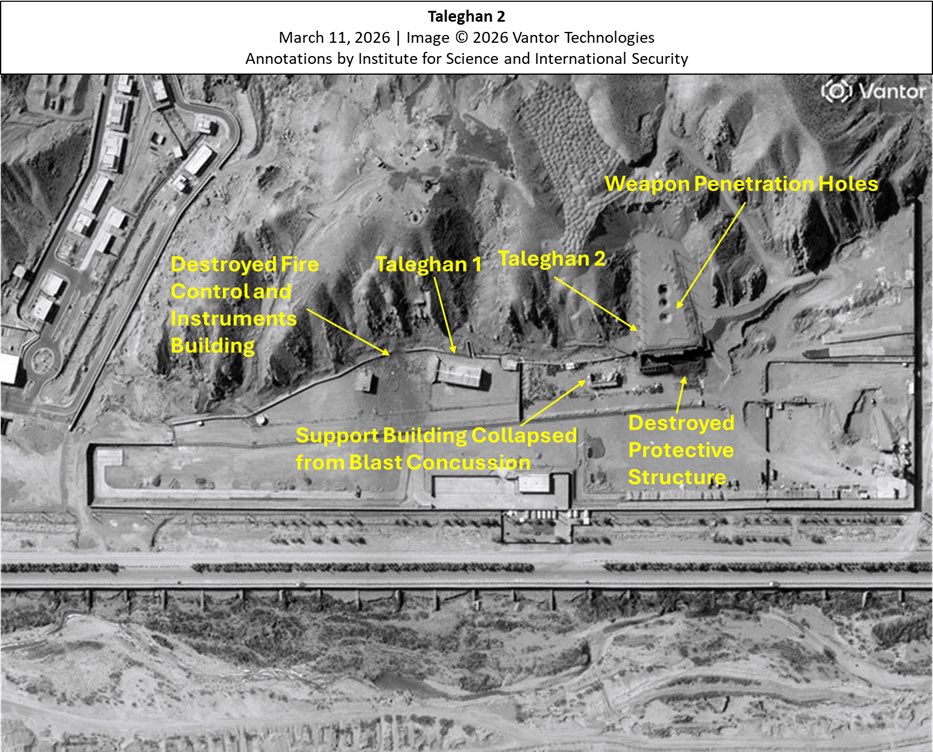
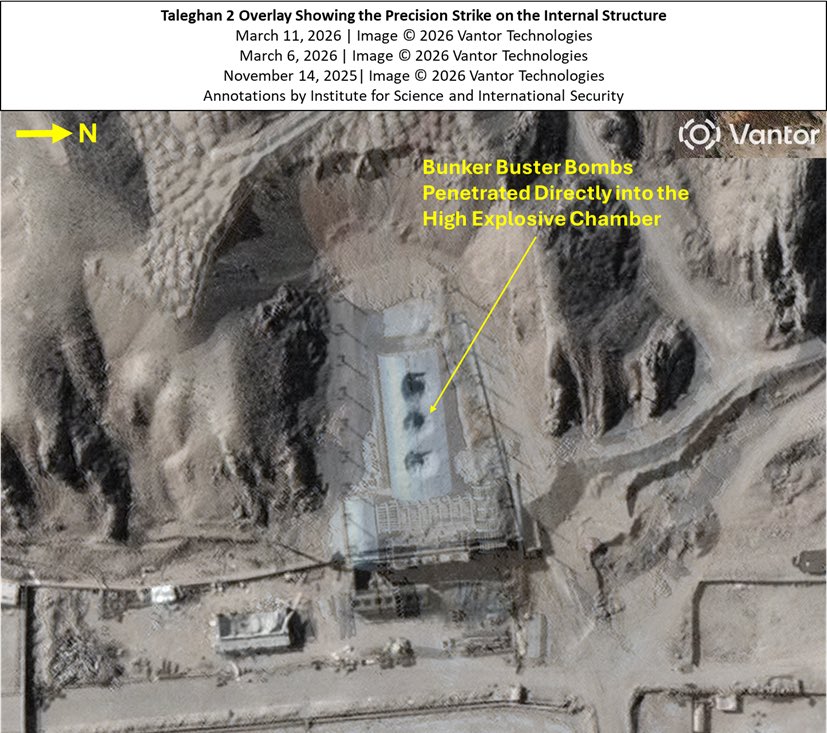
https://x.com/TheGoodISIS/status/2031915600939983043
Post-Attack Assessment of Precision Strikes on the Bunkered Taleghan 2 Facility By David Albright, Sarah Burkhard, Spencer Faragasso, and the Good ISIS Team
https://isis-online.org/isis-reports/post-attack-assessment-of-precision-strikes-on-the-bunkered-taleghan-2-facility
1,801
posted on
03/12/2026 1:13:27 PM PDT
by
AdmSmith
(GCTGATATGTCTATGATTACTCAT)
To: nuconvert; gleeaikin; BeauBo
Iran Update Morning Special Report, March 12, 2026
The US and Israeli combined force has continued to target Iranian internal security, defense industrial, and military targets across Iran. ISW-CTP has observed strikes in 11 provinces since 3:00 PM ET on March 11.
Iran is continuing to target commercial vessels in the Persian Gulf and Strait of Hormuz as part of its effort to disrupt maritime traffic and threaten freedom of navigation. Suspected improvised Iranian unmanned surface vessels (USV) hit the US-owned Marshall Islands-flagged SAFESEA VISHNU and the Malta-flagged ZEFYROS off the coast of Basra, Iraq, overnight on March 11 and 12.
Iran continued to attack the Gulf States and Israel. Iran launched projectiles targeting civilian and oil infrastructure in the UAE, Bahrain, Saudi Arabia, and Kuwait.
Hezbollah has claimed 27 attacks targeting IDF forces and positions in northern Israel since ISW-CTP’s last data cutoff at 3:00 PM ET on March 11. Hezbollah's 27 claimed attacks mark the highest number of attacks claimed by Hezbollah in an 18-hour period that ISW-CTP has observed since the start of the conflict.
The IDF is preparing to expand its ground activity in southern Lebanon. Israeli Defense Minister Katz and Israeli Prime Minister Benjamin Netanyahu instructed the IDF to prepare for an “expansion of IDF activity in Lebanon.”
https://understandingwar.org/research/middle-east/iran-update-morning-special-report-march-12-2026/
Iran Update Evening Special Report, March 12, 2026
Iranian Supreme Leader Mojtaba Khamenei issued his first statement on March 12 after the Assembly of Experts selected him as the new supreme leader on March 8 [1]:
Khamenei reaffirmed the regime's commitment to Iran's war effort in order to achieve Iran's long-standing objectives, including the erosion and eventual expulsion of American influence from the Middle East and the destruction of the Israeli state. A news anchor read Khamenei’s statement on state media. Khamenei made the following key points in his statement:
Reaffirmed Iran's commitment to disrupt international shipping in the Strait of Hormuz. Khamenei stated that Iran “must continue” to block the Strait of Hormuz. He added that Iran may “[open] additional fronts where the enemy is extremely vulnerable.”[2] Khamenei did not specify what “fronts” he was referring to. The Houthis have not conducted attacks in response to the combined force's campaign in Iran or Israeli operations in Lebanon; they have likewise issued no threats or signaled intent to retaliate for US-Israeli strikes in Iran.[3]
Reaffirmed Iran's intent to attack regional countries that host US bases. Khamenei falsely claimed that Iranian strikes in regional countries target only US facilities rather than the host countries themselves.[4] Iran has struck sites in Middle Eastern countries since the start of the war that are not US bases, including a drone strike on the Hayat Palace Hotel in Bahrain on March 3 and strikes on energy and maritime infrastructure in Oman, Saudi Arabia, and the United Arab Emirates (UAE).[5] Khamenei stated that Iran will continue to attack regional countries.[6]
Reaffirmed Iran's support for the Axis of Resistance. Khamenei described the resistance movement as “an inseparable part of the Islamic Revolution's values.”[7] The “Axis of Resistance” is the unconventional alliance that Iran has cultivated in the Middle East since the Islamic Republic came to power in 1979. Iran provides these groups with varying levels of financial, military, and political support in exchange for influence or control over their actions. Iran and the Axis of Resistance have carried out numerous attacks on US assets across the region. Iranian-backed Iraqi militias and Lebanese Hezbollah have launched attacks on US and Israeli assets, respectively, since the start of the war on February 28.[8]
Khamenei also emphasized the importance of unity among the Iranian people. He encouraged Iranians to attend Quds Day ceremonies on March 13, likely, in part, to project an image of unity amid the war and concerns about regime stability.[9] The Islamic Revolutionary Guards Corps (IRGC) similarly called on Iranians to attend the Quds Day march.[10]
An Iranian-linked hacker group conducted a cyberattack on a US healthcare company on March 11, which is likely part of an Iranian effort to target the US healthcare system in order to impose political pressure on the US administration. Iran has undertaken a similar effort to impose political pressure on the United States by striking oil infrastructure in the region and oil tankers in the Strait of Hormuz.
The US and Israeli combined force has continued to target Iranian internal security and military sites across Iran. CTP-ISW has observed strikes in ten provinces since 8:00 AM ET on March 12.
Anti-regime media reported that the Iranian armed forces are facing deepening fractures between the Artesh and the IRGC amid severe supply shortages, citing unspecified informed sources.[37] The sources stated that IRGC forces have refused to transport wounded Artesh soldiers to hospitals despite access to medical facilities. IRGC officials have reportedly rejected Artesh requests for additional support because of limited resources. The sources added that the Artesh faces a severe shortage of ammunition and basic supplies such as food and water. The sources stated that even traditionally well-resourced elements of Iran's military, including the IRGC’s missile units, are facing supply shortages. IRGC leadership has reportedly prioritized the delivery of technical components to keep missile systems operational over sending basic resources or individual equipment to forces. The sources also said that the IRGC attempted to mobilize reserve forces earlier this week, but several individuals did not report to military centers. Some Western media reports have indicated that there are no signs of mass defections within the Iranian armed forces or fractures within the regime yet, however.[38]
Recent US Central Command (CENTCOM) operations are attempting to limit Iran's ability to disrupt shipping in the Strait of Hormuz. CENTCOM said on March 12 that it has destroyed over 30 Iranian minelaying ships and that it has targeted naval mine warehouses and manufacturing facilities across Iran.
Hezbollah appears to be relying more heavily on drones to attack IDF forces and positions. Hezbollah's reliance on drones is notable given that Hezbollah did not heavily rely on drones during the October 7 War.
https://understandingwar.org/research/middle-east/iran-update-evening-special-report-march-12-2026/
1,802
posted on
03/12/2026 11:50:08 PM PDT
by
AdmSmith
(GCTGATATGTCTATGATTACTCAT)
1,803
posted on
03/12/2026 11:54:43 PM PDT
by
AdmSmith
(GCTGATATGTCTATGATTACTCAT)
01FEB2026: Hossam Al-Din Haeri Zadeh https://x.com/haerizadeh_h is Iranian regime-aligned ideologue who markets himself as a “strategy instructor with Quranic rules” offers a chilling manual for security forces: he calls street protests a “battlefield,” assumes the officer has killed someone, then asks what the officer should feel afterward. His answer is the point of the indoctrination: the problem is not killing, but killing with the “wrong intention.” In other words: kill, but for God, not out of personal anger. This is religious engineering designed to dehumanize protesters, sanctify state violence, and relieve perpetrators of moral responsibility.
https://x.com/radiojibi/status/2017929773708620239
2 min Persian
1,804
posted on
03/13/2026 1:16:47 AM PDT
by
AdmSmith
(GCTGATATGTCTATGATTACTCAT)
Iran new Supreme Leader Mojtaba Khamenei’s physical condition and inability to maintain regular communication with officials have prompted criticism and political maneuvering among some ruling clerics, according to information received by Iran International.
Ali Asghar Hejazi, deputy chief of staff to the former Supreme Leader, and Alireza Arafi, a member of the Guardian Council and a member of Interim Leadership Council are among clerics who have raised concerns about Mojtaba Khamenei’s health and managerial capacity, sources told Iran International. They are pushing for authority at the top of the Islamic Republic to return to a temporary leadership council.
Hejazi and Arafi are also among influential clerics who have criticized the growing power of the Islamic Revolutionary Guards Corps and the increasing dominance of its commanders over government decision-making during the war. Divisions between political officials and ruling clerics on one side and Revolutionary Guards commanders on the other have deepened following the killing of Iran's former leader, particularly after Mojtaba Khamenei was introduced as the new head of the Islamic Republic.
https://www.iranintl.com/en/202603132154
1,805
posted on
03/13/2026 8:35:05 AM PDT
by
AdmSmith
(GCTGATATGTCTATGATTACTCAT)
To: nuconvert
1,806
posted on
03/13/2026 10:41:53 AM PDT
by
AdmSmith
(GCTGATATGTCTATGATTACTCAT)
To: AdmSmith; BeauBo; PIF; ETCM; GBA; bert; USA-FRANCE; adorno; Jonty30; nuconvert; BroJoeK; ...
Just in case you or your friends whom you send info about this war in Iran don’t know the difference between Artesh and the IRGC (Iranian Republican Guard Corp) here is AI info:
“AI Overview:
==The Artesh (Islamic Republic of Iran Army) is Iran’s conventional military, responsible for protecting national borders and territorial integrity. As one of two parallel Iranian militaries—the other being the Islamic Revolutionary Guard Corps (IRGC)—the Artesh focuses on traditional warfare with ground, air, navy, and air defense branches.
Key Aspects of the Artesh:
—Role & Structure: Unlike the ideological IRGC, the Artesh is a conventional force with approximately 340,000–420,000 active personnel. It oversees national security and conventional defense.
—Branches: It comprises the Ground Forces, Air Force, Navy, and Air Defense Force.
—Leadership: The Commander-in-Chief is appointed directly by Iran’s Supreme Leader, ensuring loyalty.
—Distinction from IRGC: While the Artesh focuses on conventional territorial defense, the IRGC handles asymmetric warfare and protects the Islamic establishment’s internal structure.
—Origins: The Artesh predates the 1979 Islamic Revolution (formerly the Imperial State of Iran army), leading to historical suspicion regarding its loyalty, although it has since been deeply integrated with political ideological officers.
==The Artesh works under the general supervision of the Armed Forces General Staff and is heavily involved in managing border areas.”
Given that the IRGC seems to be holding on to the goodies itself, and not supplying Artesh with needed food and other supplies, how likely is a rift between the two bodies? Has any of the top leadership of Artesh been deliberately killed as compared to top leadership of the IRGC? I believe the Israelis made a point of hitting top IRGC command. Below is more info on the IRGC from AI, with some [additions] by me:
“AI Overview
==The Islamic Revolutionary Guard Corps (IRGC) and the Artesh are parallel military branches in Iran. The IRGC is an elite, ideologically driven force tasked with protecting the regime and expanding its influence, while the Artesh is the conventional army responsible for defending national borders. The IRGC holds superior funding, political influence, and control over missile and, through the Quds Force, foreign operations, whereas the Artesh holds more traditional military roles.
Key Differences:
*Role and Mission:
—IRGC (Guardians of the Revolution): Created in 1979 to prevent internal threats and protect the Islamic system, it holds high ideological, political, and economic power.
—Artesh (Conventional Army): Focused on conventional defense of Iran’s territory, borders, and airspace.
*Command Structure & Loyalty:
—IRGC: Reports directly to the Supreme Leader, functioning as his personal army.
—Artesh: Operates separately but is seen as less ideologically aligned than the IRGC.
*Funding and Resources: The IRGC is better funded and equipped, controlling major parts of the economy, whereas the Artesh often operates with older, conventional hardware.
*Structure and Units:
—IRGC: Comprised of ground forces, navy, air force, and the Quds Force (foreign operations), along with control over the Basij militia. [AI did not include numbers of troops, but I saw a while ago something like 1/2 million.]
—Artesh: Traditional military structure (Navy, Army, Air Force).
*Influence: The IRGC has a widespread presence across provinces and wields significant influence in regional conflicts, while the Artesh is generally more limited to conventional, domestic defense. [IRGC also controls the Basij, formed in 1979 by Khomeini and comprised of volunteer young Iranians and loyalists to the regime. Basij claims to have a presence in many public institutions including factories, universities, and schools, according to Wikipedia. (numbers unknown)]
Note: The two organizations are intentionally kept as rivals by Iran’s leadership to prevent coups, resulting in overlapping responsibilities but separate operations, say videos on Facebook from Aljazeera.”
I suspect a lot of the future of this war in Iran will depend on whether the Artesh can be convinced to support a possible pre Islamic style new government with more freedom for the people.
1,807
posted on
03/13/2026 4:48:23 PM PDT
by
gleeaikin
(Question Authority: report facts, and post their links in your message.)
To: AdmSmith; blitz128; SpeedyInTexas; nuconvert
Here are additional thoughts looking at the likelihood of a split between the national Iranian army Artesh and the Mullah’s army IRGC. I further asked about the likelihood of Artesh supporting Reza Palavi’s efforts to help form a nationally approved democracy-based Iranian government.
“AI Overview:
==As of March 2026, the likelihood of a serious split between Iran’s Artesh (regular army) and the Islamic Revolutionary Guard Corps (IRGC) has increased due to intense, ongoing conflict, with reports suggesting the deepest fractures in four decades. While the regime has historically managed to keep these forces divided and loyal, severe operational pressures and resource shortages have heightened tensions, potentially making Artesh support for a transition, such as one supported by Reza Pahlavi, more plausible than in previous years, though still difficult to execute.
*Likelihood of a Split Between Artesh and IRGC:
—Deepening Rifts: Reports from March 2026 indicate that the IRGC’s prioritization of its own resources, such as missile components, over supplying the conventional army has led to significant anger within the Artesh.
—Widespread Desertions: The intensifying rivalry is resulting in “group desertions” from the Artesh, with soldiers losing faith in the command structure and leaving posts.
—Operational Friction: The Artesh has reportedly refused to assist with certain IRGC, “suicidal” missions and has in some cases, refused to participate in suppressing street protests.
—Structural Safeguards: Despite these issues, the regime has for decades ensured that senior Artesh commanders are heavily vetted, with many being ex-IRGC personnel, making a united coup against the IRGC difficult. The IRGC also retains a “counter-coup” capacity should the Artesh act.
—Outcome Uncertain: If the regime shows signs of imminent collapse, some Artesh elements might seek to side with the population to avoid being targeted in a post-regime scenario.
*Artesh Support for a Reza Pahlavi-Supported Government:
—Direct Appeals: Reza Pahlavi has actively targeted military personnel, asking them to “separate from the remnants of the regime and join the side of the nation”.
—A “National Salvation” Positioning: As the regime falters, the Artesh may see itself as an “institution of national salvation”. However, this does not guarantee backing for a Pahlavi-led government, as some military elements might prefer a military-led transitional government (like a “Bonapartist” solution) to ensure stability.
—Challenges of Support: For the Artesh to support an opposition leader like Pahlavi, they would need to break with the supreme leader and the hardline IRGC, which would likely lead to internal armed conflict.
—Conditional Support: While many in the rank-and-file may favor a change, top commanders’ loyalty is linked to the regime’s survival. Support for Pahlavi would likely only materialize if the IRGC’s dominance is clearly broken first.
Conclusion on the Power Shift:
==The most likely scenario if a split occurs is not an immediate, united move by the Artesh to back a new government, but rather a chaotic period of “split loyalties” where different commanders make local decisions. While Pahlavi’s “National Cooperation Campaign” aims to bridge the gap with the military, the success of such support remains dependent on the level of destruction inflicted upon the IRGC leadership by external forces.”
Since IRGC has already angered Artesh by refusing to help wounded Artesh soldiers into hospitals for treatment, and further refused other supplies, probably including food and ammunition, it should almost certainly get worse as fighting continues. IRGC’s greed for the nations electrical power to monopolize it for the production of Bitcoin and their own wealth and power must certainly have angered the population as IRGC denied electrical power to hospitals and parts of cities. This will only get much worse as drought conditions complete drying up the reservoirs that power the electrical systems.
Suggestions of moving water short cities like Tehran and it’s 10 million people to coastal regions which will be served by desalinated sea water will not happen quickly or cheaply. Lack of water to provide for Tehran people’s physical or electrical needs can only get worse during an ongoing war, as will happen in many other areas. Soon even people who favor Islam will tire of IRGC’s fanatical selfishness and disregard for the people’s most basic needs for water, food, and medical care. This crisis will occur in many areas of Iran. At that point the Artesh will face serious decisions of it’s own.
1,808
posted on
03/13/2026 7:19:13 PM PDT
by
gleeaikin
(Question Authority: report facts, and post their links in your message.)
To: gleeaikin
1,809
posted on
03/14/2026 9:19:44 AM PDT
by
AdmSmith
(GCTGATATGTCTATGATTACTCAT)
Iran Update Morning Special Report, March 13, 2026
The Israel Defense Forces (IDF) struck multiple internal security sites in Khuzestan Province in southwestern Iran overnight on March 12 and 13, including the Khuzestan Province Law Enforcement Command Headquarters, Artesh Ground Forces 292nd Armored Brigade, and an unspecified Islamic Revolutionary Guards Corps Ground Forces headquarters.
The US and Israeli combined force has continued to target Iranian air defense systems in order to degrade Iran’s ability to defend against combined force attacks. Bloomberg, citing Israeli assessments, reported on March 12 that US-Israeli strikes have destroyed up to 80 percent of Iran’s air defenses.
The combined force has also continued to target Iranian ballistic missile infrastructure. Two Western assessments on March 12 estimated that combined force strikes have destroyed around 60 percent of Iran’s missile launchers, with one of the assessments estimating that the combined force has degraded up to 80 percent of Iran’s “offensive capability.”
US Central Command (CENTCOM) announced on March 12 that six US servicemembers died in an incident involving a US KC-135 refueling tanker and another aircraft in “friendly airspace” in western Iraq. CENTCOM noted that the incident was not caused by hostile or friendly fire.
https://understandingwar.org/research/middle-east/iran-update-morning-special-report-march-13-2026/
Iran Update Evening Special Report, March 13, 2026
The US-Israeli combined force continued to target Iranian internal security infrastructure on March 13 in order to degrade the regime’s repressive capabilities. Israeli Prime Minister Benjamin Netanyahu stated on March 12 during his first press conference since the war started that Israel is “creating the optimal conditions for toppling the regime.”
The combined force has continued to target Iranian defense industrial sites across Iran. US Defense Secretary Pete Hegseth stated on March 13 that US and Israeli strikes have “functionally defeated” Iran’s ballistic missile production capacity by destroying Iran’s defense companies and production lines across Iran that manufacture missile components.
Iran is selectively allowing some ships to transit through the Strait of Hormuz. ISW-CTP has not observed any Iranian attacks against civilian vessels in the Strait of Hormuz since Iran struck a Chinese-state-owned Liberian-flagged vessel at 10:19 PM ET on March 11. Iran seems to be trying to disrupt commercial shipping with missiles and drones while avoiding the economic and political consequences of mining the Strait completely.
Israeli officials are reportedly discussing the potential expansion of Israeli ground operations in Lebanon. Israeli media reported that Israeli security and defense officials are examining several options, ranging from an expansive ground operation reaching the Litani River to more limited actions in southern Lebanon.
details + maps: https://understandingwar.org/research/middle-east/iran-update-evening-special-report-march-13-2026/
1,810
posted on
03/14/2026 9:23:25 AM PDT
by
AdmSmith
(GCTGATATGTCTATGATTACTCAT)
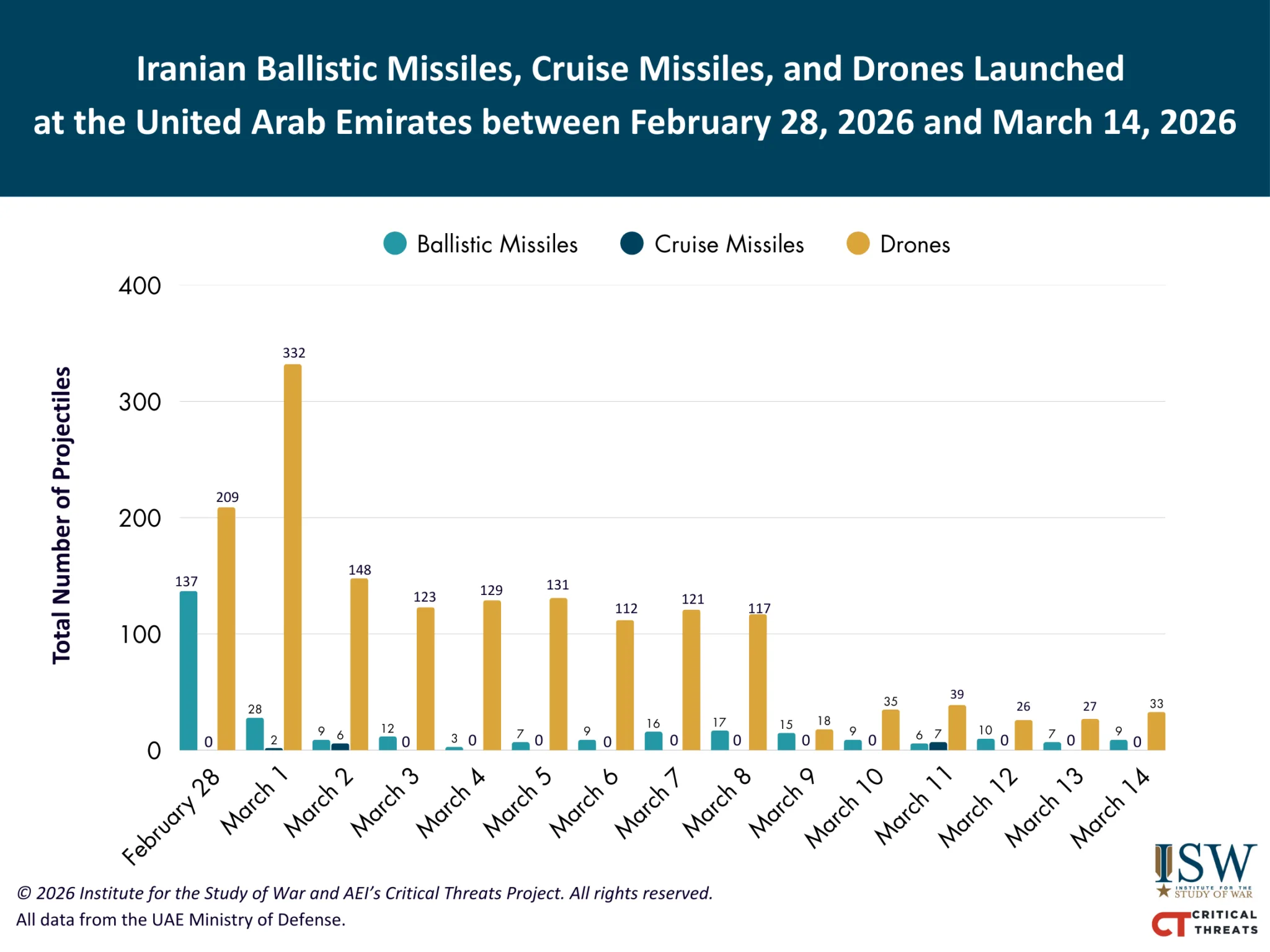
https://understandingwar.org/wp-content/uploads/2026/03/Iranian-Launches-at-the-UAE-March-14-2048x1536.webp
The United States and Israel have degraded Iran’s ability to conduct retaliatory attacks across the Middle East. This graphic shows the decrease in Iranian ballistic missile, cruise missile, and drone attacks targeting the United Arab Emirates since the start of the US-Israeli combined force’s war with Iran on February 28, 2026.
https://understandingwar.org/research/middle-east/iranian-ballistic-missiles-cruise-missiles-and-drones-launched-at-the-united-arab-emirates-between-february-28-2026-and-march-14-2026/
Iran Update Special Report, March 14, 2026
Israeli and US officials told Axios on March 13 that Israel is planning to “significantly expand” its ground campaign in Lebanon to dismantle Hezbollah infrastructure south of the Litani River. A senior Israeli official said that Israel’s objectives are to “take over territory, push Hezbollah’s forces north and away from the border, and dismantle [Hezbollah’s] military positions and weapons depots in [southern Lebanese] villages.”
Neither Iran nor the United States is prepared to hold discussions to reach a ceasefire despite mediation efforts by Oman and Egypt, according to Iranian, regional, and White House officials speaking to Reuters on March 14. Three sources familiar with the efforts told Reuters that the Trump administration rejected efforts by Middle Eastern allies, including Oman and Egypt, to start diplomatic talks to end the war with Iran.
The United States struck Iranian military infrastructure on Kharg Island in Bushehr Province on March 13, in part to degrade Iran’s ability to threaten shipping in the Strait of Hormuz. US Central Command (CENTCOM) stated that US forces conducted large-scale precision strikes targeting Kharg Island, destroying naval mine storage facilities, missile storage facilities, and other military sites.
United Kingdom Maritime Trade Operations (UKMTO) reported on March 14 that it has not observed any confirmed vessel attacks in the Persian Gulf, Strait of Hormuz, and Gulf of Oman in the past 48 hours. UKMTO warned that the threat environment in these areas remains critical, however.
Hezbollah claimed 43 attacks targeting Israeli forces and positions in northern Israel and southern Lebanon, as well as northern Israeli towns, between 3:00 PM ET on March 13 and 3:00 PM ET on March 14. This marks the highest number of attacks that Hezbollah has claimed in a 24-hour period since the start of the war.
https://understandingwar.org/research/middle-east/iran-update-special-report-march-14-2026/
1,811
posted on
03/15/2026 12:06:56 AM PDT
by
AdmSmith
(GCTGATATGTCTATGATTACTCAT)
1,812
posted on
03/15/2026 12:08:06 AM PDT
by
AdmSmith
(GCTGATATGTCTATGATTACTCAT)
What’s Going on With Shipping
Strait of Hormuz Update 15 March 2026 | Update on Other Maritime Stories | US Destroyers Sail Again
In this episode, we recap five maritime stories from around the world and provide some updates on past stories. We review the latest Join Maritime Information Center bulletin on the Strait of Hormuz for March 15, 2026, discuss relevant stories and ship passages and discuss a historical analog to the situation the US Navy is facing currently in the Strait.
https://www.youtube.com/watch?v=0SELRtaciaI
1,813
posted on
03/15/2026 1:22:14 PM PDT
by
AdmSmith
(GCTGATATGTCTATGATTACTCAT)
To: nuconvert
The War in Iran: Operational Progress, but Challenges Remain
The war in Iran is currently in a phase in which the military trajectory is relatively positive: the United States is steadily destroying Iran's ability to use its most essential tool in the war — drone and missile attacks — which in turn underpin the entire Iranian strategy. Iran has still done some damage to US forces, and it is still firing drones and missiles, though the overall attack rate is slowly decreasing. These attacks still pale in comparison to the major attacks Iran sought to conduct in an existential war and have caused neither operationally significant damage nor widespread casualties. The US-Israeli combined force will need time to achieve its military objectives and prevent Iran from inflicting further political and economic pain upon the United States and its allies in the region, but the campaign remains incomplete, and it is too soon to forecast its outcome. Declaring it an operational failure is unquestionably premature.
Iran has developed and sought to implement a multi-pronged theory of how it will defeat the United States and Israel in a major, existential conflict.This theory is that inflicting enough political and economic pain upon the United States, Israel, and America's Gulf allies will make the combined force cease its operations. The Iranians have developed five lines of effort to compel the United States and Israel to end the war: drone and ballistic missile attacks to inflict US and Israeli casualties and economic damage in the Gulf; drone, missile, and naval attacks including mines to disrupt shipping in the Persian Gulf; proxy attacks from Hezbollah and other Iranian-backed groups; global terrorism; and cyber attacks on critical infrastructure.[1] The US-Israeli combined campaign has focused on stopping drone, ballistic missile, and traditional naval attacks most urgently because these assets are the most essential Iranian tools that Tehran needs to execute its strategy.[2] Both aerial and naval drones remain a threat to shipping and oil infrastructure in the Gulf, and the threat of Iranian mining of the Strait remains real, if complex. The combined force will likely knock the drone and missile threat down to levels that would permit renewed maritime transit through the Strait if the current campaign succeeds in its aims, but oil and shipping prices depend in part on the risk-tolerance of third parties, so even an immediate end to the Iranian threat may not cause prices to drop quickly.
Read the article
https://understandingwar.org/research/middle-east/the-war-in-iran-operational-progress-but-challenges-remain/
Iran Update Evening Special Report, March 15, 2026
Iran is reportedly using Russian-produced and possibly modified Shahed drones to target US bases and Gulf countries, according to Ukrainian intelligence. Ukrainian President Volodymyr Zelensky told CNN on March 15 that he has seen intelligence that “100 percent” confirms that Iran has used Russian-produced Shahed drones “with Russian details” to attack US bases in the Middle East.[1] Zelensky added that Ukrainian intelligence assesses that Russia is sharing intelligence with Iran.[2] Russia began domestically producing Shahed drones in 2023 and has adapted them to increase their firepower and defensive capabilities.[3] These adaptations include equipping Shaheds with Verba shoulder‑fired man-portable air-defense systems (MANPADS) to increase the Shahed’s capacity to target enemy aircraft.[4] Iran recently purchased 500 Verbas and 2,500 9M336 infrared homing missiles from Russia in December 2025, according to the Financial Times in February 2026.[5] Russia's provision of Shahed drones to Iran would mark a notable shift in Russia's support for Iran in the war. Russia has thus far shared targeting intelligence and advanced drone tactics with Iran, but it has not, up till now, provided material support to Iran.
The US-Israeli combined force continued to target Iranian military and internal security infrastructure across Iran. CTP-ISW has observed strikes in six provinces since 3:00 PM ET on March 14.
IRGC Aerospace Force Commander Brigadier General Majid Mousavi and Iranian media claimed on March 15 that Iran launched a Sejjil ballistic missile at Israel for the first time during the war.
Iranian officials are attempting to obscure Iran's responsibility for recent drone and ballistic missile attacks targeting Gulf states, likely to try to strain relations between the United States and Israel and Gulf countries.
US and Israeli intelligence reportedly assess that the IRGC is making decisions because Supreme Leader Mojtaba Khamenei is wounded. CBS News reported on March 15 that the US Government believes that the IRGC is “calling the shots.”[69] Fox News similarly reported on March 15 that Israeli intelligence assesses that Mojtaba is injured and that IRGC personnel “are managing him.”[70] These assessments are consistent with previous reports that the IRGC had pushed for Mojtaba’s appointment because it views him as a “more pliant version of his father.”[71]
Neither US nor Iranian officials currently appear to be seeking a ceasefire agreement. US President Donald Trump told NBC News on March 14 that “Iran wants to make a deal,” but that he is not currently prepared to make a deal to end the war with Iran because “[Iran's] terms aren't good enough yet.”
https://understandingwar.org/research/middle-east/iran-update-evening-special-report-march-15-2026/
1,814
posted on
03/16/2026 12:19:36 AM PDT
by
AdmSmith
(GCTGATATGTCTATGATTACTCAT)
To: nuconvert
1,815
posted on
03/16/2026 10:22:38 AM PDT
by
AdmSmith
(GCTGATATGTCTATGATTACTCAT)
To: nuconvert; gleeaikin; BeauBo
Iran Update Evening Special Report: March 16, 2026
Supreme Leader Mojtaba Khamenei’s reported inner circle is dominated by long-standing hardline Islamic Revolutionary Guards Corps (IRGC) commanders. Their influence will almost certainly drive Iran toward more hardline, anti-Western policies and deepen existing patterns of regime corruption and securitization. The New York Times reported on March 16 that former IRGC Intelligence Organization head Hossein Taeb, de facto IRGC Commander Brigadier General Ahmad Vahidi, former IRGC Commander Major General Mohammad Ali Jafari, and Parliament Speaker and former IRGC Brigadier General Mohammad Bagher Ghalibaf were the main campaigners to get the Assembly of Experts to elect Mojtaba as supreme leader.[1] All four of these IRGC commanders worked for decades under former Supreme Leader Ali Khamenei.[2] The first generation of Iranian revolutionaries and long-time IRGC leaders thus remain at the top of the Iranian regime‘s hierarchy despite decapitation strikes in recent years. The New York Times article cited interviews from five senior Iranian officials, two clerics, two Iranians affiliated with the supreme leader's office and three IRGC members with knowledge of the selection process.[3] Mojtaba also selected former IRGC commander Major General Mohsen Rezaei as his military adviser on March 16.[4] Mojtaba has had strong ties to the IRGC that date back to when he fought in the Iran-Iraq War in the Habib Ibn Mazahir Battalion within the IRGC 27th Mohammad Rasoul Ollah Division.[5]
Hossein Taeb helped Mojtaba engineer the 2005 presidential election in favor of hardline candidate Mahmoud Ahmadinejad.[6] Taeb later led the Basij‘s suppression of subsequent protests in the 2009 Green Movement as the Basij commander.[7] The United States sanctioned Taeb in 2010 for his involvement in protest suppression.[8] Taeb went on to serve as head of the IRGC Intelligence Organization, the parallel organization to the Intelligence Ministry, from 2009 to 2022, and then served as adviser to the IRGC Commander.[9] Taeb reportedly pressured all 88 Assembly members to vote for Mojtaba as Supreme Leader, resulting in 59 members ultimately voting in his favor.[10]
Ahmad Vahidi is a long-time hardliner who has held some of the regime's top security posts, including IRGC Quds Force commander, defense and armed logistics minister, interior minister, and Armed Forces General Staff (AFGS) deputy chief.[11] The United States sanctioned Vahidi for his role in directing Law Enforcement Command during the 2022 Mahsa Amini protests.[12] Vahidi’s abrupt reassignment in December 2025 from AFGS deputy chief to the IRGC deputy commander followed reported clashes with Artesh leaders over post-June 2025 Israel-Iran War air defense priorities.[13]
Ali Jafari similarly has consistently pursued an uncompromising hardline domestic policy, treating reformists and protest movements as “internal enemies” of the regime and deploying IRGC, Basij, and plainclothes units to suppress dissent and intimidate political rivals.[14] The United States also sanctioned Jafari in 2010 for his role in suppressing the 2009 Green Movement protests as IRGC commander.[15] Jafari adopted asymmetrical and extra-territorial warfare that positioned the IRGC to project power beyond Iran's borders.[16]
Mohammad Bagher Ghalibaf is a veteran IRGC hardliner whose deep ties to senior commanders – dating back to his service as IRGC Air Force chief, Law Enforcement Command (LEC) chief, and in the Iran-Iraq War – have anchored his aggressive approach to domestic security and regime preservation.[17] Ghalibaf reportedly assumed an emergency senior military command after Israeli killed top commanders at the start of the June 2025 Israel-Iran War, an unprecedented move for a sitting civilian parliament speaker that underscored his entrenched influence and the unprecedented damage Iran's command and control network suffered in June.[18]
Mohsen Rezaei is a senior regime insider and long-standing member of the Supreme Leader-appointed Expediency Discernment Council, whose hardline worldview was shaped by his tenure as IRGC commander from 1981 to 1997 – including through the Iran-Iraq War from 1980 to 1988 – and his continued role advising core strategic polices.[19] Rezaei is also implicated in the 1994 AMIA bombing in Argentina that killed 85 people. He remains the subject of an Interpol Red Notice.[20]
IRGC commanders reportedly view the conflict with the United States and Israel as a unifying national struggle that also reduces pressure on the regime to address Iran's mounting economic problems. An informed source told anti-regime outlet Iran Wire on March 16 that an IRGC official told President Masoud Pezeshkian that the US and Israeli airstrikes have united the Iranian population behind the regime as the Iran-Iraq War once had, at a meeting where Pezeshkian had asked about the IRGC’s plans for post-war economic recovery.[21] Pezeshkian warned that such thinking amounted to planning for renewed repression rather than genuine post-war recovery or governance, according to the source.[22] The president's question to IRGC about plans about domestic policy, if accurate, reinforces recent reporting on the command the IRGC holds in current foreign and domestic policy decision-making.[23]
The Iranian regime has taken steps to further restrict the flow of information out of Iran, which will almost certainly limit ISW-CTP’s ability to observe strikes in Iran. Internet monitor NetBlocks reported on March 16 that the regime has further tightened internet restrictions. A BBC reporter stated on March 15 that the regime has reportedly started to target individuals with Starlink access and reduced the availability of VPNs.
The combined force targeted a likely Iranian drone facility in South Khorasan Province in one of the combined force's easternmost strikes since the war began. The strike indicates that combined force aircraft can operate deep inside Iranian territory.
Iran has not attacked any vessels in the Strait of Hormuz since March 12. Anti-regime media also published footage on March 12 that shows a US Navy F/A-18 Hornet engaging targets with its auto cannon at extremely low altitude in Chabahar, Sistan and Baluchistan Province, which is on the Iranian coast on the Gulf of Oman. This suggests that US forces have at least local air dominance along certain segments of the coast, which would enable US aircraft to engage drones and anti-ship cruise missiles at low altitudes to protect shipping if ordered to do so.
https://understandingwar.org/research/middle-east/iran-update-evening-special-report-march-16-2026/
1,816
posted on
03/16/2026 11:12:52 PM PDT
by
AdmSmith
(GCTGATATGTCTATGATTACTCAT)
To: AdmSmith
Iran is winning because all they have to do is survive. This is just like our war for independence and Vietnam. Draw it out as long as possible.
To: nuconvert; gleeaikin; BeauBo
Iran Update Special Report, March 17, 2026
The United States and Israel are currently attempting to use force to prevent Iran from disrupting shipping in the Strait of Hormuz. Such an operation will also demonstrate that the regime cannot hold the strait hostage in the future to secure strategic victories at relatively limited cost. A “very senior Israeli political source” enumerated a series of war aims to Israeli Channel 12 that included preventing Iran from disrupting shipping in the Strait of Hormuz and denying Iran's ability to do so in the future.[1] Accomplishing this objective would demonstrate that Israel and the United States have the ability to prevent Iran from trying again in the future. The US objectives are consistent with the Israeli objectives regarding the Strait of Hormuz. US Central Command (CENTCOM) commander Admiral Brad Cooper said on March 11, for example, that the United States aims to degrade Iran's ability to interrupt shipping in the Strait and “end their ability to project power and harass shipping in the Strait of Hormuz.”[2]
A weakened regime that remains in power after this war would be able to disrupt shipping whenever and for however long it pleases with little effort if its current, relatively limited, strike campaign on shipping proves sufficient to cause the US and Israel to surrender. A failure to demonstrate the will and ability to deny Iran the ability to disrupt traffic will make it enormously harder to deter Iran from future disruptions. Stopping the war in current conditions would thus represent a major strategic challenge that the United States or Israel would need to contend with in future rounds of conflict with a regime that will continue to be a committed adversary. Iranian Parliament Speaker and former military official Mohammed Bagher Ghalibaf, for example, said that the strait will never return to its pre-war state.[3] Ghalibaf is presumably suggesting that Iran will continue to use the Strait of Hormuz and threats against it to coerce its adversaries and deter future military action. Ending Iran's ability to disrupt shipping would demonstrate to Tehran that the United States and its partners can and will stop Iran by force if needed. It remains unclear whether military action will stop Iran from threatening the Strait. But ending the war without taking all feasible action to destroy Iran's ability to disrupt traffic would communicate Iran that it can use threats to the strait to defeat its adversaries, including the United States, in any future conflict.
The list of objectives also included “creating conditions for regime change.” It does not follow that “conditions for regime change” will create regime change.[4] The conditions for regime change may or may not exist after the war, but executing regime change would require a sufficiently strong, large, and organized force to topple the regime nationwide and then take control nationwide in order to avoid chaos or a large-scale indigenous movement to overthrow the regime. It is premature to forecast the likelihood of such an uprising, as the air campaign is not complete, and people are very unlikely to rise against the regime in the midst of an active air campaign.
The Israel Defense Forces (IDF) confirmed that it struck the Islamic Revolutionary Guards Corps (IRGC) Navy headquarters in Tehran on March 16.[5] It stated that commanders used the headquarters to direct IRGC Navy forces and plan operations against Israel and other regional countries. The IRGC Navy is primarily responsible for the Persian Gulf and the Strait of Hormuz.[6] Iranian leaders have historically viewed the IRGC Navy as their main tool to disrupt commercial traffic near Iran's coast and around the Strait of Hormuz. IRGC Navy Commander Alireza Tangsiri implicitly threatened on March 1 to attack any vessels that transit the strait without permission from Iran.[7] The United Kingdom Maritime Trade Organization has reported more than 20 maritime incidents in and around the strait since March 1.[8] The IRGC Navy also transports military equipment and other resources to Iranian proxy groups.[9]
Russia continues to expand its intelligence sharing and military cooperation with Iran to facilitate Iranian strikes on US and Israeli forces in the Middle East. The Wall Street Journal (WSJ) reported on March 17, citing sources familiar with the matter, that Russia has been providing Iran with satellite imagery and drone technology and advice to support Iran's strike campaign against Israeli and the US forces.[10] Anonymous sources familiar with the matter, including a senior European intelligence officer, told the WSJ that Russia provided Iran with modified Shahed drone components meant to improve communication, navigation, and targeting, and specific advice for conducting drone strikes, including at what altitude and how many drones Iran should launch. A senior European intelligence officer and a Middle Eastern diplomat reported that Russia provided Iran with satellite imagery, which another official said came from satellites the Russian Aerospace Forces (VKS) manage, to assist recent Iranian strikes on US forces in the Middle East and US allies in the region. ISW continues to assess that Russia sees aiding Iran's strike campaign as an opportunity to weaken the US, as Russia has self-defined the US as one of its primary geopolitical adversaries.[11]
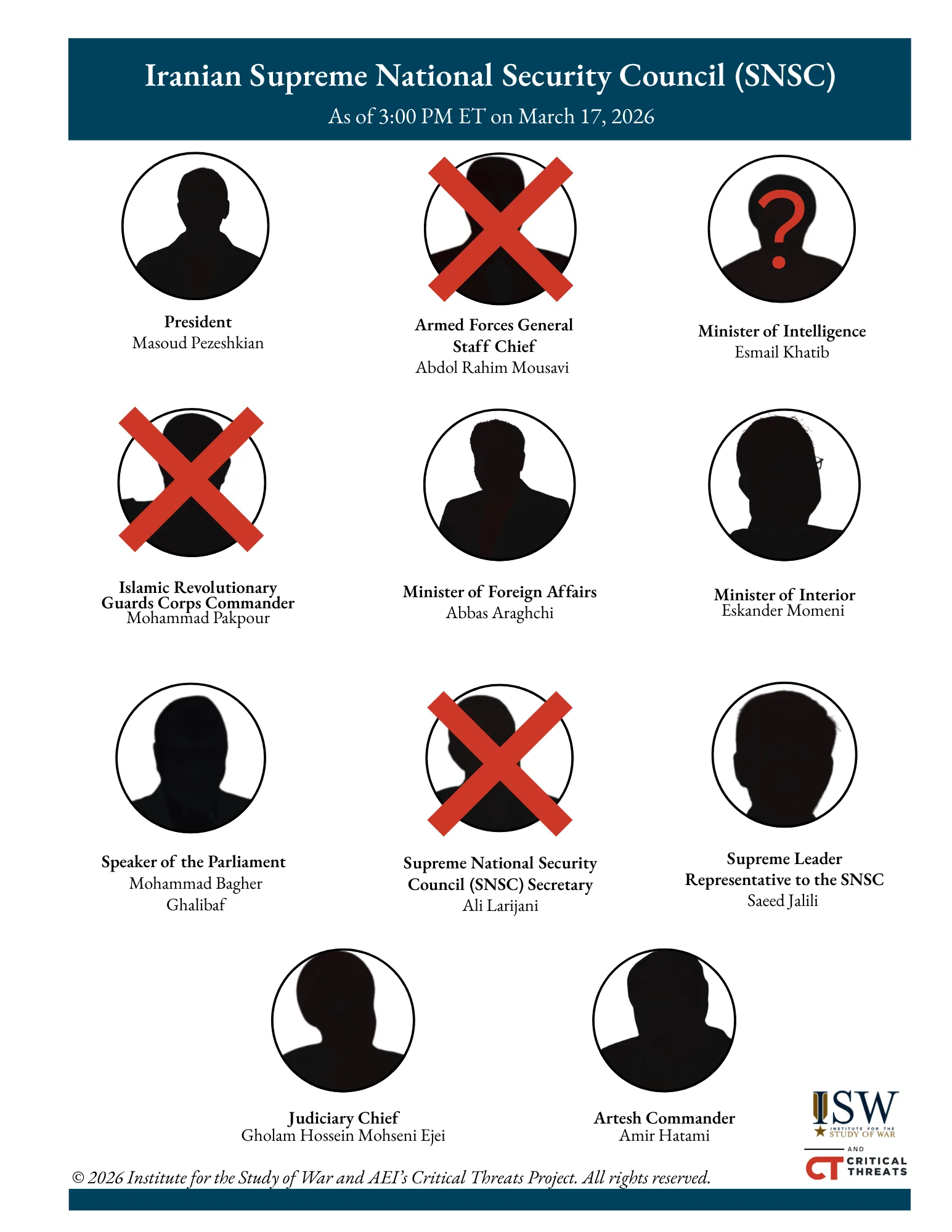
The IDF conducted a strike in Tehran killing Ali Larijani. Larijani has long been a major figure in the Iranian ruling establishment as a member of the powerful Larijani family and key player in the inner circle of recently killed Supreme Leader Ali Khamenei.[12] He has held numerous key posts over decades, including parliament speaker and most recently Supreme National Security Council (SNSC) secretary. The SNSC is the seniormost foreign and defense policy decision-making body. In that capacity, Larijani has overseen Iranian strategy in the current war and the brutal crackdown that killed 30,000 protesters in January 2026.[13] The New York Times reported in February 2026 that Larijani had “effectively been running the country” by that time.[14]
Larijani was a relative pragmatist, occasionally supporting more restrained behaviors compared to the more uncompromising hardliners. Larijani supported the Joint Comprehensive Plan of Action championed by moderate President Hassan Rouhani, for instance. Nevertheless, Larijani was a long-time regime operative who had long endorsed and helped implement some of the regime's most aggressive and authoritarian policies.
Larijani’s death likely weakens a key faction in the intra-regime competition with the Supreme Leader Mojtaba Khamenei-IRGC nexus but will not end the ongoing competition. The New York Times reported on March 17 that Larijani had been lobbying the Assembly of Experts, the body responsible for selecting the supreme leader, to change their vote in favor of a more moderate choice.[15] Anti-regime media reported on March 6 that Larijani had wanted his brother, Sadegh Amoli Larijani, to become the next Supreme Leader.[16] Anti-regime media reported in September 2025 that Ali Larijani was maneuvering to secure his influence in the regime after Khamenei dies.[17]
Competition within the regime over its future trajectory will continue despite Larijani’s death. Key factions continue to disagree over succession and governance after the combined force killed Ali Khamenei. Anti-regime media, citing unspecified sources, reported on March 13 that some clerics in Iran have raised concerns about Mojtaba’s physical condition and capacity to govern, for example.[18] Larijani’s death is also unlikely to be the last casualty from among Iran's top leaders as decapitation strikes continue. Each loss will alter the nature of the competition and the power of the various factions. Mojtaba will likely face several immediate challenges even after the war and after the decapitation strikes stop or slow. These challenges will include establishing his legitimacy and attempting to unite and gain the support of various regime factions.[19]
The IDF also killed Basij Organization Commander Brigadier General Gholamreza Soleimani and his deputy Ghassem Ghoureishi during strikes on a “makeshift headquarters” in Tehran where, according to anti-regime media, they were reportedly coordinating protest suppression efforts.[20] The strike occurred overnight on March 16 and 17. Sources told anti-regime media that senior Basij commanders held a meeting that night to discuss plans to counter potential protests during the Iranian Chaharshanbe Suri holiday on March 17.[21] The report added that the Israeli strikes overnight killed around 300 Basij commanders and field officers.[22] Israeli strikes targeting senior Basij commanders are part of a broader US-Israeli effort to degrade repressive institutions in Iran. The Basij is a paramilitary organization that the Iranian armed forces use to recruit, indoctrinate, organize, and control regime loyalists.[23] The Basij focuses largely on producing and disseminating propaganda, social policing, suppressing domestic dissent, and conducting civil defense activities. The Basij maintains elite units that receive advanced military and “ideological-political” training and function as a manpower reserve for the IRGC Ground Forces. The IRGC Ground Forces incorporates these Basij units into its ranks, especially during times of war or domestic crisis. The Basij also cooperates extensively with the IRGC Intelligence Organization to monitor the Iranian population. Israeli airstrikes overnight killed the following individuals, among others:
· Gholamreza Soleimani. Former Supreme Leader Ali Khamenei appointed Soleimani as Basij Organization commander following the 2019 protests as part of a broader reshuffling of internal security leadership.[24] The United States sanctioned Soleimani in January 2020 for the Basij’s involvement in recruiting and sending child soldiers to fight in regional conflicts.[25] Soleimani previously commanded IRGC Ground Forces units and has an extensive history of repression.[26]
· Ghassem Ghoureishi. Former IRGC Commander Hossein Salami appointed Ghoureishi in 2021 during the same reshuffling period of internal security officials.[27] He previously served as the coordination deputy to the supreme leader's representative to the IRGC.[28] The European Union sanctioned Ghoureishi on March 16 for his role in protest suppression and human rights violations.[29]
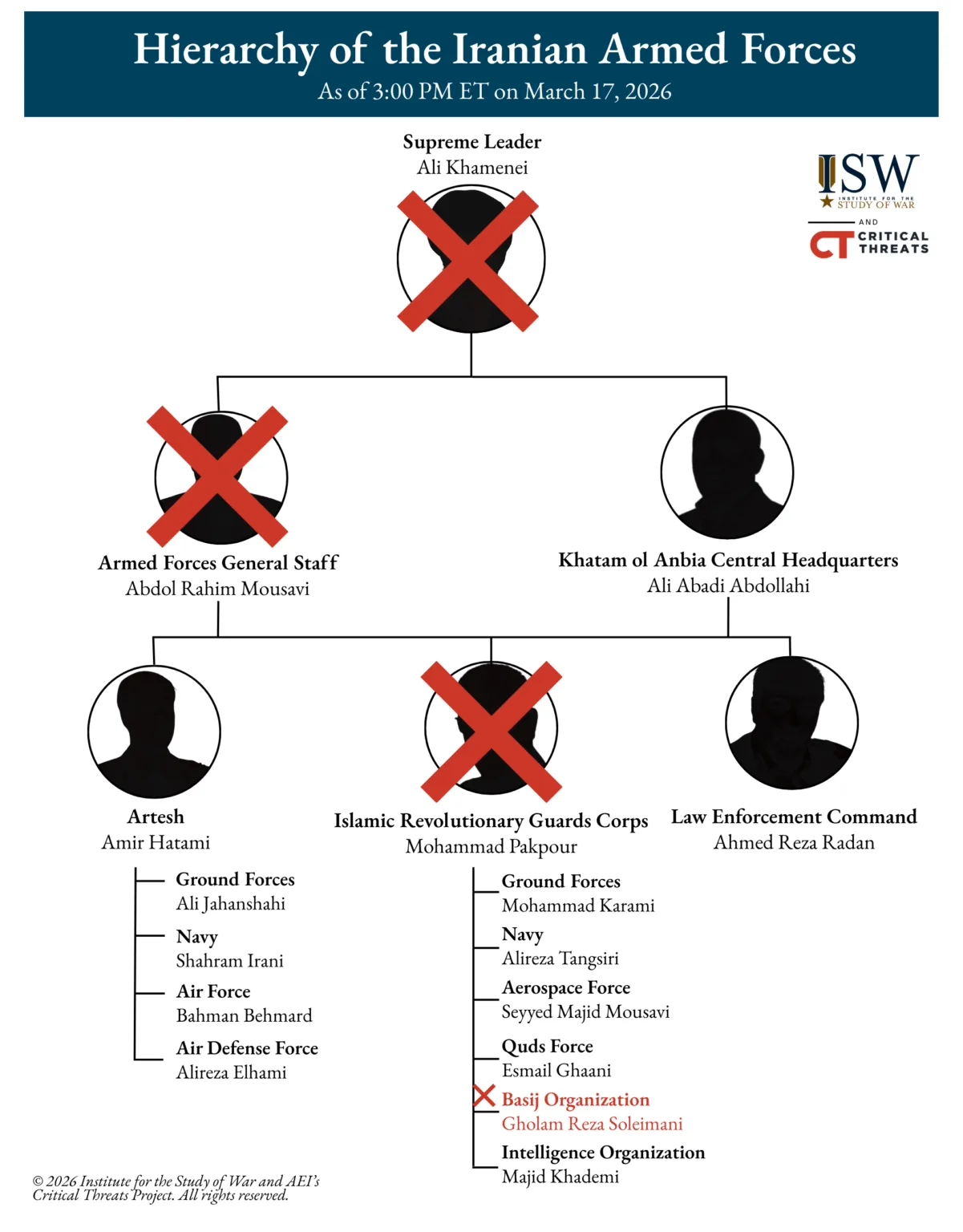
more + maps: https://understandingwar.org/research/middle-east/iran-update-special-report-march-17-2026/
Khatib is eliminated as well
1,818
posted on
03/18/2026 1:59:03 AM PDT
by
AdmSmith
(GCTGATATGTCTATGATTACTCAT)
Muhanad Seloom: The US-Israeli strategy against Iran is working. Here is why. Every aspect of Iran's ability to project regional power is being successfully degraded.
Seventeen days in, Iran's supreme leader is dead, his successor is reportedly wounded and every principal instrument of Iranian power projection – missiles, nuclear infrastructure, air defences, the navy, proxy command networks – has been degraded beyond near-term recovery. The campaign's execution has been imperfect, its public communication poor and its post-conflict planning incomplete. War is never clean. But the strategy – the actual strategy, measured in degraded capabilities rather than cable news cycles – is working.
long article
https://www.aljazeera.com/opinions/2026/3/16/the-us-israeli-strategy-against-iran-is-working-here-is-why
1,819
posted on
03/18/2026 2:56:41 AM PDT
by
AdmSmith
(GCTGATATGTCTATGATTACTCAT)
To: AdmSmith
1,820
posted on
03/18/2026 9:49:53 AM PDT
by
nuconvert
( Warning: Accused of being a radical militarist. Approach with caution.)
Navigation: use the links below to view more comments.
first previous 1-20 ... 1,781-1,800, 1,801-1,820, 1,821-1,840 ... 2,461-2,479 next last
Disclaimer:
Opinions posted on Free Republic are those of the individual
posters and do not necessarily represent the opinion of Free Republic or its
management. All materials posted herein are protected by copyright law and the
exemption for fair use of copyrighted works.
FreeRepublic.com is powered by software copyright 2000-2008 John Robinson