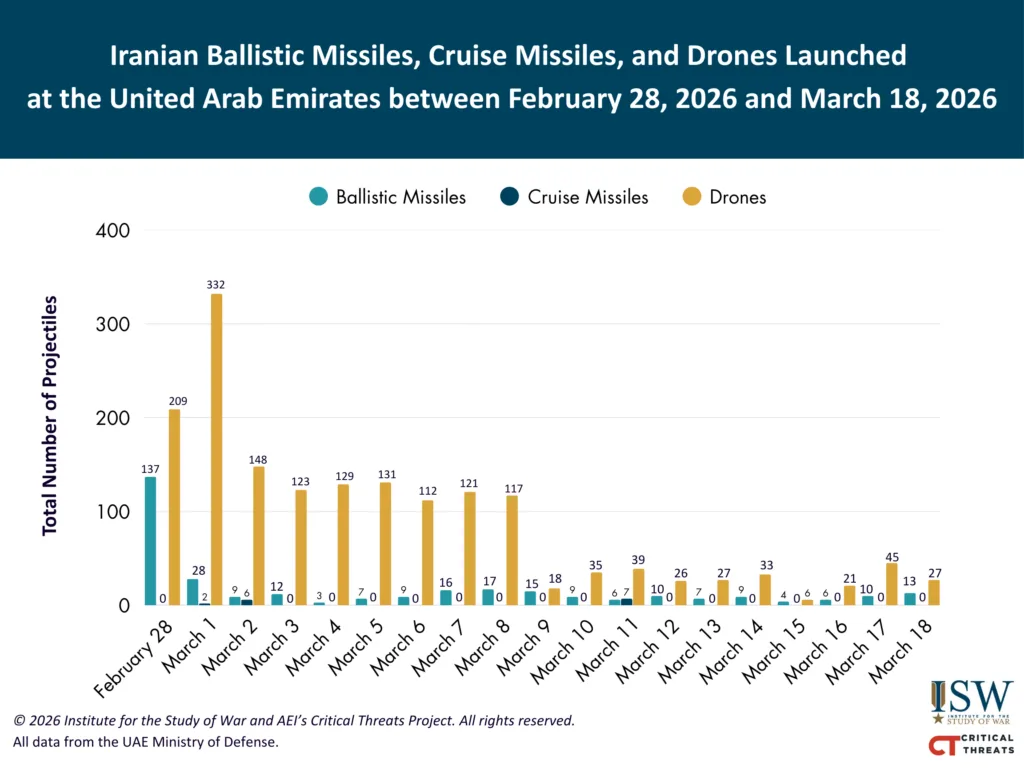
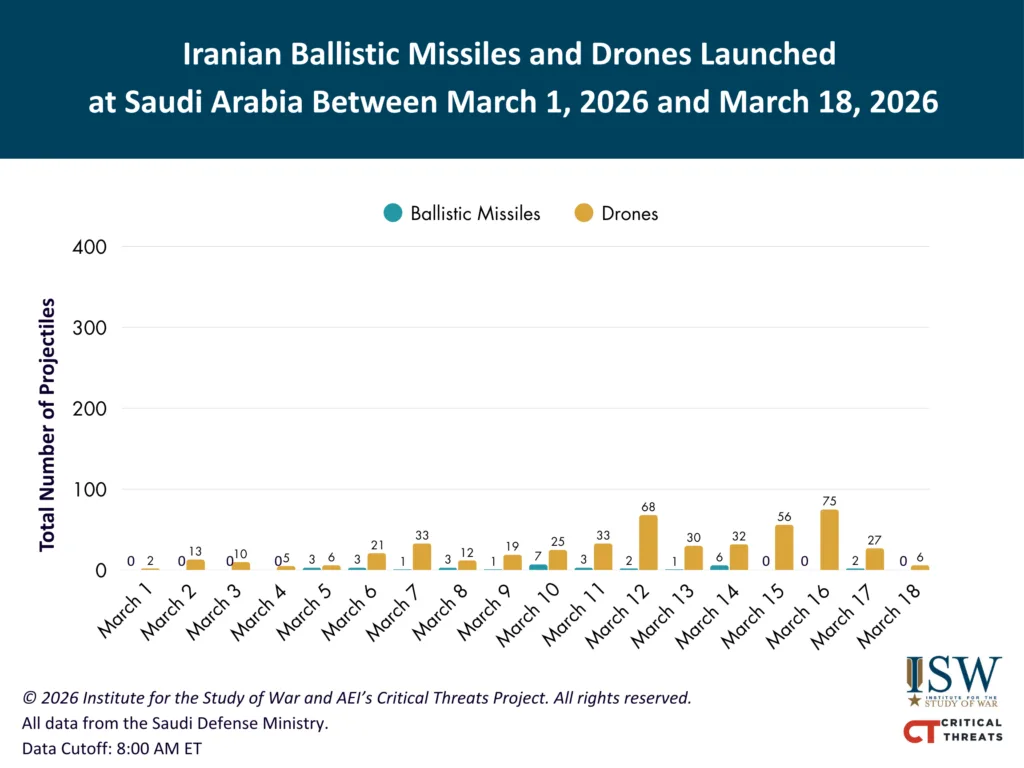
The United States and Israel are currently attempting to use force to prevent Iran from disrupting shipping in the Strait of Hormuz. Such an operation will also demonstrate that the regime cannot hold the strait hostage in the future to secure strategic victories at relatively limited cost. A “very senior Israeli political source” enumerated a series of war aims to Israeli Channel 12 that included preventing Iran from disrupting shipping in the Strait of Hormuz and denying Iran's ability to do so in the future.[1] Accomplishing this objective would demonstrate that Israel and the United States have the ability to prevent Iran from trying again in the future. The US objectives are consistent with the Israeli objectives regarding the Strait of Hormuz. US Central Command (CENTCOM) commander Admiral Brad Cooper said on March 11, for example, that the United States aims to degrade Iran's ability to interrupt shipping in the Strait and “end their ability to project power and harass shipping in the Strait of Hormuz.”[2]
A weakened regime that remains in power after this war would be able to disrupt shipping whenever and for however long it pleases with little effort if its current, relatively limited, strike campaign on shipping proves sufficient to cause the US and Israel to surrender. A failure to demonstrate the will and ability to deny Iran the ability to disrupt traffic will make it enormously harder to deter Iran from future disruptions. Stopping the war in current conditions would thus represent a major strategic challenge that the United States or Israel would need to contend with in future rounds of conflict with a regime that will continue to be a committed adversary. Iranian Parliament Speaker and former military official Mohammed Bagher Ghalibaf, for example, said that the strait will never return to its pre-war state.[3] Ghalibaf is presumably suggesting that Iran will continue to use the Strait of Hormuz and threats against it to coerce its adversaries and deter future military action. Ending Iran's ability to disrupt shipping would demonstrate to Tehran that the United States and its partners can and will stop Iran by force if needed. It remains unclear whether military action will stop Iran from threatening the Strait. But ending the war without taking all feasible action to destroy Iran's ability to disrupt traffic would communicate Iran that it can use threats to the strait to defeat its adversaries, including the United States, in any future conflict.
The list of objectives also included “creating conditions for regime change.” It does not follow that “conditions for regime change” will create regime change.[4] The conditions for regime change may or may not exist after the war, but executing regime change would require a sufficiently strong, large, and organized force to topple the regime nationwide and then take control nationwide in order to avoid chaos or a large-scale indigenous movement to overthrow the regime. It is premature to forecast the likelihood of such an uprising, as the air campaign is not complete, and people are very unlikely to rise against the regime in the midst of an active air campaign.
The Israel Defense Forces (IDF) confirmed that it struck the Islamic Revolutionary Guards Corps (IRGC) Navy headquarters in Tehran on March 16.[5] It stated that commanders used the headquarters to direct IRGC Navy forces and plan operations against Israel and other regional countries. The IRGC Navy is primarily responsible for the Persian Gulf and the Strait of Hormuz.[6] Iranian leaders have historically viewed the IRGC Navy as their main tool to disrupt commercial traffic near Iran's coast and around the Strait of Hormuz. IRGC Navy Commander Alireza Tangsiri implicitly threatened on March 1 to attack any vessels that transit the strait without permission from Iran.[7] The United Kingdom Maritime Trade Organization has reported more than 20 maritime incidents in and around the strait since March 1.[8] The IRGC Navy also transports military equipment and other resources to Iranian proxy groups.[9]
Russia continues to expand its intelligence sharing and military cooperation with Iran to facilitate Iranian strikes on US and Israeli forces in the Middle East. The Wall Street Journal (WSJ) reported on March 17, citing sources familiar with the matter, that Russia has been providing Iran with satellite imagery and drone technology and advice to support Iran's strike campaign against Israeli and the US forces.[10] Anonymous sources familiar with the matter, including a senior European intelligence officer, told the WSJ that Russia provided Iran with modified Shahed drone components meant to improve communication, navigation, and targeting, and specific advice for conducting drone strikes, including at what altitude and how many drones Iran should launch. A senior European intelligence officer and a Middle Eastern diplomat reported that Russia provided Iran with satellite imagery, which another official said came from satellites the Russian Aerospace Forces (VKS) manage, to assist recent Iranian strikes on US forces in the Middle East and US allies in the region. ISW continues to assess that Russia sees aiding Iran's strike campaign as an opportunity to weaken the US, as Russia has self-defined the US as one of its primary geopolitical adversaries.[11]
The IDF conducted a strike in Tehran killing Ali Larijani. Larijani has long been a major figure in the Iranian ruling establishment as a member of the powerful Larijani family and key player in the inner circle of recently killed Supreme Leader Ali Khamenei.[12] He has held numerous key posts over decades, including parliament speaker and most recently Supreme National Security Council (SNSC) secretary. The SNSC is the seniormost foreign and defense policy decision-making body. In that capacity, Larijani has overseen Iranian strategy in the current war and the brutal crackdown that killed 30,000 protesters in January 2026.[13] The New York Times reported in February 2026 that Larijani had “effectively been running the country” by that time.[14]
Larijani was a relative pragmatist, occasionally supporting more restrained behaviors compared to the more uncompromising hardliners. Larijani supported the Joint Comprehensive Plan of Action championed by moderate President Hassan Rouhani, for instance. Nevertheless, Larijani was a long-time regime operative who had long endorsed and helped implement some of the regime's most aggressive and authoritarian policies.
Larijani’s death likely weakens a key faction in the intra-regime competition with the Supreme Leader Mojtaba Khamenei-IRGC nexus but will not end the ongoing competition. The New York Times reported on March 17 that Larijani had been lobbying the Assembly of Experts, the body responsible for selecting the supreme leader, to change their vote in favor of a more moderate choice.[15] Anti-regime media reported on March 6 that Larijani had wanted his brother, Sadegh Amoli Larijani, to become the next Supreme Leader.[16] Anti-regime media reported in September 2025 that Ali Larijani was maneuvering to secure his influence in the regime after Khamenei dies.[17]
Competition within the regime over its future trajectory will continue despite Larijani’s death. Key factions continue to disagree over succession and governance after the combined force killed Ali Khamenei. Anti-regime media, citing unspecified sources, reported on March 13 that some clerics in Iran have raised concerns about Mojtaba’s physical condition and capacity to govern, for example.[18] Larijani’s death is also unlikely to be the last casualty from among Iran's top leaders as decapitation strikes continue. Each loss will alter the nature of the competition and the power of the various factions. Mojtaba will likely face several immediate challenges even after the war and after the decapitation strikes stop or slow. These challenges will include establishing his legitimacy and attempting to unite and gain the support of various regime factions.[19]
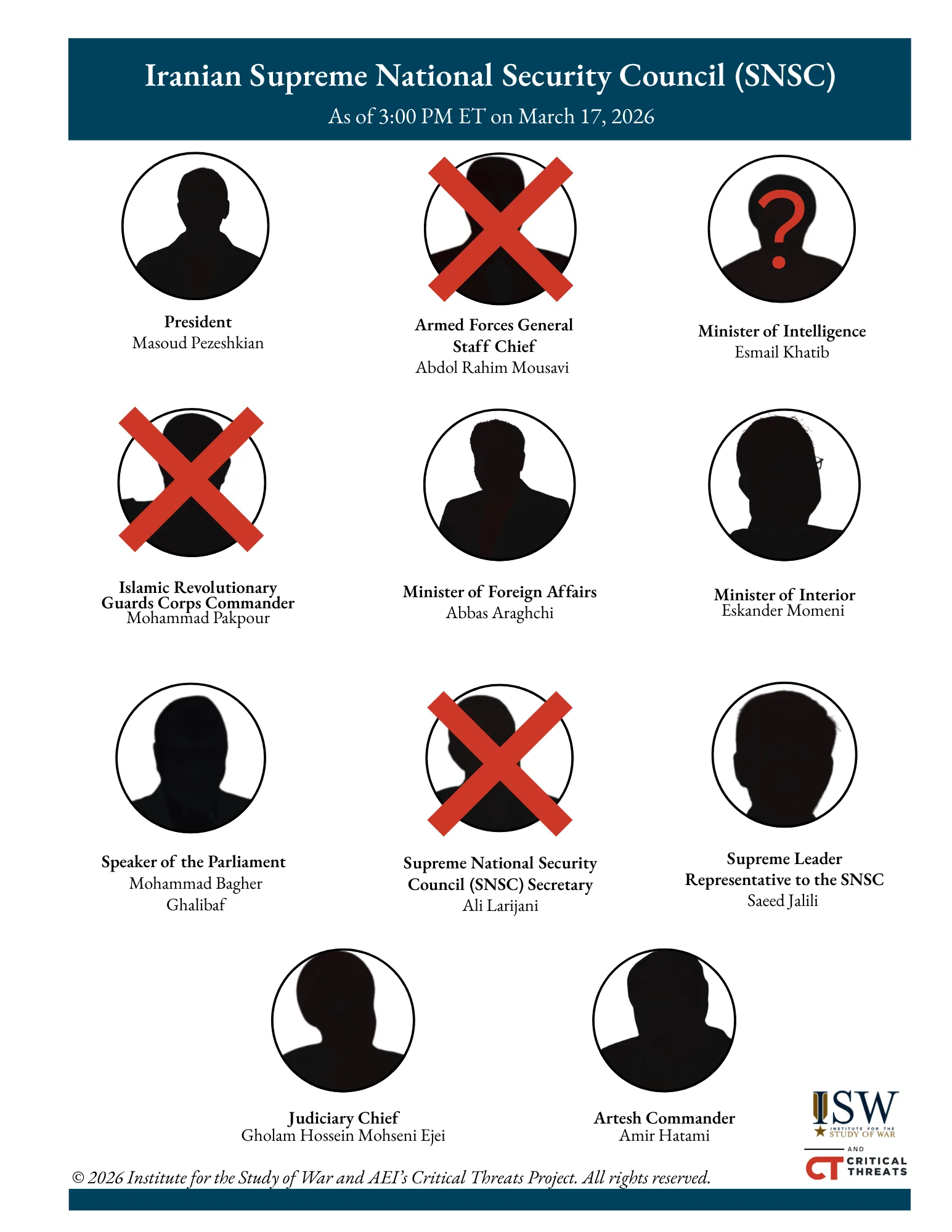
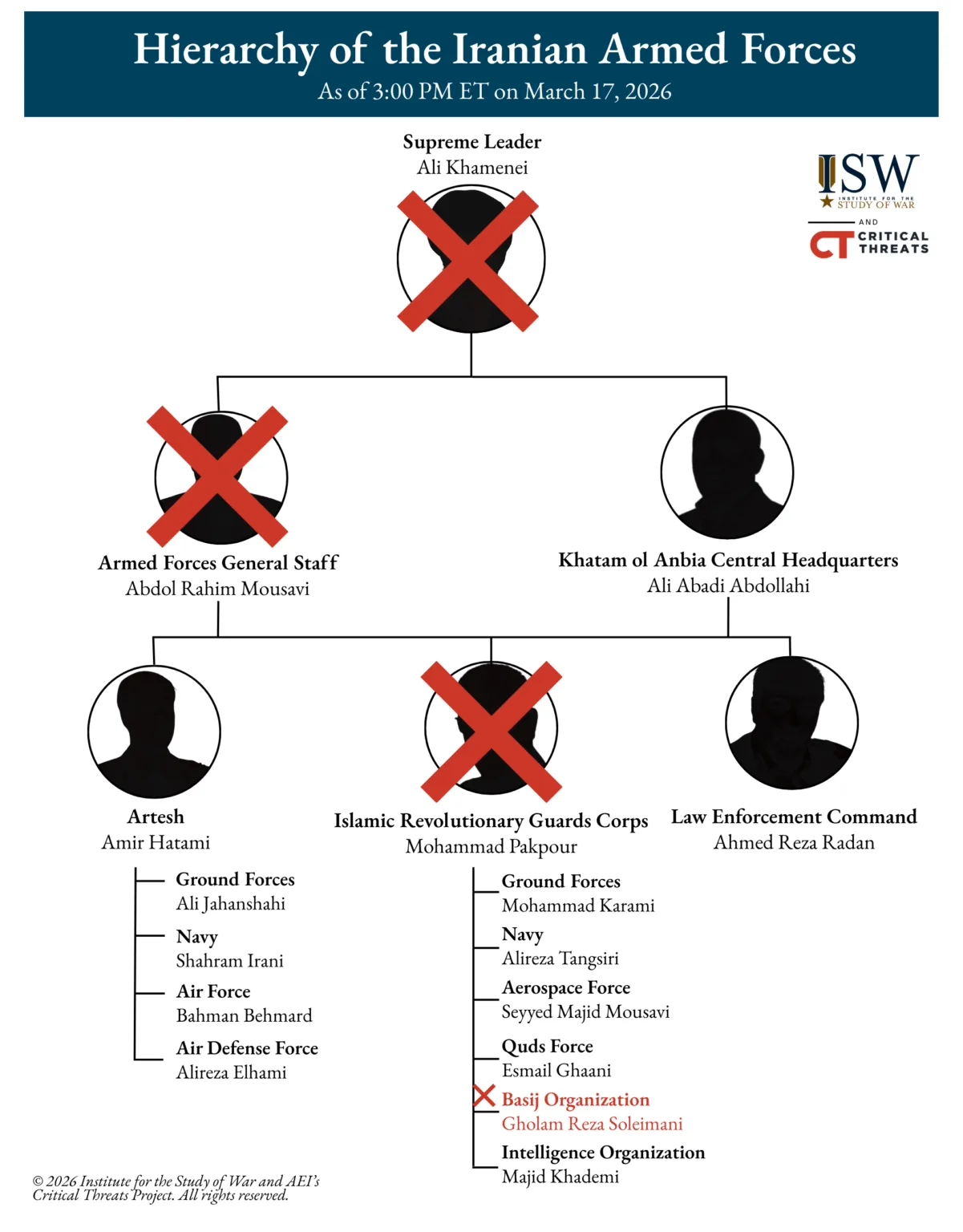
The IDF also killed Basij Organization Commander Brigadier General Gholamreza Soleimani and his deputy Ghassem Ghoureishi during strikes on a “makeshift headquarters” in Tehran where, according to anti-regime media, they were reportedly coordinating protest suppression efforts.[20] The strike occurred overnight on March 16 and 17. Sources told anti-regime media that senior Basij commanders held a meeting that night to discuss plans to counter potential protests during the Iranian Chaharshanbe Suri holiday on March 17.[21] The report added that the Israeli strikes overnight killed around 300 Basij commanders and field officers.[22] Israeli strikes targeting senior Basij commanders are part of a broader US-Israeli effort to degrade repressive institutions in Iran. The Basij is a paramilitary organization that the Iranian armed forces use to recruit, indoctrinate, organize, and control regime loyalists.[23] The Basij focuses largely on producing and disseminating propaganda, social policing, suppressing domestic dissent, and conducting civil defense activities. The Basij maintains elite units that receive advanced military and “ideological-political” training and function as a manpower reserve for the IRGC Ground Forces. The IRGC Ground Forces incorporates these Basij units into its ranks, especially during times of war or domestic crisis. The Basij also cooperates extensively with the IRGC Intelligence Organization to monitor the Iranian population. Israeli airstrikes overnight killed the following individuals, among others:
· Gholamreza Soleimani. Former Supreme Leader Ali Khamenei appointed Soleimani as Basij Organization commander following the 2019 protests as part of a broader reshuffling of internal security leadership.[24] The United States sanctioned Soleimani in January 2020 for the Basij’s involvement in recruiting and sending child soldiers to fight in regional conflicts.[25] Soleimani previously commanded IRGC Ground Forces units and has an extensive history of repression.[26]
· Ghassem Ghoureishi. Former IRGC Commander Hossein Salami appointed Ghoureishi in 2021 during the same reshuffling period of internal security officials.[27] He previously served as the coordination deputy to the supreme leader's representative to the IRGC.[28] The European Union sanctioned Ghoureishi on March 16 for his role in protest suppression and human rights violations.[29]
more + maps: https://understandingwar.org/research/middle-east/iran-update-special-report-march-17-2026/
Khatib is eliminated as well