Posted on 08/27/2023 3:29:43 PM PDT by algore
Apart from Garfield’s legendary love of lasagna, perhaps no food is more associated with cats than tuna. The dish is a staple of everything from The New Yorker cartoons to Meow Mix jingles—and more than 6% of all wild-caught fish goes into cat food. Yet tuna (or any seafood for that matter) is an odd favorite for an animal that evolved in the desert. Now, researchers say they have found a biological explanation for this curious craving.
In a study published this month in Chemical Senses, scientists report that cat taste buds contain the receptors needed to detect umami—the savory, deep flavor of various meats, and one of the five basic tastes in addition to sweet, sour, salty, and bitter. Indeed, umami appears to be the primary flavor cats seek out. That’s no surprise for an obligate carnivore. But the team also found these cat receptors are uniquely tuned to molecules found at high concentrations in tuna, revealing why our feline friends seem to prefer this delicacy over all others.
“This is an important study that will help us better understand the preferences of our familiar pets,” says Yasuka Toda, a molecular biologist at Meiji University and a leader in studying the evolution of umami taste in mammals and birds. The work could help pet food companies develop healthier diets and more palatable medications for cats, says Toda, who was not involved with the industry-funded study.
SIGN UP FOR THE SCIENCEADVISER NEWSLETTER The latest news, commentary, and research, free to your inbox daily Sign up Cats have a unique palate. They can’t taste sugar because they lack a key protein for sensing it. That’s probably because there’s no sugar in meat, says Scott McGrane, a flavor scientist and research manager for the sensory science team at the Waltham Petcare Science Institute, which is owned by pet food–maker Mars Petcare UK. There’s a saying in evolution, he says: “If you don’t use it, you lose it.” Cats also have fewer bitter taste receptors than humans do—a common trait in uber-carnivores.
But cats must taste something, McGrane reasoned, and that something is likely the savory flavor of meat. In humans and many other animals, two genes—Tas1r1 and Tas1r3—encode proteins that join together in taste buds to form a receptor that detects umami. Previous work had shown that cats express the Tas1r3 gene in their taste buds, but it was unclear whether they had the other critical puzzle piece.
So McGrane and colleagues biopsied the tongue of a 6-year-old male cat that had been euthanized for health reasons unrelated to the study. Genetic sequencing revealed his taste buds expressed both the Tas1r1 and Tas1r3 genes—the first time scientists showed that cats have all the molecular machinery needed to detect umami.
When the researchers compared the protein sequences encoded by these genes with those of humans, however, they found a striking difference: Two critical sites that allow the human receptor to bind to glutamic and aspartic acid—the main amino acids that activate umami taste in people—were mutated in cats. “So I began thinking, maybe cats can’t taste umami,” McGrane says.
To double check, he and his team engineered cells to produce the cat umami receptor on their surface. They then exposed the cells to a variety of amino acids and nucleotides. The cells did respond to umami—but with a twist. In people, the amino acids bind first and the nucleotides amplify the response. But in cats, the nucleotides activated the receptor, and the amino acids further boosted it, McGrane says. “That’s the exact opposite of what we see in people.”
In the last part of the experiment, McGrane and colleagues gave 25 cats a taste test. In a series of trials, they presented the felines with two bowls of water, each with various combinations of amino acids and nucleotides, or just water alone. The cats showed a strong preference for bowls that contained molecules found in umami-rich foods, suggesting this flavor—above all others—is the primary motivator for cats.
“I think umami is as important for cats as sweet is for humans,” Toda says. Dogs, she notes, can taste both sweet and umami, which may explain why they’re not such fussy eaters.
But it wasn’t just umami in general the cats craved. The felines showed a particular preference for bowls containing histidine and inosine monophosphate—compounds found at particularly high levels in tuna. “It was one of the most preferred combinations,” McGrane says. “It really seems to hit that umami sweet spot.”
That jibes with Toda’s personal experience. When she was a veterinary student, she got cats with no appetite to eat by sprinkling their food with dried flakes of bonito—a common umami ingredient in Japan and a close relative of tuna. “It worked very well!” she says.
Indeed, one application of the work could be developing foods that are more palatable to cats, McGrane says. He also thinks a spoonful of umami (figuratively speaking) could help feline medications go down easier—welcome news for anyone who’s almost lost a finger trying to pill a cat.
Why cats have a hankering for tuna in the first place remains a mystery. They evolved in the deserts of the Middle East about 10,000 years ago, where fish of any kind was unlikely to be on the menu.
It may have been a taste cats developed over time. As far back as 1500 B.C.E., cats are depicted eating fish in the art of Ancient Egypt. And by the Middle Ages, felines in some Middle Eastern ports were consuming large quantities of fish—including tuna—likely because they were feasting on the scraps left by fishers. In both cases, cats that evolved a taste for fish—and perhaps tuna in particular—may have had an advantage over their comrades, says Fiona Marshall, a zooarchaeologist at Washington University in St. Louis.
“We’re at a starting point—it’s not a finished story,” McGrane admits. “But all of this work is building up to our basic understanding of what it means to be a cat.”
You have a dog..........................
Good one. LOL
My cat Daisy detests fish in any form. She’s a chicken in gravy, and turkey in gravy girl. She hates pate. I feed two strays every night. Female likes anything in gravy, but male goes down the street to another person who feeds them and gets pate.
I calll them the Gourmet Strays.
Most of mine are fine with tuna, some crave it. One loves sardines with hot sauce but it gives him hiccups and...what he really loves is Arby’s roast beef and Braum’s burgers and especially the liquid in Vienna sausage cans. They all like string cheese.
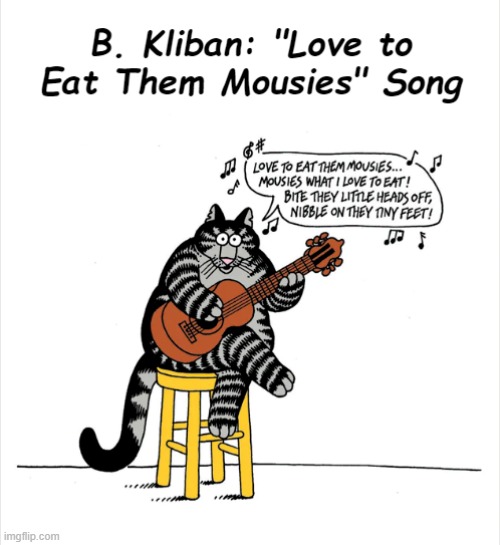
We have a cat that eats the mouse heads. Crunchy and flavorful I guess.
If the desert they are said to have evolved in didn’t have the Nile running through it, it would seem strange for cats to prefer tuna to all else (in my experience every animal I ever had except cattle just loved Italian food over everything else. Rabbits, woodchucks, parrots, cats, dogs, etc. All loved Italian food.)
But the Nile flooded regularly, and when rivers flood, they leave bayous. In a desert land these orphaned bodies of water would rapidly evaporate, leaving trapped fish in easy reach ....of cats.
So it really isn’t strange at all for desert critters to like fish.In a land with abundant raunfall the cats may never see a fish, but in a desert like that of Egypt the opportunity would occur after flash floods.
Disclaimer: Opinions posted on Free Republic are those of the individual posters and do not necessarily represent the opinion of Free Republic or its management. All materials posted herein are protected by copyright law and the exemption for fair use of copyrighted works.