Skip to comments.
Scientists find ancient lost settlements in Amazon
Reuters ^
| Aug 28, 2008
| Reporting by Will Dunham; Editing by Maggie Fox
Posted on 08/28/2008 5:54:59 PM PDT by decimon
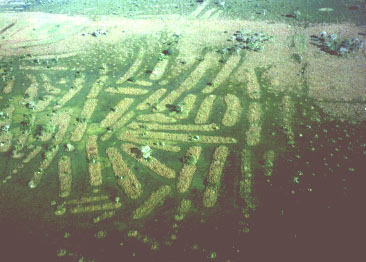
WASHINGTON (Reuters) - A vast region of the Amazon forest in Brazil was home to a complex of ancient towns in which about 50,000 people lived, according to scientists assisted by satellite images of the region.
The scientists, whose findings were published on Thursday in the journal Science, described clusters of towns and smaller villages connected by complex road networks and housing a society doomed by the arrival of Europeans five centuries ago.
< >
The existence of the ancient settlements in the Upper Xingu region of the Amazon in north-central Brazil means what many experts had considered virgin tropical forests were in fact heavily affected by past human activity, the scientists said.
< >
(Excerpt) Read more at news.yahoo.com ...
TOPICS: History
KEYWORDS: agriculture; amazon; animalhusbandry; brazil; dietandcuisine; godsgravesglyphs; huntergatherers; latinamerica
Navigation: use the links below to view more comments.
first 1-20, 21-26 next last
That the Amazon forests were managed is not news but the research is ongoing.
1
posted on
08/28/2008 5:54:59 PM PDT
by
decimon
To: SunkenCiv; blam
2
posted on
08/28/2008 5:58:52 PM PDT
by
decimon
To: decimon
... a society doomed by the arrival of Europeans five centuries ago.Shouldn't that read: "a society doomed by the arrival of white Europeans five centuries ago"?
To: decimon
4
posted on
08/28/2008 6:09:20 PM PDT
by
johnthebaptistmoore
(Vote for conservatives AT ALL POLITICAL LEVELS! Encourage all others to do the same on November 4!)
To: LiberConservative
Pedro Alvares Cabral arrvied in Brazil with ships with Europeans of Caucasian, Middle Eastern and Negroid descent.
To: LiberConservative
Perhaps it would be mor accurate to say, “a society doomed by the arrival of European pathogens five centuries ago.’ That was the true tragedy that no one understood clearly at the time as germs and disease vectors where not known or understood.
6
posted on
08/28/2008 6:19:34 PM PDT
by
JimSEA
(just another liberal-bashing fearmonger)
To: johnthebaptistmoore
Amazon.com? Might be stacks of unsold Pelosi books.
7
posted on
08/28/2008 6:22:00 PM PDT
by
FlingWingFlyer
(A History and Science Minute.- "Climate change" has been going on for millions of years!)
To: decimon
I note that almost all articles about South and Central American Paleo Indians omit that they were largely characterized by cannibalism, human sacrifice, slavery, rape of captured women and children, and using human heads as soccer balls. The PCing of anthropology.
8
posted on
08/28/2008 6:24:41 PM PDT
by
pabianice
To: FlingWingFlyer
Their main warehouse in California must be HUDGE.
9
posted on
08/28/2008 6:27:20 PM PDT
by
johnthebaptistmoore
(Vote for conservatives AT ALL POLITICAL LEVELS! Encourage all others to do the same on November 4!)
To: decimon
Complex indeed.
All that I need to know is that they are all long gone.
About as important and relevant to me as the complexity of a spideweb, or a beaver dam...
10
posted on
08/28/2008 6:33:14 PM PDT
by
Publius6961
(You're Government, it's not your money, and you never have to show a profit.)
To: pabianice
I note that almost all articles about South and Central American Paleo Indians omit that they were largely characterized by cannibalism, human sacrifice, slavery, rape of captured women and children, and using human heads as soccer balls. ......................Not that there’s anything wrong with that.
To: pabianice
I note that almost all articles about South and Central American Paleo Indians omit that they were largely characterized by cannibalism, human sacrifice, slavery, rape of captured women and children, and using human heads as soccer balls. The PCing of anthropology.Well, if you buy into the PC, then you can go ahead and join the "all cultures are equal and relevant to me" club.
Or we can make the other choice and wonder why this is a universal great story and relevant to modern civilization in any way.
I do notice that the clueless are already blaming the "nasty Europeans" for introducing the means to exterminate them --- without an iota of supporting evidence, as usual.
12
posted on
08/28/2008 6:37:05 PM PDT
by
Publius6961
(You're Government, it's not your money, and you never have to show a profit.)
To: pabianice
"I note that almost all articles about South and Central American Paleo Indians omit that they were largely characterized by cannibalism, human sacrifice, slavery, rape of captured women and children, and using human heads as soccer balls."
And that was just on the week-ends!
13
posted on
08/28/2008 6:56:00 PM PDT
by
Tainan
(Talk is cheap. Silence is golden. All I got is brass...lotsa brass.)
To: pabianice
>"cannibalism, human sacrifice, slavery, rape of captured women and children, and using human heads as soccer balls."Wow, sounds like isSlime beat the Europeans across the ocean.
14
posted on
08/28/2008 7:02:41 PM PDT
by
rawcatslyentist
(I will stand with the Muslims ~B Hussein Obomunist ~~~~~~~~~~~~~~~ Verito Possumus~Verified Sleeper!)
To: decimon
Let me guess. The walls weren’t defensive to help them against violent humans. They were peaceful enclosures to keep their domestic animals and children from accidentally wandering out into the jungle, right?
To: decimon; StayAt HomeMother; Ernest_at_the_Beach; 1ofmanyfree; 21twelve; 24Karet; 2ndDivisionVet; ...
16
posted on
08/29/2008 7:04:23 AM PDT
by
SunkenCiv
(https://secure.freerepublic.com/donate/_______Profile hasn't been updated since Friday, May 30, 2008)
To: decimon
Scientists find ancient lost settlements in Amazon
I bet. Just like that story about the lost tribe in the Amazon that has never had any contact with the outside world.
17
posted on
08/29/2008 8:52:48 AM PDT
by
A. Patriot
(CZ 52's ROCK)
To: decimon
Isn’t this fairly old neaw? I recall photos with the markings of elaborate irrigation works on a very large scale grid that were published quite some time ago.
18
posted on
08/29/2008 1:52:57 PM PDT
by
bert
(K.E. N.P. +12 . Conservation? Let the NE Yankees freeze.... in the dark)
To: bert
Isn’t this fairly old neaw?I thought of this as an update. I believe blam and maybe some others have posted such articles.
19
posted on
08/29/2008 2:11:30 PM PDT
by
decimon
To: SunkenCiv; decimon
20
posted on
08/29/2008 4:08:05 PM PDT
by
Fred Nerks
(fair dinkum!)
Navigation: use the links below to view more comments.
first 1-20, 21-26 next last
Disclaimer:
Opinions posted on Free Republic are those of the individual
posters and do not necessarily represent the opinion of Free Republic or its
management. All materials posted herein are protected by copyright law and the
exemption for fair use of copyrighted works.
FreeRepublic.com is powered by software copyright 2000-2008 John Robinson