Posted on 07/28/2026 4:34:39 PM PDT by ebb tide
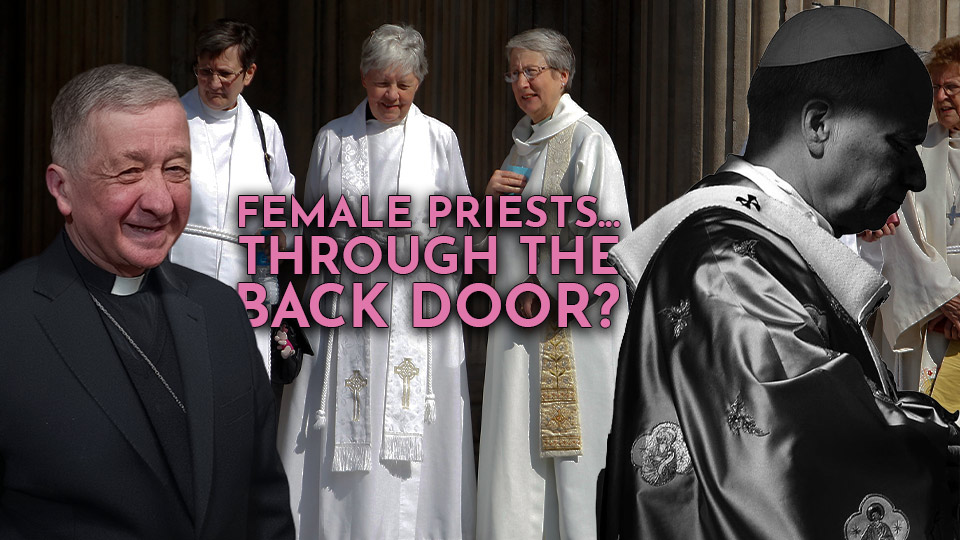
The impossibility of formally modifying the doctrine on female ordination is leading some ecclesial circles to pursue the same result through liturgy, canon law and even European civil law.
At times, the Catholic hierarchy appears to view the Anglican world with admiration and astonishment, almost as one looks at a “successful” neighbour, but without really managing to understand how and what to do in order to reach and equal it. Indeed, the Anglican Communion presents several characteristics that, in the eyes of neo-modernists, appear more than attractive: widespread woke theology, episcopalism and absolute collegialism, synodality, broad participation of the laity in governance, female priesthood at every level, total surrender to politically correct language.
King Charles is officially the head of the Anglican Communion, but he does not possess a primacy analogous to the Petrine primacy for Catholics: a purely symbolic and constitutional primacy, a spokesperson who in fact exercises no spiritual or doctrinal power, and who represents only the unity of the Communion itself.
If doctrine cannot be overturned, the revolution simply changes everything around it.Tweet this quote
Everything is decided at the local level: each national Church (such as the Church of England, the Episcopal Church USA, the Church of Nigeria, etc.) that participates in the Anglican Communion decides for itself how to interpret this or that doctrine. If a faithful member does not share the positions of his own Church, he can request to join another Anglican Church or an affiliated community, without formally breaking communion. Is this not perhaps a dream for the various Cupichs, Radcliffes, Hollerichs? Synodality lived out to the fullest!
Let us not forget that King Charles — although, according to doctrine, he is the head of a schismatic Church whose sacraments are not only illegitimate, but completely invalid — was formally granted by the Holy See the title of “Royal Confraternity Member of Saint Paul” on October 23, 2025. This is an honorary title linked to the lay Confraternity of the Basilica of Saint Paul Outside the Walls, historically connected to the English monarchy, and he participated in an ecumenical prayer with the Pope on the same day.
The Archbishop of Canterbury is also considered by the Anglican Communion a primus inter pares (“first among equals”) bishop, that is, a spiritual and symbolic point of reference, not a universal legislator. As is well known, for the first time in Anglican history, the Archbishop is now a woman.
Sarah Mullally, a former nurse, feminist, supporter of abortion and gender theories, was received in an audience by Leo XIV last April 27. The Pope had no reservations in addressing Mullally with the traditional episcopal appellation “Your Grace”, while knowing and believing — I hope — that that woman is not a bishop, having validly received no Holy Orders whatsoever, but only being a woman dressed as a bishop.
The goal is no longer to redefine the priesthood—but to make priesthood itself functionally unnecessary.Tweet this quote
That meeting did not go unnoticed. The issue of female priesthood deeply troubles and questions the revolutionary souls of the neo-modernist theologians, bishops and cardinals who today occupy the Roman chairs, those who want to see realised, from the heights of their seats (relatively high, in reality), the utopia of a Church at the service of a global community where all nations and all religions cooperate, guided by a new Nehemiah, to build the new Jerusalem, paradise on earth. (Exactly the dystopian dream described in Magnifica Humanitas.)
Unlike in the Anglican Communion or in other Protestant denominations, however, in the Catholic Church bypassing this heavy doctrinal burden of the patriarchal privilege of priesthood is not easy. It is a true obstacle to the neo-modernist revolution within the Church, because by its mere presence it refutes all egalitarian arguments: if we are all equal, if there are no differences of any order or degree, if all differences are intrinsically unjust, if all human beings possess infinite dignity and therefore infinite rights, why do women not have the right to be ordained priests?
In Catholicism there remains that hateful and troublesome dogma of papal infallibility, not coincidentally fought against and ridiculed by Masonic sects even before its proclamation at the First Vatican Council.
A divine seal upon doctrine and morality, which precludes any formal possibility of revocation, because it is equivalent to saying: this is what the Church has always and everywhere believed, despite the resistance and innovations of heretics, and this is what we must transmit to future generations, because no one in the Church, not even the Pope, has received from God the authority to change what is good and what is evil, what is true and what is false.
The patriarchal privilege of priesthood belongs among the things solemnly and dogmatically defined. Therefore, if doctrine is unshakable, other ways must be found to modify it, replace it, or cast it into oblivion if possible. If the enemy cannot be brought in through the Gate of Dogma, one must try to bring him in through the window: “whoever does not enter the sheepfold by the gate, but climbs in by another way, is a thief and a robber. […] The thief comes only to steal and kill and destroy” (Jn 10:1.10).
For this reason, today the novatores invite people no longer to engage in doctrinal debates on the female diaconate or priesthood, but to “look beyond”. Concretely, this means for the moment entrusting women with governing roles: parish administrators, vicars of bishops, up to reaching the roles of prefect and pro-prefect in Roman dicasteries.
Female ordination is advancing through liturgy, bureaucracy and civil law—not through honest theological debate.Tweet this quote
In this way, as already happens in the civil world when certain roles are assigned according to criteria such as ethnic belonging, physical disability or sexual gender rather than according to competence, a logic of representation is introduced which, far from promoting social justice, undermines the very effectiveness of institutions. In the ecclesial sphere, this principle produces even more serious effects: jurisdiction is gradually deprived of any relationship with Holy Orders, and the government of the Church takes on the features of a secular bureaucracy, where the criterion of grace is replaced by that of inclusiveness.
The neo-modernists therefore have two possible windows, two possible paths for reforming the Church according to the egalitarian and revolutionary expectations of the world. Let us always remember that the ultimate and gnostic goal of the historical process usually given the name of Revolution is absolute equality: eritis sicut Deus.
The first path is that of the novus ordo liturgy. Unlike the Traditional one, in fact, the Montinian liturgy is constitutionally susceptible to abuses. The rubrics are not fixed, but subjected to the dictatorship of the “or”. Now, from the modernist perspective, the boundary between “or”, abuse and experiment is very blurred, almost non-existent. The Missal of Paul VI was promulgated as a complete and normative rite, not as a provisional or experimental text. However, post-conciliar liturgical theology introduced a principle of “permanent reform”, according to which the liturgy would always be “evolving” in order to respond to the pastoral and cultural needs of the time. An experiment that never ends.
Indeed, one of the most prestigious bishops of the Italian Episcopal Conference, Erio Castellucci, bishop of Modena-Nonantola and rumoured to be the next Archbishop of Milan (no less), had no qualms about proposing, last May 24, during a feminist conference, a very particular proposal for liturgical reform, namely that of establishing a co-presidency of the Mass. The Liturgy of the Word would thus be led by a woman, who “announces Easter” like a new Mary Magdalene, while the Eucharistic Liturgy would remain the responsibility of the ordained minister.
There is, however, a second path, more perverse, because it reverses the traditional relationship between the Church and civil power. On July 12, an article signed by a collective of theologians and legal scholars appeared in the pages of La Croix, the newspaper close to the French bishops.
According to the authors, the meeting between Leo XIV and Sarah Mullally was a signal that could encourage a revision of Catholic discipline regarding male ordination. The proposal for initiating this process of revision is not to directly challenge Catholic doctrine. An approach recognised by scholars as destined to fail from the outset. Rather, one should find a way to bring the matter before European civil courts, treating it as a problem of equality and discrimination.
When secular courts decide what the Church may teach, natural law has already surrendered to political ideology.Tweet this quote
According to the jurists, denying women access to roles involving authority of governance, teaching and sanctification would amount to discrimination based on gender. And if it is true that the European Court of Human Rights protects the autonomy of religious communities in defining their own internal rules, the authors say, it is also true that freedom must always give way to equality. A principle dear to the Revolution and to its aberrant socio-economic manifestation, namely socialism.
Since the Vatican is located in the heart of Europe — this is the implicit but central thesis of the study — it must answer to European Union law for what it affirms and what it does, because its decisions directly influence the lifestyle of millions of European citizens.
Now, according to European law, differences in treatment must be “essential, legitimate and justified”, and subject to judicial review. Since male sex is not considered a necessary requirement for the proper exercise of priesthood, the theologians argue, this requirement must be “overcome”. If the hierarchical Church does not wish to think about adjusting the rules, the European Union must apply pressure.
Certainly, one could dismiss this thesis as the bizarre idea of some French jurists. After all, in France churches belong to the State, and the French are accustomed to thinking that, when the Church contradicts the State, it is the State that must prevail.
However, I fear that these statements are only the symptom of a broader phenomenon. The European Union already exerts constant pressure on the Vatican on various issues — and in more than one case has achieved tangible results, pushing official Catholic doctrine in recent years to align itself, not only in language, with the legal and cultural principles of the European Union. To give some concrete examples, starting with the most evident ones:
For almost two millennia, despite compromises, errors and human weaknesses, the Holy See has claimed and affirmed a position of substantial independence from temporal powers, indeed of superiority, because the Church is the perfect society to which every other society (family, state) must look as to its own model.
It was precisely this independence that allowed it, at least in principle, to judge States in the light of natural law and Revelation, without allowing itself to be determined by the passing legal or ideological categories of the moment. Today, however, an opposite paradigm seems to be emerging: it is no longer natural law that judges positive law, but the latter that becomes the standard through which the goodness or otherwise of Catholic doctrine is interpreted.
The most dangerous revolution is not the one that abolishes doctrine—but the one that leaves the words while emptying them of their meaning.Tweet this quote
It is not difficult to identify what these priorities are. For years, official documents have focused almost exclusively on issues such as environmental sustainability, global governance, migration, sustainable development, social inclusion, interreligious dialogue and the fight against climate change. The Vatican, especially since the advent of Francis (although the process is much older), acts increasingly as an instrument of the European Union’s soft power in the rest of the world.
Pontifical diplomacy in fact enjoys a credibility that many European institutions do not possess, especially in Africa, Latin America and vast areas of Asia. When the Pope speaks about the environment, migration, global governance or international cooperation, his message reaches peoples and governments that would hardly pay the same attention to the commissioners in Brussels.
The spiritual prestige accumulated by the Church over the centuries thus becomes an effective multiplier of European political influence. And if we add to the balance the fact that China, in recent years, has sought to exercise strong economic and strategic influence over the EU in an anti-American direction (even though Brussels is attempting to reduce it), it is easy to draw the conclusions.
Within this framework, the debate on female priesthood takes on a very strong significance. It does not concern simply the possibility of modifying ecclesiastical discipline, but rather the very principle according to which the Church receives her own constitution from Christ or from the temporary and fallible legal systems of States and supranational organisations.
The strategy, therefore, does not consist in directly overthrowing dogma, but in rendering it irrelevant. It is a far more effective method, because it avoids the scandal of an explicit rupture and produces, in the long term, the same result: a Church that preserves the formulas of the past while progressively modifying their operative content.
Its coming; homos have control of the Curia.
HERESY!!!!!!!!!!!!..................
Ebb, I don’t think a female priest could come through the back door.
First ordained woman
“priest” is announced, and I leave the RC Church. We have Maronite, Melkite, and Orthodox congregations here. I will go there.
I wonder who they will bugger?
Not in Jesus Christ’s church.
This will not sit well with Bobby’s muslim handlers.
Yawn.
Catholic “doctrine” has been changing over the last 2000 years...
As far as singleness and celibacy - The Official Universal Mandate: First & Second Lateran Councils (1123 & 1139 AD)
As far as Papal Infability - The concept of Papal Infallibility was officially instituted as a dogmatic belief on July 18, 1870, during the First Vatican Council (Vatican I) under Pope Pius IX.
As far as language in Mass - The Catholic Church officially shifted away from requiring Mass to be exclusively in Latin between 1963 and 1969, through the actions of the Second Vatican Council (Vatican II) and Pope Paul VI.
Catholic “tradition” is a malleable concept - which means one shouldn’t fret over it changing under the fallible mortals running the religion.
Disclaimer: Opinions posted on Free Republic are those of the individual posters and do not necessarily represent the opinion of Free Republic or its management. All materials posted herein are protected by copyright law and the exemption for fair use of copyrighted works.