Posted on 05/18/2026 9:29:05 AM PDT by ebb tide
How does it feel?
How does it feel?
To be on your own
With no direction home
Like a complete unknown
Like a rolling stone?i>
— Bob Dylan, 1965
They do not call it “change.” They call it a “paradigm shift.” This is what someone says when they want to make you think that nothing is changing, when in fact everything is going to be different. I am talking about the “Final Report” of Study Group 9, released May 5, 2026.
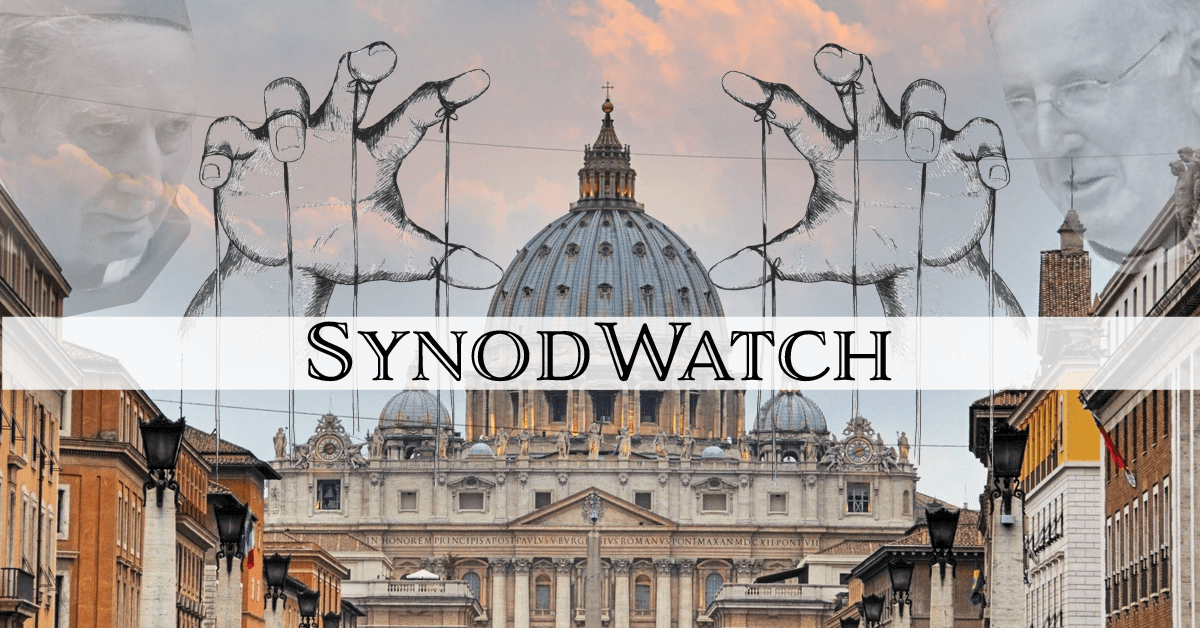
In response to the Synthesis Report of the First Session of the XVI Ordinary Assembly of the Synod of Bishops in 2024, several “study groups” have been working out the final details for creation of a “synodal” church, which will emerge at an Ecclesial Assembly to be held at the Vatican in October, 2028. Study Group 9 was charged with coming up with “synodal methodologies” for dealing with “emerging doctrinal, pastoral and ethical” issues.
The methodology that Study Group 9 came up with is a “paradigm shift” from the prevalent paradigms of past centuries (§ I, 1.1). A “paradigm shift” is defined in the Merriam-Webster Dictionary as an “important change that happens when the usual way of thinking about or doing something is replaced by a new and different way.”
No longer will the Church abstractly proclaim and deductively apply principles that are set out in “an immutable and rigid manner.” Instead the Church will foster “a living encounter with the person of the risen Lord Jesus, by engaging with the lived experience of faith of the People of God in its personal and social relevance, in relation to the diverse situations of life and the many cultural contexts.” (§I, 1.1).
In other words, the new, synodal church will be untethered from any moral or doctrinal principles that were established over the centuries by the Catholic Church. Going forward, context will supply the principles. One’s “lived experience” will ultimately determine any issue. Study Group 9 claims that this shift “in reality, is a return to the liberating experience of encountering the saving truth of the Gospel…” as described in the Acts of the Apostles, chapters 10 – 15 (§I, 1.1). Yet the recorded sum of all the liberating experiences of the apostles and their successors over the centuries means nothing.
Cardinal Joseph Ratzinger saw this coming in 2005. Speaking to the conclave that would later elect him pope, he warned,
We are moving toward a dictatorship of relativism which does not recognize anything as for certain and which has as its highest goal one’s own ego and one’s own desires.
Proving Cardinal Ratzinger’s point, Study Group 9 made headlines when, applying context and life experiences to the “emerging issue” of same-sex attractions within the Christian community, it found that “…sin, at its root, does not consist in the (same-sex) couple relationship, but in a lack of faith in a God who desires our fulfillment.” (§III, 2.1).
❦
Is a religion where there are no moral or doctrinal principles and nothing is certain, still a religion? Ross Douthat, a convert to Catholicism, wrestled with this question in his 2018 book, To Change the Church, Pope Francis and the Future of Catholicism. The book is about the questions raised by the first five years of the Francis papacy.
Douthat begins the book with a “Personal Preface,” where he offers a “brief confession” about who he is and how he came to the Catholic Church.
I became a Catholic because I thought that Catholicism had the most compelling claim to being the true church founded by Jesus of Nazareth, whose radical message and strange story offers the likeliest reason in all of recorded human history to believe that God loves us, that He so loved the world that our sins will be redeemed and our suffering will make sense in the end. I will die a Catholic; there is no getting rid of me now.
He quickly comes to the heart of the matter, the reason why he wrote his book: how does the papacy of Francis square with “the Catholic core?”
…I think the recent history of the church should instill a certain amount of doubt about what exactly constitutes the Catholic core, where the bright lines lie and where they might be blurry, and what the church can do without touching doctrine and dogma to accommodate the modern world.
Note that he assumed that the church would not touch doctrine and dogma as it sought to accommodate the modern world. Study Group 9 has dashed that assumption.
Mr. Douthat realized that the legitimacy of Catholicism depends upon links to the early Church. He had no inkling that modernists would claim their roots in the early Church as well.
This book is…conservative, in the sense that it assumes the church needs a settled core of doctrine, a clear unbroken link to the New Testament and the early church, for Catholicism’s claims and structure and demands to make any sense at all. If the church is just a religious tribe with constantly evolving views, a spiritual party in which the party line changes with the views of the ecclesiastical nomenklatura, then for all the good works and lovely paintings and clever arguments the whole thing seems like a high-minded fraud, a trick upon the masses of believers, Philip Larkin’s “moth-eaten musical brocade.”
It seems, then, that the new, synodal church, which claims legitimacy through the Acts of the Apostles, nevertheless will no longer be rigidly attached to the paradigms of past centuries. The inchoate synodal church seems hell-bent on becoming merely a “religious tribe with constantly evolving views.” Such a tribe cannot, however, be the holy and indefectible Catholic Church. Until our leadership begins to defend that Church from the heretical wolves and their anti-Church, we are on our own, with no direction home. Like a rolling stone.
Ping

The assertion that the Church is obviously not in a state of emergency seems—well, it seems deranged to the point of madness, as of someone who is suffering a psychotic break with reality.
Normalcy bias writ large.
In other words, if it feels good, do it.
No longer will the Church abstractly proclaim and deductively apply principles that are set out in “an immutable and rigid manner.” Instead the Church will foster “a living encounter with the person of the risen Lord Jesus, by engaging with the lived experience of faith of the People of God in its personal and social relevance, in relation to the diverse situations of life and the many cultural contexts.” (§I, 1.1).
BOTH are needed. But that is too complex for our small minds without the guidance of the Holy Spirit.
As a parent do you want your children’s obedience or their hearts? God wants our hearts, if he has that, we desire to obey him, He has everything.
Personally, I don’t like that word obedience, it points to the wrong thing. When ever I see the word “obey” I replace it with the word “choose”. The same thing with the word “love” I see “choose” There is freedom in expressing your choice. You can bring God a bunch of weeds in place of flowers if your heart is right. My mother got a bunch of hand picked dandelions from me quite often.
Then the synodal "church" is just the place for you!
Personally, I don’t like that word obedience,...
Then the synodal “church” is just the place for you!
Reading and thinking is hard for some people.
Preach that “obedience” to sspx, ebby. You know they’ll listen!
(Hat Tip to R.R. Reno, editor of "First Things" for his book "Return of the Strong Gods..." )
Just the sort of psychobabble gobbledegook that will justify abortion and pedophilia.
Excellent, PP -- it IS both/and rather than either/or
A living encounter with Christ does not mean throwing out objective principles, just as holding onto principles is useless if they are detached from a loving relationship with God
PP, I agree with you that a healthy faith requires both structure and spirit.
About your "Obedience or their hearts" -- I would put a caveat that true obedience is the ultimate expression of giving one's heart.
For example - Jesus in the Garden of Gethsemane: "Not my will, but yours be done." That was an act of supreme obedience born entirely out of perfect love.
Though one point, PP - completely replacing "obey" and "love" with "choose" can lean too far into modern individualism or voluntarism (the idea that the will is supreme).
Choice is just the mechanism; Love is the substance, and Obedience is the surrender. If we only "choose," the focus remains on our autonomy. If we "obey," the focus is on God’s authority.
And your analogy fantastically captures the heart of God’s mercy and grace. God looks at our imperfect, clumsy efforts and, because He loves us, He treasures them. In Catholic theology, our own works are like dandelions—worthless on their own—but made beautiful because they are offered in union with Christ. God loves us exactly as we are (bringing Him weeds), but He loves us too much to leave us that way. His grace actively transforms our "weeds" into actual "flowers" over time.
Disclaimer: Opinions posted on Free Republic are those of the individual posters and do not necessarily represent the opinion of Free Republic or its management. All materials posted herein are protected by copyright law and the exemption for fair use of copyrighted works.