Posted on 03/15/2026 8:14:24 PM PDT by ebb tide
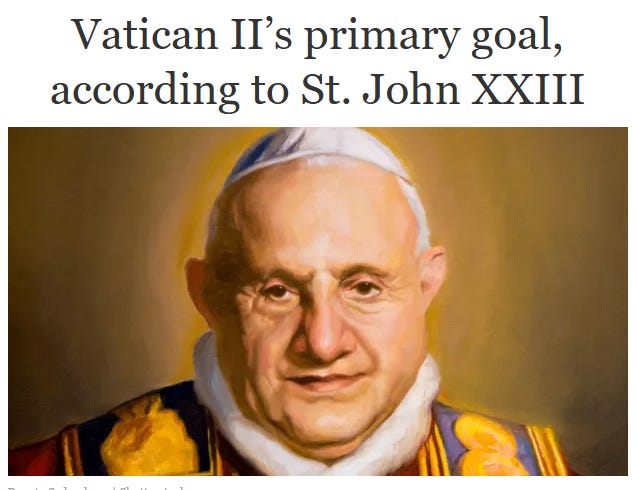
In his Opening Speech to Vatican II on Oct. 11, 1962, John XXIII made it clear that Vatican II was about tone and not doctrine:
[The Council must present] “the sacred patrimony of truth received from the Fathers [and] transmit that doctrine pure and integral, without any attenuation or distortion, which throughout twenty centuries, notwithstanding difficulties and constraints, has become the common patrimony of men.”
From the looks of things, the Council failed. If Nostra Aetate isn’t an “attenuation or distortion” of truth handed down from the Apostles to the Fathers and, through the centuries, to us, then nothing is. Everything goes because all is relative.
The document advocates religious indifferentism under the guise of brotherhood. It runs contrary to the infallible dogma of the Catholic Church, Extra Ecclesiam nulla salus—there is no salvation outside the Church.
In an earlier post, I wrote that “for the postconciliar church, the fact that man was made in the image of God eclipses all else. Repentance becomes irrelevant. The Deposit of Faith becomes an artifact to be interpreted anew while a choir of Modernists sings Kumbaya.”
“The problem: The ultimate synthesis VII is pushing is a cauldron of opposites simmering into new dialectical equations of Thesis + Antithesis = Synthesis. It’s a never-ending war disguised as peace. It’s the Devil’s Brew.”
Nostra Aetate is just one example. There are others. The point is that VII failed to transmit the “doctrine pure and integral, without any attenuation or distortion.” It doesn’t matter that it reaffirmed some dogmas because it distorted others.
VII’s stated mission failed.
John XXII went on to say, “[T]he Sacred Deposit of Christian Doctrine should be guarded and taught more efficaciously [with a] renewed, serene, and tranquil adherence to all the teachings of the Church in their entirety and preciseness, as they still shine forth in the acts of the council of Trent and the First Vatican Council.”
The Council wasn’t about doctrine. It wasn’t about definitions. It wasn’t about pointing out heresy.
It was about tone.
The “renewed, serene, and tranquil” tone was supposed to adhere “to all the teachings of the Church in their entirety and preciseness.” It didn’t because it couldn’t.
If you change the tone, you likely change the story, or at least the precision with which it was originally told.
At VII, changing the tone was like switching from the 3rd person omniscient narrator in The Lord of the Rings to the first person POV of Galadriel, who, in this version, doesn’t refuse the ring when it is offered to her by Frodo.
The VII Galadriel failed the test and took the ring in an effort to harness its powers for earthly matters.
The Deposit of Faith, however, isn’t earthly in its essence. It is of the Holy Spirit.
VII tried to change a story that cannot be changed.
“There will be no infallible definitions. All that was done by former Councils. That is enough,” said John XXII.
It was enough because he couldn’t change the story, so he decided to change its tone. Then, maybe then—with the passage of time—people would be open to a new story emerging out of the old.
Don’t take my word for it.

Paul VI, at the close of VII on Dec. 7, 1965, said: “The magisterium of the Church did not wish to pronounce itself under the form of extraordinary dogmatic pronouncements…. ”
On Aug. 6, 1975, he reiterated, “Differing from other Councils, this one was not directly dogmatic, but disciplinary and pastoral.”
There’s a problem: How can you administer discipline when, in the case of VII, there is no definition to be broken?
VII was called to get the post-conciliar church in tune with the worldly tone. It was designed to take three steps away from heaven toward earth.
In March 1964, the Theological Commission of the Council concerning the authority of the Council stated, “In view of the conciliar practice and the pastoral purpose of the present council, this sacred Synod defines matters of faith or morals as binding on the Church only when the Synod itself openly declares so.”
Guess what? VII never did openly declare any of its teaching as binding on the Church. You can’t put it any plainer than that.
Dietrich Von Hildebrand, whom Pius XI declared the 20th century Doctor of the Church, stated, “The Second Vatican Council solemnly declared in its Constitution on the Church that all the teachings of the Council are in full continuity with the teachings of former councils.”
Too bad so many passages were written in an ambiguous tone, like an unreliable narrator who questions their own sanity.
“Moreover,” Hilderbrand continued, “let us not forget that the canons of the Council of Trent and of Vatican I are de fide, whereas none of the decrees of Vatican II are de fide; The Second Vatican Council was pastoral in nature.”
De fide doctrines are infallibly true and binding on the consciences of the faithful. Pastoral pronunciations are not.
“Cardinal Felici rightly stated that the Credo solemnly proclaimed by Pope Paul VI at the end of the Year of Faith is from a dogmatic point of view much more important than the entire Second Vatican Council.”
The Credo trumps VII, no matter if it is chanted, sung, said out loud, or recited silently.
Then the punch:
Thus, those who want to interpret certain passages in the documents of Vatican II as if they implicitly contradicted definitions of Vatican I or the Council of Trent should realize that even if their interpretation were right, the canons of the former councils would overrule these allegedly contradictory passages of Vatican II, because the former are de fide, the latter not.
Bottom line: VII is not de fide and, therefore, not binding.
The SSPX has a legitimate gripe with VII and will not accept it. That’s their right.
The SSPX does not wish to break from eternal Rome, far from it. Instead, they seek to honor it by guarding and transmitting the faith.
Should the Vatican excommunicate SSPX because it rejects critical portions of VII, it will only prove that the post-conciliar church is not the Catholic Church and nothing more.
“There will be no infallible definitions. All that was done by former Councils. That is enough,” said John XXII.
It was enough because he couldn’t change the story, so he decided to change its tone. Then, maybe then—with the passage of time—people would be open to a new story emerging out of the old.
Ping
Vatican II was approved by the Pope and voted by the majority of the world’s bishops
So what, Mitch?
A pope and the majority of bishops agreed with the heretic, Arius, at one time.
I recommend you look up St. Athanasius who was “excommunicated” by that pope.
You don’t get to personally disapprove a church council because it hurts your feelings
You’re aren’t required to be an idiot to blind obedience and proclaim you adore the same “god” the Muslims do.
You’re aren’t required to be an idiot to blind obedience and proclaim the Latin Mass the only valid mass
Not Binding? Its good to hear that there will not be any ecclesiastic constipation.
The whole institution needs a huge dose of hierarchical Beano.
A pastoral council that defined no doctrine. Gaudum et Spes reads like a hippie manifesto, and the “spirit of Vatican II” is an evil spirit.
Name one person who believes that, Mitch. I bet you can't.
However, I can name the Cardinal Prefect of the Dicastery for Divine Worship, Frankencardinal Arthur Cockroche, who believes the Bugnini Mess is the “the sole expression of the lex orandi of the Roman Rite”:
The document insists that the Missal of Paul VI, promulgated “in accordance with the decrees of the Second Vatican Council”, constitutes “the sole expression of the lex orandi of the Roman Rite”.
This document exposes the heresies (and other errors) found in following documents of Vatican II (or at least those statements which can be given a heretical interpretation):
Disclaimer: Opinions posted on Free Republic are those of the individual posters and do not necessarily represent the opinion of Free Republic or its management. All materials posted herein are protected by copyright law and the exemption for fair use of copyrighted works.