Skip to comments.
Only a quarter of Catholic Priests, Mainline Protestant pastors ‘definitely’ believe Adam and Eve existed
Christian Post ^
| 06/09/2025
| Anugrah Kumar
Posted on 06/09/2025 8:49:16 AM PDT by SeekAndFind
Just one in four Catholic priests and Mainline Protestant pastors in the United States say they're certain that Adam and Eve were real people. In contrast, 80% of Evangelical pastors and 89% of black Protestant clergy affirm this belief with certainty.
Data from the National Survey of Religious Leaders reveal significant differences among clergy in their core theological beliefs, including their views on the Bible, Hell, miracles, and the existence of God, as noted by Graphs About Religion on Substack.
When asked whether they “definitely believe” Adam and Eve were historical figures, the numbers diverged sharply across denominations, dropping to 25% among Catholic and Mainline Protestant respondents.
The pattern was consistent in other areas of doctrine.
When asked about belief in Hell, 93% of Evangelical pastors expressed certainty, compared to 70% of Catholic priests and 45% of Mainline Protestant leaders. For belief in miraculous healing, 84% of Evangelical pastors and 78% of priests said they definitely believed in it, while the number fell to 47% for Mainline clergy.
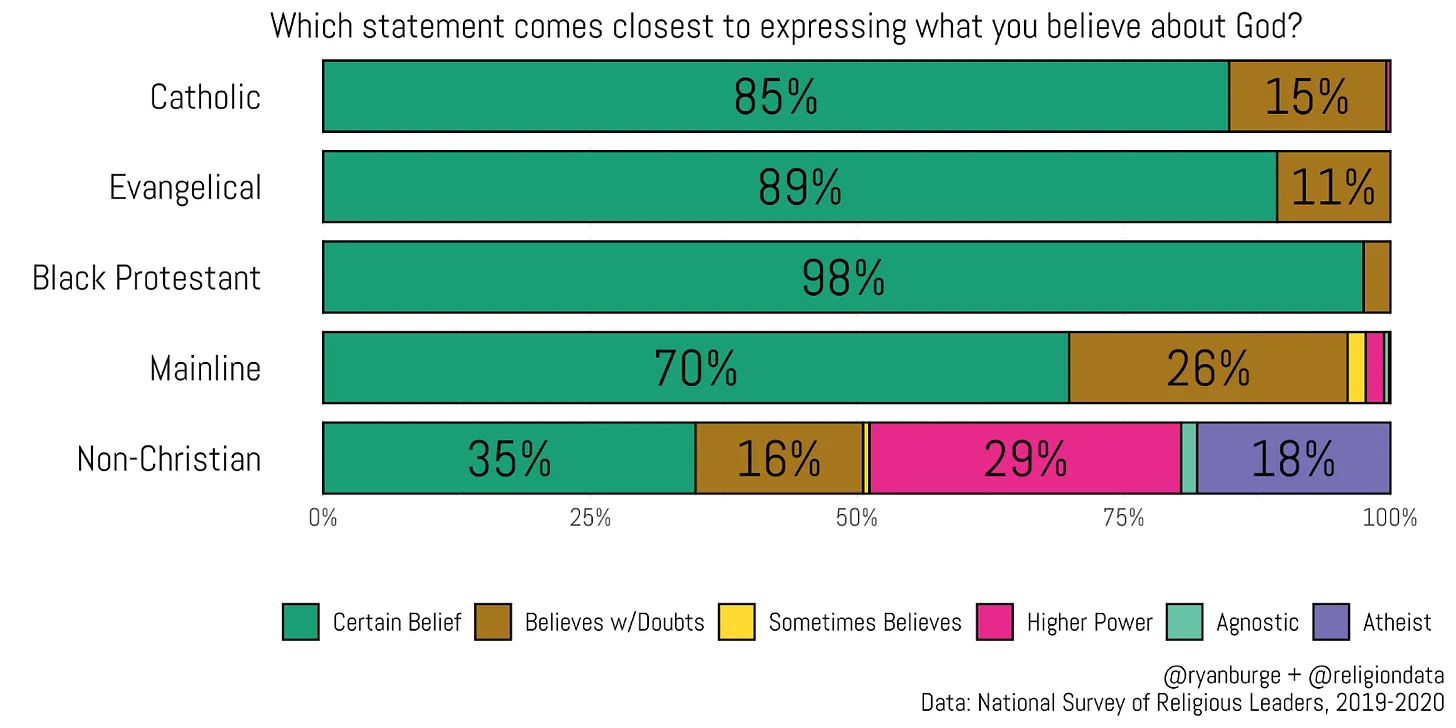
On the question of God’s existence, Evangelical and black Protestant leaders again showed the highest levels of certainty — 98% and 89%, respectively. Catholics followed at 85%. Mainline Protestants reported the lowest confidence, with 70% saying they had no doubts, and 26% acknowledging belief in God while admitting to doubts.
Among non-Christian clergy surveyed, only about a third expressed complete certainty in God’s existence. Another 29% said they believed in a higher power but not a personal God, while roughly 20% identified as atheist or agnostic.
The survey also probed beliefs about the Bible. Across the Christian sample, three dominant views emerged.
One group described the Bible as the literal Word of God to be taken word-for-word. Another said it was the inspired Word of God without errors, with symbolic elements. The third group believed the Bible was inspired but not historically accurate in all parts, with some sections reflecting the cultural norms of the time and therefore no longer applicable today.
Ninety-eight percent of Christian clergy selected one of these three descriptions.
The literalist view was selected by about 20% of Evangelical and black Protestant clergy. Among Catholics and Mainline Protestants, that position was virtually absent. The most common response among Evangelicals (70%) and black pastors (67%) was that the Bible is inspired and without errors but includes symbolic sections. Half of Catholic priests chose this option, while the other half said the Bible includes culturally bound sections that are not historically accurate. That latter option was the top choice for Mainline clergy, selected by 70%.
Certainty in core theological claims often aligned with attitudes toward evangelism. When asked if their religion was “the best one for all people regardless of background,” 93% of Evangelical pastors agreed, followed by 71% of black Protestant leaders, 58% of Catholic priests, and 51% of Mainline Protestant clergy. Among non-Christian clergy, a majority disagreed with the idea that their religion was superior to others.
Responses to a question about persuading people in other religions to convert revealed a similar gap. Eighty-two percent of Evangelical pastors said they strongly believed in trying to convert others to their faith. Among Catholic priests and Mainline leaders, the figure was around 32%. Among non-Christian clergy, just 8% agreed with that statement, while 72% disagreed.
The data suggest that certainty in theology often correlates with a willingness to “proselytize.” Evangelical pastors showed the highest rates of both. Catholic and Mainline leaders were generally less certain about key doctrines and less inclined toward evangelism. Black Protestant clergy, while largely aligned with Evangelicals on beliefs, expressed lower support for proselytizing.
Christian clergy also showed broad agreement on rejecting certain beliefs. Almost none said they definitely believed in astrology or physical reincarnation.
A 2022 study by the Cultural Research Center at Arizona Christian University adds further context to these findings.
Surveying about 1,000 Christian pastors across the United States, the study found that only 37% held a biblical worldview, while 62% adhered to a hybrid belief system referred to as Syncretism. Among senior pastors, 41% were found to have a biblical worldview, compared to 28% of associate pastors, 13% of teaching pastors, and just 12% of children’s and youth pastors. The study concluded that spiritual renewal is “needed just as desperately in our pulpits as in the pews,” according to the researchers.
TOPICS: Catholic; History; Mainline Protestant; Religion & Culture
KEYWORDS: adam; adamandeve; anugrahkumar; bible; catholic; catholicpriests; catholics; christian; christianclergy; christianpost; clergy; eve; faithandphilosophy; genesis; pastors; priests; protestant; protestantpastors
Navigation: use the links below to view more comments.
first 1-20, 21-40, 41-60, 61-74 next last
To: SeekAndFind
Islam is conquering Europe, sexual deviants are grooming our children and grandchildren, a pagan Pope prayed to Pachamama; and we’re supposed to be worried about this?
2
posted on
06/09/2025 8:51:16 AM PDT
by
BenLurkin
(The above is not a statement of fact. It is opinion or satire. Or both.)
To: SeekAndFind
I never understand this stuff.
As far as I am concerned, the core of religious belief is that God created us. God created the entire universe. Jesus came to redeem our sins. Jesus died and then rose 3 days later. Lots of other stuff too.
None of this "makes sense". None of this "follows science". You either believe all of it, or you believe none of it. What? You have some partial belief, that, yeah, I suppose some of this might be true, but, heck, even God couldn't do this piece? Ummmmmmmmmmm. He's God, remember?
I just can't picture anyone with incomplete faith actually working as a pastor. Wouldn't you feel like a complete fraud?
To: BenLurkin
RE: a pagan Pope prayed to Pachamama
When did that happen?
To: SeekAndFind
The Scriptures are 100% literal
Adam and Eve were absolutely real.
That Old Serpent 🐍 called
the Devil and Satan
(Revelation 12) was there too.
Now in Galatians the Apostle Paul gave an allegory, but clearly defined it as such (for example)
5
posted on
06/09/2025 9:01:20 AM PDT
by
SaveFerris
(Luke 17:28 ... as it was in the Days of Lot; They did Eat, They Drank, They Bought, They Sold ......)
To: SeekAndFind
Mitochondrial DNA (mtDNA) evidence indicates the existence of “Eve,” i.e., one individual woman whom all living humans are descend in an unbroken line purely through their mothers. Whether that gal was in the business of chatting with serpents and passing around apples... your guess is as good as mine.
To: SeekAndFind
Bottom line is religion keeps people in check. It gives us hope. It gives us peace during difficult times. If the stories aren’t 100 percent accurate, who cares. The goal is to live a good life with hopes of getting to heaven.
7
posted on
06/09/2025 9:02:11 AM PDT
by
napscoordinator
(DeSantis is a beast! Florida is the freest state in the country! )
To: ClearCase_guy
Human beings are imperfect, even faithful religious ones.
8
posted on
06/09/2025 9:02:12 AM PDT
by
Jamestown1630
("A Republic, if you can keep it.")
To: ClearCase_guy
Ditto, it’s become an academic exercise where human understanding rules. It’s no longer based on an immovable rock but the shifting sands of humanism.
9
posted on
06/09/2025 9:03:44 AM PDT
by
556x45
To: SeekAndFind
Time to rebuild the foundation of our faith and be salt and light.
It’s disturbing to read for all the money congregents give to build the next generation for the cause of Christ,church leadership neglected to check if the youth pastors believed the Word of God.
It appears most youth groups are religious YMCAs (which has fallen away too).
To: SeekAndFind
Time to rebuild the foundation of our faith and be salt and light.
It’s disturbing to read for all the money congregents give to build the next generation for the cause of Christ,church leadership neglected to check if the youth pastors believed the Word of God.
It appears most youth groups are religious YMCAs (which has fallen away too).
To: SeekAndFind
Depends on your definition of adam and eve. Father Robert Spitzer, for example, has pointed out that homo sapiens did not start showing advanced forms of thinking until around 75,000 years ago although humans are much older than that. He theorizes that the sudden burst of thinking might mean that around that time God intervened into a man and woman and gave them true full sapience, so in a sense God turned them into the first “man and woman” although they were not the first homo sapiens.
To: SeekAndFind
I used to profess a literal belief in most stories of the Bible, mainly with the New Testament. In my family, at my parochial school, to say anything else then, would have been considered as blasphemous at worst, a venial sin at most minor.
Now, I think many of the stories were told in a metaphoric sense, while others were truly meant to be interpreted as a literal event. Most are a matter of historic fact, especially the wars, and how people survived through droughts and tribal challenges. It is the overall lesson that we are meant to ponder and learn from.
I was raised as Catholic, and within my soul, I always will be, whether I go to Church or not. That is my belief.
To: SeekAndFind
Time to rebuild the foundation of our faith and be salt and light.
It’s disturbing to read for all the money congregents give to build the next generation for the cause of Christ, the majority of church leadership neglected to check if the youth pastors believed the Word of God.
It appears most youth groups are religious YMCAs (which has fallen away too).
To: napscoordinator
To: ClearCase_guy
I just can't picture anyone with incomplete faith actually working as a pastor. Wouldn't you feel like a complete fraud? I'd like info on the questions in the survey. For example, look at the graph below from the article. Is the "believe with doubts" option referring to sometimes feeling frustrated that God isn't answering prayers, with an every once in a blue moon doubt of God's existence while going through hard times? If that's what's meant by "believe with doubts" then I'll cut even pastors some slack for not having Jesus-level perfect faith. But if "believe with doubts" means that on an average day you're only 70% certain God exists, then I agree with you that this is horrible.
16
posted on
06/09/2025 9:06:39 AM PDT
by
Tell It Right
(1 Thessalonians 5:21 -- Put everything to the test, hold fast to that which is true.)
To: SaveFerris
Well, it looks like these priests and pastors are also required logically to believe that Jesus Christ was wrong then ( and if He is, then He can’t be God in the flesh can he? Unless they also want to believe that God can make mistakes).
Jesus referenced Adam and Eve in ways that suggest he regarded them as real historical figures. In Matthew 19:4-6, he affirmed the Genesis account of their creation, saying, “Have you not read that he who created them from the beginning made them male and female?” He used this reference to establish the foundation of marriage, implying that Adam and Eve were actual individuals.
Additionally, in Luke 3:38, Adam is listed in Jesus’ genealogy, tracing his lineage back to the first man. This suggests that the Gospel writers understood Adam as a historical person rather than a symbolic figure.
The broader theological tradition of BOTH Catholics and Protestants also supports this view.
Paul, in Romans 5:12-19 and 1 Corinthians 15:21-22, contrasts Adam with Christ, treating Adam’s sin as a real event that affected humanity, just as Christ’s redemption does.
If Adam and Eve were not historical figures, it would significantly impact several core doctrines of Christian theology, particularly original sin, redemption, and the necessity of Christ’s atonement.
So, all Christianity becomes is a religion just like any other — Just be a good person.
To: SeekAndFind
So? Not important. Faith in a Christian God does not require belief in these stories.
18
posted on
06/09/2025 9:12:41 AM PDT
by
Vaquero
(Don't pick a fight with an old guy. If he is too old to fight, he'll just kill you. )
To: SeekAndFind
(Jesus referenced Adam and Eve in ways that suggest He regarded them as real historical figures. In Matthew 19:4-6, He affirmed the Genesis account of their creation, saying, “Have you not read that He Who created them from the beginning made them MALE and FEMALE?”)
🔝🔝🔝 ✝️✝️✝️🙏🙏🙏🛐🛐 🔝🔝🔝
If Democrat Manchurian Candidate
Mullah Barack Hussein Obama
had his way, America would not be too
far behind apostate Great Britain
Yet another reason I'm trying to
do some small part for Christianity,
the Gospel and the Lord Jesus Christ.This works MUCH BETTER if LURKERS
COPY, TEXT/EMAIL these pictures and
Scriptures and SHARE with others.As Nervous Tick says: Be Part
of the Billion-Soul Harvest!! We will share until our Lord comes back for us! (Lord willing that we can sow The Seeds of His Word) 😇✝️🙏🛐
Believe in the One Messiah of God...
Jesus Christ of Nazareth
 JESUS CHRIST IS LORD
JESUS CHRIST IS
THE SON OF GOD
JESUS CHRIST IS THE
ONLY MESSIAH OF GOD (lurkers please click on my screen name to
see my FR homepage for more information)
19
posted on
06/09/2025 9:14:25 AM PDT
by
SaveFerris
(Luke 17:28 ... as it was in the Days of Lot; They did Eat, They Drank, They Bought, They Sold ......)
To: playindatrumpcard
"God turned them into the first “man and woman” although they were not the first homo sapiens." I don't understand the logic here. In this scenario, who created the original benighted homo sapiens? Was God not capable of imparting advanced thinking on those original people? It seems like a convoluted effort to bend theology to conform with the current interpretation of a fragmentary fossil record.
20
posted on
06/09/2025 9:14:46 AM PDT
by
Flag_This
(They're lying.)
Navigation: use the links below to view more comments.
first 1-20, 21-40, 41-60, 61-74 next last
Disclaimer:
Opinions posted on Free Republic are those of the individual
posters and do not necessarily represent the opinion of Free Republic or its
management. All materials posted herein are protected by copyright law and the
exemption for fair use of copyrighted works.
FreeRepublic.com is powered by software copyright 2000-2008 John Robinson