Free Republic
Browse · Search
Religion
Topics · Post Article

Skip to comments.

Catholic Caucus: Daily Mass Readings, 11-02-2020, The Commemoration of All the Faithful Departed(All Souls)
USCCB/RNAB ^ | 2 November 2020 | USCCB/RNAB

Posted on 11/01/2020 11:17:04 PM PST by Cronos

November 3 2020

The Commemoration of All the Faithful Departed(All Souls)

Thirtieth First Monday in Ordinary Time

Lectionary: 668

Reading 1

WIS 3:1-9
The souls of the just are in the hand of God,
and no torment shall touch them.
They seemed, in the view of the foolish, to be dead;
and their passing away was thought an affliction
and their going forth from us, utter destruction.
But they are in peace.
For if before men, indeed, they be punished,
yet is their hope full of immortality;
chastised a little, they shall be greatly blessed,
because God tried them
and found them worthy of himself.
As gold in the furnace, he proved them,
and as sacrificial offerings he took them to himself.
In the time of their visitation they shall shine,
and shall dart about as sparks through stubble;
they shall judge nations and rule over peoples,
and the LORD shall be their King forever.
Those who trust in him shall understand truth,
and the faithful shall abide with him in love:
because grace and mercy are with his holy ones,
and his care is with his elect.

Responsorial Psalm

R. (1) The Lord is my shepherd; there is nothing I shall want.
or:
R. Though I walk in the valley of darkness, I fear no evil, for you are with me.
The LORD is my shepherd; I shall not want.
In verdant pastures he gives me repose;
beside restful waters he leads me;
he refreshes my soul.
R. The Lord is my shepherd; there is nothing I shall want.
or:
R. Though I walk in the valley of darkness, I fear no evil, for you are with me.
He guides me in right paths
for his name’s sake.
Even though I walk in the dark valley
I fear no evil; for you are at my side
with your rod and your staff
that give me courage.
R. The Lord is my shepherd; there is nothing I shall want.
or:
R. Though I walk in the valley of darkness, I fear no evil, for you are with me.
You spread the table before me
in the sight of my foes;
You anoint my head with oil;
my cup overflows.
R. The Lord is my shepherd; there is nothing I shall want.
or:
R. Though I walk in the valley of darkness, I fear no evil, for you are with me.
Only goodness and kindness follow me
all the days of my life;
and I shall dwell in the house of the LORD
for years to come.
R. The Lord is my shepherd; there is nothing I shall want.
or:
R. Though I walk in the valley of darkness, I fear no evil, for you are with me.

Reading II

Brothers and sisters:
Are you unaware that we who were baptized into Christ Jesus
were baptized into his death?
We were indeed buried with him through baptism into death,
so that, just as Christ was raised from the dead
by the glory of the Father,
we too might live in newness of life.

For if we have grown into union with him through a death like his,
we shall also be united with him in the resurrection.
We know that our old self was crucified with him,
so that our sinful body might be done away with,
that we might no longer be in slavery to sin.
For a dead person has been absolved from sin.
If, then, we have died with Christ,
we believe that we shall also live with him.
We know that Christ, raised from the dead, dies no more;
death no longer has power over him.

Alleluia

R. Alleluia, alleluia.
Come, you who are blessed by my Father;
inherit the Kingdom prepared for you from the foundation of the world.
R. Alleluia, alleluia.

Gospel

Jesus said to the crowds:
“Everything that the Father gives me will come to me,
and I will not reject anyone who comes to me,
because I came down from heaven not to do my own will
but the will of the one who sent me.
And this is the will of the one who sent me,
that I should not lose anything of what he gave me,
but that I should raise it on the last day.
For this is the will of my Father,
that everyone who sees the Son and believes in him
may have eternal life,
and I shall raise him on the last day.”


TOPICS: Catholic; General Discusssion; Prayer; Worship
KEYWORDS: catholic; jn6; ordinarytime; prayer
For your reading, reflection, faith-sharing, comments, questions, discussion.

1 posted on 11/01/2020 11:17:04 PM PST by Cronos
[ Post Reply | Private Reply | View Replies]

To: All

catholic;jn6;ordinarytime;prayer


2 posted on 11/01/2020 11:17:31 PM PST by Cronos
[ Post Reply | Private Reply | To 1 | View Replies]

To: nickcarraway; NYer; ELS; Pyro7480; livius; ArrogantBustard; Catholicguy; RobbyS; marshmallow; ...
Alleluia Ping

Please FReepmail me to get on/off the Alleluia Ping List.


3 posted on 11/01/2020 11:17:46 PM PST by Cronos
[ Post Reply | Private Reply | To 2 | View Replies]

To: Cronos

Edit - this is for November 2, not November 3 — my apologies


4 posted on 11/01/2020 11:18:48 PM PST by Cronos
[ Post Reply | Private Reply | To 3 | View Replies]

To: All
John
  English: Douay-Rheims Latin: Vulgata Clementina Greek NT: Byzantine/Majority Text (2000) Hebrew: Modern  
37 All that the Father giveth to me shall come to me; and him that cometh to me, I will not cast out. Omne quod dat mihi Pater, ad me veniet : et eum qui venit ad me, non ejiciam foras : παν ο διδωσιν μοι ο πατηρ προς εμε ηξει και τον ερχομενον προς με ου μη εκβαλω εξω כל אשר יתננו לי אבי יבוא אלי והבא אלי לא אהדפנו החוצה׃ .37
38 Because I came down from heaven, not to do my own will, but the will of him that sent me. quia descendi de cælo, non ut faciam voluntatem meam, sed voluntatem ejus qui misit me. οτι καταβεβηκα εκ του ουρανου ουχ ινα ποιω το θελημα το εμον αλλα το θελημα του πεμψαντος με כי ירדתי מן השמים לא לעשות רצוני כי אם רצון שלחי׃ .38
39 Now this is the will of the Father who sent me: that of all that he hath given me, I should lose nothing; but should raise it up again in the last day. Hæc est autem voluntas ejus qui misit me, Patris : ut omne quod dedit mihi, non perdam ex eo, sed resuscitem illud in novissimo die. τουτο δε εστιν το θελημα του πεμψαντος με πατρος ινα παν ο δεδωκεν μοι μη απολεσω εξ αυτου αλλα αναστησω αυτο [εν] τη εσχατη ημερα וזה רצון האב אשר שלחני כי כל אשר נתן לי לא יאבד לי כי אם אקימנו ביום האחרון׃ .39
40 And this is the will of my Father that sent me: that every one who seeth the Son, and believeth in him, may have life everlasting, and I will raise him up in the last day. Hæc est autem voluntas Patris mei, qui misit me : ut omnis qui videt Filium et credit in eum, habeat vitam æternam, et ego resuscitabo eum in novissimo die. τουτο δε εστιν το θελημα του πεμψαντος με ινα πας ο θεωρων τον υιον και πιστευων εις αυτον εχη ζωην αιωνιον και αναστησω αυτον εγω τη εσχατη ημερα וזה רצון שלחי אשר כל הראה את הבן ומאמין בו יהיו לו חיי עולמים ואני אקימנו ביום האחרון׃ .40

5 posted on 11/01/2020 11:19:21 PM PST by Cronos
[ Post Reply | Private Reply | To 4 | View Replies]

To: All

Catena Aurea by St. Thomas Aguinas

6:35–40

35. And Jesus said unto them, I am the bread of life: he that cometh to me shall never hunger; and he that believeth on me shall never thirst.

36. But I said unto you, That ye also have seen me, and believe not.

37. All that the Father giveth me shall come to me; and him that cometh to me I will in no wise cast out.

38. For I came down from heaven, not to do mine own will, but the will of him that sent me.

39. And this is the Father’s will which hath sent me, that of all which he hath given me I should lose nothing, but should raise it up again at the last day.

40. And this is the will of him that sent me, that every one which seeth the Son, and believeth on him, may have everlasting life: and I will raise him up at the last day.

CHRYSOSTOM. (Hom. xlv. 2) Our Lord now proceeds to set forth mysteries; and first speaks of His Divinity: And Jesus said unto them, I am the bread of life. He does not say this of His body, for He speaks of that at the end; The bread that I will give you is My flesh. Here He is speaking of His Divinity. The flesh is bread, by virtue of the Word; this bread is heavenly bread, on account of the Spirit which dwelleth in it.

THEOPHYLACT. He does not say, I am the bread of nourishment, but of life, for, whereas all things brought death, Christ hath quickened us by Himself. But the life here, is not our common life, but that which is not cut short by death: He that cometh to Me shall never hunger; and He that believeth on Me shall never thirst.

AUGUSTINE. (Tr. xxv. 14) He that cometh to Me, i. e. that believeth on Me, shall never hunger, has the same meaning as shall never thirst; both signifying that eternal society, where there is no want.

THEOPHYLACT. Or, shall never hunger or thirst, i. e. shall never be wearied1 of hearing the word of God, and shall never thirst as to the understanding: as though He had not the water of baptism, and the sanctification of the Spirit.

AUGUSTINE. (Tr. xxv. 14) Ye desire bread from heaven: but, though you have it before you, you eat it not. This is what I told you: But I said unto you, that ye also have seen Me, and believe not.

ALCUIN. As if He said, I did not say what I did to you about the bread, because I thought you would eat it, but rather to convict you of unbelief. I say, that ye see Me, and believe not.

CHRYSOSTOM. (Hom. xliv. 2. c. 5.) Or, I said to you, refers to the testimony of the Scriptures, of which He said above, They are they which testify of Me; and again, I am come in My Father’s name, and ye receive Me not. That ye have seen Me, is a silent allusion to His miracles.

AUGUSTINE. (Tr. xxv. 14) But, because ye have seen Me, and believed not, I have not therefore lost the people of God: All that the Father giveth Me, shall come unto Me; and him that cometh to Me, I will in no wise cast out.

BEDE. All, He saith, absolutely, to shew the fulness of the number who should believe. These are they which the Father gives the Son, when, by His secret inspiration, He makes them believe in the Son.

ALCUIN. Whomsoever therefore the Father draweth to belief in Me, he, by faith, shall come to Me, that he may be joined to Me. And those, who in the steps of faith and good works, shall come to Me, I will in no wise cast out; i. e. in the secret habitation of a pure conscience, he shall dwell with Me, and at the last I will receive him to everlasting felicity.

AUGUSTINE. (Tr. xxv. 14) That inner place, whence there is no casting out, is a great sanctuary, a secret chamber, where is neither weariness, or the bitterness of evil thoughts, or the cross of pain and temptation: of which it is said, Enter thou into the joy of thy Lord. (Mat. 25)

CHRYSOSTOM. (Hom. xliv. 2) The expression, that the Father giveth Me, shews that it is no accident whether a man believes or not, and that belief is not the work of human cogitation, but requires a revelation from on high, and a mind devout enough to receive the revelation. Not that they are free from blame, whom the Father does not give, for they are deficient even in that which lies in their own power, the will to believe. This is a virtual rebuke to their unbelief, as it shews that whoever does not believe in Him, transgresses the Father’s will. Paul, however, says, that He gives them up to the Father: When He shall have given up the kingdom to God, even the Father. (1 Cor. 15:24) But as the Father, in giving, does not take from Himself, so neither does the Son when He gives up. The Son is said to give up to the Father, because we are brought to the Father by Him. And of the Father at the same time we read, By Whom ye were called unto the fellowship of His Son. (1 Cor. 1:9) Whoever then, our Lord says, cometh to Me, shall be saved, for to save such I took up flesh: For I came down from heaven not to do Mine own will, but the will of Him that sent Me. But what? Has thou one will, He another? No, certainly. Mark what He says afterwards; And this is the will of Him that sent Me, that every one which seeth the Son, and believeth on Him, should have everlasting life. And this is the Son’s will too; For the Son quickeneth whom He will. (c. 5:21) He says then, I came to do nothing but what the Father wills, for I have no will distinct from My Father’s: all things that the Father hath are Mine. But this not now: He reserves these higher truths for the end of His ministry.

AUGUSTINE. (Tr. xxv. 15) This is the reason why He does not cast out those who come to Him. For I came down from heaven not to do Mine own will, but the will of Him that sent Me. The soul departed from God, because it was proud. Pride casts us out, humility restores us. When a physician in the treatment of a disease, cures certain outward symptoms, but not the cause which produces them, his cure is only temporary. So long as the cause remains, the disease may return. That the cause then of all diseases, i. e. pride, might be eradicated, the Son of God humbled Himself. Why art thou proud, O man? The Son of God humbled Himself for thee. It might shame thee, perhaps, to imitate a humble man; but imitate at least a humble God. And this is the proof of His humility: I came not to do Mine own will, but the will of Him that sent Me. Pride does its own will; humility the will of God.

HILARY. (iii. de Trin. c. 9) Not that He does what He does not wish. He fulfils obediently His Father’s will, wishing also Himself to fulfil that will.

AUGUSTINE. (Tr. xxv in Joan. 16) For this very reason therefore, I will not cast out Him that cometh to Me; because I came not to do Mine own will. I came to teach humility, by being humble Myself. He that cometh to Me, is made a member of Me, and necessarily humble, because He will not do His own will, but the will of God; and therefore is not cast out. He was cast out, as proud; he returns to Me humble, he is not sent away, except for pride again; he who keeps his humility, falleth not from the truth. And further, that He does not cast out such, because He came not to do His will, He shews when He says, And this is the Father’s will which hath sent Me, that of all which He hath given Me, I should lose nothing. (Mat. 18:14) Every one of an humble mind is given to Him: It is not the will of your Father, that one of these little ones should perish. The swelling ones may perish; of the little ones none can; for except ye be as a little child, ye shall not enter into the kingdom of heaven. (Mat. 18:3, 5)

AUGUSTINE. (de Cor. et Gratia, c. ix) They therefore who by God’s unerring providence are foreknown, and predestined, called, justified, glorified, even before their new birth, or before they are born at all, are already the sons of God, and cannot possibly perish; these are they who truly come to Christ. By Him there is given also perseverance in good unto the end; which is given only to those who will not perish. Those who do not persevere will perish.

CHRYSOSTOM. (Hom. xliv. 3) I should lose nothing; He lets them know, he does not desire his own honour, but their salvation. After these declarations, I will in no wise cast out, and I should lose nothing, He adds, But should raise it up at the last day. In the general resurrection the wicked will be cast out, according to Matthew, Take him, and cast him into outer darkness. (Mat. 22:13) And, Who is able to cast both soul and body into hell. (Mat. 10:28) He often brings in mention of the resurrection for this purpose: viz. to warn men not to judge of God’s providence from present events, but to carry on their ideas to another world.

AUGUSTINE. (Tr. xxv. 19) See how the twofold resurrection is expressed here. He who cometh to Me, shall forthwith rise again; by becoming humble, and a member of Me. But then He proceeds; But I will raise him up at the last day. To explain the words, All that the Father hath given Me, and, I should lose nothing, He adds; And this is the will of Him that hath sent Me, that every one which seeth the Son, and believeth on Him, may have everlasting life: and I will raise him up at the last day. Above He said, Whoso heareth My word, and believeth on Him that sent Me: (c. 5:24) now it is, Every one which seeth the Son, and believeth on Him. He does not say, believe on the Father, because it is the same thing to believe on the Father, and on the Son; for as the Father hath life in Himself, even so hath He given to the Son to have life in Himself; and again, That whoso seeth the Son and believeth on Him, should have everlasting life: i. e. by believing, by passing over to life, as at the first resurrection. But this is only the first resurrection, He alludes to the second when He says, And I will raise him up at the last day.
6 posted on 11/01/2020 11:21:39 PM PST by Cronos
[ Post Reply | Private Reply | To 5 | View Replies]

To: All

7 posted on 11/01/2020 11:22:19 PM PST by Cronos
[ Post Reply | Private Reply | To 6 | View Replies]

To: All
Prayer thread for Salvation's recovery
8 posted on 11/01/2020 11:23:31 PM PST by Cronos
[ Post Reply | Private Reply | To 7 | View Replies]

To: Cronos

Well, if I can’t sleep, I might as well pray.


9 posted on 11/01/2020 11:31:00 PM PST by dp0622 (Tried a coup, a fake tax story, tramp slander, Russia nonsense, impeachment and a virus. They lost.)
[ Post Reply | Private Reply | To 1 | View Replies]

To: Cronos

Eternal Rest Grant Unto (name) Them Oh Lord Let The Perpetual Light Shine Upon (name)Them May Their Soul Rest In Peace Amen


10 posted on 11/02/2020 1:53:07 AM PST by mosesdapoet (mosesdapoet aka L.J.Keslin posting here for the record hoping somebody might read and pass around)
[ Post Reply | Private Reply | To 7 | View Replies]

To: Cronos
NAVARRE BIBLE COMMENTARY (RSV)

For: Monday, November 2, 2020

Commemoration of All the Faithful Departed (All Souls)

From: Wisdom 3:1-9

The death of the righteous
--------------------------------------
[1] But the souls of the righteous are in the hand of God,
and no torment will ever touch them.
[2] In the eyes of the foolish they seemed to have died,
and their departure was thought to be an affliction.
[3] and their going from us to be their destruction;
but they are at peace.
[4] For though in the sight of men they were punished,
their hope is full of immortality.
[5] Having been disciplined a little, they will receive great good,
because God tested them and found them worthy of himself;
[6] like gold in the furnace he tried them,
and like a sacrificial burnt offering he accepted them.
[7] In the time of their visitation they will shine forth,
and will run like sparks through the stubble.
[8] They will govern nations and rule over peoples,
and the Lord will reign over them for ever.
[9] Those who trust in him will understand truth,
and the faithful will abide with him in love,
because grace and mercy are upon his elect,
and he watches over his holy ones.

*****************************************************
Commentary:

3:1-4:20. This passage describes at some length the contrasting situations of the righteous and the ungodly in this life, in death, and beyond the grave. The author has consoling things to say to the righteous as regards afflictions; they have every reason to hope. But evildoers he describes as foolish; theirs is a fundamental error which will cause them grief now; any suffering they experience will do them no good; their death is grievous and so is what lies beyond it: "Two possibilities are laid open to us at the same time: life and death – and each person will come to the end that befits him. Life and death are like two types of coin, one belongs to God and the other to this world, each with its own hallmark: unbelievers deal in the currency of this world, and those who have remained faithful through love carry the coin of God the Father, which is marked with Jesus Christ. If we are not ready to die for him or to imitate his passion, we will not have his life within us" (St Ignatius of Antioch, Ad Magnesios, 5, 2).

3:1-9. These very poetic lines convey very well the notion of the reward that awaits the just in the after-life, but they are not very specific about it. The author uses expressions that correspond to the time in history and Revelation in which he lives, but they do enable us to get an idea of the state of the blessed: "The souls of the righteous are in the hands of God, and no torment will ever touch them" (v. 1); the righteous dead are "at peace" (v. 3), that is, in the sphere proper to God; they can be sure of immortality, athanasia (v. 4). They will abide in the Kingdom of God forever and share in God's power to judge and rule (v. 8; cf. Mt 19:28) – a pointer to their power of intercession. One could say that the most encouraging line of all is, "the faithful will abide with him in love" (v. 9). Still to come is the explicit New Testament revelation which tells us that the blessed "shall see God as he is" (1 Jn 3:2), not as in a (dull) mirror but "face to face"; they will know him as he knows them (cf. 1 Cor 13:12) and they will be with Christ forever in heaven (cf. 1 Thess 4:17).

11 posted on 11/02/2020 4:58:15 AM PST by fidelis (Zonie and USAF Cold Warrior)
[ Post Reply | Private Reply | To 8 | View Replies]

To: Cronos


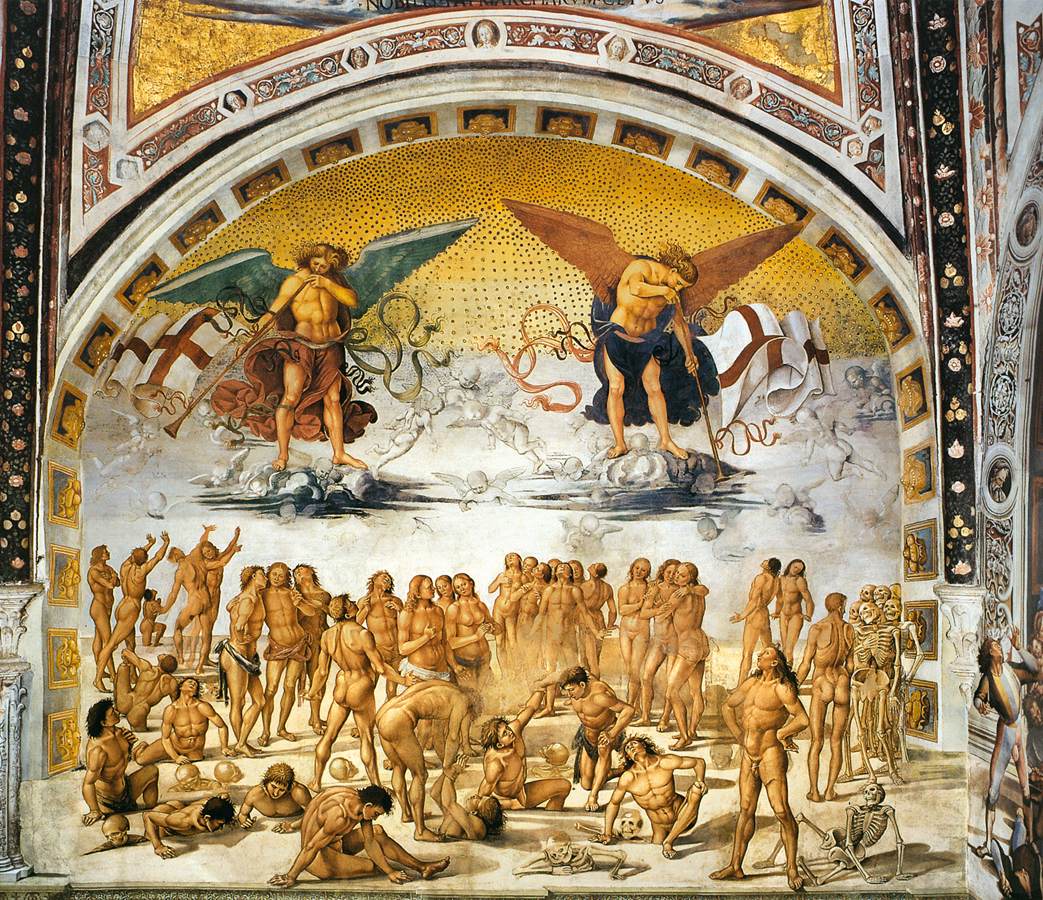
Resurrection of the Flesh

Luca Signorelli

1499-1502
Fresco, width 700 cm
Chapel of San Brizio, Duomo, Orvieto

12 posted on 11/02/2020 5:10:20 AM PST by annalex (fear them not)
[ Post Reply | Private Reply | To 7 | View Replies]

To: fidelis
From: Romans 6:3-9

Baptism (Continuation)
---------------------------------
[3] Do you not know that all of us who have been baptized into Christ Jesus were baptized into His death? [4] We were buried therefore with Him by baptism into death, so that as Christ was raised from the dead by the glory of the Father, we too might walk in newness of life.

[5] For if we have been united with Him in a death like His, we shall certainly be united with Him in a resurrection like His. [6] We know that our old self was crucified with Him so that the sinful body might be destroyed, and we might no longer be enslaved to sin. [7] For He who has died is freed from sin. [8] But if we have died with Christ, we believe that we shall also live with Him. [9] For we know that Christ being raised from the dead will never die again; death no longer has dominion over him.

*********************************************************************
Commentary:

1-11. The universal dominion of sin, which began with the sin of Adam, is not the only event to be reckoned with. When sin reached its full extent, the grace brought by Jesus Christ came in superabundance. Through Baptism this grace reaches each of us and frees us from the control of sin. When we receive this Sacrament we die: that is to say, our blameworthiness is destroyed, we renounce sin once and for all, and are born again into a new life.

"The Lord", St. Ambrose tells the newly baptized, "who wanted His benefactions to endure, the serpent's plans to be turned to naught, and the harm done to be put right, delivered a sentence to mankind: 'You are dust, and to dust you shall return' (Genesis 3:19), and made man subject to death [...]. The remedy was given him: man would die and rise again [...]. You ask me how? [...] Pay attention. So that in this world too the devil's snare would be broken, a rite was instituted whereby man would die, being alive, and rise again, being alive [...]. Through immersion in water the sentence is blotted out: 'You are dust, and to dust you shall return'" (De Sacramentis, II, 6).

This passage of the epistle, which reveals the key truths concerning Baptism, also reminds us of the profound meaning of this rite which Christ established, its spiritual effects in Christians and its far-reaching effects with respect to the Christian life. Thus, we can apply to Baptism what St. Thomas Aquinas says about all the sacraments: "Three aspects of sanctification may be considered -- its very cause, which is Christ's Passion; its form, which is grace and the virtues; and its ultimate end, which is eternal life. And all these are signified by the sacraments. Consequently, a sacrament is a sign which is both a reminder of the past, that is, of the Passion of Christ, and an indication of what is effected in us by Christ's Passion, and a foretelling and pledge of future glory" (Summa Theologiae, III, q. 60, a. 3).

In the specific case of Baptism, the various things which the Sacrament implies carry a special nuance -- a new birth which presupposes a symbolic death. It reproduces in us not only the Passion, Death and burial of Christ, symbolized by immersion in water (verses 3-4, 6), but also new life, the life of grace which pours into the soul, enabling the person to share in the Resurrection of Christ (verses 4-5). This sharing in Christ's Resurrection to immortal life is a kind of seed which will ultimately produce the glorious resurrection of our bodies.

The baptized person is, therefore, someone newly created, someone born into a new life, someone who has moved out of darkness into light. The white garment used at Baptism symbolizes innocence and grace; the burning candle, the light of Christ -- two symbols the Church uses in the baptismal liturgy to signify what is happening.

Thus, in Baptism, God "removes every trace of sin, whether original or personal" ("The Rite of Baptism", Introduction, 5) and also remits the penalties that these sins incur. On being baptized in the name of the Three Divine Persons, the Christian is shown God the Father's love for him (a love he has not merited), is given a share in the Paschal Mystery of the Son, and to him is communicated new life in the Spirit (cf. Instruction on Infant Baptism, 20 October 1980, 9). Baptism, which is also described as "the door of the spiritual life", unites a person to Christ and to the Church by means of grace, which makes us children of God and heirs to Heaven. Finally, in addition to the infused virtues and supernatural gifts, the per- son is given "the graces necessary to live in a Christian way, and on his soul is impressed the sacramental character which makes him a Christian for evermore" (St. Pius X Catechism, 250).

Baptism, which confers a "character", that is, a kind of seal confirming our Christian calling, gives us a share in Christ's priesthood and makes us capable of receiving the other sacraments. ,p> 4. It is easier to grasp the symbolism of burial and resurrection if one remembers that in earlier times, and particularly in the apostolic period, Baptism was usually administered by immersion in water -- in some cases by total immersion, up to three times, with one Person of the Blessed Trinity being invoked each time. "They asked you, 'Do you believe in God the Father almighty?' You said, 'I believe', and you were immersed, that is, you were buried. Again they asked you, 'Do you believe in our Lord Jesus Christ and in His Cross?' You said, 'I believe', and you were again immersed. This time you have been buried with Christ, and he who is buried with Christ rises with Christ. For a third time you were asked, 'Do you believe in the Holy Spirit?' You said, 'I believe', and for a third time you were immersed, so that by this three-fold confession you might be loosed of your many attachments to your past life" (St. Ambrose, De Sacramentis, II, 7).

Today Baptism is normally administered by pouring water over the head -- a method also used in apostolic times and which gradually came into general use because it was found more convenient.

5. Just as the ingraft and the plant form a single thing and make a single principle of life, Christians by being grafted onto or incorporated into Christ through Baptism form one single thing with Him and begin to draw on His divine life. We are also "united with Him in a death like His": Christ suffered physical death; we, in Baptism, die spiritually to the life of sin. St. John Chrysostom explains this as follows: "Baptism is for us what the Cross and burial were for Christ; but with this difference: the Savior died physically, He was physically buried, whereas we ought to die spiritually. That is why the Apostle does not say we are 'united with Him with His death', but 'in a death like his'" (Hom. on Rom., 10).

9-10. Jesus Christ chose to bear all the consequences of sin, even though He was sinless. His voluntary death on the Cross and His glorious Resurrection broke the bonds of death, for Himself and for all His own. Death no longer shall have dominion: "[Christ died] that through death He might destroy him who has the power of death, that is, the devil, and deliver all those who through fear of death were subject to lifelong bondage" (Hebrews 2:14-15). And as a consequence He won, for His own human nature and for us, a new life.

In all those who have been baptized these same events in Christ's life are in some way reproduced. "Our past sins have been wiped out by the action of grace. Now, so as to stay dead to sin after Baptism, personal effort is called for, although God's grace continues to be with us, providing us with great help" (Chrysostom, Hom. on Rom., 11). This personal effort might be encapsulated in a resolution: "May we never die through sin; may our spiritual resurrection be eternal" (St. J. Escriva, Holy Rosary, 1st Glorious Mystery).

13 posted on 11/02/2020 5:11:09 AM PST by fidelis (Zonie and USAF Cold Warrior)
[ Post Reply | Private Reply | To 11 | View Replies]

To: fidelis
From: John 6:37-40

The Discourse on the Bread of Life (Continuation)
------------------------------------------------
[37] All that the Father gives Me will come to Me; and him who comes to Me I will not cast out. [38] For I have come down from Heaven, not to do My own will, but the will of Him who sent Me; [39] and this is the will of Him who sent Me, that I should lose nothing of all that He has given Me, but raise it up on the last day. [40] For this is the will of My Father, that every one who sees the Son and believes in Him should have eternal life; and I will raise him up at the last day."

**********************************************************************
Commentary:

37-40. Jesus clearly reveals that He is the one sent by the Father. This is something St. John the Baptist proclaimed earlier on (Jn 3:33-36), and Jesus Himself stated it in His dialogue with Nicodemus (Jn 3:17-21) and announced publicly to the Jews in Jerusalem (Jn 5:20-30). Since Jesus is the one sent by the Father, the bread of life come down from Heaven to give life to the world, everyone who believes in Him has eternal life, for it is God's will that everyone should be saved through Jesus Christ. These words of Jesus contain three mysteries: 1) that of faith in Jesus Christ, which means "going to Jesus", accepting His miracles (signs) and His words; 2) the mystery of the resurrection of believers, something which begins in this life through faith and becomes fully true in Heaven; 3) the mystery of predestination, the will of our Father in Heaven that all men be saved. These solemn words of our Lord fill the believer with hope.

St. Augustine, commenting on vv. 37 and 38, praises the humility of Jesus, the perfect model for the humility of the Christian: Jesus chose not to do His own will but that of the Father who sent Him: "Humbly am I come, to teach humility am I come, as the master of humility am I come; he who comes to Me is incorporated in Me; he who comes to Me becomes humble; he who cleaves to Me will be humble, for he does not his will but God's" (In Ioann. Evang., 25, 15 and 16).

14 posted on 11/02/2020 5:15:42 AM PST by fidelis (Zonie and USAF Cold Warrior)
[ Post Reply | Private Reply | To 13 | View Replies]

Disclaimer: Opinions posted on Free Republic are those of the individual posters and do not necessarily represent the opinion of Free Republic or its management. All materials posted herein are protected by copyright law and the exemption for fair use of copyrighted works.

Free Republic
Browse · Search
Religion
Topics · Post Article

FreeRepublic, LLC, PO BOX 9771, FRESNO, CA 93794
FreeRepublic.com is powered by software copyright 2000-2008 John Robinson