Free Republic
Browse · Search
Religion
Topics · Post Article

Skip to comments.

De Mattei: Francis imposes concelebration in the Priestly Colleges of Rome [Catholic Caucus]
Rorate Caeli ^ | June 28, 2017 | Roberto de Mattei

Posted on 06/29/2017 10:13:28 AM PDT by ebb tide

De Mattei: Francis imposes concelebration in the Priestly Colleges of Rome

Roberto de Mattei
Corrispondenza Romana
June 282017


There is this rumour going around in the Vatican. One of Pope Francis’ collaborators asked him if it were true that a commission had been set up “to re-interpret” Humanae Vitae and he responded “It is not a commission, it’s a study group”. This is not only a linguistic ploy to hide the truth, but a play on words which reveal how the cult of contradiction is the essence of this pontificate. Monsignor Gilfredo Marengo, coordinator of the “study group”, sums up this philosophy well when he says we need to avoid the “polemical game - the pill - yes - the pill - no, just like today’s – Communion to the divorced - yes - Communion to the divorced - no” (Vatican Insider, March 23rd 2017).

We need this premise to present a new confidential document, it also, the product of another “study group”. It is the “working paper” of the Congregation for the Clergy “On Concelebration in the Colleges and Seminaries of Rome”, which is circulating in an unofficial way in the Roman colleges and seminaries.  What emerges clearly from this text is that Pope Francis wants to impose Eucharistic Concelebration in the colleges and seminaries of Rome, de facto, if not in principle, affirming that: “the celebration in community must always be preferred to individual celebration”. 

The motive for this decision emerges from the document. Rome is not only the See of the Chair of Peter and the heart of Christendom, but it is also the place where priests and seminarians from all over the world meet to acquire that veneration towards the faith, the rites and  traditions of the Church, which was once called “the Roman spirit”.  The sojourn in Rome, which helped to develop love for the Tradition of the Church, today offers the opportunity for a liturgical and doctrinal “re-education”, to those who want to “reform” the Church according to the directives of Pope Bergoglio. Life in the Roman colleges – affirms the “working paper” in fact: offers the occasion “of experiencing, at the same time, an intense period of permanent, integral formation”. 

The document refers explicitly to a recent speech given to priests studying in Rome, wherein Pope Francis expressed the ecclesial importance of concelebration in the context of the communities of priest-students: “ It is a unending challenge to overcome individualism and experience diversity as a gift, seeking the unity of the presbyter, which is a sign of God’s presence in community life.  The presbyter who doesn’t maintain unity, de facto, drives God away from the life of the community. He doesn’t give witness to the presence of God. He drives Him out. Thus, gathered in the Name of the Lord, especially when the Eucharist is celebrated, you manifest also sacramentally that He is the love of your heart.(Discourse, April 1st 2017).

In the light of this doctrine, the “working paper” by the Congregation for the Clergy, repeats that “ the concelebrated Mass is preferable to individual celebration” (the bold is in the original and also in the following citations).

 “Therefore, Superiors are heartily recommended to encourage Concelebration, even several times a day, in the large priestly communities. Hence, several concelebrations can be anticipated in the various Colleges, so that the resident priests can participate according to their personal needs, carefully establishing [Masses] two or three times a day.”

In effect, everyday relations, shared on a daily basis for years in the same Roman College are an important experience in every priest’s vocational trajectory.  By way of this mediation, in fact, fraternal bonds and communion are established among priests of different dioceses and nations which find a sacramental expression in Eucharistic concelebration.”

Certainly, leaving one’s own diocese and pastoral mission for quite a long time guarantees not only intellectual preparation, but above all, offers the opportunity, at the same time, to experience an intense period of enduring, integral formation.  With this in mind, the community life in the priestly Colleges offers this modality of presbyterial fraternity, probably new in respect to that of the past.

 “The College experience is an opportunity for fruitful celebration of the Eucharist on the part of the priests. Thus, the practice of daily  Eucharistic Concelebration in Colleges can become an occasion for deepening the spiritual life of priests, with important fruits such as: the expression of communion among priests from different particular Churches, which is manifest especially when Bishops of different dioceses preside over the concelebration on their visits to Rome; the chance to listen to the homilies of other confreres; the carefully prepared celebration, even solemn, of the daily Eucharist, the deepening of Eucharistic devotion which every priest needs to cultivate, outside the celebration itself.”

Among the practical norms indicated, we can read:

It is to be recommended that priests can participate ordinarily in the Eucharistic Concelebration in the hours established by the College, always preferring community celebration to the individual one. In this sense, the Colleges with a large group of priests could establish the Eucharistic Concelebration in 2 or 3 different hours of the day, so that everyone may be allowed to participate according to their personal, academic or pastoral needs.”
             
If the resident priests in the College for particular circumstances cannot participate in the Concelebration during the hours established, they must always prefer to celebrate together in another more convenient hour.”

The violation of Canon 902, according to which priests “may concelebrate the Eucharist; they are however, fully entitled to celebrate the Eucharist individually, is obvious and repeated in two passages of the text, with the result that the colleges that apply the “working paper to the letter”, will violate the current universal law. But beyond the juridical considerations, there are others of a theological and spiritual nature.

On March 5th 2012, on occasion of the presentation of Monsignor Guillaume Derville’s book, Eucharistic Concelebration. From Symbol to Reality. (Wilson & Lafleur, Montréal 2012), Cardinal Antonio Cañizares, the then Prefect of the Congregation for Divine Worship, underlined the need for “moderating” concelebration, making the words of Benedict XVI his own: “I join […] in recommending the daily celebration of Mass, even when the faithful are not present. This recommendation is consistent with the objectively infinite value of every celebration of the Eucharist, and is motivated by the Mass's unique spiritual fruitfulness. If celebrated in a faith-filled and attentive way, Mass is formative in the deepest sense of the word, since it fosters the priest's configuration to Christ and strengthens him in his vocation.” (Apostolic Exhortation, Sacramentum caritatis, n. 80).

Catholic Doctrine in fact, sees in Holy Mass the unbloody reenactment of the Sacrifice of the Cross. The multiplication of Masses renders greater glory to God and is an immense good for souls. “if every Mass has in itself the same infinite value – writes Father Joseph de Sainte Marie – the dispositions of men to receive its fruits are always imperfect and, in this sense, limited. From here [comes] the importance of the number of celebrations of Masses in order to multiply the fruits of salvation. Sustained by this elementary but sufficient theological reasoning, the  redeeming fecundity of the multiplication of Masses is moreover proved by the liturgical practice of the Church and of the stance of the Magisterium.  Of this fecundity, the Church – history teaches – has become progressively more aware over the course of the centuries, has promoted the practice of the multiplication of Masses and subsequently has encouraged it officially more and more.” (L’Eucharistie, salut du monde, Dominique Martin Morin, Paris 1982, pp. 457-458)).

For the neo-modernists, the Mass is reduced to an assembly: the more priests and faithful present, the more significant it is.  Concelebration is intended as a means for the Priest to lose slowly the awareness of who he is and what his mission is, which is exclusively the celebration of the Eucharistic Sacrifice and the salvation of souls. The diminution of Masses, however -- as well as the right conception of the Mass --  is one of the main causes for today’s religious crisis.

Now even the Congregation for the Clergy, at the request of Pope Francis, is making its contribution to the demolition of the Catholic Faith.

Translation: Contributor Francesca Romana


TOPICS: Catholic; Worship
KEYWORDS: concelebration; francischurch; tlm
Navigation: use the links below to view more comments.
first 1-2021 next last

1 posted on 06/29/2017 10:13:29 AM PDT by ebb tide
[ Post Reply | Private Reply | View Replies]

To: ebb tide

Concelebration is ancient and accepted. Talk about a nothing burger.

I think the author has a perpetual ax to grind with Francis, and demonstrates it with his rumor-based allegation on Humanae Vitae.


2 posted on 06/29/2017 10:18:36 AM PDT by SpirituTuo
[ Post Reply | Private Reply | To 1 | View Replies]

To: SpirituTuo
Only accepted since VC II.

In the Latin Church the rite survives only at the ordination of priests and bishops. [Note: Concelebration was fully restored to the Latin Church after the Second Vatican Council.] The newly-ordained priests say the Offertory prayers and the whole Canon, including the words of consecration, aloud with the bishop, kneeling around him. The words of consecration especially must be said "slowly and rather loud" and "at the same moment with the pontiff" (Pont. Rom., do Ord. Presb., rubric). They must say the words significative, that is with the intention of consecrating (Benedict XIV, de SS. Missæ Sacr., III, xvi, 6), and must be careful not to say them before, but exactly with, the bishop (op. cit., loc. cit., 7). They receive Holy Communion under one kind. The same rite is used at a bishop's consecration, except that in this case the new bishop communicates with the consecrator under both kinds (Pont. Rom., de Cons. Electi in Episc., rubric in the text).

Catholic Encyclopedia

3 posted on 06/29/2017 10:27:35 AM PDT by ebb tide (We have a rogue curia in Rome)
[ Post Reply | Private Reply | To 2 | View Replies]

To: NewJerseyJoe

P4L


4 posted on 06/29/2017 10:32:53 AM PDT by NewJerseyJoe (Rat mantra: "Facts are meaningless! You can use facts to prove anything that's even remotely true!")
[ Post Reply | Private Reply | To 1 | View Replies]

To: SpirituTuo
“I join […] in recommending the daily celebration of Mass, even when the faithful are not present. This recommendation is consistent with the objectively infinite value of every celebration of the Eucharist, and is motivated by the Mass's unique spiritual fruitfulness. If celebrated in a faith-filled and attentive way, Mass is formative in the deepest sense of the word, since it fosters the priest's configuration to Christ and strengthens him in his vocation.” (Apostolic Exhortation, Sacramentum caritatis, n. 80).

Pope Benedict XVI

5 posted on 06/29/2017 10:35:51 AM PDT by ebb tide (We have a rogue curia in Rome)
[ Post Reply | Private Reply | To 2 | View Replies]

To: ebb tide
"... Pope Francis wants to impose Eucharistic Concelebration in the colleges and seminaries of Rome, de facto, if not in principle, affirming that: “the celebration in community must always be preferred to individual celebration”. Really, why? And - Benedict XVI : “I join […] in recommending the daily celebration of Mass, even when the faithful are not present. This recommendation is consistent with the objectively infinite value of every celebration of the Eucharist, and is motivated by the Mass's unique spiritual fruitfulness. If celebrated in a faith-filled and attentive way, Mass is formative in the deepest sense of the word, since it fosters the priest's configuration to Christ and strengthens him in his vocation.” (Apostolic Exhortation, Sacramentum caritatis, n. 80).
6 posted on 06/29/2017 10:36:00 AM PDT by heterosupremacist (Domine Iesu Christe, Filius Dei, miserere me peccatorem!)
[ Post Reply | Private Reply | To 1 | View Replies]

To: SpirituTuo
Concelebration is ancient and accepted. Talk about a nothing burger.

It's not a nothingburger. This means way fewer masses will be celebrated in Rome. From the article:

From here [comes] the importance of the number of celebrations of Masses in order to multiply the fruits of salvation. Sustained by this elementary but sufficient theological reasoning, the redeeming fecundity of the multiplication of Masses is moreover proved by the liturgical practice of the Church and of the stance of the Magisterium. Of this fecundity, the Church – history teaches – has become progressively more aware over the course of the centuries, has promoted the practice of the multiplication of Masses and subsequently has encouraged it officially more and more.”

Fewer prayers, especially the most important one -- Mass -- are always a bad thing.

7 posted on 06/29/2017 10:42:51 AM PDT by BlessedBeGod (To restore all things in Christ~~Appeasing evil is cowardice~~Francis is temporary. Hell is forever.)
[ Post Reply | Private Reply | To 2 | View Replies]

To: ebb tide

Note two words: survives and restored. That indicates it started at some period before, and was accepted.

Also from the article, was the discussion of having “several” concelebrated masses per day, not fewer.


8 posted on 06/29/2017 10:59:22 AM PDT by SpirituTuo
[ Post Reply | Private Reply | To 3 | View Replies]

To: SpirituTuo

Three concelebrated Masses in one day, by three priests is not the same as nine Masses.

Do the math.


9 posted on 06/29/2017 11:02:11 AM PDT by ebb tide (We have a rogue curia in Rome)
[ Post Reply | Private Reply | To 8 | View Replies]

To: SpirituTuo

Why did it have to be “restored”?

For good reason, the Latin Church had limited it, until the infamous VC II.

Since then we now have altar chicks, Communion in the Paw and on the Hoof, women lecturers, male and female Eucharistic Monsters, permanent deacons, liturgical dance, et al.


10 posted on 06/29/2017 11:16:41 AM PDT by ebb tide (We have a rogue curia in Rome)
[ Post Reply | Private Reply | To 8 | View Replies]

To: SpirituTuo

If priests are expected to concelebrate, why the need for Eucharistic Monsters?


11 posted on 06/29/2017 11:21:02 AM PDT by ebb tide (We have a rogue curia in Rome)
[ Post Reply | Private Reply | To 9 | View Replies]

To: ebb tide

LOL! “Eucharistic Monsters!”

I don’t know why it’s so hard for priests to get down to the front for Communion - or why it’s now so impossible for the laity to kneel and receive communion quickly as the priest moves along, making Communion even at a well attended mass pretty speedy. Part of it has to do with the removal of altar rails and the fact that people don’t kneel now.


12 posted on 06/29/2017 11:47:20 AM PDT by livius
[ Post Reply | Private Reply | To 11 | View Replies]

To: ebb tide

I don’t read that as the intention.


13 posted on 06/29/2017 12:31:44 PM PDT by SpirituTuo
[ Post Reply | Private Reply | To 9 | View Replies]

To: ebb tide

Slow your roll. Any number of things have been suppressed only to be renewed. Concelebrated Masses were held in Latin, as well as ancient Greek.

As far as Extraordinary Ministers of Holy Communion, it is preferable for priests to administer. At one of my parishes, there were 7 priests, so it was no big deal to have four of them administering Holy Communion. In my current parish, there are two priests, and each Mass has at least 200 people, with Sunday 10am having close to 700.

Permanent deacons were part of the ancient church, called out specifically in the Bible. They were personal aids to the bishops. In some larger Churches, permanent deacons help relieve the load of many administrative tasks, as well as handle baptisms. The bishop serves the diocese, and if a parish has needs that can be filled by deacons, he deploys them.

Having read most of the documents of Vatican II, the abuses that followed happened “in the spirit” of Vatican II, and not necessarily called out.

Don’t forget, Vatican II was held by Pre-Vatican II bishops.


14 posted on 06/29/2017 12:41:32 PM PDT by SpirituTuo
[ Post Reply | Private Reply | To 10 | View Replies]

To: SpirituTuo

It may not be the direct intent but it’s a fact that Masses will be offered less.

But then again.

Theology is not #Mathematics. 2 + 2 in #Theology can make 5. Because it has to do with #God and real #life of #people...

— Antonio Spadaro (@antoniospadaro) January 5, 2017


15 posted on 06/29/2017 12:48:18 PM PDT by ebb tide (We have a rogue curia in Rome)
[ Post Reply | Private Reply | To 13 | View Replies]

To: SpirituTuo
At one of my parishes, there were 7 priests, so it was no big deal to have four of them administering Holy Communion.

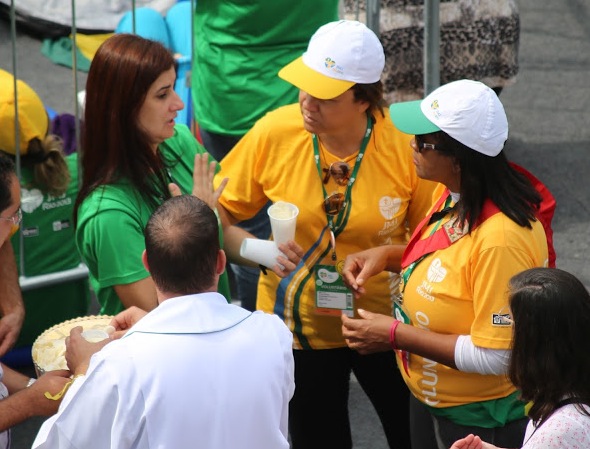
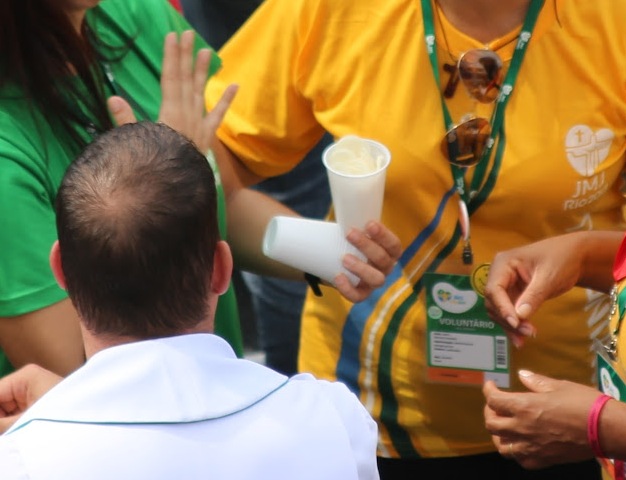
How many priests do you think were present at Bergoglio's World Yute Day in Rio?


16 posted on 06/29/2017 1:29:28 PM PDT by ebb tide (We have a rogue curia in Rome)
[ Post Reply | Private Reply | To 14 | View Replies]

To: ebb tide

Good question! The organizer is at fault for not making this smooth. At other events, it has been handled much, much better.


17 posted on 06/29/2017 1:34:35 PM PDT by SpirituTuo
[ Post Reply | Private Reply | To 16 | View Replies]

To: SpirituTuo
In my current parish, there are two priests, and each Mass has at least 200 people, with Sunday 10am having close to 700.

In my TLM church there is one priest and about 560 people assisting at the Holy Sacrifice of the Mass. Only the lone priest administers Holy Communion and everyone receives on the tongue and on the knees (handicaps excluded) at the altar rail.

Nobody is in rush and nobody leaves Mass early.

18 posted on 06/29/2017 1:40:49 PM PDT by ebb tide (We have a rogue curia in Rome)
[ Post Reply | Private Reply | To 14 | View Replies]

To: SpirituTuo

Do you receive Holy Communion in the hand?


19 posted on 06/29/2017 1:41:23 PM PDT by ebb tide (We have a rogue curia in Rome)
[ Post Reply | Private Reply | To 17 | View Replies]

To: SpirituTuo
Witnessing a marvel from his cell

As time went by, the priest lost track of hours and days while imprisoned in the coal bin. He endured the stillness of the surroundings and at times he heard sounds he wasn’t used to. One morning, he heard the door open quietly. Through the little opening, the priest saw the little Chinese girl sneaking ever so carefully into the sanctuary, kneeling and bowing in homage. As she lowered her head, she took a desecrated Host with her tongue. She raised her head, folded her hands, closed her eyes and prayed in silence. Several moments later, she arose and departed.

Every morning the priest witnessed the uplifting scene that became a source of comfort inside the dark and somber environs of his makeshift prison cell. There he eagerly waited the break of dawn expecting to see the sweet, enchanting, little girl receive and adore the Host. Though it occurred many times, he couldn’t recall how often times she came to practice the soul-stirring daily ritual.


A Heroic Death

But alas, the day of final reckoning arrived. As the little heroine went through her daily pious exercise one morning; knees bent, hands folded and absorbed in deep prayer, the church door behind her burst open. Tumultuous screams stirred the air and a shot rang out.

As the priest hurriedly looked through his peephole, he saw the pallid little girl crawl agonizingly along the floor as she reached a Host to receive Holy Communion. When the soldier drew near to check on her, she tried in vain to pull herself up and to fold her hands. Instead she fell on her back and hit her head on the floor with a thud. The little Chinese girl-martyr lay dead motionless on the floor. For a moment, the soldier stood hesitant not knowing what to make of his deed and its fatal outcome. Finally, he turned around and stormed out of the church.


Set free

The moving yet harrowing scene left the priest in a state of shock. While he pondered on that painful experience, his prison door opened and the same soldier went in to announce that he was free to go.

Without any hesitation, he scampered towards the sanctuary to see the lifeless little girl. As he knelt besides her, the soldier approached him and uttered, “Sir, if in every town there was such a little girl, no soldier would ever fight for the Communists!”

The Little Girl Who Inspired Archbishop Fulton Sheen's Vow

20 posted on 06/29/2017 1:58:41 PM PDT by ebb tide (We have a rogue curia in Rome)
[ Post Reply | Private Reply | To 19 | View Replies]


Navigation: use the links below to view more comments.
first 1-2021 next last

Disclaimer: Opinions posted on Free Republic are those of the individual posters and do not necessarily represent the opinion of Free Republic or its management. All materials posted herein are protected by copyright law and the exemption for fair use of copyrighted works.

Free Republic
Browse · Search
Religion
Topics · Post Article

FreeRepublic, LLC, PO BOX 9771, FRESNO, CA 93794
FreeRepublic.com is powered by software copyright 2000-2008 John Robinson