
Photo by R. Scott Lloyd
Closeup of Joseph Smith handwritten account of First Vision
Posted on 08/14/2011 9:33:46 AM PDT by greyfoxx39
Joseph Smith's First Vision in which he saw the Father and the Son during the spring of 1820 may be the best-documented theophany in history, said Steven C. Harper in his Aug. 4 FAIR Conference address.
"In the 1830s and '40s, Joseph wrote or enabled scribes to write eight known documents declaring that the Lord opened the heavens upon him," said Brother Harper, associate chair of the Department of Church History and Doctrine at BYU. Five of the documents are unique, with the other three being copies of previous ones, and five other writers documented the event during Joseph's lifetime, said Brother Harper, who is an editor in the Joseph Smith Papers Project of the Church History Department.
"Scholars would be thrilled to have that much direct and indirect documentation of Moses' encounter at the burning bush, Isaiah's vision of the heavenly temple or Paul's experience on the road to Damascus," remarked Brother Harper. He noted that Joseph worked hard to document his experience in the Sacred Grove and that scholars have worked hard to raise awareness of his several accounts, with images of the Prophet's own direct statements being available in the Church's archives.
"Even so, they are little known by most Latter-day Saints and others," he said. "Strangely, some believers do not want to know the plentiful historical record. They can hardly be troubled with Joseph's efforts to capture his sublime experience.
"Some critics, meanwhile, assume that the documentary richness shows Joseph to be a fraud."
Brother Harper commented that as seekers thirst for all the evidence and examine it for themselves, "they read, remember and ponder Joseph's descriptions, they seek understanding and verification. My presentation is for them."
He outlined a few of the more prominent accounts of the vision, then spoke of three criticisms of it separated widely in time:
The Methodist minister to whom Joseph confided a few days after his experience and who treated it contemptuously, saying there was no such thing as visions in modern times.
Fawn Brodie's biography of No Man Knows My History, written more than a century later.
A generation thereafter, the Rev. Wesley Walters' charge — later discredited — that Joseph invented the revivalism the Prophet said prompted his seeking of the Lord and preceded his encounter with the Father and the Son in the grove.
"Each of these three arguments begins with the premise that it could not have happened as Joseph described it," Brother Harper observed. He characterized such reasoning by the Latin term a priori, or that which is essentially assumed and does not rely on experience or verification, but rather is based on definitions and widely held beliefs.
"The critics' a priori preconceived certainty that the vision never happened as Joseph Smith said it did prevents them from exploring the variety of possibilities that the historical accounts offer," he said. "All of the unbelieving accounts share a common hermeneutic, or interpretive method, sometimes called the hermeneutic of suspicion, which in this case simply means interpreting Joseph Smith's statements skeptically, unwilling to trust that he might be telling the truth.
"One historian who doesn't believe Joseph Smith said that he couldn't trust the accounts of the vision because they were subjective, and it was his job to figure out what really happened. By what method, I wonder, is this scholar going to discover what actually happened when he is unwilling to trust the only eyewitness.
"Such historians assume God-like abilities to know. They don't seem to grasp the profound irony that they're replacing the subjectivity of historical witnesses, granted, with their own. I call their methods 'subjectivity squared.' They dismiss the historical documents, and they severely limit possible interpretations by predetermining that Joseph Smith's accounts cannot be possible."
Brother Harper said he worries that the danger of closed-mindedness is as real for believers as it is for skeptics, that some believers are "just as likely to begin with preconceived notions rather than a willingness to go where Joseph's accounts lead them."
"Many assume, for instance, that Joseph told his family of the vision immediately, or that he wrote it immediately, or that he understood all of its implications perfectly or consistently through the years, or that he would always remember or tell the exact same story, that it would always be recorded and transmitted the same. But none of those assumptions is supported by the evidence."
"Apologetics" is a well-named description of this article.
Ping
for later
Of course there is no mention of all the inconsistencies in the accounts of the ‘first vision’.
This isn’t apologetics, it is ‘lying for the Lord’.
Where’s the golden tablet? At the price of gold nowadays . . . .
What inconsistencies? They are "revisions". and more and more revisions. all differing from the earlier accounts. But there are no inconsistencies. {insert picture of BagdadBob here.
The level of deception required to actually believe that is staggering.
I guess the Bible is meaningless then.
So, in other words, because Smith wrote it down or "enabled" others to (in other words strong-armed them) it's considered by LDS as "well-documented"?
LOL.
ROFL. Guess he paid them off in wives.
I wonder which version they are talking about...if my memory is correct, there are at least 5 or 6 different ones documented.
No; the BIBLE shows JS to be a fraud!
Numbers 23:19
God is not a man, that he should lie; neither the son of man, that he should repent: has he said, and shall he not do it? or has he spoken, and shall he not make it good?
Why would you try to convince a JURY withOUT showing the EVIDENCE?
| Version Number When Published Brief Description |
Age/Year | Evil Power | Pillar of Light or Fire |
Number of Personages |
Father | Son | Question: Join What Sect |
Remarks |
|
Official Version,
Mormon scripture,
Pearl of Great Price
p. 47, 48, 1974 Ed. |
Age 14 1820 |
Yes | Yes Light |
2 | Yes | Yes | Join None | Lucy, Hyrum, Samuel, Sopronia Join Presbyterian Church 1820 |
| Paper by Joseph Smith, Times and Seasons March, April 1842 |
Same as item 1 above | |||||||
|
Letter from Joseph Smith
to John Wentworth, editor Chicago Democrat
1841 account Published March 1,1842 |
None given | No | No | 2 | ? | ? | No question, told all incorrect |
Joseph Smith's First Vision by Milton V. Backman Jr. Bookcraft, Appendix D. Ensign, Jan.1985, p. 16 |
| Both looked the Same They spoke |
||||||||
|
Dictated by Joseph Smith,
in hand of James Mulholland, 1838
|
Same as item 1 above, first known account of the official version. |
Ensign,
Jan. 1985 p. 14
|
||||||
|
Joseph Smith's diary of 1835, Recorded by
Warren Cowdery
Nov. 9, 1835, conversation of Joseph Smith with Joshua
|
Joseph, about 14 | No Tongue seemed swollen; heard someone; at first couldn't pray |
Yes Fire |
One, and then another like unto the first | ? | ? | No question, told sins are forgiven, Jesus Christ is the Son of God |
Joseph Smith's First Vision
by Milton V. Backman Jr. Bookcraft, Appendix B
|
| Second spoke. | ||||||||
| Saw many angels | ||||||||
|
Messenger & Advocate
by Oliver Cowdery supervised by
Joseph Smith
Feb. 1835
p. 77-79;
Also see Dec. 1834 p. 43
|
Joseph 17 1823 |
No | Yes | 1 |
No | No | No question told sin are forgiven | Note on pg. 78 that the revival was in 1823 (NOT 1820) so this must be the First Vision. |
| Messenger from God | ||||||||
|
Dictated by Joseph Smith
to F. G. Williams Summer to Nov. 1832
|
Joseph 14 or 16 | No | Yes | 1 | No | Yes | No question, told "None doeth good", sins forgiven |
Joseph Smith's First Vision
by Milton V. Backman Jr. Bookcraft, Appendix A
|
| Saw Lord (Jesus) he "spoke" | ||||||||
| Written by Joseph Smith, 1832 diary | Joseph 15 | No | Yes | 1 | No | Yes | No question, told sins forgiven all do no good |
Ensign,
Dec. 1984 pgs. 24-26
Jan. 1985 pg. 11
|
| Saw the Lord Jesus Christ (said He was crucified) | ||||||||
|
Early Church leaders
B. Young,
G. A. Smith,
J. Taylor
|
Joseph 15 | No | No | 1 | No | No | Join None | Journal of Discourses, 2:171; 18:239; 13:77,78; 20:167; 12:333,334 |
| Saw an angel, and asked the angel | ||||||||
“Judge, I submit these eight witnesses as evidence proving the defendant is telling the truth.”
“Who are these witnesses?”
“The defendant, the defendant, the defendant, the defendant, let’s see, the defendant, again the defendant, the defendant, and finally the defendant.”
“What?! Are you insane??”
“Certainly not! We’re gods!”
So it would sound Biblical -
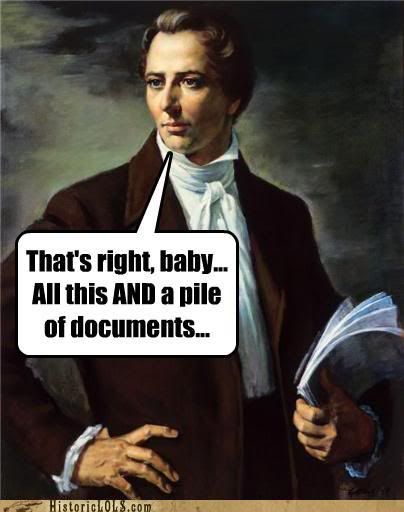
Post 13. The ‘revisions’ are inconsistent. Many cannot be possibly true at the same time.
I thin BB gets that, note the Baghdad bob at the end...
Disclaimer: Opinions posted on Free Republic are those of the individual posters and do not necessarily represent the opinion of Free Republic or its management. All materials posted herein are protected by copyright law and the exemption for fair use of copyrighted works.