Biblically Optimistic and Gospel-Based

"For these are the days of vengeance, that all things which are written may be fulfilled." (Luke 21:22)
Posted on 10/06/2009 7:19:14 AM PDT by topcat54
The futurist interpretation concerning this passage is that the fig tree symbolizes the nation of Israel. Scofield says that the fig tree passage is “a prophecy that Israel shall again bud.” In the year 1948, the present nation called Israel came into existence. Some believe this has been the budding of the fig tree of which Jesus spoke. But was this what Jesus meant?
It has been supposed by some that throughout the Bible we might find references to Israel being symbolized by the fig tree. Looking into the Old Testament, there is little — if any — proof that the fig tree is a symbol of the nation of Israel. In the New Testament, there are two references in which the fig tree is sometimes regarded as symbolizing the nation of Israel. Whether this is corrector not, neither passage pictures the tree as budding or fruitful, but just the opposite!
(Excerpt) Read more at the-highway.com ...
"For these are the days of vengeance, that all things which are written may be fulfilled." (Luke 21:22)
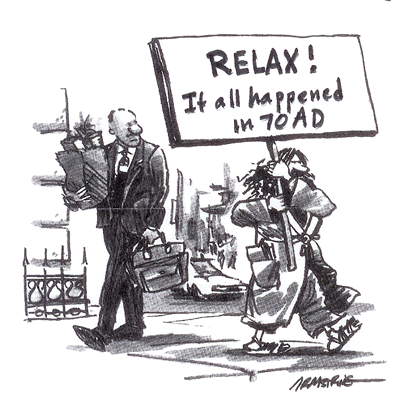

Did you know that the Greek word for 'pearl' is "margarita"?
The Bible seems to uses symbolism to represent different things in different places. I don’t think you can apply the symbolism from one story into a different story.
I would add:

Not to worry if you were part of "this generation" since the worst is over.
However, I’ve got good news and bad news for you since you were not part of “this generation”.
The good news is you missed:
The abomination of desolation, spoken of by Daniel the prophet
The great tribulation, such as was not since the beginning of the world to this time, no, nor ever shall be.
The sun darkened, and the moon shall not give her light, and the stars shall fall from heaven, and the powers of the heavens shall be shaken:
The bad news is you missed:
The coming of the Son of man coming in the clouds of heaven with power and great glory.
The coming of his angels with a great sound of a trumpet, and they shall gather together his elect from the four winds, from one end of heaven to the other.
The consequence being, YOU’VE BEEN LEFT BEHIND!!!
Mat 24:31 And he shall send his angels with a great sound of a trumpet, and they shall gather together his elect from the four winds, from one end of heaven to the other.
PRICELESS!
YOURS?
Gotta save/steal that one.
I see the
blaphemous, heretical, Replacementarian et al
blather factory has been working overtime AGAIN! LOL.
Does anyone ever post anything meaningful?
I'll make an attempt, sir, and I hop to be found edifying, as contrasted with merely argumentative.
BUT, a few verses later, in Matthew 24 when Jesus said: “This generation shall not pass, till all these things be fulfilled” — a statement which would clearly place the great tribulation back then, instead of in the future!
NOT SO FAST...
Without prejudice, nor devotion to the camp of any known "ism"...
I submit to you that the word "generation" truly means a literal generation in both Matthew 23:36 and Matthew 24:34, but there is some misunderstanding of WHO Jesus is referring to as "this generation" in the second reference, and some confusion about what "these things" refer to in the various places where "these things" are mentioned.
In Matthew 23:31-36, Jesus declares the egregious sin that would bring judgment upon "this generation," describing in vv.34-35 how there would even yet be more offenses added. He uses "these things" in v.36 in reference to both the added offenses (v.34) and the coming judgment (v.35).
I would submit for your consideration that it was THIS SPECIFIC JUDGMENT that was poured out upon Jerusalem in 70A.D.; that "this generation" in Matthew 23:36 is not at all figurative, but quite literal, and by it Jesus meant that those about whom he had been speaking -- that is the scribes and Pharisees over whom he had just pronounced eight woes -- would see this specific judgment poured out.
Jesus went on to lament and prophesy over Jerusalem, "From now on, you will not see Me until you -- that is, those who refused to confess it upon His Triumphal Entry -- say, 'BLESSED IS HE WHO COMES IN THE NAME OF THE LORD,'" then left the temple. On the way out, he discusses the fate of the temple and surrounding structures with his disciples, before going out to the Mount of Olives. There is a complete break in the narrative between Matthew 24:2 and Matthew 24:3, and it would not be reasonable to insist that a phrase used both before and afterward must reference the same things UNLESS that was clearly mandated by the immediate context.
In Matthew 24:2 Jesus calls the temple and surroundings "these things," and says that not one stone will be left upon another. Now, I note that it is perfectly natural that "these things" referenced here be different things than "these things" referenced in Matthew 23:36, and it seems clear from the text that they are, but we should also note that, given the break in narrative between Jesus' departure from the temple, and the beginning of his discourse at the Mount of Olives, the specific set of nouns and/or events bound up in the Matthew 24:3 usage of "these things" is less than certain, and may not be at all the same "these things" as in either of the prior two references.
It isn't a long walk from the temple to the Mount of Olives, but it is far enough that the destruction of "these things" mentioned in v.2 cannot reasonably be required to be the same "these things" that the disciples ask about in v.3. Fortunately, God has helped us understand, because the disciples clarify the matter by a further question asking, "What will be the sign of Your coming, and of the end of the age?" This is a hint as to what the disciples mean by "these things" in v.3.
An even more powerful clue comes when Jesus answers, because -- in a move that should be a flag for us as readers -- he answers the disciples' questions as one, addressing them in Matthew 24:4-31. The disciples asked about some set of "these things" that we cannot precisely pin down, and Jesus answers them with references to some very specific "things." Note that, in v.6, after revealing the coming of false christs, wars, and rumors of wars, Jesus says "those things must take place," and in v.8, after mentioning conflicts between nations, and kingdoms, and natural disasters "in various places," Jesus says "these things are merely the beginning of birth pangs." He then goes on to describe the progression from birth pangs all the way to His coming. So, "those things" (false christs, wars, rumors of war), and "these things" (conflicts, famines, disasters), and Jesus' Second Coming all get bound up together in Jesus' answer.
Absent a clear textual mandate to do otherwise, we are left to deduce from this that what Jesus spoke of in vv.4-31 were, in fact, the "these things" the disciples wanted to know about when they posed their questions in v.3.
It is in this context that we come to the parable of the fig tree.
Having just concluded his description of the sign of his coming and the end of the age, Jesus describes the natural budding and the appearance of leaves on the fig tree as a parable of how times and seasons are recognizable by the appearing of certain signs. Jesus says, "When you see all these things, recognize that he is near, right at the door." Here, it is obvious from the immediate context that "these things" refers to the events leading up to Jesus' Second Coming as he just described them in vv.4-28, and as embodied in the metaphor of leaves appearing on a fig tree. Jesus then says, in v.34, "Truly, I say to you, this generation shall not pass away until these things take place."
Now, the article referenced by this thread takes issue with "this generation" being interpreted to mean anything other than a literal generation, and -- finding no justification for that -- asserts that Jesus meant the generation of persons to whom he was speaking at that moment, then concludes that all of the events of vv.4-31 save Jesus' Second Coming must, therefore, be past events. But, there is another view that bears consideration; one that also maintains the literal meaning of "this generation," and it is this: when Jesus says "this generation" in Matthew 24:34 it is in reference to the generation of people who are alive to witness "the fig tree" as it "puts forth its leaves"; the generation that would be expected to "know that summer is near." That usage of "this generation" means a literal generation, nothing contrived or figurative about it.
I went to the trouble to look, and I think it worth noting that, in v.33, the verb "you see" (or "ye shall see," in the KJV) is in the aorist tense, indicating no regard for past, present or future time, and in the subjunctive mood, indicating that the action may or may not occur dependent upon other circumstances. This is important, because it gives additional footing for the assertion that Jesus' fig tree parable was not meant to be a figure of something that his then-present hearers would certainly witness themselves. The construction in English makes no such mandate, either, but the tense and mood of the Greek make the lack of one all the more evident. Thus, the fig tree is not necessarily constrained in time to those people then living, and for us to so constrain it would not be proper. [As a parenthetical, it'd be interesting to get the connotations from the original Aramaic, too.]
We, in our modern speech, commonly utilize a generalized form of address where we say things like, "First, you turn left at that light, then you go two blocks, and then you turn right into the K-Mart parking lot," where "you" has the implied meaning "anyone trying get from here to K-Mart," not necessarily "only those I'm speaking to right now." This usage of "you" is similar to Jesus' usage in that it does not mandate that the "you" doing the hearing in the present is the same "you" as the "you" trying to get to K-Mart. Likewise, then, the "you" who would "see all these things" need not be, of necessity, the same "you" as the "you" to whom Jesus was immediately speaking.
So, the fig tree parable may be acceptably paraphrased:
In the same way that someone trying to discern the times knows summer is near when they see the fig tree has tender branches, and has put forth leaves, likewise, when you see all these things (ref. vv.4-28), recognize that he is near, right at the door.
Understanding the text in this way allows "this generation" in v.34 to mean a literal generation, without forcing the phrase "this generation shall not pass" to mean that any of the events of vv.4-31 be past events. The understanding of this text as I have described enables a faithful, plain-language reading that does not twist words to mean what they do not mean, conveys that the sacking of Jerusalem in 70A.D. was the then-impending judgment Jesus declared in Matthew 23:36, yet separates that event from the birth pangs, tribulation, and Second Coming outlined in Matthew 24:4-31. All of this, in turn meshes perfectly with the more detailed Revelation of Jesus Christ that was shown to John as a yet-future sequence of events some twenty years or so after the fall of Jerusalem.
I hope that perhaps, in this, some will recognize that here is a credibly sound reading of this text that eliminates difficulties arising from other interpretations that have been taught. Specifically, I hope that I have successfully refuted that the text necessarily supports a preterist view. I suppose the notion that it MAY could yet be argued, but that it MUST cannot be.
No, I found that on another site.
I guess if you right click it, you can find the source info.
AND IT IS CERTAINLY wonderful that the winsome attractiveness of your prose and tone provide a splendid contrast with my raspy, fiesty scratchings. THANKS ENORMOUSLY.
##########################################
.
##########################################
.
##########################################
It isn't a long walk from the temple to the Mount of Olives, but it is far enough that the destruction of "these things" mentioned in v.2 cannot reasonably be required to be the same "these things" that the disciples ask about in v.3. Fortunately, God has helped us understand, because the disciples clarify the matter by a further question asking, "What will be the sign of Your coming, and of the end of the age?" This is a hint as to what the disciples mean by "these things" in v.3.
An even more powerful clue comes when Jesus answers, because -- in a move that should be a flag for us as readers -- he answers the disciples' questions as one, addressing them in Matthew 24:4-31. The disciples asked about some set of "these things" that we cannot precisely pin down, and Jesus answers them with references to some very specific "things." Note that, in v.6, after revealing the coming of false christs, wars, and rumors of wars, Jesus says "those things must take place," and in v.8, after mentioning conflicts between nations, and kingdoms, and natural disasters "in various places," Jesus says "these things are merely the beginning of birth pangs." He then goes on to describe the progression from birth pangs all the way to His coming. So, "those things" (false christs, wars, rumors of war), and "these things" (conflicts, famines, disasters), and Jesus' Second Coming all get bound up together in Jesus' answer.
Absent a clear textual mandate to do otherwise, we are left to deduce from this that what Jesus spoke of in vv.4-31 were, in fact, the "these things" the disciples wanted to know about when they posed their questions in v.3.
It is in this context that we come to the parable of the fig tree.
Having just concluded his description of the sign of his coming and the end of the age, Jesus describes the natural budding and the appearance of leaves on the fig tree as a parable of how times and seasons are recognizable by the appearing of certain signs. Jesus says, "When you see all these things, recognize that he is near, right at the door." Here, it is obvious from the immediate context that "these things" refers to the events leading up to Jesus' Second Coming as he just described them in vv.4-28, and as embodied in the metaphor of leaves appearing on a fig tree. Jesus then says, in v.34, "Truly, I say to you, this generation shall not pass away until these things take place."
Now, the article referenced by this thread takes issue with "this generation" being interpreted to mean anything other than a literal generation, and -- finding no justification for that -- asserts that Jesus meant the generation of persons to whom he was speaking at that moment, then concludes that all of the events of vv.4-31 save Jesus' Second Coming must, therefore, be past events. But, there is another view that bears consideration; one that also maintains the literal meaning of "this generation," and it is this: when Jesus says "this generation" in Matthew 24:34 it is in reference to the generation of people who are alive to witness "the fig tree" as it "puts forth its leaves"; the generation that would be expected to "know that summer is near." That usage of "this generation" means a literal generation, nothing contrived or figurative about it.
I went to the trouble to look, and I think it worth noting that, in v.33, the verb "you see" (or "ye shall see," in the KJV) is in the aorist tense, indicating no regard for past, present or future time, and in the subjunctive mood, indicating that the action may or may not occur dependent upon other circumstances. This is important, because it gives additional footing for the assertion that Jesus' fig tree parable was not meant to be a figure of something that his then-present hearers would certainly witness themselves. The construction in English makes no such mandate, either, but the tense and mood of the Greek make the lack of one all the more evident. Thus, the fig tree is not necessarily constrained in time to those people then living, and for us to so constrain it would not be proper. [As a parenthetical, it'd be interesting to get the connotations from the original Aramaic, too.]
We, in our modern speech, commonly utilize a generalized form of address where we say things like, "First, you turn left at that light, then you go two blocks, and then you turn right into the K-Mart parking lot," where "you" has the implied meaning "anyone trying get from here to K-Mart," not necessarily "only those I'm speaking to right now." This usage of "you" is similar to Jesus' usage in that it does not mandate that the "you" doing the hearing in the present is the same "you" as the "you" trying to get to K-Mart. Likewise, then, the "you" who would "see all these things" need not be, of necessity, the same "you" as the "you" to whom Jesus was immediately speaking.
So, the fig tree parable may be acceptably paraphrased: In the same way that someone trying to discern the times knows summer is near when they see the fig tree has tender branches, and has put forth leaves, likewise, when you see all these things (ref. vv.4-28), recognize that he is near, right at the door.
Understanding the text in this way allows "this generation" in v.34 to mean a literal generation, without forcing the phrase "this generation shall not pass" to mean that any of the events of vv.4-31 be past events. The understanding of this text as I have described enables a faithful, plain-language reading that does not twist words to mean what they do not mean, conveys that the sacking of Jerusalem in 70A.D. was the then-impending judgment Jesus declared in Matthew 23:36, yet separates that event from the birth pangs, tribulation, and Second Coming outlined in Matthew 24:4-31. All of this, in turn meshes perfectly with the more detailed Revelation of Jesus Christ that was shown to John as a yet-future sequence of events some twenty years or so after the fall of Jerusalem.
I hope that perhaps, in this, some will recognize that here is a credibly sound reading of this text that eliminates difficulties arising from other interpretations that have been taught. Specifically, I hope that I have successfully refuted that the text necessarily supports a preterist view. I suppose the notion that it MAY could yet be argued, but that it MUST cannot be.
tHANKS THANKS.
I’ve saved it already.
That cartoon is hilarious. Love it.
You seem to be getting nervous?
That's an illusion. Like the gap theory.
So, the fig tree parable may be acceptably paraphrased: In the same way that someone trying to discern the times knows summer is near when they see the fig tree has tender branches, and has put forth leaves, likewise, when you see all these things (ref. vv.4-28), recognize that he is near, right at the door.to here:
Understanding the text in this way allows "this generation" in v.34 to mean a literal generation, without forcing the phrase "this generation shall not pass" to mean that any of the events of vv.4-31 be past events.The explanation for the meaning of the fig tree parable, which I accept, by its nature does not assign the events of vv 4-32 to be pass, present, or future. However, I do not see “Assuredly, I say to you, this generation will by no means pass away till all these things take place” as opened ended as the fig tree parable might suggest.
Your explanation also does not account for the contextual and logical relationship between the judgment in Matt. 23:36 and Matt. 24:2, "Assuredly, I say to you, not one stone shall be left here upon another, that shall not be thrown down." There are no chapter breaks in the original. Jesus' statement and the subsequent questions of the disciples logically follows on the statement by Jesus at the end of Matt. 23.
Perhaps I'm still missing something.
A hyper-preterist, no doubt.
Once you realize that Preterists have taken it upon themselves to erase large portions of what God wrote in the Bible, it puts the entire matter to rest.
Who do we know would love to have people believe that almost half of the Scriptures are a lie??
Disclaimer: Opinions posted on Free Republic are those of the individual posters and do not necessarily represent the opinion of Free Republic or its management. All materials posted herein are protected by copyright law and the exemption for fair use of copyrighted works.