
Posted on 09/21/2006 6:32:44 AM PDT by Salvation
Feast of Saint Matthew, Apostle and evangelist
Reading 1
Eph 4:1-7, 11-13
Brothers and sisters:
I, a prisoner for the Lord,
urge you to live in a manner worthy of the call you have received,
with all humility and gentleness, with patience,
bearing with one another through love,
striving to preserve the unity of the Spirit
through the bond of peace:
one Body and one Spirit,
as you were also called to the one hope of your call;
one Lord, one faith, one baptism;
one God and Father of all,
who is over all and through all and in all.
But grace was given to each of us
according to the measure of Christ’s gift.
And he gave some as Apostles, others as prophets,
others as evangelists, others as pastors and teachers,
to equip the holy ones for the work of ministry,
for building up the Body of Christ,
until we all attain to the unity of faith
and knowledge of the Son of God, to mature manhood,
to the extent of the full stature of Christ.
Responsorial Psalm
Ps 19:2-3, 4-5
R. (5) Their message goes out through all the earth.
The heavens declare the glory of God;
and the firmament proclaims his handiwork.
Day pours out the word to day,
and night to night imparts knowledge.
R. Their message goes out through all the earth.
Not a word nor a discourse
whose voice is not heard;
Through all the earth their voice resounds,
and to the ends of the world, their message.
R. Their message goes out through all the earth.
Gospel
Mt 9:9-13
As Jesus passed by,
he saw a man named Matthew sitting at the customs post.
He said to him, “Follow me.”
And he got up and followed him.
While he was at table in his house,
many tax collectors and sinners came
and sat with Jesus and his disciples.
The Pharisees saw this and said to his disciples,
“Why does your teacher eat with tax collectors and sinners?”
He heard this and said,
“Those who are well do not need a physician, but the sick do.
Go and learn the meaning of the words,
I desire mercy, not sacrifice.
I did not come to call the righteous but sinners.”
Please notify me via FReepmail if you would like to be added to or taken off the Alleluia Ping List.
Remnants of the monastery in which the relics of St. Matthews may reside discovered in Kirghizia

Since the 16th century Catholic piety has assigned entire months to special devotions. Due to her feast day on September 15, the month of September has traditionally been set aside to honor Our Lady of Sorrows. All the sorrows of Mary (the prophecy of Simeon, the three days' loss, etc.) are merged in the supreme suffering at the Passion. In the Passion, Mary suffered a martyrdom of the heart because of Our Lord's torments and the greatness of her love for Him. "She it was," says Pope Pius XII, "who immune from all sin, personal or inherited, and ever more closely united with her Son, offered Him on Golgotha to the Eternal Father together with the holocaust of her maternal rights and motherly love. As a new Eve, she made this offering for all the children of Adam contaminated through his unhappy fall. Thus she, who was the mother of our Head according to the flesh, became by a new title of sorrow and glory the spiritual mother of all His members."
INVOCATIONS
Mary most sorrowful, Mother of Christians, pray for us.
Virgin most sorrowful, pray for us.
TO THE QUEEN OF MARTYRS
Mary, most holy Virgin and Queen of Martyrs, accept the sincere homage of my filial affection. Into thy heart, pierced by so many swords, do thou welcome my poor soul. Receive it as the companion of thy sorrows at the foot of the Cross, on which Jesus died for the redemption of the world. With thee, O sorrowful Virgin, I will gladly suffer all the trials, contradictions, and infirmities which it shall please our Lord to send me. I offer them all to thee in memory of thy sorrows, so that every thought of my mind, and every beat of my heart may be an act of compassion and of love for thee. And do thou, sweet Mother, have pity on me, reconcile me to thy divine Son Jesus, keep me in His grace, and assist me in my last agony, so that I may be able to meet thee in heaven and sing thy glories. Amen.
TO THE MOTHER OF SORROWS
Most holy Virgin. and Mother, whose soul was pierced by a sword of sorrow in the Passion of thy divine Son, and who in His glorious Resurrection wast filled with never-ending joy at His triumph; obtain for us who call upon thee, so to be partakers in the adversities of Holy Church and the sorrows of the Sovereign Pontiff, as to be found worthy to rejoice with them in the consolations for which we pray, in the charity and peace of the same Christ our Lord. Amen.
IN HONOR OF THE SORROWS OF THE BLESSED VIRGIN MARY
O most holy and afflicted Virgin! Queen of Martyrs! thou who didst stand motionless beneath the Cross, witnessing the agony of thy expiring Son--through the unceasing sufferings of thy life of sorrow, and the bliss which now more than amply repays thee for thy past trials, look down with a mother's tenderness and pity on me, who kneel before thee to venerate thy dolors, and place my requests, with filial confidence, in the sanctuary of thy wounded heart; present them, I beseech thee, on my behalf, to Jesus Christ, through the merits of His own most sacred death and passion, together with thy sufferings at the foot of the cross, and through the united efficacy of both obtain the grant of my present petition. To whom shall I resort in my wants and miseries if not to thee, O Mother of Mercy, who, having so deeply drunk of the chalice of thy Son, canst compassionate the woes of those who still sigh in the land of exile? Offer for me to my Savior one drop of the Blood which flowed from His sacred veins, one of the tears which trickled from His divine eyes, one of the sighs which rent His adorable Heart. O refuge of the universe and hope of the whole world, do not reject my humble prayer, but graciously obtain the grant of my petition.
TO OUR LADY OF SORROWS
O most holy Virgin, Mother of our Lord Jesus Christ: by the overwhelming grief you experienced when you witnessed the martyrdom, the crucifixion, and the death of your divine Son, look upon me with eyes of compassion, and awaken in my heart a tender commiseration for those sufferings, as well as a sincere detestation of my sins, in order that, being disengaged from all undue affection for the passing joys of this earth, I may sigh after the eternal Jerusalem, and that henceforward all my thoughts and all my actions may be directed towards this one most desirable object. Honor, glory, and love to our divine Lord Jesus, and to the holy and immaculate Mother of God. Amen. --Saint Bonaventure
Prayer Source: Prayer Book, The by Reverend John P. O'Connell, M.A., S.T.D. and Jex Martin, M.A., The Catholic Press, Inc., Chicago, Illinois, 1954

| Lord, have mercy on us. Lord, have mercy on us. Christ, hear us. Christ, graciously hear us. God, the Father of heaven, God the Son, Redeemer of the world, . God the Holy Ghost, Holy Mary, Mother of God, Holy Virgin of virgins, Mother of the Crucified, Sorrowful Mother, Mournful Mother, Sighing Mother, Afflicted Mother, Foresaken Mother, . Desolate Mother, Mother most sad, Mother set around with anguish, Mother overwhelmed by grief, Mother transfixed by a sword, Mother crucified in thy heart, Mother bereaved of thy Son, Sighing Dove, Mother of Dolors, Fount of tears, Sea of bitterness, Field of tribulation, Mass of suffering, Mirror of patience, Rock of constancy, Remedy in perplexity, Joy of the afflicted, Ark of the desolate, Refuge of the abandoned,. Shiled of the oppressed, Conqueror of the incredulous, Solace of the wretched, Medicine of the sick, Help of the faint, Strength of the weak, Protectress of those who fight, Haven of the shipwrecked, Calmer of tempests, Companion of the sorrowful, Retreat of those who groan, Terror of the treacherous, Standard-bearer of the Martyrs, Treasure of the Faithful, Light of Confessors, Pearl of Virgins, . Comfort of Widows, . Joy of all Saints, Queen of thy Servants, Holy Mary, who alone art unexampled, Pray for us, most Sorrowful Virgin, |
Christ, have mercy on us. Christ, graciously hear us. |
| Let us pray, --- O God, in whose Passion, according to the prophecy of Simeon, a sword of grief pierced through the most sweet soul of Thy glorious Blessed Virgin Mother Mary: grant that we, who celebrate the memory of her Seven Sorrows, may obtain the happy effect of Thy Passion, Who lives and reigns world without end, Amen. |
|
| The Seven Sorrows of Our Lady 1. The Prophecy of Simeon 2. The Flight into Egypt . 3. The Loss of Jesus in the Temple 4. Mary meets Jesus Carrying the Cross 5. The Crucifixion 6. Mary Receives the Dead Body of Her Son 7. The Burial of Her Son and Closing of the Tomb. |
|
| Consecration to Our Lady of Sorrows Most holy Virgin and Queen of Martyrs, Mary, would that I could be in Heaven, there to contemplate the honors rendered to thee by the Most Holy Trinity and by the whole Heavenly Court! But since I am still a pilgrim in this vale of tears, receive from me, thy unworthy servant and a poor sinner, the most sincere homage and the most perfect act of vassalage a human creature can offer thee. In thy Immaculate Heart, pierced with so many swords of sorrow, I place today my poor soul forever; receive me as a partaker in thy dolors, and never suffer that I should depart from that Cross on which thy only begotten Son expired for me. With thee, O Mary, I will endure all the sufferings, contradictions, infirmities, with which it will please thy Divine Son to visit me in this life. All of them I offer to thee, in memory of the Dolors which thou didst suffer during thy life, that every thought of my mind, every beating of my heart may henceforward be an act of compassion to thy Sorrows, and of complacency for the glory thou now enjoyest in Heaven. Since then, O Dear Mother, I now compassionate thy Dolors, and rejoice in seeing thee glorified, do thou also have compassion on me, and reconcile me to thy Son Jesus, that I may become thy true and loyal son (daughter); come on my last day and assist me in my last agony, even as thou wert present at the Agony of thy Divine Son Jesus, that from this painful exile I may go to Heaven, there to be made partaker of thy glory. Amen. |
|
|
|
|
From: Ephesians 4:7-11, 11-13
A Call to Unity
From: Matthew 9:9-13
The Call of Matthew
| First reading | Ephesians 4:1 - 13 © |
|---|---|
| I, the prisoner in the Lord, implore you to lead a life worthy of your vocation. Bear with one another charitably, in complete selflessness, gentleness and patience. Do all you can to preserve the unity of the Spirit by the peace that binds you together. There is one Body, one Spirit, just as you were all called into one and the same hope when you were called. There is one Lord, one faith, one baptism, and one God who is Father of all, over all, through all and within all. Each one of us, however, has been given his own share of grace, given as Christ allotted it. And to some, his gift was that they should be apostles; to some, prophets; to some, evangelists; to some, pastors and teachers; so that the saints together make a unity in the work of service, building up the body of Christ. In this way we are all to come to unity in our faith and in our knowledge of the Son of God, until we become the perfect Man, fully mature with the fullness of Christ himself. |
|
| Psalm or canticle: Psalm 18 |
| Gospel | Matthew 9:9 - 13 © |
|---|---|
| As Jesus was walking on from there he saw a man named Matthew sitting by the customs house, and he said to him, ‘Follow me’. And he got up and followed him. While he was at dinner in the house it happened that a number of tax collectors and sinners came to sit at the table with Jesus and his disciples. When the Pharisees saw this, they said to his disciples, ‘Why does your master eat with tax collectors and sinners?’ When he heard this he replied, ‘It is not the healthy who need the doctor, but the sick. Go and learn the meaning of the words: What I want is mercy, not sacrifice. And indeed I did not come to call the virtuous, but sinners.’ |
|
O God, come to my aid.
O Lord, make haste to help me.
Glory be to the Father and to the Son and to the Holy Spirit,
as it was in the beginning, is now, and ever shall be,
world without end.
Amen. Alleluia.
A suitable hymn may be inserted at this point.
| Psalm 18 (19) |
|---|
| Praise of God the creator |
| The skies tell the story of the glory of God, the firmament proclaims the work of his hands; day pours out the news to day, night passes to night the knowledge. Not a speech, not a word, not a voice goes unheard. Their sound is spread throughout the earth, their message to all the corners of the world. At the ends of the earth he has set up a dwelling place for the sun. Like a bridegroom leaving his chamber, it rejoices like an athlete at the race to be run. It appears at the edge of the sky, runs its course to the sky’s furthest edge. Nothing can hide from its heat. Glory be to the Father and to the Son and to the Holy Spirit, as it was in the beginning, is now, and ever shall be, world without end. Amen. |
| Psalm 63 (64) |
|---|
| A prayer against enemies |
| Listen, O God, to my voice; keep me safe from fear of the enemy. Protect me from the alliances of the wicked, from the crowd of those who do evil. They have sharpened their tongues like swords, aimed poisonous words like arrows, to shoot at the innocent in secret. They will attack without warning, without fear, for they are firm in their evil purpose. They have set out to hide their snares – for they say, “Who will see us?” They have thought out plans to commit wicked deeds, and they carry out what they have planned. Truly the heart and soul of a man are bottomless depths. And God has shot them with his arrow: in a moment, they are wounded – their own tongues have brought them low. All who see them will shake their heads; all will behold them with fear and proclaim the workings of God and understand what he has done. The just will rejoice and hope in the Lord: the upright in heart will give him glory. Glory be to the Father and to the Son and to the Holy Spirit, as it was in the beginning, is now, and ever shall be, world without end. Amen. |
| Psalm 96 (97) |
|---|
| The glory of God in his judgements |
| The Lord reigns! Let the earth rejoice, let the many islands be glad. Clouds and dark mist surround him, his throne is founded on law and justice. Fire precedes him, burning up his enemies all around. His lightnings light up the globe; the earth sees and trembles. The mountains flow like wax at the sight of the Lord, at the sight of the Lord the earth dissolves. The heavens proclaim his justice and all peoples see his glory. Let them be dismayed, who worship carved things, who take pride in the images they make. All his angels, worship him. Sion heard and was glad, the daughters of Judah rejoiced because of your judgements, O Lord. For you are the Lord, the Most High over all the earth, far above all other gods. You who love the Lord, hate evil! The Lord protects the lives of his consecrated ones: he will free them from the hands of sinners. A light has arisen for the just, and gladness for the upright in heart. Rejoice, you just, in the Lord and proclaim his holiness. Glory be to the Father and to the Son and to the Holy Spirit, as it was in the beginning, is now, and ever shall be, world without end. Amen. |
| Reading | Ephesians 4:1 - 16 © |
|---|---|
| I, the prisoner in the Lord, implore you to lead a life worthy of your vocation. Bear with one another charitably, in complete selflessness, gentleness and patience. Do all you can to preserve the unity of the Spirit by the peace that binds you together. There is one Body, one Spirit, just as you were all called into one and the same hope when you were called. There is one Lord, one faith, one baptism, and one God who is Father of all, over all, through all and within all. Each one of us, however, has been given his own share of grace, given as Christ allotted it. It was said that he would: When he ascended to the height, he captured prisoners, he gave gifts to men. When it says, ‘he ascended’, what can it mean if not that he descended right down to the lower regions of the earth? The one who rose higher than all the heavens to fill all things is none other than the one who descended. And to some, his gift was that they should be apostles; to some, prophets; to some, evangelists; to some, pastors and teachers; so that the saints together make a unity in the work of service, building up the body of Christ. In this way we are all to come to unity in our faith and in our knowledge of the Son of God, until we become the perfect Man, fully mature with the fullness of Christ himself. Then we shall not be children any longer, or tossed one way and another and carried along by every wind of doctrine, at the mercy of all the tricks men play and their cleverness in practising deceit. If we live by the truth and in love, we shall grow in all ways into Christ, who is the head by whom the whole body is fitted and joined together, every joint adding its own strength, for each separate part to work according to its function. So the body grows until it has built itself up, in love. |
|
| Reading | A sermon by St Bede the Venerable |
|---|---|
| Jesus saw him through the eyes of mercy and chose him | |
| Jesus saw a man called Matthew sitting at the tax office, and he said to him: Follow me. Jesus saw Matthew, not merely in the usual sense, but more significantly with his merciful understanding of men. He saw the tax collector and, because he saw him through the eyes of mercy and chose him, he said to him: Follow me. This following meant imitating the pattern of his life – not just walking after him. St. John tells us: Whoever says he abides in Christ ought to walk in the same way in which he walked. And he rose and followed him. There is no reason for surprise that the tax collector abandoned earthly wealth as soon as the Lord commanded him. Nor should one be amazed that neglecting his wealth, he joined a band of men whose leader had, on Matthew’s assessment, no riches at all. Our Lord summoned Matthew by speaking to him in words. By an invisible, interior impulse flooding his mind with the light of grace, he instructed him to walk in his footsteps. In this way Matthew could understand that Christ, who was summoning him away from earthly possessions, had incorruptible treasures of heaven in his gift. As he sat at table in the house, behold many tax collectors and sinners came and sat down with Jesus and his disciples. This conversion of one tax collector gave many men, those from his own profession and other sinners, an example of repentance and pardon. Notice also the happy and true anticipation of his future status as apostle and teacher of the nations. No sooner was he converted than Matthew drew after him a whole crowd of sinners along the same road to salvation. He took up his appointed duties while still taking his first steps in the faith, and from that hour he fulfilled his obligation and thus grew in merit. To see a deeper understanding of the great celebration Matthew held at his house, we must realise that he not only gave a banquet for the Lord at his earthly residence, but far more pleasing was the banquet set in his own heart which he provided through faith and love. Our Saviour attests to this: Behold I stand at the door and knock; if anyone hears my voice and opens the door, I will come in to him and eat with him, and he with me. On hearing Christ’s voice, we open the door to receive him, as it were, when we freely assent to his promptings and when we give ourselves over to doing what must be done. Christ, since he dwells in the hearts of his chosen ones through the grace of his love, enters so that he might eat with us and we with him. He ever refreshes us by the light of his presence insofar as we progress in our devotion to and longing for the things of heaven. He himself is delighted by such a pleasing banquet. |
|
| Canticle | Te Deum |
|---|---|
| God, we praise you; Lord, we proclaim you! You, the Father, the eternal – all the earth venerates you. All the angels, all the heavens, every power – The cherubim, the seraphim – unceasingly, they cry: “Holy, Holy, Holy, Lord God of Hosts: heaven and earth are full of the majesty of your glory!” The glorious choir of Apostles – The noble ranks of prophets – The shining army of martyrs – all praise you. Throughout the world your holy Church proclaims you. – Father of immeasurable majesty, – True Son, only-begotten, worthy of worship, – Holy Spirit, our Advocate. You, Christ: – You are the king of glory. – You are the Father’s eternal Son. – You, to free mankind, did not disdain a Virgin’s womb. – You defeated the sharp spear of Death, and opened the kingdom of heaven to those who believe in you. – You sit at God’s right hand, in the glory of the Father. – You will come, so we believe, as our Judge. And so we ask of you: give help to your servants, whom you set free at the price of your precious blood. Number them among your chosen ones in eternal glory. Bring your people to safety, Lord, and bless those who are your inheritance. Rule them and lift them high for ever. Day by day we bless you, Lord: we praise you for ever and for ever. Of your goodness, Lord, keep us without sin for today. Have mercy on us, Lord, have mercy on us. Let your pity, Lord, be upon us, as much as we trust in you. In you, Lord, I trust: let me never be put to shame. Glory be to the Father and to the Son and to the Holy Spirit, as it was in the beginning, is now, and ever shall be, world without end. Amen. |
|
| A concluding prayer may follow here. |

|
God calls each one of us to be a saint.
|
 |
 |
|
|
September 21, 2006
St. Matthew
Matthew was a Jew who worked for the occupying Roman forces, collecting taxes from other Jews. Though the Romans probably did not allow extremes of extortion, their main concern was their own purses. They were not scrupulous about what the "tax-farmers" got for themselves. Hence the latter, known as "publicans," were generally hated as traitors by their fellow Jews. The Pharisees lumped them with "sinners." So it was shocking to them to hear Jesus call such a man to be one of his intimate followers.
Matthew got Jesus in further trouble by having a sort of going-away party at his house. The Gospel tells us that "many" tax collectors and "those known as sinners" came to the dinner. The Pharisees were still more badly shocked. What business did the supposedly great teacher have associating with such immoral people? Jesus' answer was, "Those who are well do not need a physician, but the sick do. Go and learn the meaning of the words, 'I desire mercy, not sacrifice.' I did not come to call the righteous but sinners" (Matthew 9:12b-13). Jesus is not setting aside ritual and worship; he is saying that loving others is even more important. No other particular incidents about Matthew are found in the New Testament. Quote:
|
||||
|
|
| Thursday, September 21, 2006 St. Matthew, Apostle, Evangelist (Feast) |
||
|
|
 |
September 21, 2006    Feast of St. Matthew, Apostle and Evangelist Old Calendar: St. Matthew, Apostle and Evangelist
St. Matthew No one was more shunned by the Jews than a publican, who was a Jew working for the Roman enemy by robbing his own people and making a large personal profit. Publicans were not allowed to trade, eat, or even pray with others Jews. One day, while seated at his table of books and money, Jesus looked at Matthew and said two words: "Follow me." This was all that was needed to make Matthew rise, leaving his pieces of silver to follow Christ. His original name, "Levi", in Hebrew signifies "Adhesion" while his new name in Christ, Matthew, means "Gift of God". The only other outstanding mention of Matthew in the Gospels is the dinner party for Christ and His companions to which he invited his fellow tax-collectors. The Jews were surprised to see Jesus with a publican, but Jesus explained that he had come "not to call the just, but sinners".
Not much else is known about Matthew. According to tradition, he preached in Egypt and Ethiopia and further places East. Some legends say he lived until his nineties, dying a peaceful death, others say he died a martyr's death. In the traditional symbolization of the evangelists, based on Ezech. 1:5-10 and Rev. 4:6-7, the image of the winged man is accorded to Matthew because his Gospel begins with the human genealogy of Christ. Patron: Accountants; bankers; bookkeepers; customs officers; security guards; stock brokers; tax collectors; Salerno, Italy. Symbols: Angel holding a pen or inkwell; bag of coins; loose coins; halberd; inkwell; king; lance; man holding money; man holding money box and/or glasses; money bag; money box; purse; spear; sword; winged man; young man; book; man sitting at a desk. Things to Do:
|
|
Healing Power of Love Thursday of the 24th Week in Ordinary Time Luke 7:36-50 Introductory Prayer: Holy Trinity, I cannot see you, but you are with me. I cannot touch you, but I am in your hands. I cannot comprehend you, but I love you with all my heart. Petition: Lord Jesus, teach me by your example and word. Help me to be willing to change. 1. Ostensible Openness and Spiritual Pride. Simon the Pharisee has an apparent openness to the Lord. He invites him to dine. He observes him. Moreover, he engages him in cordial dialogue. Nonetheless, we see that Simon interiorly judges the Lord, dismisses him as a farce, and ultimately rejects him. The Pharisaical attitude consists essentially in trying to force God into our own preconceived notions of how he should operate. The Pharisees had the correct view of moral precepts; both Simon and Jesus agree that this woman is a sinner. But they fail in recognizing their own sins, which here consist of pride. This pride manifests itself in that unspoken principle that God must adjust himself to my way of being and acting. 3. The Goodness of Christ. Our Lord’s remarkable treatment of both the woman and Simon displays a remarkable balance of kindness. He carefully avoids the opposite extremes of condemnation and indifference to others’ sins. The reason Our Lord is able to offer hope and consolation to the repentant sinner, as well as invite the proud with a gentle call to repentance, is that Christ will die for both. In this, we see Christ’s goodness. He comes to save us all, but we must choose to accept his goodness. Dialogue with Christ: Jesus, help me to realize who I am and who you are. Teach me gratitude for your goodness and hope in your mercy. Resolution: I will avoid making excuses today for my sins and failings, opening my heart to Christ’s mercy. |
O God, come to my aid.
O Lord, make haste to help me.
Glory be to the Father and to the Son and to the Holy Spirit,
as it was in the beginning, is now, and ever shall be,
world without end.
Amen. Alleluia.
A suitable hymn may be inserted at this point.
| Psalm 62 (63) |
|---|
| Thirsting for God |
| O God, you are my God, I wait for you from the dawn. My soul thirsts for you, my body longs for you. I came to your sanctuary, as one in a parched and waterless land, so that I could see your might and your glory. My lips will praise you, for your mercy is better than life itself. Thus I will bless you throughout my life, and raise my hands in prayer to your name; my soul will be filled as if by rich food, and my mouth will sing your praises and rejoice. I will remember you as I lie in bed, I will think of you in the morning, for you have been my helper, and I will take joy in the protection of your wings. My soul clings to you; your right hand raises me up. Glory be to the Father and to the Son and to the Holy Spirit, as it was in the beginning, is now, and ever shall be, world without end. Amen. |
| Canticle | Daniel 3 |
|---|---|
| All creatures, bless the Lord | |
| Bless the Lord, all his works, praise and exalt him for ever. Bless the Lord, you heavens; all his angels, bless the Lord. Bless the Lord, you waters above the heavens; all his powers, bless the Lord. Bless the Lord, sun and moon; all stars of the sky, bless the Lord. Bless the Lord, rain and dew; all you winds, bless the Lord. Bless the Lord, fire and heat; cold and warmth, bless the Lord. Bless the Lord, dew and frost; ice and cold, bless the Lord. Bless the Lord, ice and snow; day and night, bless the Lord. Bless the Lord, light and darkness; lightning and storm-clouds, bless the Lord. Bless the Lord, all the earth, praise and exalt him for ever. Bless the Lord, mountains and hills; all growing things, bless the Lord. Bless the Lord, seas and rivers; springs and fountains, bless the Lord. Bless the Lord, whales and fish; birds of the air, bless the Lord. Bless the Lord, wild beasts and tame; sons of men, bless the Lord. Bless the Lord, O Israel, praise and exalt him for ever. Bless the Lord, his priests; all his servants, bless the Lord. Bless the Lord, spirits of the just; all who are holy and humble, bless the Lord. Ananias, Azarias, Mishael, bless the Lord, praise and exalt him for ever. Let us bless Father, Son and Holy Spirit, praise and exalt them for ever. Bless the Lord in the firmament of heaven, praise and glorify him for ever. |
|
| Psalm 149 |
|---|
| The saints rejoice |
| Sing a new song to the Lord, his praise in the assembly of the faithful. Let Israel rejoice in its maker, and the sons of Sion delight in their king. Let them praise his name with dancing, sing to him with timbrel and lyre, for the Lord’s favour is upon his people, and he will honour the humble with victory. Let the faithful celebrate his glory, rejoice even in their beds, the praise of God in their throats; and swords ready in their hands, to exact vengeance upon the nations, impose punishment on the peoples, to bind their kings in fetters and their nobles in manacles of iron, to carry out the sentence that has been passed: this is the glory prepared for all his faithful. Glory be to the Father and to the Son and to the Holy Spirit, as it was in the beginning, is now, and ever shall be, world without end. Amen. |
| A short Bible reading and responsory may follow here. |
| Canticle | Benedictus |
|---|---|
| The Messiah and his forerunner | |
| Blessed be the Lord, the God of Israel, for he has come to his people and brought about their redemption. He has raised up the sign of salvation in the house of his servant David, as he promised through the mouth of the holy ones, his prophets through the ages: to rescue us from our enemies and all who hate us, to take pity on our fathers, to remember his holy covenant and the oath he swore to Abraham our father, that he would give himself to us, that we could serve him without fear – freed from the hands of our enemies – in uprightness and holiness before him, for all of our days. And you, child, will be called the prophet of the Most High: for you will go before the face of the Lord to prepare his path, to let his people know their salvation, so that their sins may be forgiven. Through the bottomless mercy of our God, one born on high will visit us to give light to those who walk in darkness, who live in the shadow of death; to lead our feet in the path of peace. Glory be to the Father and to the Son and to the Holy Spirit, as it was in the beginning, is now, and ever shall be, world without end. Amen. |
|
| Some short prayers may follow here, to offer up the day's work to God. |
| Our Father, who art in Heaven, hallowed be thy name. Thy kingdom come, thy will be done on earth as it is in heaven. Give us this day our daily bread, and forgive us our trespasses as we forgive those that trespass against us, and lead us not into temptation, but deliver us from evil. |
| A concluding prayer may follow here. |
| May the Lord bless us and keep us from all harm; and may he lead us to eternal life. |
| A M E N |
|
Eph 4:1-7,11-13 / Mt 9:9-13 Self-knowledge is a hard-won treasure, and even the best of us are blind to much of what our friends see clearly. Too often we blithely give convoluted explanations of our actions and intentions which convince no one but ourselves. Fictions like "I was just resting my eyes during the third act," make us feel fine, but fool no one. The self-deception may reach far deeper. We may well end up like the Pharisees in today's gospel, who clearly thought they were sinless and needful of no forgiveness, and therefore seemed apt critics of Jesus' decision to consort with sinners. What they said sounds foolish and the height of arrogance, and indeed it was. But we do the same thing whenever we put ourselves outside the circle of the world's fools and sinners by ridiculing or denouncing them. If we were forced to depend solely on our lifetime record, unamended and uncleansed by any unearned forgiveness, we would all be doomed — without exception. We are all in trouble if left to our own devices. God gives His forgiveness freely; but there is no earning it. He asks but one thing in return, that we extend forgiveness with equal abandon to one another. If you want to be forgiven, learn first to forgive. |
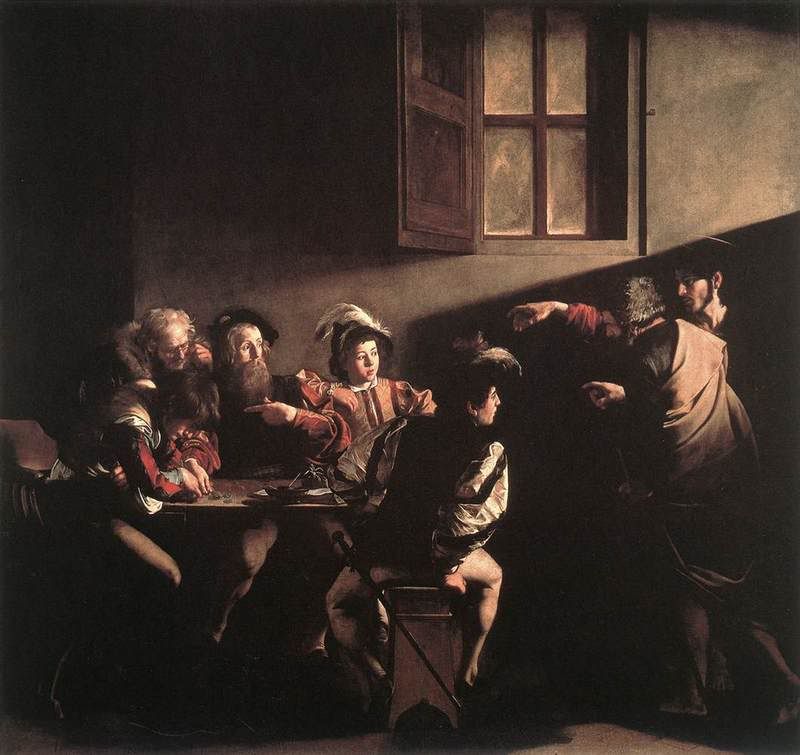
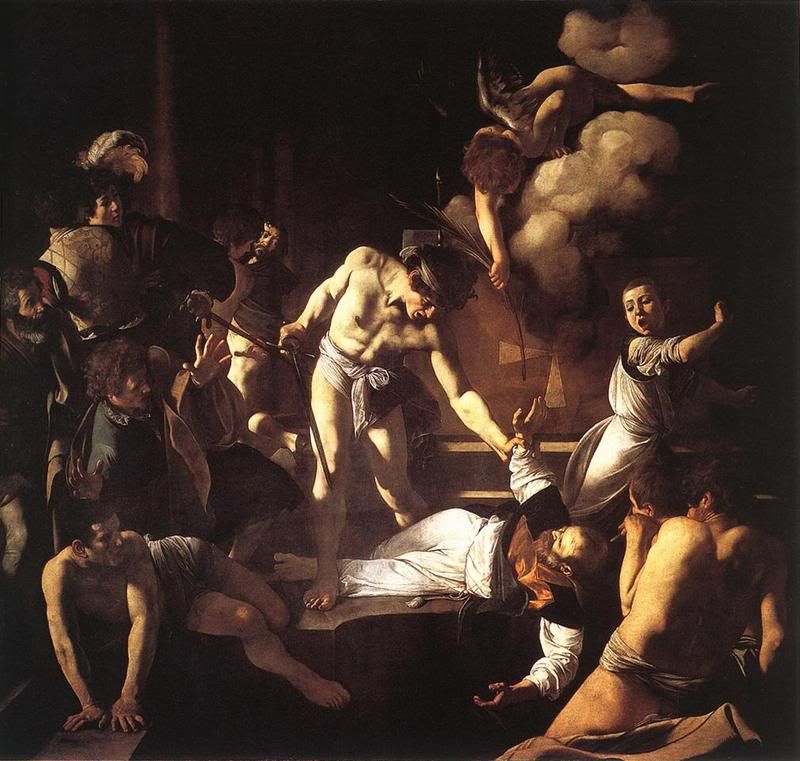
It's so much more vibrant in person that can't be captured here. The other Matthew paintings by Caravaggio found there are:
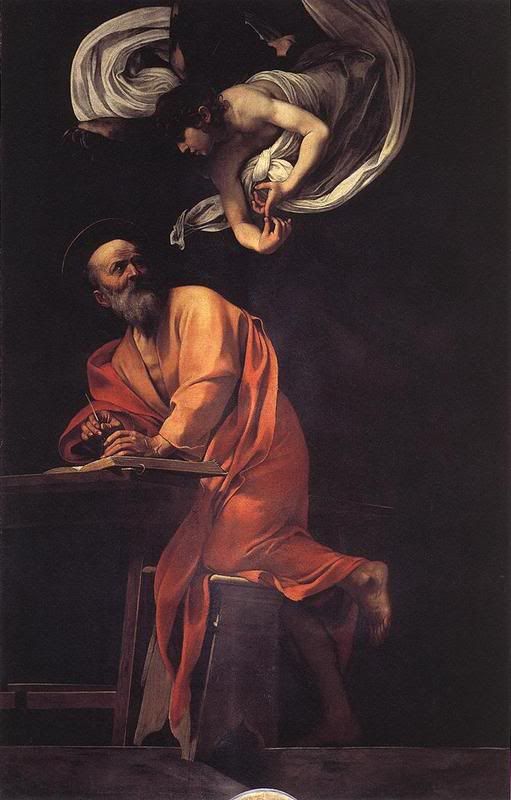
The Inspiration of St. Matthew
and The Martyrdom of St. Matthew
Beautiful paintings! Thank you. I can almost hear Christ's words in the first one: "Come, follow me."
O God, come to my aid.
O Lord, make haste to help me.
Glory be to the Father and to the Son and to the Holy Spirit,
as it was in the beginning, is now, and ever shall be,
world without end.
Amen. Alleluia.
A suitable hymn may be inserted at this point.
| Psalm 115 (116B) |
|---|
| Thanksgiving in the Temple |
| Still I trusted, even when I said “I am greatly afflicted”, when I said in my terror, “all men are liars”. How shall I repay the Lord for all he has done for me? I will take up the cup of salvation and call on the name of the Lord. I will fulfil my vows to the Lord before all his people. Precious in the sight of the Lord is the death of his faithful. O Lord, I am your servant, your maidservant’s son. You have torn apart my chains: I will make you a sacrifice of praise, I will call on the name of the Lord. I will fulfil my vows to the Lord before all his people, in the courts of the house of the Lord, within your walls, Jerusalem. Glory be to the Father and to the Son and to the Holy Spirit, as it was in the beginning, is now, and ever shall be, world without end. Amen. |
| Psalm 125 (126) |
|---|
| Gladness and hope in the Lord |
| When the Lord gave Sion back her captives, we became like dreamers. Our mouths were filled with gladness and our voices cried in exultation. Among the Gentiles they were saying, “By his deeds the Lord has shown himself great”. The Lord’s deeds showed forth his greatness, and filled us with rejoicing. Give us back our captives, O Lord, as you renew the dry streams in the desolate South. Those who sow in tears will rejoice at the harvest. They wept as they went, went with seed for the sowing; but with joy they will come, come bearing the sheaves. Glory be to the Father and to the Son and to the Holy Spirit, as it was in the beginning, is now, and ever shall be, world without end. Amen. |
| Canticle | Ephesians 1 |
|---|---|
| God the Saviour | |
| Blessed be God, the Father of our Lord Jesus Christ, who has blessed us, in Christ, with every spiritual blessing in heaven. In love, he chose us before the creation of the world, to be holy and spotless in his sight. He predestined us to be his adopted children through Jesus Christ, simply because it pleased him to do so. This he did for the praise of the glory of his grace, of his free gift of us to his Beloved, in whose blood we have gained redemption, and the forgiveness of our sins. This he did according to the riches of his grace, which he gave us in abundance, with all wisdom and discernment, revealing to us the mysteries of his will, because it pleased him to do so. In this action he has planned, in the fulfilment of time, to bring all things together in Christ, from the heavens and from the earth. Glory be to the Father and to the Son and to the Holy Spirit, as it was in the beginning, is now, and ever shall be, world without end. Amen. |
|
| A short Bible reading and responsory may follow here. |
| Canticle | Magnificat |
|---|---|
| My soul rejoices in the Lord | |
| My soul proclaims the greatness of the Lord, and my spirit rejoices in God, my salvation. For he has shown me such favour – me, his lowly handmaiden. Now all generations will call me blessed, because the mighty one has done great things for me. His name is holy, his mercy lasts for generation after generation for those who revere him. He has put forth his strength: he has scattered the proud and conceited, torn princes from their thrones; but lifted up the lowly. He has filled the hungry with good things; the rich he has sent away empty. He has come to the help of his servant Israel, he has remembered his mercy as he promised to our fathers, to Abraham and his children for ever. Glory be to the Father and to the Son and to the Holy Spirit, as it was in the beginning, is now, and ever shall be, world without end. Amen. |
|
| Some short prayers may follow here, to offer up the day's work to God. |
| Our Father, who art in Heaven, hallowed be thy name. Thy kingdom come, thy will be done on earth as it is in heaven. Give us this day our daily bread, and forgive us our trespasses as we forgive those that trespass against us, and lead us not into temptation, but deliver us from evil. |
| A concluding prayer may follow here. |
| May the Lord bless us and keep us from all harm; and may he lead us to eternal life. |
| A M E N |
 |
Thursday, September 21, 2006 Meditation Ephesians 4:1-7,11-13 As we hear Paul advising us to be patient, we might easily say to ourselves, “Yes, but who is going to help me do that?” After all, the world tells us we should be able to get whatever we want now! We want “instant” everything: food, money, entertainment, even “instant” relationships. We have been conditioned to be disappointed if we have to wait more than a couple of days for anything. So how can we possibly be patient with each other in this impatient world? Surely this was a challenge that faced Matthew as he learned to work with his fellow disciples. Imagine the kind of patience that a tax collector—probably worldly wise, well-connected, and accustomed to ignoring the “little people” whose taxes he took—would need in order to live with Peter’s passionate outbursts, Thomas’ doubts, or James and John’s competitiveness. The key is to realize where patience comes from. We can’t create patience ourselves. It is a gift from God, a virtue, a tool that he gives us to help us become more like him. Real patience doesn’t come from gritting our teeth and just coping with a difficult person. It comes from being filled with the Holy Spirit. When we love with his perfect love, we won’t be so intent on finding fault with those around us; we’ll be too busy trying to serve them. If we could stop just long enough to let Jesus love us, we would find the grace to deal with those who irritate us, and more importantly, to change our attitudes toward them. What’s more, we will become the kind of people who bring patience and kindness to others. If you have a problem with patience, begin by trying to be a little more patient with God. Take the time in prayer to slow down and listen for his voice. Perhaps Jesus wants to say something important to you. Perhaps he just wants to say, “I love you.” Whatever it is, his word has the power to calm your racing mind. If we could spend just a few extra minutes in prayer each day, waiting on the Lord, it could make a huge difference—both to us and to the people we’re going to meet! “Lord, help me to slow down! Fill me with the peace of your Spirit, so that I can share your love with this hectic and hurting world!” Psalm 19:2-5; Matthew 9:9-13 |
|
||||||||||||||||||||||||||||||||||||||||||||||
Disclaimer: Opinions posted on Free Republic are those of the individual posters and do not necessarily represent the opinion of Free Republic or its management. All materials posted herein are protected by copyright law and the exemption for fair use of copyrighted works.


 St. Matthew is known to us principally as an Evangelist, with his Gospel being the first in the New Testament. His Gospel was written in Aramaic, the language that our Lord Himself spoke and was written to convince the Jews that their anticipated Messiah had come in the person of Jesus.