Posted on 05/15/2006 6:55:09 AM PDT by Salvation
| ST. ISIDORE OF MADRID, LABORER, PATRON OF MADRID |
| Feast: May 15 |
|
It is a misfortune which deserves to be lamented with floods of tears, that ignorance, obstinacy, and vice should so often taint a country life, the state which of all others is most necessary and important to the world; the most conformable to a human condition and to nature; the state which was sanctified by the example of the primitive holy patriarchs, and which affords the most favorable opportunities for the perfect practice of every virtue and Christian duty. What advantageous helps to piety did the ancient hermits seek in the deserts, which the circumstances of a country laborer do not offer?
The life of St. Isidore is a most sensible proof of this assertion. He was born at Madrid, of poor but very devout parents, and was christened Isidore from the name of their patron, St. Isidore of Seville. They had not the means to procure him learning or a polite education; but, both by word and example, they infused into his tender soul the utmost horror and dread of all sin, and the most vehement ardor for every virtue, and especially for prayer. Good books are a great help to holy meditation; but not indispensably requisite. St. Irenaeus mentions whole nations which believed in Christ, and abounded in exemplary livers, without knowing the use of ink or paper. Many illustrious anchorets knew no other alphabet than that of humility and divine charity. The great St. Antony himself could not so much as read the Greek or Latin languages: nay, from the words of St. Austin, some doubt whether he could read even his own barbarous Egyptian dialect. Yet in the science of the saints, what philosopher or orator ever attained to the A B C of that great man? Learning, if it puffs up the mind, or inspires any secret self-sufficiency, is an impediment to the communications of the Holy Ghost: simplicity and sincere humility being the dispositions which invite him into the soul. By these was Isidore prepared to find him an interior instructor and comforter. His earnestness in seeking lessons and instructions of piety made him neglect no opportunity of hearing them; and so much the more tender and the deeper were the impressions which they left in his soul, as his desire was the stronger and the more pure. His patience in bearing all injuries and in overcoming the envy of fellow-servants by cordial kindnesses, his readiness to obey his masters, and in indifferent things to comply with the inclinations of others, and humbly to serve every one, gave him the most complete victory over himself and his passions. Labor he considered as enjoined him by God in punishment of sin, and for a remedy against it. And he performed his work in a spirit of compunction and penance. Many object that their labors and fatigues leave them little time for the exercises of religion. But Isidore, by directing his attention according to the most holy motives of faith, made his work a most perfect act of religion. He considered it as a duty to God. Therefore he applied himself to it with great diligence and care, in imitation of the angels in heaven, who in all things fulfil the will of God with the greatest readiness and alacrity of devotion. The more humbling and the more painful the labor was, the dearer it was to the saint, being a means the more suitable to tame his flesh, and a more noble part of his penance. With the same spirit that the saints subdued their bodies by toils in their deserts, Isidore embraced his task. He moreover sanctioned it by continual prayer. While his hand held the plough, he in his heart conversed with God, with his angel guardian, and the other blessed spirits; sometimes deploring the sins of the world, and his own spiritual miseries, at other times in the melting words of the royal prophet, raising his desires to the glory of the heavenly Jerusalem. It was chiefly by this perfect spirit of prayer, joined with, or rather engrafted upon a most profound humility and spirit of mortification, that St. Isidore arrived at so eminent a degree of sanctity as rendered him the admiration of all Spain. In his youth he was retained servant by a gentleman named John de Vargas of Madrid, to till his land and do his husbandry work. The saint afterwards took a most virtuous woman to wife, named Mary Toribia. Those who call her de la Cabeza were deceived by a chapel to which that name is given, because her head is kept in it. After the birth of one child, which died young, the parents, by mutual consent, served God in perfect continency.
St. Isidore continued always in the service of the same master. On account of his fidelity, he could say to him as Jacob did to Laban,1 that, to guard and improve his stock, he had often watched the nights, and had suffered the scorching heats of summer, and the cold of winter; and that the stock, which he found small, had been exceedingly increased in his hands. Don John de Vargas, after long experience of the treasure he possessed in this faithful ploughman, treated him as a brother, according to the advice of Ecclesiasticus,2 Let a wise servant be dear to thee as thy own soul. He allowed him the liberty of assisting daily at the public office of the church. On the other side, Isidore was careful by rising very early, to make his devotions no impediment to his business, nor any encroachment upon what he owed to his master. This being a duty of justice, it would have been a false devotion to have pretended to please God by a neglect of such an obligation; much less did the good servant indulge his compassionate charity to the poor, by relieving them otherwise than out of his own salary. The saint was sensible that in his fidelity, diligence, and assiduous labor consisted, in great part, the sanctification of his soul; and that his duty to his master was his duty to God. He also inspired his wife with the same confidence in God, the same love of the poor, and the same disengagement from the things of this world: he made her the faithful imitatrix of his virtues, and a partner in his good works. She died in 1175, and is honored in Spain among the saints. Her immemorial veneration was approved by pope Innocent XII. in 1697. See Benedict XIV., de Canoniz. 1. 2, c. 24, p. 246. St. Isidore being seized with the sickness of which he died, foretold his last hour, and prepared himself for it with redoubled fervor, and with the most tender devotion, patience, and cheerfulness. The piety with which he received the last sacraments drew tears from all that were present. Repeating inflamed acts of divine love, he expired on the 15th of May, 1170, being near sixty years of age. His death was glorified by miracles. After forty years, his body was removed out of the churchyard into the church of St. Andrew. It has been since placed in the bishop's chapel, and during these five hundred years remains entire and fresh, being honored by a succession of frequent miracles down to this time. The following, among others, is very well attested. Philip III., in his return from Lisbon, was taken so ill at Casarubios del Monte, that his life was despaired of by his physicians. Whereupon the shrine of St. Isidore was ordered to be carried in a solemn procession of the clergy, court, and people, from Madrid to the chamber of the sick king. The joint prayers of many prevailed. At the same time the shrine was taken out of the church, the fever left the king; and upon its being brought into his chamber, he was perfectly cured. The year following the body of the saint was put into a new rich shrine, which cost one thousand six hundred ducats of gold. St. Isidore had been beatified a little before by Paul V., in 1619, at the solicitation of the same king. His solemn canonization was performed, at the request of king Philip IV., on the 12th of March, 1622; though the bull was only made public by Benedict XIII. See the life of St. Isidore, written by John of Madrid, one hundred and forty years after his death; and Card. Lambertini, de Canoniz. SS. t. 3. Endnotes 1 Gen. xxxi. 40; xxx 30. 2 Eccles. vii. 28. (Taken from Vol. V of "The Lives or the Fathers, Martyrs and Other Principal Saints" by the Rev. Alban Butler, the 1864 edition published by D. & J. Sadlier, & Company) |
|
Provided Courtesy of: |
St. Isidore the Farmer
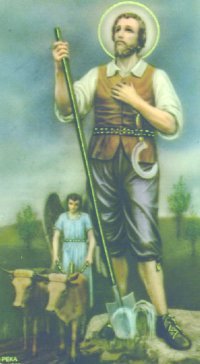
![63kb jpg painting of Saint Isidore with his helpful angel, artist unknown; please do not write to ask about the image [painting of Saint Isidore]](http://www.catholic-forum.com/saints/sainti03.jpg)
St. Isidore the Farmer1070-1130
Isidore was born to very poor yet very pious Catholic parents in Madrid, Spain. His parents were unable to support him when he was a youth and sent him to work for a wealthy landowner, John de Vergas (He ended up working for him for the rest of his life).
He married a very religious woman named Maria Torribia (also known as Maria de la Cabeza). She, like Isidore became a saint. They had one son who died unexpectedly as a child. Their grief inclined them to believe their son's death to be a sign from God and consequently vowed to live a life of perfect continence.
Isidore frequented Holy Mass every morning but often reported to work late. Late, though he was, his plowing was nevertheless accomplished by angels that resulted in three times more productivity. His coworkers and his boss witnessed such miraculous events and accorded Isidore with great respect.
St. Isidore loved the poor and loved the animals. The miracle of the multiplication of food occurred when Isidore fed a flock of starving birds and on another time when Isidore shared his food with a large group of beggars.
Isidore died on May 15, 1120 at 60 years of age and was canonized in 1622 along with four very notable Spanish saints. The group, known as "the five saints", included St. Ignatius of Loyola, St. Teresa of Avila, St. Francis Xavier, St. Phillip Neri, and St. Isidore. His body has been found incorrupt. His memorial is celebrated on May 15th on the Roman Calendar.
St. Isidore is known as the patron of Madrid, Spain as well as Leon, Saragosa, and Seville. He is also considered the patron of farmers, peasants, day laborers, and rural communities. Lastly, he is the patron of the United States National Rural Life Conference.
Summarized and adapted from:
1.Leonard Foley, O.F.M., Editor "Saint of the Day: Lives and Lessons for Saints and Feasts of the New Missal"
2.Joan Carroll Cruz, "Secular Saints: 250 Canonized and Beatified Lay Men, Women, and Children.
Saint Isidore, is the "Patron Saint of the Internet".
I will see if I can get any information to that effect later today, and I will post it on this Thread.
There are two St. Isidores. One is St. Isidore of Seville, April 4; the other is St. Isidore, the Farmer, May 15. They are both on FR.

|
|
![]() |
May 15, 2006
St. Isidore the Farmer
(1070-1130)
Isidore has become the patron of farmers and rural communities. In particular he is the patron of Madrid, Spain, and of the United States National Rural Life Conference. When he was barely old enough to wield a hoe, Isidore entered the service of John de Vergas, a wealthy landowner from Madrid, and worked faithfully on his estate outside the city for the rest of his life. He married a young woman as simple and upright as himself who also became a saintMaria de la Cabeza. They had one son, who died as a child. Isidore had deep religious instincts. He rose early in the morning to go to church and spent many a holiday devoutly visiting the churches of Madrid and surrounding areas. All day long, as he walked behind the plow, he communed with God. His devotion, one might say, became a problem, for his fellow workers sometimes complained that he often showed up late because of lingering in church too long. He was known for his love of the poor, and there are accounts of Isidores supplying them miraculously with food. He had a great concern for the proper treatment of animals. He died May 15, 1130, and was declared a saint in 1622 with Ignatius of Loyola, Francis Xavier, Teresa of Avila and Philip Neri. Together, the group is known in Spain as the five saints. Quote:
|
||||||
| Monday, May 15, 2006 Saint Isidore the Farmer (Optional Memorial) |
||
|
Please notify me via FReepmail if you would like to be added to or taken off the Saint of the Day Ping List.
for all those FReepers involved in farming or ranching.
Feast: May 15
Born c.1070 Died: May 15, 1130
Canonized: March 12, 1622 by Pope Gregory XV
St. Isidore the Farmer was a simple man of the earth, who attended the daily Catholic Latin Mass and demonstrated love of people and animals by his many acts of kindness and mercy. Isidore spent Sundays and holidays visiting the churches of Madrid and nearby towns. He offered food to those poorer than himself, and often did not eat himself until they had finished. Following his death, King Alphonsus of Castille had a vision of Isidore in the Pass of Navas de Tolosa during a battle with the Moors in 1211AD. In the vision, Isidore showed King Alphonsus an unknown pass that enabled his men to flank the Moors position and defeat them. Already Patron Saint of Madrid, Pope Pius XII declared Isidore Patron of farmers (in the United States of America). In 1947, he was proclaimed Patron of the National Rural Conference in the United States.
Litany of Saint Isidore -
Lord, have mercy on us.
Christ, have mercy on us.
Lord, have mercy on us.
Christ, hear us.
Christ, graciously hear us.
God the Father of heaven, have mercy on us.
God the Son, Redeemer of the world, have mercy on us.
God, the Holy Ghost, have mercy on us.
Holy Mary, pray for us.
St. Isidore, pray for us.
St. Isidore, patron of farmers, pray for us.
St. Isidore, illustrious tiller of the soul, pray for us.
St. Isidore, model of laborers, pray for us.
St. Isidore, devoted to duty, pray for us.
St. Isidore, loaded down with the labors of the field, pray for us.
St. Isidore, model of filial piety, pray for us.
St. Isidore, support of family life, pray for us.
St. Isidore, confessor of the faith, pray for us.
St. Isidore, example of mortification, pray for us.
St. Isidore, assisted by angels, pray for us.
St. Isidore, possessor of the gift of miracles, pray for us.
St. Isidore, burning with lively faith, pray for us.
St. Isidore, zealous in prayer, pray for us.
St. Isidore, ardent lover of the Blessed Sacrament, pray for us.
St. Isidore, lover of God's earth, pray for us.
St. Isidore, lover of poverty, pray for us.
St. Isidore, lover of fellowmen, pray for us.
St. Isidore, most patient, pray for us.
St. Isidore, most humble, pray for us.
St. Isidore, most pure, pray for us.
St. Isidore, most just, pray for us.
St. Isidore, most obedient, pray for us.
St. Isidore, most faithful, pray for us.
St. Isidore, most grateful, pray for us.
Jesus, Our Lord: we beseech You, hear us.
That You would vouchsafe to protect all tillers of the soil: we beseech You, hear us.
That You would vouchsafe to bring to all a true knowledge of the stewardship of the land...
That You would vouchsafe to preserve and increase our fields and flocks...
That You would vouchsafe to give and preserve the fruits of the earth...
That You would vouchsafe to bless our fields...
That You would vouchsafe to preserve all rural pastors...
That You would vouchsafe to grant peace and harmony in our homes...
That You would vouchsafe to lift up our hearts to You...
Be merciful, spare us, O Lord.
Be merciful, graciously hear us, O Lord.
From lightning and tempest: deliver us, O Lord.
From pestilence and floods...
From winds and drought...
From hail and storm...
From the scourge of insects...
From the spirit of selfishness...
Lamb of God, who takes away the sins of the world: spare us, O Lord.
Lamb of God, who takes away the sins of the world: graciously hear us, O Lord.
Lamb of God, who takes away the sins of the world: have mercy on us.
Christ, hear us.
Christ, graciously hear us.
Let Us Pray:
Grant, O Lord, that through the intercession of Blessed Isidore, the husbandman,
we may follow his example of patience and humility, and so walk faithfully in his footsteps
that in the evening of life we may be able to present to You an abundant harvest of merit
and good works, Who lives and reigns world without end. Amen.
Great find -- for private use, I would guess.
St. Isidore the Farmer, pray for us. Bless our land and bless our crops. Keep us as humble as you were. Amen.
Here in the rural Philippines, Saint Isadore the farm worker is quite beloved....probably because this is also a farm area
BTTT on the Optional Memorial of St. Isidore the Farmer, May 15, 2007!
Isidore the Farmer
Born: 1070
Died: May 15, 1172
Canonized: 1622
Feast Day: May 15
Patron Saint of: laborers, farmers
Also known as St. Isidore the Husbandman and St. Isidore the Farm-Labourer.
St. Isidore the Farmer, born of a poor family near Madrid, Spain, was raised devoted to the faith; in fact, Isidore was named after his parent's patron saint, Isidore of Seville. As a young boy, Isidore was sent off to work in Madrid for John de Vargas to plow the fields. While working for John de Vargas, Isidore fell in love with a young woman that shared his devotion and faith. After the loss of their only child, the young couple decided to live the rest of their lives in continence. Isidore was widely known for his generosity. On several occasions, he was reported to have shared what little food he had with those less fortunate; and it is reported that these meager offerings miraculously doubled and redoubled until all were fed. Those jealous of Isidore informed de Vargas that his charitable activity was keeping Isidore from his responsibilities. When de Vargas investigated the allegations for himself, he did indeed find that Isidore was reporting to work late but his work was not suffering what John de Vargas saw for himself was that unseen powers (which he surmised were in fact angels) were leading snow-white oxen on their plowing chores. In another miracle, Isidore shared some of his grain with hungry birds, but when the grain that remained was turned into flour, the amount was more than double what should have been produced by a full sack.
Saint Isidore the Farmer May 15th
ST. ISIDORE OF MADRID, LABORER, PATRON OF MADRID Feast: May 15
Saint Isidore the Farmer
[In the diocese of the United States]
Optional Memorial
May 15th

Francisco Goya
etching
1775-1778
History:
Also known as Saint Isidore the Laborer. A Spanish day laborer; born near Madrid, about the year 1070; died May 15, 1130, at the same place. He was in the service of a certain Juan de Vargas on a farm in the vicinity of Madrid. Every morning before going to work he went to Mass at one of the churches in Madrid. One day his fellow-laborers complained to their master that Isidore was always late for work in the morning. Upon investigation, so runs the legend, the master found Isidore at prayer, while an angel was doing the ploughing for him. On another occasion his master saw an angel ploughing on either side of him, so that Isidore's work was equal to that of three of his fellow-laborers.He was married to Maria Torribia, a canonized saint, who is venerated in Spain as Maria della Cabeza, from the fact that her head (Spanish, cabeza) is often carried in procession especially in time of drought. They had one son, who died in his youth. On one occasion this son fell into a deep well and at the prayers of his parents the water of the well is said to have risen miraculously to the level of the ground, bringing the child with it, alive and well. Hereupon the parents made a vow of continence and lived in separate houses. Forty years after Isidore's death, his body was transferred from the cemetery to the church of Saint Andrew.
He is said to have appeared to Alfonso of Castile, and to have shown him the hidden path by which he surprised the Moors and gained the victory of Las Nevas de Tolosa, in 1212. When King Philip III of Spain was cured of a deadly disease by touching the relics of the saint, the king replaced the old reliquary by a costly silver one. He was canonized by Gregory XV, along with Saint Ignatius, Francis Xavier, Teresa, and Philip Neri, on March 12, 1622. Saint Isidore is widely venerated as the patron of peasants and day-laborers. The cities of Madrid, Leon, Saragossa, and Seville honor him as their patron.
(Principal source - Catholic Encyclopedia - 1913 edition)
Collect:
Lord God,
all creation is Yours, and You call us to serve You
by caring for the gifts that surround us.
May the example of Saint Isidore urge us
to share our food with the hungry
and to work for the salvation of mankind.
We ask this through our Lord Jesus Christ, Your Son,
who lives and reigns with You and the Holy Spirit,
one God, for ever and ever. +Amen.Readings are taken from the Common of Holy Men and Women.
Disclaimer: Opinions posted on Free Republic are those of the individual posters and do not necessarily represent the opinion of Free Republic or its management. All materials posted herein are protected by copyright law and the exemption for fair use of copyrighted works.