
Posted on 03/18/2006 9:25:51 PM PST by Salvation
Third Sunday of Lent
Reading I
Ex 20:1-17 or 20:1-3, 7-8, 12-17
In those days, God delivered all these commandments:
“I, the LORD, am your God,
who brought you out of the land of Egypt, that place of slavery.
You shall not have other gods besides me.
You shall not carve idols for yourselves
in the shape of anything in the sky above
or on the earth below or in the waters beneath the earth;
you shall not bow down before them or worship them.
For I, the LORD, your God, am a jealous God,
inflicting punishment for their fathers( wickedness
on the children of those who hate me,
down to the third and fourth generation;
but bestowing mercy down to the thousandth generation
on the children of those who love me and keep my commandments.
“You shall not take the name of the LORD, your God, in vain.
For the LORD will not leave unpunished
the one who takes his name in vain.
“Remember to keep holy the sabbath day.
Six days you may labor and do all your work,
but the seventh day is the sabbath of the LORD, your God.
No work may be done then either by you, or your son or daughter,
or your male or female slave, or your beast,
or by the alien who lives with you.
In six days the Lord made the heavens and the earth,
the sea and all that is in them;
but on the seventh day he rested.
That is why the LORD has blessed the sabbath day and made it holy.
“Honor your father and your mother,
that you may have a long life in the land
which the LORD, your God, is giving you.
You shall not kill.
You shall not commit adultery.
You shall not steal.
You shall not bear false witness against your neighbor.
You shall not covet your neighbor’s house.
You shall not covet your neighbor’s wife,
nor his male or female slave, nor his ox or ass,
nor anything else that belongs to him.”
or
In those days, God delivered all these commandments:
“I, the LORD am your God,
who brought you out of the land of Egypt, that place of slavery.
You shall not have other gods besides me.
“You shall not take the name of the LORD, your God, in vain.
For the LORD will not leave unpunished
the one who takes his name in vain.
“Remember to keep holy the sabbath day.
Honor your father and your mother,
that you may have a long life in the land
which the Lord, your God, is giving you.
You shall not kill.
You shall not commit adultery.
You shall not steal.
You shall not bear false witness against your neighbor.
You shall not covet your neighbor’s house.
You shall not covet your neighbor’s wife,
nor his male or female slave, nor his ox or ass,
nor anything else that belongs to him.”
Responsorial Psalm
Ps 19:8, 9, 10, 11
R. (John 6:68c) Lord, you have the words of everlasting life.
The law of the LORD is perfect,
refreshing the soul;
The decree of the LORD is trustworthy,
giving wisdom to the simple.
R. Lord, you have the words of everlasting life.
The precepts of the LORD are right,
rejoicing the heart;
the command of the LORD is clear,
enlightening the eye.
R. Lord, you have the words of everlasting life.
The fear of the LORD is pure,
enduring forever;
the ordinances of the LORD are true,
all of them just.
R. Lord, you have the words of everlasting life.
They are more precious than gold,
than a heap of purest gold;
sweeter also than syrup
or honey from the comb.
R. Lord, you have the words of everlasting life.
Reading II
1 Cor 1:22-25
Brothers and sisters:
Jews demand signs and Greeks look for wisdom,
but we proclaim Christ crucified,
a stumbling block to Jews and foolishness to Gentiles,
but to those who are called, Jews and Greeks alike,
Christ the power of God and the wisdom of God.
For the foolishness of God is wiser than human wisdom,
and the weakness of God is stronger than human strength.
Gospel
Jn 2:13-25
Since the Passover of the Jews was near,
Jesus went up to Jerusalem.
He found in the temple area those who sold oxen, sheep, and doves,
as well as the money changers seated there.
He made a whip out of cords
and drove them all out of the temple area, with the sheep and oxen,
and spilled the coins of the money changers
and overturned their tables,
and to those who sold doves he said,
“Take these out of here,
and stop making my Father’s house a marketplace.”
His disciples recalled the words of Scripture,
Zeal for your house will consume me.
At this the Jews answered and said to him,
“What sign can you show us for doing this?”
Jesus answered and said to them,
“Destroy this temple and in three days I will raise it up.”
The Jews said,
“This temple has been under construction for forty-six years,
and you will raise it up in three days?”
But he was speaking about the temple of his body.
Therefore, when he was raised from the dead,
his disciples remembered that he had said this,
and they came to believe the Scripture
and the word Jesus had spoken.
While he was in Jerusalem for the feast of Passover,
many began to believe in his name
when they saw the signs he was doing.
But Jesus would not trust himself to them because he knew them all,
and did not need anyone to testify about human nature.
He himself understood it well.
Please notify me via FReepmail if you would like to be added to or taken off the King of Endless Glory Ping List.
Farewell to Alleluia and Gloria
During the penitential seasons of the Church, the Gloria and the Alleluia are not said or sung. The Gloria is sung only at the Mass on Holy Thursday, usually with great ceremony, organ and sometimes trumpets, and often with the ringing of bells. After the singing of the Gloria, musical instruments are to be silent until the Alleluia at the Easter Vigil. (Catholic families might imitate this solemn silence by not playing instrumental music in their homes at this time.)
In the Middle Ages and throughout the 16th century, the "burying" of the Alleluia was a solemn ritual on Septuagesima Sunday. A procession of children carrying a wooden plaque bearing the word "Alleluia" laid it at the feet of the statue of the Blessed Virgin, covering it with a purple cloth. It remained there until Easter at the Gospel procession, when the plaque was carried as the priest intoned the three Alleluias before the Easter Gospel. In Paris, a straw figure inscribed with the word was carried out of the choir at the end of the service and burned in the church yard.
Although the practice of literally removing the Alleluia from the Church may have disappeared, even today in some parish celebrations of the Easter Vigil an Alleluia card is carried in procession and placed in front of the altar during the singing of the first Alleluias before the Gospel for Easter.
The hymn Alleluia, Song of Gladness and the one that follows date from the early 9th and 10th centuries; both refer to the farewell to the Alleluia in the liturgy.
The Holy Season of Lent -- Fast and Abstinence
The Holy Season of Lent -- The Stations of the Cross
Mardi Gras' Catholic Roots [Shrove Tuesday]
MESSAGE OF HIS HOLINESS BENEDICT XVI FOR LENT 2006
Lent a Time for Renewal, Says Benedict XVI
Lent: A Time to Fast From Media and Criticism Says President of Pontifical Liturgical Institute
From: Exodus 20:1-17
The Ten Commandments
From: 1 Corinthians 1:22-25
The Wisdom of the Cross (Continuation)
From: John 2:13-25
The Cleansing of the Temple
|
|
| Jesus’ Father’s House |
|
 |
|
| 03/18/06 |
 |
 |
Jesus is in Jerusalem for the Passover, a customary time of pilgrimage. The outer courtyard of the Temple is apparently a chaotic scene. Money-changers are converting coins into proper denominations for the Temple tax. Animals are being sold for sacrifice. |
Author: Joseph of Jesus and Mary
Dear Freepers in Christ,
This is a prayer request and prayer need for the Catholic Church in Goa as well as in Bombay, but specially all over Goa which is going through an extremely trying time. I request the Prayer Warriors at Free Republic to add this to their list of Prayer Petitions.
In Jesus and Mary,
1. http://www.theindiancatholic.com/news_read.asp?nid=1306
March 18, 2006
Catholic priest murdered in Goa
Panaji (ICNS) -- In a ghastly incident that has shocked the Church in India, a Catholic priest in the Goa Archdiocese was found murdered on Saturday morning in the presbytery of the St. Francis Church in Macasana in South Goa.
According to reports, Fr Eusebio Ferrao, the parish priest of Macasana Parish in South Goa, was found dead by parishioners on March 18 morning.
Visitors to the Church spotted the priest lying dead around 6.20 am, while the cook of the priest's house was found bound with ropes and gagged.
Since Fr. Ferrao did not come to celebrate the mass, a few parishioners went to parish house to search for the priest. But to their horror, they found the parish priest lying on the ground in the parish house. His cook was found locked inside a room.
Reports said it is suspected that the previous (Friday) night his friends arrived from Uttar Pradesh in north India and stayed with the priest. They had dinner together. No one knows where the friends vanished, or who the friends were.
Since the visitors are missing from the scene and their identity is not known, police suspect them to be the culprits behind the murder. A pillow was said to have been used to suffocate the priest to death.
The Macasana parish, dedicated to the patron saint of Goa, St Francis Xavier, was established in 1809 and is situated in the southern sub-province of Curtorim. The parish has a Catholic population of 3,200.
The Goa Archbishop has urged the state government and police authorities to nab the culprits and bring them to justice.
Church officials in Goa have condemned the incident and police officials said they have launched an investigation to find out the motive behind the murder.
2. http://www.asianews.it/view.php?l=en&art=5670
17 March, 2006
INDIA
"Implacable" violence against Goa Christians, says Archbishop
by Nirmala Carvalho
Mgr Filipe Neri Ferrao slams cross desecration and church burglaries in Goa calling on the authorities to do something. Council for Justice and Peace director says such acts are politically motivated.
Goa (AsiaNews) – "Another cross was vandalized in Comba, Margao; another symbol of the Christian faith is desecrated. The violence against places of worship and symbols belonging to the minority community seem implacable,” said Mgr Filipe Neri Ferrao, archbishop of Goa and Daman. His outburst came in the wake of the destruction of a cross in “Our Lady of Grace” Parish, near Margao’s commercial district.
And the incident is but the latest in a long string.
In an official statement, the prelate urged the local authorities to “take prompt and effective steps” against the culprits. “We are deeply pained with this disturbing trend [. . .] our heart reaches out first to our Christian brethren in their grief in a spirit of genuine solidarity. We appeal to everyone, especially to Christians, to remain calm and not to let themselves be provoked by such violent acts.”
He went on to invite Christians to follow in “the footsteps of our Master and Lord, Jesus Christ [. . .] to be promoters of peace and harmony and, inspired by His supreme sacrifice on the Cross, be witnesses of love and reconciliation.”
Fr Valerian Vaz, chairman of the Council for Justice and Peace in the archdiocese of Goa, explained that “the incident took place at around 4.20 am, which goes to show the cowardice of these fanatical elements and their desire to destroy religious harmony.”
According to Archbishop Ferrao, “those who perpetrated this act belong to no religious community because violence has neither religion nor God”.
He expressed gratitude and appreciation for the solidarity shown by people of other religions who helped in rebuilding the cross “and restoring a sense of security in the local aggrieved Christian community”.
According to Father Maverick, director of Goa Council for Justice and Peace, these incidents are politically motivated.
“Elections are scheduled in Goa next year, and mutual tensions, mistrust and insecurity can favour political parties,” he said.
Archbishop Ferrao told local authorities that “in the last 14 months there has been a host of burglaries in our churches and chapels as well as a number of acts of vandalism involving our revered religious symbols. [But] in spite of repeated requests and appeals to the concerned authorities, there seems to be certain indifference in tackling the matter”.
“Therefore, we strongly urge our civil authorities to take prompt and effective action and restore the confidence of the people who are wondering whether security has collapsed in our state.”
3. http://www.theindiancatholic.com/news_read.asp?nid=1063
January 31, 2006
Catholic Bishop, priests attacked in India
Mumbai (ICNS) -- Bishop Thomas Dabre of Vasai and his three priests were pelted with stones as they opened a hostel for tribal children in a village.
A priest sustained head injuries in the Jan. 29 attack in Ghosali village of Mokhada Taluka, which comes under Bishop Dabre’s Vasai diocese in Maharashtra.
Bishop Dabre and Fathers Oneil Faroz, Philip Vaz and Andrew Rodrigues were inaugurating the Suryodaya Ashram, a hostel to help tribal children’s education.
“Miscreants who allegedly belonged to the Bajrang Dal and Vanvasi Kalyan Parishad numbering over a hundred were armed with sticks,” according to a statement from Bombay Catholic Sabha (forum). Vasai was formerly part of Bombay archdiocese.
The attackers shouted slogans and threw stones at the gathering. “This was intimidation of its worst kind. Had it not to be for the strong opposition of the villagers, who repulsed the attack by the hooligans something worse could have happened,” the statement said.
It said the presence of more than 300 members of the Bajrang Dal and Vanvasi Kalyan Parishad triggered off ugly scenes.
The activists were under the impression that the educational institutions would convert some of the students to Christianity, informed Abraham Mathai, vice chairman of the Minorities Commission.
The statement wanted the “fascist elements” appreciate “the good work done” by the Church for the marginalized. It also asked the attackers “to have the guts to follow” Church’s example of social service.
The statement said BCS officials have taken this matter with Maharashtra Chief Minister Vilasrao Deshmukh.
They have also contacted Deputy Chief Minister and Home Minister R.R. Patil to ensure “adequate protection” for Bishop Dabre, Suryodaya Ashram, its children and other the Christian Institutions in the Thane District, it said.
4.
http://www.catholic.org/international/international_story.php?id=18519
This was also posted as a Prayer Need on Spirit Daily on the 1st of February 2006.
Prayer Need : Hosts defiled in India.
URL- http://www.spiritdaily.org/Headlines/hdln020106prt.htm
Tabernacle stolen, hosts defiled at India church
1/31/2006
UCANews (www.ucanews.com)
PANAJI, India (UCAN) –
In the latest in a series of crimes involving Catholic churches in Goa during the past year, robbers broke into a church, carried off the tabernacle and scattered consecrated hosts.
The incident occurred on the night of Jan. 26-27 at Sts. Cosmas and Damian Church in Bogmalo, 30 kilometers (about 20 miles) south of Panaji, the state capital. Panaji is 1,910 kilometers south of New Delhi (about 1,200 miles).
The parish sacristan noticed the church door open and the tabernacle missing on the morning of Jan. 27.
Parish priest Father Emidio Braganza told UCA News he gathered parishioners by ringing the church bell.
With the help of police dogs, the tabernacle was found abandoned on a nearby hillock. The consecrated hosts were scattered on the ground and the gold-plated ciborium was missing, he said. Some 100 rupees (US$2.20) also were missing from a collection box inside the church, he added.
The theft is the 13th church break-in Goa Archdiocese has recorded since February 2005. Most of the incidents involved thefts of antiques and artifacts.
There was no defilement of consecrated hosts earlier. The archdiocese covers Goa state, which was a Portuguese colony until 1961.
The "spate of robberies has become a growing concern" for the church, according to Father Joaquim Loiola Pereira, secretary to Archbishop Filipe Neri Ferrao of Goa. "We are at a loss to understand how not a single culprit has been booked," he said.
Father Braganza said the latest incident seems to have been carried out by "people who do not know what they were doing." He said the parish prayed for God's forgiveness for them. Experts reportedly lifted fingerprints from the tabernacle. The parish priest "did not hear any noise – not even the church lock being broken." The "heavy" tabernacle was not affixed to the altar, but at least two people would have been needed to carry it outside, he said.
However, Father Pereira called the latest event "alarming" and said it "seems to be calculated to offend the Christian community." In his view, "It seems most unlikely that the holy tabernacle was mistaken for a strongbox."
Father Maverick Fernandes, co-coordinator of the archdiocesan Social Justice and Peace Cell, said the archdiocese is "terribly disappointed and let down" by the "indifference and lack of seriousness" from state police.
Each break-in incident has been reported to the police, but "not a single" lead was followed up or perpetrator apprehended. "To us, there seems to be a clear pattern to these robberies. Unfortunately, it does not seem so to the police," he told UCA News.
The Bogmalo break-in happened two weeks after the archdiocese held a meeting Jan. 7 seeking a strategy to protect church's heritage. Father Braganza said the meeting of priests and lay leaders resolved to undertake round-the-clock security for churches containing valuable objects.
Creating strong rooms for church treasures, installing alarm systems and hiring night watchmen also were suggested as preventive measures. Participants further decided to document and record religious art objects, with the possibility of insuring them if necessary.
5. http://www.theindiancatholic.com/news_read.asp?nid=1112
February 12, 2006
Cross vandalized in Old Goa
Panaji (ICNS) --
A roadside cross was knocked off its pedestal at Carambolim, near Old Goa on Feb. 9, the second case of vandalism in nine days on Church premises in this West Indian coastal state.
Local people later re-installed the cross, Church officials said.
Footprints were also noticed on the pedestal, which incidentally was whitewashed the previous day.
Believed to be over 100 years old, the cross is located barely 1.5 kms from the Old Goa church complex, Basilica of Bom Jesu where the incorrupt body of Saint Francis Xavier is kept in a casket.
"The concrete cross was forcibly removed from the seven-foot pedestal and was hurled on the ground sometime between Wednesday night and early Thursday morning,” police inspector V Karpe told Indian Catholic.
A police team led by Karpe brought the defiled cross to the police station for safe custody.
“We are shocked at such incidents of vandalism on places of worship," village Sarpanch Wilson Valladares said.
This is the second cross to be vandalized since January 31 when another roadside cross was broken into pieces at Carona-Aldona.
On that occasion, miscreants scribed the words "Shree Pardeshi" (Mr Foreigner) on the pedestal.
The January 31 incident was just four days after the Sacred Tabernacle was pulled out from Sts Cosmos and Damian Church at Bogmalo, 30 kilometers south of the state capital Panaji, and flung on a nearby hill along with the consecrated hosts.
Between June and July 2005, as many as four crosses were desecrated at various places in the state.
Meanwhile, the executive committee of state unit of the Congress has demanded that the government take strong action against those involved in vandalizing places of worship in the state.
Dear Friends in Christ,
I have a Fine Homily for you on the Second Sunday of Lent, preached by Father James Farfaglia from the Diocese of Corpus Christi, Texas.
Father James Farfaglia often appears on "Catholic Answers" Radio Live.
http://www.goccn.org/diocese/spcl/reflect.asp
March 19, 2006
The Third Sunday of Lent
A Homily Reflection with
Fr. James Farfaglia
St. Helena of the True Cross Parish
Corpus Christi, Texas
Cleaning Out The Temple
"Since the Passover of the Jews was near, Jesus went up to Jerusalem. He found in the temple area those who sold oxen, sheep, and doves, as well as the money changers seated there.
He made a whip out of cords and drove them all out of the temple area, with the sheep and oxen, and spilled the coins of the money changers and overturned their tables, and to those who sold doves he said, ‘Take these out of here, and stop making my Father’s house a marketplace’" (John 2: 13-16).
The Sacrament of baptism has made us temples of the Holy Spirit. Baptism washes away original sin, but we are left with the effects of original sin. Our intellect is darkened and our will is weakened. St. Paul famously describes the inner struggle in chapter 7 of his letter to the Romans. He describes this struggle in dramatic terms. He states that he cannot understand his own behavior, and that he finds himself doing the very things that he hates (see Romans 7: 14-25).
Due to the effects of original sin and our own personal sins that are committed after baptism, our temples are filled with many things that are not of God. Lent provides us an excellent opportunity to take up a whip and chase out of our souls anything and everything that does not belong there. The practice of mortification is the way to rid our souls of sins and attachments that keep God from fully possessing our lives.
St. Paul’s letters are so practical. Regarding mortification he tells us, again from Romans: “So then there is no necessity for us to obey our unspiritual selves or to live unspiritual lives. If you do live in that way, you are doomed to die; but if by the Spirit you put an end to the misdeeds of the body you will live” (Romans 8: 12-13).
In his letter to the Colossians the theme is repeated with these words: “That is why you must kill everything in you that belongs only to earthly life: fornication, impurity, guilty passion, evil desires and especially greed, which is the same thing as worshipping a false god…” (Colossians 3: 5). Finally, in his letter to the Galatians he writes emphatically: “You cannot belong to Christ Jesus unless you crucify all self-indulgent passions and desires” (Galatians 5:24).
The practice of continual mortification is an essential part of our walk with the Lord.
Without the use of daily mortification, we will not be able to resist the onslaught of our sinful human nature, the temptations caused by Satan, and the allurements of the world. Not only are we to fight against sin, be it mortal sin or venial sin, but we must also get to the root of our sins and remove the inordinate affections that cause us to sin in a certain way.
However, to avoid sin is not enough. We must grow in holiness. The practice of mortification must be daily and life long. The battle never ends until we are dead. The practice of mortification demands a conscious and willful renewal every day of our lives. The struggle may be more or less intense during the different stages of our life journey.
Although we may have to deal with different issues, the struggle will always be present.
If we want to save our souls, an intense, dramatic struggle is necessary. We need to take up the whip and continually force out of our temple anything that keeps us from getting to heaven.
Let us consider briefly some of our most common struggles and the mortification that needs to take place in order that Jesus may take full possession of our temple.
Pride is at the top of the list of the seven deadly sins. Pride is an ugly sin and it must be dealt with seriously and energetically. This sin will be uprooted by replacing it with the virtue of humility. Repeated concrete acts of humility will continue to hammer away at this sin.
The Litany of Humility provides an excellent program for anyone who struggles with this vice (see http://www.rc.net/wcc/humility.htm).
Greed is another sin that causes many problems. Two weeks ago I addressed this issue in the Sunday homily.
Excellent acts of mortification include establishing a budget, practice the Biblical teaching of tithing, eliminate your debt, limit the use of credit cards, live within your means, and be content with what you already have.
Gluttony is a very addictive sin. If we can control our eating habits and our spending habits, we will then have a greater ability to live the virtue of chastity.
Gluttony needs to be mortified by a strict spirit of self-control.
It is said that Blessed Pope John XXIII struggled with this sin.
He had a life long battle with his weight. One day he was seen crying as he was eating a huge bowl of ice-cream. Acts of mortification include not snacking between meals, eating smaller portions, eating healthy foods, saving deserts for Sundays and special feast days, and exercising moderation in the use of alcoholic beverages.
Laziness is also a very controlling sin. The lazy person is not so much concerned about the bad that he does, but the good that is left undone. The lazy person has to form and strengthen the will.
Getting up on time in the morning, making your bed, cleaning your room, doing your duty with perfection, using your time well, regular physical exercise, and personal discipline are very important acts of mortification that will successfully uproot the sin of laziness and replace it with the virtue of diligence.
Lust is another big struggle, if not the biggest for most people. Of all of the sins that have been mentioned thus far, this one is the most addictive. Lust must be dealt with severely.
This is something that we cannot fool around with. The best weapon against lust is to run away from the occasions of sin. When we accept our weakness, we will not put ourselves into dangerous situations.If the cable is a problem, then get rid of it.
There are a number of pornography free Internet servers that can be used.
Living a moral life, modesty in dress, control of our eyes, avoiding sensual movies and television programs, and staying away from dangerous friends are some of the things that we can do to replace lust with the virtue of chastity.
Finally, anger is another sin that most people struggle with. Anger must be replaced with the virtue of charity. Never deal with situations such as disciplining children when you are angry. Exercise mortification by walking away from a difficult situation and deal with it latter when you are serene.
Walking around the neighborhood for a few minutes can be very beneficial when you are ready to explode.
Physical exercise is also a good remedy for anger. After work, it is a good habit to work out at the local gym or go for a run. You can blow off a lot of steam and stress, and then enter your house calm and refreshed.
Of course, all of these acts of mortification that I have mentioned presupposes a mature spiritual life.
Self-knowledge, a serious battle plan, and the regular use of the sacrament of confession are also indispensable tools for spiritual growth and development. Remember, the goal of our spiritual life is to become a new person in Christ. It is not enough just to be a “good person” or to be “nice”. We are called to be saints.
The continual struggle with ourselves can be exhausting at times. We can even become discouraged when we struggle over long periods of time with the same sin. Discouragement must be met with Christian hope. T
here maybe something that we will struggle with for the rest of our lives. We may chase the thing out of our temple, but it keeps on trying to get back in. It may continually pound on the door, look for an open window, or even a crack in the foundation. If a dominant fault does not go away, it must be surrounded with heroic virtue.
St. Paul was given an answer that he was not looking for when he complained to the Lord about his “thorn in the flesh”. “My grace is enough for you: my power is at is best in weakness” (II Corinthians 12: 9).
Let us then take up a whip and chase out of our soul whatever maybe an obstacle to our relationship with Jesus Christ.
Mortification is an act of the will. Mortification cannot be based on wishful thinking. We have to really die to ourselves in order for Jesus to live in our temple. Dying to sin, attachments, addictions, obsessions, and selfish tendencies will be a painful and even dramatic experience.
But, too many people today are looking for an easy Christianity. We need to look upon the crucifix and understand once again that the only Jesus that there is, is the Crucified Jesus.
"Jews demand signs and Greeks look for wisdom, but we proclaim Christ crucified…"(1 Corinthians 1: 22).
Dear Freepers in Christ,
My apologies today, is the Third Sunday in Lent. In my previous post, I had said that today is the Second Sunday in Lent.
In Jesus and Mary,
Please notify me via FReepmail if you would like to be added to or taken off the Prayer Ping List.
Please post your prayers to SOLDIEROFJESUSCHRIST;
| Sunday, March 19, 2006 Third Sunday of Lent |
||
|
O God, come to my aid.
O Lord, make haste to help me.
Glory be to the Father and to the Son and to the Holy Spirit,
as it was in the beginning, is now, and ever shall be,
world without end.
Amen.
A suitable hymn may be inserted at this point.
| Psalm 144 (145) |
|---|
| The greatness and goodness of God |
| I will praise you to the heights, O God, my king – I will bless your name for ever and for all time. I will bless you, O God, day after day – I will praise your name for ever and all time. The Lord is great, to him all praise is due – he is great beyond measuring. Generation will pass to generation the praise of your deeds, and tell the wonders you have done. They will tell of your overwhelming power, and pass on the tale of your greatness. They will cry out the story of your great kindness, they will celebrate your judgements. The Lord takes pity, his heart is merciful, he is patient and endlessly kind. The Lord is gentle to all – he shows his kindness to all his creation. Glory be to the Father and to the Son and to the Holy Spirit, as it was in the beginning, is now, and ever shall be, world without end. Amen. |
| Psalm 144 (145) |
|---|
| Let all your creatures proclaim you, O Lord, let your chosen ones bless you. Let them tell of the glory of your reign, let them speak of your power – so that the children of men may know what you can do, see the glory of your kingdom and its greatness. Your kingdom stands firm for all ages, your rule lasts for ever and ever. Glory be to the Father and to the Son and to the Holy Spirit, as it was in the beginning, is now, and ever shall be, world without end. Amen. |
| Psalm 144 (145) |
|---|
| The Lord is faithful in all his words, the Lord is holy in all his deeds. The Lord supports all who are falling, the Lord lifts up all who are oppressed. All look to you for help, and you give them their food in due season. In your goodness you open your hand, and give every creature its fill. The Lord is just in all his ways, the Lord is kind in all that he does. The Lord is near to those who call on him, to all those who call on him in truth. For those that honour him, he does what they ask, he hears all their prayers, and he keeps them safe. The Lord keeps safe all who love him, but he dooms all the wicked to destruction. My mouth shall tell the praises of the Lord. Let all flesh bless his holy name, for ever and ever. Glory be to the Father and to the Son and to the Holy Spirit, as it was in the beginning, is now, and ever shall be, world without end. Amen. |
| Reading | Exodus 22:19 - 23:9 © |
|---|---|
| The Lord said to Moses: “Anyone who sacrifices to other gods shall come under the ban. “You must not molest the stranger or oppress him, for you lived as strangers in the land of Egypt. You must not be harsh with the widow, or with the orphan; if you are harsh with them, they will surely cry out to me, and be sure I shall hear their cry; my anger will flare and I shall kill you with the sword, your own wives will be widows, your own children orphans. “If you lend money to any of my people, to any poor man among you, you must not play the usurer with him: you must not demand interest from him. “If you take another’s cloak as a pledge, you must give it back to him before sunset. It is all the covering he has; it is the cloak he wraps his body in; what else would he sleep in? If he cries to me, I will listen, for I am full of pity. “You shall not revile God nor curse a ruler of your people. “Do not be slow to make offering from the abundance of your threshing-floor and your winepress. You must give me the first-born of your sons; you must do the same with your flocks and herds. The first-born must remain with its mother for seven days; on the eighth day you must give it to me. “You are to be men consecrated to me. You must not eat the flesh of an animal that has been savaged by wild beasts; you must throw it to the dogs. “You must not make false assertions. You must not support a guilty man by giving malicious evidence. You must not take the side of the greater number in the cause of wrong-doing nor side with the majority and give evidence in a lawsuit in defiance of justice; nor in a lawsuit must you show partiality to the poor. “If you come on your enemy’s ox or donkey going astray, you must lead it back to him. If you see the donkey of a man who hates you fallen under its load, instead of keeping out of his way, go to him to help him. “You must not cheat any poor man of yours of his rights at law. Keep out of trumped-up cases. See that the man who is innocent and just is not done to death, and do not acquit the guilty. You must not accept a bribe, for a bribe blinds clear-sighted men and is the ruin of the just man’s cause. “You must not oppress the stranger; you know how a stranger feels, for you lived as strangers in the land of Egypt.” |
|
| Reading | From a treatise on John by Saint Augustine, bishop |
|---|---|
| A Samaritan woman came to draw water | |
| A woman came. She is a symbol of the Church not yet made righteous. Righteousness follows from the conversation. She came in ignorance, she found Christ, and he enters into conversation with her. Let us see what it is about, let us see why a Samaritan woman came to draw water. The Samaritans did not form part of the Jewish people: they were foreigners. The fact that she came from a foreign people is part of the symbolic meaning, for she is a symbol of the Church. The Church was to come from the Gentiles, of a different race from the Jews. We must then recognise ourselves in her words and in her person, and with her give our own thanks to God. She was a symbol, not the reality; she foreshadowed the reality, and the reality came to be. She found faith in Christ, who was using her as a symbol to teach us what was to come. She came then to draw water. She had simply come to draw water; in the normal way of man or woman. Jesus says to her: Give me water to drink. For his disciples had gone to the city to buy food. The Samaritan woman therefore says to him: How is it that you, though a Jew, ask me for water to drink, though I am a Samaritan woman? For Jews have nothing to do with Samaritans. The Samaritans were foreigners; Jews never used their utensils. The woman was carrying a pail for drawing water. She was astonished that a Jew should ask her for a drink of water, a thing that Jews would not do. But the one who was asking for a drink of water was thirsting for her faith. Listen now and learn who it is that asks for a drink. Jesus answered her and said: If you knew the gift of God, and who it is that is saying to you, “Give me a drink”, perhaps you might have asked him and he would have given you living water. He asks for a drink, and he promises a drink. He is in need, as one hoping to receive, yet he is rich, as one about to satisfy the thirst of others. He says: If you knew the gift of God. The gift of God is the Holy Spirit. But he is still using veiled language as he speaks to the woman and gradually enters into her heart. Or is he already teaching her? What could be more gentle and kind than the encouragement he gives? If you knew the gift of God, and who it is that is saying to you, “Give me a drink”, perhaps you might ask and he would give you living water. What is this water that he will give if not the water spoken of in Scripture: With you is the fountain of life? How can those feel thirst who will drink deeply from the abundance in your house? He was promising the Holy Spirit in satisfying abundance. She did not yet understand. In her failure to grasp his meaning, what was her reply? The woman says to him: Master, give me this drink, so that I may feel no thirst or come here to draw water. Her need forced her to this labour, her weakness shrank from it. If only she could hear those words: Come to me, all who labour and are burdened, and I will refresh you. Jesus was saying this to her, so that her labours might be at an end; but she was not yet able to understand. |
|
| A concluding prayer may follow here. |
Recipes:
Activities:
|
 |
March 19, 2006    Third Sunday of Lent He found in the temple area those who sold oxen, sheep, and doves, as well as the money-changers seated there. He made a whip out of cords and drove them all out of the temple area, with the sheep and oxen, and spilled the coins of the money-changers and overturned their tables, and to those who sold doves he said, "Take these out of here, and stop making my Father's house a marketplace." His disciples recalled the words of scripture, "Zeal for your house will consume me (John 2:12-14)."
Sunday Readings The first reading is taken from the Book of Exodus 20:1-17. When God had freed the Chosen People from the slavery of Egypt, He led them to Mount Sinai. There he made a Covenant with the Israelites through which He promised to make them His own people, to lead them into the Promised Land, and to protect them from their enemies there. The Israelites were to reverence Him and Him only as their Lord, and they were to obey the moral and cultic laws which He laid down for them. The second reading is from the letter of St. Paul to the Corinthians 1:22-25. In these few sentences St. Paul gives us the basic reasons which motivated opposition to the gospel message on the part of Jews and Gentiles. The Jews because Christ did not fit the preconceived ideas they had formed of the Messiah and the Gentiles because they looked to philosophy or human "wisdom" for the solution of man's problems.
On this particular visit he made it clear to them that he was someone special, someone close to God whose house they were desecrating, and whom he even called his Father. In hidden language he told them that they would put him to death but that that would not be the end, for he would rise again. Some of them seem to have remembered this saying of his after they had put him to death, for they asked Pilate to place a guard on his tomb lest his disciples should remove the body and pretend he had risen for: "we recall," they said, "that this impostor said while he was still living, 'after three days I shall rise again"' (Mt. 27 : 63). But even the miracle of his resurrection did not affect the majority of them. They had made up their minds and "there are none so blind as those who will not see." The reasons for their blindness were the same as those that keep millions of the neo-pagans of today from accepting and living the Christian faith. These, like the priests and Pharisees of Jerusalem in the year 28, are so immersed in the affairs of this world that they can give no thought to their own future. Their eyes are so fixed on the earthly objectives that they have set themselves, that they can see nothing else. The priests and Pharisees wanted more than political freedom from Rome. They had hopes that their Messiah would give them a great world empire, and with it wealth and power without limit. Our contemporaries' aims may not go so far, but worldly aims are important enough in their eyes to make them exclude from their minds the thought of anything higher. Yet, they have more than enough reminders whichever way they turn to recall their minds to the historical facts of Christianity. This is 2006 A.D., that is 2006 years since the birth of Christ. Who was he, why was he born, why does the world divide its history into before he came, B.C., and after he came, A.D.? In every town and village of our once Christian western world there is a church or two with steeples pointing to the sky. Why? What do churches mean to men? Near every town there are cemeteries or "sleeping places," according to the meaning of that Greek word. Are those buried there only sleeping and waiting to be called, if not already called, or are they finished forever just like the ox or the unthinking cow that may be buried in the next field. The agnostics and free-thinkers of our day should start to think about the real facts of life—the central ones of which are that Christ, who was the Son of God, took our human nature and lived for some time on this earth, so that he would raise us up to sonship with God. He suffered crucifixion, because the world was full of sin when he came. But his death made atonement to the heavenly Father for all the sins of the world. His resurrection from the dead was the prelude and the guarantee that we shall all rise to a life of glory in heaven, if only we have followed him faithfully during our years on earth. Excerpted from The Sunday Readings by Fr. Kevin O'Sullivan, O.F.M.
|
|
Purify Us, Lord! Third Sunday of Lent John 2:13-25 Introductory Prayer: Lord Jesus, teach me through the purification of the Temple to open my heart to purification. Take control of my life. Make me an instrument of your love and a true temple for the Holy Spirit. Petition: Lord, purify me! 1. “Zeal for Your House Will Consume Me.” When they witnessed Jesus cleansing the Temple, the apostles remembered the words from Psalm 69: “It is zeal for your house that has consumed me” (Psalm 69:9). Through Christ’s zeal -- his passionate love for God’s house --, Jesus fulfills the words from the Old Testament. He takes possession of his own house -- the Temple -- and he evicts all of those who are making it a place of commerce. In doing so Christ teaches us that our faith must also be pure from all selfish, pragmatic concerns. We must be purified to grow in our friendship with Christ. 2. Destroy This Temple. Jesus’ teachings about the Temple also show us the path to interior purification: the Paschal Mystery. He refers to his death and resurrection when he says, “Destroy this Temple and in three days I will raise it up.” Not only does he fulfill the Old Testament in this Gospel passage, but he also gives us the example and the key to our own purification: We must die to ourselves in order to have life! We must cast out the concerns and “commerce” that dominate our hearts and minds even during times of prayer. Only through purification can we can hear the voice of the Holy Spirit. 3. Jesus Knows. Jesus does not need anyone to tell him about human nature. He knows it well. He knows how hard it is to break away from what is merely human and to elevate all we do to a spiritual level. When he was on earth, he experienced the struggle and the temptations we face, and through his unfailing example he taught us how to live. He taught us to be radical in choosing God in our lives and courageously put him first. We need to put him first in our work, family and personal lives. When we can put God first, then we can truly be temples of the Holy Spirit. Dialogue with Christ: Lord Jesus, you know how we become weighed down with mere human concerns; yet you desire much more for us. Help me to follow your example and be radical in my interior life. Give me the strength to put you above all other worries and concerns. Resolution: Lord, today I resolve to be faithful to my prayer commitments. |
O God, come to my aid.
O Lord, make haste to help me.
Glory be to the Father and to the Son and to the Holy Spirit,
as it was in the beginning, is now, and ever shall be,
world without end.
Amen.
A suitable hymn may be inserted at this point.
| Psalm 92 (93) |
|---|
| The magnificence of the Creator |
| The Lord reigns! He is robed in splendour, clothed in glory and wrapped round in might. He set the earth on its foundations: it will not be shaken. Your throne is secure from the beginning; from the beginning of time, Lord, you are. The rivers have raised, O Lord, the rivers have raised their voices. The rivers have raised their clamour. Over the voices of many waters, over the powerful swell of the sea, you are the Lord, powerful on high. All your promises are to be trusted: and holy is your habitation, O Lord, to the end of time. Glory be to the Father and to the Son and to the Holy Spirit, as it was in the beginning, is now, and ever shall be, world without end. Amen. |
| Canticle | Daniel 3 |
|---|---|
| All creatures, bless the Lord | |
| Bless the Lord, all his works, praise and exalt him for ever. Bless the Lord, you heavens; all his angels, bless the Lord. Bless the Lord, you waters above the heavens; all his powers, bless the Lord. Bless the Lord, sun and moon; all stars of the sky, bless the Lord. Bless the Lord, rain and dew; all you winds, bless the Lord. Bless the Lord, fire and heat; cold and warmth, bless the Lord. Bless the Lord, dew and frost; ice and cold, bless the Lord. Bless the Lord, ice and snow; day and night, bless the Lord. Bless the Lord, light and darkness; lightning and storm-clouds, bless the Lord. Bless the Lord, all the earth, praise and exalt him for ever. Bless the Lord, mountains and hills; all growing things, bless the Lord. Bless the Lord, seas and rivers; springs and fountains, bless the Lord. Bless the Lord, whales and fish; birds of the air, bless the Lord. Bless the Lord, wild beasts and tame; sons of men, bless the Lord. Bless the Lord, O Israel, praise and exalt him for ever. Bless the Lord, his priests; all his servants, bless the Lord. Bless the Lord, spirits of the just; all who are holy and humble, bless the Lord. Ananias, Azarias, Mishael, bless the Lord, praise and exalt him for ever. Let us bless Father, Son and Holy Spirit, praise and exalt them for ever. Bless the Lord in the firmament of heaven, praise and glorify him for ever. |
|
| Psalm 148 |
|---|
| An anthem to the Lord, the Creator |
| Praise the Lord from the heavens, praise him in the highest heavens. Praise him, all his angels; praise him, all his powers. Praise him, sun and moon, praise him, all stars that shine. Praise him, waters of the heavens, and all the waters above the heavens. Let them praise the name of the Lord, for he commanded and they were made. He set them firm for all ages, he made a decree that will last for ever. Praise the Lord from the earth, sea-serpents and depths of the sea, fire, hail, snow and fog, storms and gales that obey his word, mountains and hills, fruit-trees and cedars, wild beasts and tame, serpents and birds. Kings of the earth, all peoples, all leaders and judges of the earth, young men and women, old people with the young – praise the name of the Lord, for his name alone is exalted. His splendour is above heaven and earth, he has raised up the strength of his people. This song is for all his chosen ones, the children of Israel, the people close to him. Glory be to the Father and to the Son and to the Holy Spirit, as it was in the beginning, is now, and ever shall be, world without end. Amen. |
| A short Bible reading and responsory may follow here. |
| Canticle | Benedictus |
|---|---|
| The Messiah and his forerunner | |
| Blessed be the Lord, the God of Israel, for he has come to his people and brought about their redemption. He has raised up the sign of salvation in the house of his servant David, as he promised through the mouth of the holy ones, his prophets through the ages: to rescue us from our enemies and all who hate us, to take pity on our fathers, to remember his holy covenant and the oath he swore to Abraham our father, that he would give himself to us, that we could serve him without fear – freed from the hands of our enemies – in uprightness and holiness before him, for all of our days. And you, child, will be called the prophet of the Most High: for you will go before the face of the Lord to prepare his path, to let his people know their salvation, so that their sins may be forgiven. Through the bottomless mercy of our God, one born on high will visit us to give light to those who walk in darkness, who live in the shadow of death; to lead our feet in the path of peace. Glory be to the Father and to the Son and to the Holy Spirit, as it was in the beginning, is now, and ever shall be, world without end. Amen. |
|
| Some short prayers may follow here, to offer up the day's work to God. |
| Our Father, who art in Heaven, hallowed be thy name. Thy kingdom come, thy will be done on earth as it is in heaven. Give us this day our daily bread, and forgive us our trespasses as we forgive those that trespass against us, and lead us not into temptation, but deliver us from evil. |
| A concluding prayer may follow here. |
| May the Lord bless us and keep us from all harm; and may he lead us to eternal life. |
| A M E N |
Today was my First Scrutiny at this morning's mass. I would appreciate your prayers as we draw close to the Easter vigil.
Disclaimer: Opinions posted on Free Republic are those of the individual posters and do not necessarily represent the opinion of Free Republic or its management. All materials posted herein are protected by copyright law and the exemption for fair use of copyrighted works.

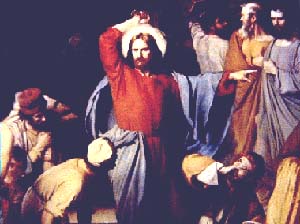


 The Gospel is from St. John 2:13-25. If we had only the Synoptic gospels (Mt., Mk., Lk.) we could easily conclude that Jesus spent almost all his public life and did all his preaching in Galilee and its neighborhood. St. John who wrote his gospel several years later corrects this false impression by mentioning visits made by our Lord to Jerusalem, He gave the "leaders of the people" in Jerusalem plenty of opportunity of hearing his message and his claims. He also worked some astounding miracles in or near the city. For instance, the man crippled for thirty-eight years (Jn. 5); the man born blind (Jn. 9), the raising of Lazarus; who had been four days buried (Jn. 11). St. John makes it very clear that the leaders (the priests and Pharisees) in Jerusalem were given every opportunity to learn who Jesus was, and every help to believe in him, but they would not. The fault was theirs, therefore, and the loss.