
Posted on 02/18/2006 4:19:22 PM PST by Salvation
Seventh Sunday in Ordinary Time
Reading I
Is 43:18-19, 21-22, 24b-25
Thus says the LORD:
Remember not the events of the past,
the things of long ago consider not;
see, I am doing something new!
Now it springs forth, do you not perceive it?
In the desert I make a way,
in the wasteland, rivers.
The people I formed for myself,
that they might announce my praise.
Yet you did not call upon me, O Jacob,
for you grew weary of me, O Israel.
You burdened me with your sins,
and wearied me with your crimes.
It is I, I, who wipe out,
for my own sake, your offenses;
your sins I remember no more.
Responsorial Psalm
Ps 41:2-3, 4-5, 13-14
R. (5b) Lord, heal my soul, for I have sinned against you.
Blessed is the one who has regard for the lowly and the poor;
in the day of misfortune the LORD will deliver him.
The LORD will keep and preserve him;
and make him blessed on earth,
and not give him over to the will of his enemies.
R. Lord, heal my soul, for I have sinned against you.
The LORD will help him on his sickbed,
he will take away all his ailment when he is ill.
Once I said, “O LORD, have pity on me;
heal me, though I have sinned against you.”
R. Lord, heal my soul, for I have sinned against you.
But because of my integrity you sustain me
and let me stand before you forever.
Blessed be the LORD, the God of Israel,
from all eternity. Amen. Amen.
R. Lord, heal my soul, for I have sinned against you.
Reading II
2 Cor 1:18-22
Brothers and sisters:
As God is faithful,
our word to you is not “yes” and “no.”
For the Son of God, Jesus Christ,
who was proclaimed to you by us, Silvanus and Timothy and me,
was not “yes” and “no, ” but “yes” has been in him.
For however many are the promises of God, their Yes is in him;
therefore, the Amen from us also goes through him to God for glory.
But the one who gives us security with you in Christ
and who anointed us is God;
he has also put his seal upon us
and given the Spirit in our hearts as a first installment.
Gospel
Mk 2:1-12
When Jesus returned to Capernaum after some days,
it became known that he was at home.
Many gathered together so that there was no longer room for them,
not even around the door,
and he preached the word to them.
They came bringing to him a paralytic carried by four men.
Unable to get near Jesus because of the crowd,
they opened up the roof above him.
After they had broken through,
they let down the mat on which the paralytic was lying.
When Jesus saw their faith, he said to the paralytic,
“Child, your sins are forgiven.”
Now some of the scribes were sitting there asking themselves,
“Why does this man speak that way? He is blaspheming.
Who but God alone can forgive sins?”
Jesus immediately knew in his mind
what they were thinking to themselves,
so he said, “Why are you thinking such things in your hearts?
Which is easier, to say to the paralytic,
‘Your sins are forgiven,’
or to say, ‘Rise, pick up your mat and walk?’
But that you may know
that the Son of Man has authority to forgive sins on earth”
—he said to the paralytic,
“I say to you, rise, pick up your mat, and go home.”
He rose, picked up his mat at once,
and went away in the sight of everyone.
They were all astounded
and glorified God, saying, “We have never seen anything like this.”
Please notify me via FReepmail if you would like to be added to or taken off the Alleluia Ping List.
From: Isaiah 43:18-19, 21-22, 24b-25
Announcement of a New Exodus (Continuation)
From: 2 Corinthians 1:18-22
Why He Has Not Visited Corinth (Continuation)

The friends of the paralyzed man in the Gospel really did give him a lift!
From: Mark 2:1-12
The Curing of a Paralytic
| Sunday, February 19, 2006 Seventh Sunday in Ordinary time |
||
|
Year B- 7th Sunday in ordinary time
Get up, pick up your mat and walk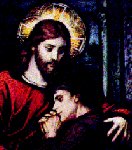 Mark 2:1-12 Mark 2:1-12 1 When he returned to Capernaum after some days, it was reported that he was at home. |
Author: Joseph of Jesus and Mary
|
|
| Lessons from the Paralytic |
|
 |
|
| 02/18/06 |
 |
 |
Sometimes we act as if sins are just black marks against us in God’s ledger, debits against our rewards account. |
Thanks, as always, for posting this. I'd forgotten that I'm the lector at the 11:00 Mass this morning -- and I'd not prepared. But, as usual, I'm able to log onto FR and check the readings for prep.
This is a lifesaver (in more ways than one).
God bless you for serving the Lord in this way.
(BTW, our church provides what we call a workbook, that has the readings, pronunciations, a little bit about how the reading should be proclaimed, and a general synopsis and commentary on the reading. I find it very helpful.)
O God, come to my aid.
O Lord, make haste to help me.
Glory be to the Father and to the Son and to the Holy Spirit,
as it was in the beginning, is now, and ever shall be,
world without end.
Amen. Alleluia.
A suitable hymn may be inserted at this point.
| Psalm 144 (145) |
|---|
| The greatness and goodness of God |
| I will praise you to the heights, O God, my king – I will bless your name for ever and for all time. I will bless you, O God, day after day – I will praise your name for ever and all time. The Lord is great, to him all praise is due – he is great beyond measuring. Generation will pass to generation the praise of your deeds, and tell the wonders you have done. They will tell of your overwhelming power, and pass on the tale of your greatness. They will cry out the story of your great kindness, they will celebrate your judgements. The Lord takes pity, his heart is merciful, he is patient and endlessly kind. The Lord is gentle to all – he shows his kindness to all his creation. Glory be to the Father and to the Son and to the Holy Spirit, as it was in the beginning, is now, and ever shall be, world without end. Amen. |
| Psalm 144 (145) |
|---|
| Let all your creatures proclaim you, O Lord, let your chosen ones bless you. Let them tell of the glory of your reign, let them speak of your power – so that the children of men may know what you can do, see the glory of your kingdom and its greatness. Your kingdom stands firm for all ages, your rule lasts for ever and ever. Glory be to the Father and to the Son and to the Holy Spirit, as it was in the beginning, is now, and ever shall be, world without end. Amen. |
| Psalm 144 (145) |
|---|
| The Lord is faithful in all his words, the Lord is holy in all his deeds. The Lord supports all who are falling, the Lord lifts up all who are oppressed. All look to you for help, and you give them their food in due season. In your goodness you open your hand, and give every creature its fill. The Lord is just in all his ways, the Lord is kind in all that he does. The Lord is near to those who call on him, to all those who call on him in truth. For those that honour him, he does what they ask, he hears all their prayers, and he keeps them safe. The Lord keeps safe all who love him, but he dooms all the wicked to destruction. My mouth shall tell the praises of the Lord. Let all flesh bless his holy name, for ever and ever. Glory be to the Father and to the Son and to the Holy Spirit, as it was in the beginning, is now, and ever shall be, world without end. Amen. |
| Reading | Ecclesiastes 1:1 - 18 © |
|---|---|
| The words of Qoheleth son of David, king in Jerusalem. Vanity of vanities, Qoheleth says. Vanity of vanities. All is vanity! For all his toil, his toil under the sun, what does man gain by it? A generation goes, a generation comes, yet the earth stands firm for ever. The sun rises, the sun sets; then to its place it speeds and there it rises. Southward goes the wind, then turns to the north; it turns and turns again; back then to its circling goes the wind. Into the sea all the rivers go, and yet the sea is never filled, and still to their goal the rivers go. All things are wearisome. No man can say that eyes have not had enough of seeing, ears their fill of hearing. What was will be again; what has been done will be done again; and there is nothing new under the sun. Take anything of which it may be said, ‘Look now, this is new’. Already, long before our time, it existed. Only no memory remains of earlier times, just as in times to come next year itself will not be remembered. I, Qoheleth, have reigned in Jerusalem over Israel. With the help of wisdom I have been at pains to study all that is done under heaven; oh, what a weary task God has given mankind to labour at! I have seen everything that is done under the sun, and what vanity it all is, what chasing of the wind! What is twisted cannot be straightened, what is not there cannot be counted. I thought to myself, ‘I have acquired a greater stock of wisdom than any of my predecessors in Jerusalem. I have great experience of wisdom and learning. Wisdom has been my careful study; stupidity, too, and folly. And now I have come to recognise that even this is chasing of the wind. Much wisdom, much grief, the more knowledge, the more sorrow. |
|
| Reading | A treatise on Charity by St Maximus the Confessor |
|---|---|
| Without love everything is in vain | |
| Charity is a right attitude of mind which prefers nothing to the knowledge of God. If a man possesses any strong attachment to the things of this earth, he cannot possess true charity. For anyone who really loves God prefers to know and experience God rather than his creatures. The whole set and longing of his mind is ever directed toward him. For God is far superior to all his creation, since everything which exists has been made by God and for him. And so, in deserting God, who is beyond compare, for the inferior works of creation, a man shows that he values God, the author of creation, less than creation itself. The Lord himself reminds us: Whoever loves me will keep my commandments. And this is my commandment: that you love one another. So the man who does not love his neighbour does not obey God’s command. But one who does not obey his command cannot love God. A man is blessed if he can love all men equally. Moreover, if he truly loves God, he must love his neighbour absolutely. Such a man cannot hoard his wealth. Rather, like God himself, he generously gives from his own resources to each man according to his needs. Since he imitates God’s generosity, the only distinction he draws is the person’s need. He does not distinguish between a good man and a bad one, a just man and one who is unjust. Yet his own goodness of will makes him prefer the man who strives after virtue to the one who is depraved. A charitable mind is not displayed simply in giving money; it is manifested still more by personal service as well as by the communication of God’s word to others: In fact, if a man’s service toward his brothers is genuine and if he really renounces worldly concerns, he is freed from selfish desires. For he now shares in God’s own knowledge and love. Since he does possess God’s love, he does not experience weariness as he follows the Lord his God. Rather, following the prophet Jeremiah, he withstands every type of reproach and hardship without even harbouring an evil thought toward any man. For Jeremiah warns us: Do not say: “We are the Lord’s temple”. Neither should you say: “Faith alone in our Lord Jesus Christ can save me”. By itself faith accomplishes nothing. For even the devils believe and shudder. No, faith must be joined to an active love of God which is expressed in good works. The charitable man is distinguished by sincere and long-suffering service to his fellow man: it also means using things aright. |
|
| Canticle | Te Deum |
|---|---|
| God, we praise you; Lord, we proclaim you! You, the Father, the eternal – all the earth venerates you. All the angels, all the heavens, every power – The cherubim, the seraphim – unceasingly, they cry: “Holy, Holy, Holy, Lord God of Hosts: heaven and earth are full of the majesty of your glory!” The glorious choir of Apostles – The noble ranks of prophets – The shining army of martyrs – all praise you. Throughout the world your holy Church proclaims you. – Father of immeasurable majesty, – True Son, only-begotten, worthy of worship, – Holy Spirit, our Advocate. You, Christ: – You are the king of glory. – You are the Father’s eternal Son. – You, to free mankind, did not disdain a Virgin’s womb. – You defeated the sharp spear of Death, and opened the kingdom of heaven to those who believe in you. – You sit at God’s right hand, in the glory of the Father. – You will come, so we believe, as our Judge. And so we ask of you: give help to your servants, whom you set free at the price of your precious blood. Number them among your chosen ones in eternal glory. Bring your people to safety, Lord, and bless those who are your inheritance. Rule them and lift them high for ever. Day by day we bless you, Lord: we praise you for ever and for ever. Of your goodness, Lord, keep us without sin for today. Have mercy on us, Lord, have mercy on us. Let your pity, Lord, be upon us, as much as we trust in you. In you, Lord, I trust: let me never be put to shame. Glory be to the Father and to the Son and to the Holy Spirit, as it was in the beginning, is now, and ever shall be, world without end. Amen. |
|
| A concluding prayer may follow here. |
|
 |
February 19, 2006    Seventh Sunday of Ordinary Time
Sunday Readings The first reading is taken from the Book of the Prophet Isaiah 43:18-19, 21-22, 24-25. The prophet is in Babylon with the exiles and is encouraging his fellow sufferers with words of hope and consolation. The second reading is from the Second Letter of St. Paul to the Corinthians 1:18-22. In today's excerpts from his letter we find the Apostle asserting under oath that he was not fickle and changeable. He and his companions taught the truth for they taught Jesus Christ who is absolute, existing truth. Paul's commission to preach the gospel to the Corinthians came from God himself; and the Spirit of God was with him in his missionary activities guaranteeing success. The Gospel is from St. Mark 2:1-12. In this incident we have the fundamental dogma of our Christian faith, namely, that Christ was the Son of God, stated by no less an authority than Christ himself. He had said to the paralytic: "your sins are forgiven"; straight away the Scribes, who knew their Old Testament, objected. This was blasphemy. They said: only God can forgive sins, for all sins are committed against God and it is only the offended person who can forgive an offense; this man is claiming to be God. This was surely blasphemy, for according to them this man was not and could not be God. Christ, in his answer, proved to them how wrong they were. First, he showed them that he knew the thoughts they had in their minds—they had not expressed their feelings openly. Secondly, he asked them which was easier to say and to say effectively: "your sins are forgiven," or "rise, take up your pallet and walk"? Both effective statements required divine power. To prove that he had that power, and to prove it in a way that was visible to them (they could not see whether the man's sins were forgiven or not) he went on: "But that you may know that the Son of man has authority on earth to forgive sins"—he said to the paralytic—"I say to you rise, take up your pallet and go home." The sick man arose immediately, took up his stretcher and walked away in the presence of that huge crowd. Whether the Scribes were among those who "were amazed and who glorified God" because of what they had witnessed, is doubtful. They were hardhearted and full of pride and therefore, found the reversing of the judgments more than difficult. But we can leave them to the mercy of God. For ourselves, we can thank our divine Lord for giving us this clear proof of his divinity. He claimed to be God, when he forgave sins; he proved that claim by an outstanding miracle. He would have worked this miracle of mercy even if the Scribes had never interfered, but he tells them that he is about to work it to prove to them that he is divine. By a single word of command, given on his own authority, the paralysis leaves the sick man and he is healed instantly—a visible proof of Christ's claim to be God. This is but one of the many proofs of his divinity which Christ gave to his disciples, and through them to us, during his public ministry. His claim to be divine was well known to his enemies, it was in fact the principal charge on which they had him crucified. "The Jews answered Pilate: we have a law and according to that law he must die because he made himself Son of God" (In. 19:7). They did not say that he was God, they could never admit that, all the evidence notwithstanding; but only that he, falsely of course, claimed to be Son of God. We who already are firm believers in the divinity of Christ our Savior have no new doctrine to learn from today's gospel. It can, however, fill us with an ever deeper gratitude to God who sent his Son as man on earth, to make us his own adopted sons and heirs to heaven. It should also make us have a greater appreciation of our own value in the sight of God. He wants us in heaven with himself and so he sent his Son among us to make us capable of going there. Christ, his Son, humbled himself so that we should be glorified. Christ bore the cross so that we might get the eternal crown. Christ died an agonizing death that we might have an unending life of happiness. Is there anything more that God could have done for us? Like the crowd that day in Capernaum, we are amazed at the love God has shown us and the fatherly interest he has in our eternal welfare. Let us imitate the same crowd by glorifying God and his divine Son, who has made us his brothers. Excerpted from The Sunday Readings by Fr. Kevin O'Sullivan, O.F.M.
|
1 And when he returned to Caper'na-um after some days, it was reported that he was at home.
2 And many were gathered together, so that there was no longer room for them, not even about the door; and he was preaching the word to them.
3 And they came, bringing to him a paralytic carried by four men.
4 And when they could not get near him because of the crowd, they removed the roof above him; and when they had made an opening, they let down the pallet on which the paralytic lay.
5 And when Jesus saw their faith, he said to the paralytic, "My son, your sins are forgiven."
6 Now some of the scribes were sitting there, questioning in their hearts,
7 "Why does this man speak thus? It is blasphemy! Who can forgive sins but God alone?"
8 And immediately Jesus, perceiving in his spirit that they thus questioned within themselves, said to them, "Why do you question thus in your hearts?
9 Which is easier, to say to the paralytic, 'Your sins are forgiven,' or to say, 'Rise, take up your pallet and walk'?
10 But that you may know that the Son of man has authority on earth to forgive sins" --he said to the paralytic--
11 "I say to you, rise, take up your pallet and go home."
12 And he rose, and immediately took up the pallet and went out before them all; so that they were all amazed and glorified God, saying, "We never saw anything like this!"
Jesus is the Son of God, who forgives our sins now.
|
Is 43:18-19, 21-22, 24b-25 / 2 Cor 1:18-22 / Mk 2:1-12 Three men came upon a fiercely raging river which they absolutely had to cross. But they were scared to death and didn't know what to do. So the first man prayed, "Lord, give me the strength and courage to cross this river." And poof, God gave him huge arms and strong legs, and he swam across that river in only two hours. The second man prayed too. "Lord, please give me the courage and ability to cross this river." Poof! God gave him a rowboat and he rowed across in only three hours. The third man was so scared that he couldn't move. So he prayed fervently, "Lord, please give me the strength and ability to cross this river." Poof! God turned him into a woman, and she walked across the bridge in two minutes! + + + At times we all get paralyzed and just can't move. Sometimes it's fear of the unknown that freezes us in place. Sometimes it's grief that plunges us into darkness so deep that we can't think. Sometimes it's the memory of past failures that makes our heart shrink and turn into itself. Sometimes it's anger or an old grievance that steals life and energy from us and leaves us dead in the water. Whatever its cause, spiritual paralysis is something everyone experiences at some time in life. And that's why Sunday's gospel has such a valuable lesson for us. The paralyzed man needed healing, in body and spirit. But he couldn't move; he couldn't get to Jesus. So his friends did for him what he couldn't do for himself: They carried him to the place where he could be healed. They made an opening in the roof and carefully lowered him into Jesus' presence! And Jesus did the rest. It's a perfect model for what we need to do for one another. When our friends hit a time of paralysis — from grief, fear, or whatever, we can pick them up and, ever so gently, carry them spiritually to a 'place' — not a physical but a spiritual place — where healing can happen and their future can be re-imagined. We can help make an opening to a new road. Finding that opening, or creating it, takes time, and the process of helping our friend move through that opening may be slow. But it's holy work, God's work, to carry our brothers and sisters when they can't walk on their own and when they can see no openings in the blank walls that surround them. Think how often God has done that for us: Carried and carried us until at last we're ready to receive his healing. There's only one way we can ever thank God for that: By carrying one another as he has carried us, helping our friends find the openings through the walls and into grace and healing, helping them see the bridge and walk across it. What we have received as a gift, let us give as a gift. |
O God, come to my aid.
O Lord, make haste to help me.
Glory be to the Father and to the Son and to the Holy Spirit,
as it was in the beginning, is now, and ever shall be,
world without end.
Amen. Alleluia.
A suitable hymn may be inserted at this point.
| Psalm 92 (93) |
|---|
| The magnificence of the Creator |
| The Lord reigns! He is robed in splendour, clothed in glory and wrapped round in might. He set the earth on its foundations: it will not be shaken. Your throne is secure from the beginning; from the beginning of time, Lord, you are. The rivers have raised, O Lord, the rivers have raised their voices. The rivers have raised their clamour. Over the voices of many waters, over the powerful swell of the sea, you are the Lord, powerful on high. All your promises are to be trusted: and holy is your habitation, O Lord, to the end of time. Glory be to the Father and to the Son and to the Holy Spirit, as it was in the beginning, is now, and ever shall be, world without end. Amen. |
| Canticle | Daniel 3 |
|---|---|
| All creatures, bless the Lord | |
| Bless the Lord, all his works, praise and exalt him for ever. Bless the Lord, you heavens; all his angels, bless the Lord. Bless the Lord, you waters above the heavens; all his powers, bless the Lord. Bless the Lord, sun and moon; all stars of the sky, bless the Lord. Bless the Lord, rain and dew; all you winds, bless the Lord. Bless the Lord, fire and heat; cold and warmth, bless the Lord. Bless the Lord, dew and frost; ice and cold, bless the Lord. Bless the Lord, ice and snow; day and night, bless the Lord. Bless the Lord, light and darkness; lightning and storm-clouds, bless the Lord. Bless the Lord, all the earth, praise and exalt him for ever. Bless the Lord, mountains and hills; all growing things, bless the Lord. Bless the Lord, seas and rivers; springs and fountains, bless the Lord. Bless the Lord, whales and fish; birds of the air, bless the Lord. Bless the Lord, wild beasts and tame; sons of men, bless the Lord. Bless the Lord, O Israel, praise and exalt him for ever. Bless the Lord, his priests; all his servants, bless the Lord. Bless the Lord, spirits of the just; all who are holy and humble, bless the Lord. Ananias, Azarias, Mishael, bless the Lord, praise and exalt him for ever. Let us bless Father, Son and Holy Spirit, praise and exalt them for ever. Bless the Lord in the firmament of heaven, praise and glorify him for ever. |
|
| Psalm 148 |
|---|
| An anthem to the Lord, the Creator |
| Praise the Lord from the heavens, praise him in the highest heavens. Praise him, all his angels; praise him, all his powers. Praise him, sun and moon, praise him, all stars that shine. Praise him, waters of the heavens, and all the waters above the heavens. Let them praise the name of the Lord, for he commanded and they were made. He set them firm for all ages, he made a decree that will last for ever. Praise the Lord from the earth, sea-serpents and depths of the sea, fire, hail, snow and fog, storms and gales that obey his word, mountains and hills, fruit-trees and cedars, wild beasts and tame, serpents and birds. Kings of the earth, all peoples, all leaders and judges of the earth, young men and women, old people with the young – praise the name of the Lord, for his name alone is exalted. His splendour is above heaven and earth, he has raised up the strength of his people. This song is for all his chosen ones, the children of Israel, the people close to him. Glory be to the Father and to the Son and to the Holy Spirit, as it was in the beginning, is now, and ever shall be, world without end. Amen. |
| A short Bible reading and responsory may follow here. |
| Canticle | Benedictus |
|---|---|
| The Messiah and his forerunner | |
| Blessed be the Lord, the God of Israel, for he has come to his people and brought about their redemption. He has raised up the sign of salvation in the house of his servant David, as he promised through the mouth of the holy ones, his prophets through the ages: to rescue us from our enemies and all who hate us, to take pity on our fathers, to remember his holy covenant and the oath he swore to Abraham our father, that he would give himself to us, that we could serve him without fear – freed from the hands of our enemies – in uprightness and holiness before him, for all of our days. And you, child, will be called the prophet of the Most High: for you will go before the face of the Lord to prepare his path, to let his people know their salvation, so that their sins may be forgiven. Through the bottomless mercy of our God, one born on high will visit us to give light to those who walk in darkness, who live in the shadow of death; to lead our feet in the path of peace. Glory be to the Father and to the Son and to the Holy Spirit, as it was in the beginning, is now, and ever shall be, world without end. Amen. |
|
| Some short prayers may follow here, to offer up the day's work to God. |
| Our Father, who art in Heaven, hallowed be thy name. Thy kingdom come, thy will be done on earth as it is in heaven. Give us this day our daily bread, and forgive us our trespasses as we forgive those that trespass against us, and lead us not into temptation, but deliver us from evil. |
| A concluding prayer may follow here. |
| May the Lord bless us and keep us from all harm; and may he lead us to eternal life. |
| A M E N |
Thanks.
It is good to be reminded of what is truth and what is not.
These are our truths.
Ah, we have the same workbook. I've used it as well, but it's been hard to find in my house. My seven-year-old daughter has began to snag it for reading in her room. She did - by the way - have her first confession this week. Only three more months until her first Communion.
Faith-sharing bump.
Disclaimer: Opinions posted on Free Republic are those of the individual posters and do not necessarily represent the opinion of Free Republic or its management. All materials posted herein are protected by copyright law and the exemption for fair use of copyrighted works.

