
Posted on 01/26/2006 7:44:41 AM PST by Salvation
Memorial of Saints Timothy and Titus, bishops
Reading I
2 Tm 1:1-8
Paul, an Apostle of Christ Jesus by the will of God
for the promise of life in Christ Jesus,
to Timothy, my dear child:
grace, mercy, and peace from God the Father
and Christ Jesus our Lord.
I am grateful to God,
whom I worship with a clear conscience as my ancestors did,
as I remember you constantly in my prayers, night and day.
I yearn to see you again, recalling your tears,
so that I may be filled with joy,
as I recall your sincere faith
that first lived in your grandmother Lois
and in your mother Eunice
and that I am confident lives also in you.
For this reason, I remind you to stir into flame
the gift of God that you have through the imposition of my hands.
For God did not give us a spirit of cowardice
but rather of power and love and self-control.
So do not be ashamed of your testimony to our Lord,
nor of me, a prisoner for his sake;
but bear your share of hardship for the Gospel
with the strength that comes from God.
or
Ti 1:1-5
Paul, a slave of God and Apostle of Jesus Christ
for the sake of the faith of God’s chosen ones
and the recognition of religious truth,
in the hope of eternal life
that God, who does not lie, promised before time began,
who indeed at the proper time revealed his word
in the proclamation with which I was entrusted
by the command of God our savior,
to Titus, my true child in our common faith:
grace and peace from God the Father and Christ Jesus our savior.
For this reason I left you in Crete
so that you might set right what remains to be done
and appoint presbyters in every town, as I directed you.
Responsorial Psalm
Ps 96:1-2a, 2b-3, 7-8a, 10
R. (3) Proclaim God’s marvelous deeds to all the nations.
Sing to the LORD a new song;
sing to the LORD, all you lands.
Sing to the LORD; bless his name.
R. Proclaim God’s marvelous deeds to all the nations.
Announce his salvation, day after day.
Tell his glory among the nations;
among all peoples, his wondrous deeds.
R. Proclaim God’s marvelous deeds to all the nations.
Give to the LORD, you families of nations,
give to the LORD glory and praise;
give to the LORD the glory due his name!
R. Proclaim God’s marvelous deeds to all the nations.
Say among the nations: The LORD is king.
He has made the world firm, not to be moved;
he governs the peoples with equity.
R. Proclaim God’s marvelous deeds to all the nations.
Gospel
Mk 4:21-25
Jesus said to his disciples,
“Is a lamp brought in to be placed under a bushel basket
or under a bed,
and not to be placed on a lampstand?
For there is nothing hidden except to be made visible;
nothing is secret except to come to light.
Anyone who has ears to hear ought to hear.”
He also told them, “Take care what you hear.
The measure with which you measure will be measured out to you,
and still more will be given to you.
To the one who has, more will be given;
from the one who has not, even what he has will be taken away.”
Please notify me via FReepmail if you would like to be added to or taken off the Alleluia Ping List.
From: 2 Timothy 1:1-8
Greeting
From: Mark 4:21-25
Parables of the Lamp and the Measure
| Thursday, January 26, 2006 Saints Timothy and Titus, Bishops (Memorial) |
||
|

|
January 26, 2005
 Sts. Timothy and Titus
Timothy (d. 97?): What we know from the New Testament of Timothy’s life makes it sound like that of a modern harried bishop. He had the honor of being a fellow apostle with Paul, both sharing the privilege of preaching the gospel and suffering for it. Timothy had a Greek father and a Jewish mother named Eunice. Being the product of a “mixed” marriage, he was considered illegitimate by the Jews. It was his grandmother, Lois, who first became Christian. Timothy was a convert of Paul around the year 47 and later joined him in his apostolic work. He was with Paul at the founding of the Church in Corinth. During the 15 years he worked with Paul, he became one of his most faithful and trusted friends. He was sent on difficult missions by Paul—often in the face of great disturbance in local Churches which Paul had founded. Timothy was with Paul in Rome during the latter’s house arrest. At some period Timothy himself was in prison (Hebrews 13:23). Paul installed him as his representative at the Church of Ephesus. Timothy was comparatively young for the work he was doing. (“Let no one have contempt for your youth,” Paul writes in 1 Timothy 4:12a.) Several references seem to indicate that he was timid. And one of Paul’s most frequently quoted lines was addressed to him: “Stop drinking only water, but have a little wine for the sake of your stomach and your frequent illnesses” (1 Timothy 5:23). When Paul was having trouble with the community at Corinth, Titus was the bearer of Paul’s severe letter and was successful in smoothing things out. Paul writes he was strengthened not only by the arrival of Titus but also “by the encouragement with which he was encouraged in regard to you, as he told us of your yearning, your lament, your zeal for me, so that I rejoiced even more.... And his heart goes out to you all the more, as he remembers the obedience of all of you, when you received him with fear and trembling” (2 Corinthians 7:7a, 15). The Letter to Titus addresses him as the administrator of the Christian community on the island of Crete, charged with organizing it, correcting abuses and appointing presbyter-bishops. Quote:
|
||||
Activities:
|
 |
January 26, 2006    Memorial of Sts. Timothy and Titus, bishops Old Calendar: St. Polycarp, bishop and martyr
St. Titus, a convert from paganism, was a fellow laborer of St. Paul on many apostolic missions. St. Paul later made him bishop of Crete, a difficult charge because of the character of the inhabitants and the spread of erroneous doctrines on that island. St. Paul's writings tell us that St. Titus rejoiced to discover what was good in others and drew the hearts of men by his wide and affectionate sympathy. Previously St. Titus' feast was celebrated on February 23. This date was formerly the feast of St. Polycarp, now moved to February 23.
St. Timothy  Timothy was Paul's dearest disciple, his most steadfast associate. He was converted during the apostle's first missionary journey. When Paul revisited Lystra, Timothy, though still very young (about twenty) joined him as a co-worker and companion. Thereafter, there existed between them a most intimate bond, as between father and son. St. Paul calls him his beloved child, devoted to him "like a son to his father" (Phil. 2:22). Of a kindly disposition, unselfish, prudent, zealous, he was a great consolation to Paul, particularly in the sufferings of his later years. He also assisted the apostle in the establishment of all the major Christian communities and was entrusted with missions of highest importance. Timothy was with Paul during his first Roman imprisonment. Paul made his self-sacrificing companion bishop of Ephesus, but the finest monument left him by his master are the two canonical Epistles bearing his name. Timothy was Paul's dearest disciple, his most steadfast associate. He was converted during the apostle's first missionary journey. When Paul revisited Lystra, Timothy, though still very young (about twenty) joined him as a co-worker and companion. Thereafter, there existed between them a most intimate bond, as between father and son. St. Paul calls him his beloved child, devoted to him "like a son to his father" (Phil. 2:22). Of a kindly disposition, unselfish, prudent, zealous, he was a great consolation to Paul, particularly in the sufferings of his later years. He also assisted the apostle in the establishment of all the major Christian communities and was entrusted with missions of highest importance. Timothy was with Paul during his first Roman imprisonment. Paul made his self-sacrificing companion bishop of Ephesus, but the finest monument left him by his master are the two canonical Epistles bearing his name. Excerpted from The Church's Year of Grace, Pius Parsch. Patron: Intestinal disorders; stomach diseases. Symbols: Club and stones; broken image of Diana. Things to Do:
St. Titus  St. Titus, a pagan by birth, became one of St. Paul's most illustrious disciples. He accompanied the apostle on several of his missionary journeys and was entrusted with important missions. Finally he came with St. Paul to the island of Crete, where he was appointed bishop. He performed this duty in accordance with the admonition given him, ". . . in all things show yourself an example of good works" (Tit. 2:7). St. Titus, a pagan by birth, became one of St. Paul's most illustrious disciples. He accompanied the apostle on several of his missionary journeys and was entrusted with important missions. Finally he came with St. Paul to the island of Crete, where he was appointed bishop. He performed this duty in accordance with the admonition given him, ". . . in all things show yourself an example of good works" (Tit. 2:7). Tradition tells us that he died a natural death at the age of 94, having lived in the state of virginity during his whole life. St. Paul left a worthy monument to Titus, his faithful disciple, in the beautiful pastoral letter which forms part of the New Testament. Today's feast in his honor was introduced in 1854. Excerpted from The Church's Year of Grace, Pius Parsch. Patron: Crete. Symbols: Broken images; ruined temple of Jupiter. Things to Do:
|
|
2 Tm 1:1-8 / Mk 4:21-25 The ending of today’s gospel sounds like a cynical commentary on modern society. “To those who have, more will be given; from those who have not, what little they have will be taken away.” It seems to say that the rich will get richer and the poor will get poorer. But that’s not at all what this text is about. So what is it that people have and then either get more of or lose all of? Jesus isn’t talking about money or wealth in any form. He’s talking about the extent and depth of our connectedness to God. If we are already deeply rooted in God, our spirits will grow larger, richer, and fuller by the day. But if our connection to the Lord is only superficial, it certainly won’t grow, and it probably won’t last at all. So here’s our question for the day: Does your God-connection have growing power? Is it changing your life day by day? Or is it anemic and able to do little more than stumble through a memorized prayer? If it’s the former, you’ve got an enviable future ahead of you for sure. If your God-connection is the latter, be prepared for a future you’d never choose. That’s the equation, and there are no exceptions. Why not be rich through and through! |
O God, come to my aid.
O Lord, make haste to help me.
Glory be to the Father and to the Son and to the Holy Spirit,
as it was in the beginning, is now, and ever shall be,
world without end.
Amen. Alleluia.
A suitable hymn may be inserted at this point.
| Psalm 86 (87) |
|---|
| Jerusalem, mother of all nations |
| Its foundations are set on the sacred mountains – the Lord loves the gates of Sion more than all the tents of Jacob. Glorious things are said of you, city of God! I shall count Rahab and Babylon among those who acknowledge me. The Philistines, Tyrians, Ethiopians – all have their birthplace here. Of Sion it will be said “Here is the birthplace of all people: the Most High himself has set it firm”. The Lord shall write in the book of the nations: “Here is their birthplace”. They will sing as in joyful processions: “All my being springs from you”. Glory be to the Father and to the Son and to the Holy Spirit, as it was in the beginning, is now, and ever shall be, world without end. Amen. |
| Canticle | Isaiah 40 |
|---|---|
| The good shepherd is God, the Most High | |
| Behold, the Lord God comes in strength, and his right arm triumphs. Behold, his reward is with him, his prize is before him. Like a shepherd he feeds his flock, he gathers the lambs in his arms and lifts them to his breast; he carries the pregnant ewes. Who has measured the waters in the hollow of his hand and arranged the heavens with his palms? Who has measured the dust of the earth, weighed out the mountains, weighed the hills on the balance? Who directed the spirit of the Lord? Who gave him advice in his task? With whom did he consult? Who taught him? Who led him in the paths of justice, gave him knowledge, showed him the way of understanding? Behold, the Gentiles are like a drop in a bucket, a piece of fluff on the scales. All the islands are a handful of dust. What burnt-offering could be worthy of the Lord? The forests of Lebanon could not feed that fire; all the animals of Lebanon would not be enough for that sacrifice. All the nations count for nothing before him: for him, they are nothingness and emptiness. Glory be to the Father and to the Son and to the Holy Spirit, as it was in the beginning, is now, and ever shall be, world without end. Amen. |
|
| Psalm 98 (99) |
|---|
| The Lord our God is holy |
| The Lord reigns! let the peoples tremble. He is enthroned on the cherubim: let the earth shake. The Lord is great in Sion, he is high above all the peoples. Let them proclaim his name – great and terrible it is, let them proclaim his holy name, the powerful king, who loves justice. The laws you establish are just: you have given Jacob uprightness and right judgement. Praise the Lord, our God, worship at his footstool, for he is holy. Moses and Aaron were among his prophets, Samuel one of those who called on him. They called on the Lord and he listened, and from the pillar of cloud he spoke to them. They kept his decrees and the commands he gave them. Lord our God, you listened to them; O God, you were gracious to them, but you punished their wrongdoing. Praise the Lord, our God, worship on his holy mountain, for the Lord our God is holy. Glory be to the Father and to the Son and to the Holy Spirit, as it was in the beginning, is now, and ever shall be, world without end. Amen. |
| A short Bible reading and responsory may follow here. |
| Canticle | Benedictus |
|---|---|
| The Messiah and his forerunner | |
| Blessed be the Lord, the God of Israel, for he has come to his people and brought about their redemption. He has raised up the sign of salvation in the house of his servant David, as he promised through the mouth of the holy ones, his prophets through the ages: to rescue us from our enemies and all who hate us, to take pity on our fathers, to remember his holy covenant and the oath he swore to Abraham our father, that he would give himself to us, that we could serve him without fear – freed from the hands of our enemies – in uprightness and holiness before him, for all of our days. And you, child, will be called the prophet of the Most High: for you will go before the face of the Lord to prepare his path, to let his people know their salvation, so that their sins may be forgiven. Through the bottomless mercy of our God, one born on high will visit us to give light to those who walk in darkness, who live in the shadow of death; to lead our feet in the path of peace. Glory be to the Father and to the Son and to the Holy Spirit, as it was in the beginning, is now, and ever shall be, world without end. Amen. |
|
| Some short prayers may follow here, to offer up the day's work to God. |
| Our Father, who art in Heaven, hallowed be thy name. Thy kingdom come, thy will be done on earth as it is in heaven. Give us this day our daily bread, and forgive us our trespasses as we forgive those that trespass against us, and lead us not into temptation, but deliver us from evil. |
| A concluding prayer may follow here. |
| May the Lord bless us and keep us from all harm; and may he lead us to eternal life. |
| A M E N |

Thursday January 26, 2006 Third Week in Ordinary Time
Reading (2 Timothy 1:1-8) Gospel (St. Mark 4:21-25)
In the Gospel reading today, we hear a reading that tends to trouble a lot of people, that is, Our Lord telling us that to those who have more, more will be given, and from those who have not, what little they think they have will be taken away. We ask ourselves: How is it, if God is just and merciful, kind and gracious, that He would take away the little bit somebody has? And why is it that He would give more to those who already have plenty? The point is not quite what it would appear on the surface.
We have to look at this in two ways. First of all, given the society in which we live, we live in a society that has gone completely astray. In this world, those who have chosen to reject Our Lord are spiraling downward at an accelerated pace. It is amazing, with all the different things a person can get themselves into these days, how quickly people who at one time seemed to have at least a little bit of faith throw themselves headlong into every possible sin they can get themselves into. At the same time, those who choose to try to live good and upright lives, those who try to have a spiritual life, are growing by leaps and bounds. There has never been a time when the distinction between a sinner and a saint is more clear, because there has never been a time when it has been easier to become a saint. Neither has there been a time when it is easier to throw yourself headlong into sin. We have a choice we have to make. If we want to grow in holiness, more will be given. If we want to throw ourselves into sin, the little bit of holiness we think we have will be quickly lost.
We see exactly that in what Saint Paul is talking about. He says to Timothy today: I remind you to stir into flame the gift that God gave you. In other words, the gift is already there, but it is given in seminal form. In this case, it is a spark, and Timothy has to fan it into flame. He reminds Timothy that God did not give us a spirit of cowardice, but rather a spirit of power, a spirit of self-control. Then he goes on to talk about how we do have to bear our share of the hardship which the Gospel entails, but with the strength that comes from God. So if we are going to grow in holiness, we know we are going to have to suffer, but the grace comes from God to be able to do it.
If we look, then, at the ultimate question about what Our Lord is speaking of, we say, “For those who will go to heaven, they will receive all, because they will receive God. And for those who choose instead to go to hell, they will lose everything that they thought they had; they will have nothing.” Those who have will indeed receive more until they have received all, because of God. But those who refuse to serve God will lose even the little bit they have, and they will have nothing for eternity. It is not God Who is taking these things away – it is the person himself who has chosen it.
We need to understand that those choices are made in this life. We know that every single person who dies in the state of grace will go to heaven. We may have to stop off at Purgatory for a while, but we will go to heaven if we die in the state of grace. Every single person who dies in the state of mortal sin will go to hell. They cannot go to heaven because they have chosen against God. Once again, grace is the life of God. To those who have, more will be given until they have the fullness of God. Those who have not will lose even the little they think they have.
Our Lord tells us that we have to be very cautious about how we hear, because He says, The measure with which you measure will be measured back to you, and then reminds us of that statement again: To those who have, more will be given; and from those who have not, what little they think they have will be taken from them. That is true both in this life, as well as in eternity. In this life, we can repent, we can turn our lives around, and we can choose to become saints. Once we die, there is no more choice to make; it is too late at that point to change our minds. We have the opportunity right now to be able to grow in holiness in great abundance through the grace of God, and ultimately with our focus set on heaven, what we desire in this life we will receive in its fullness in the next, so that indeed we can be counted among those who have and will receive more until all is ours.
* This text was transcribed from the audio recording with minimal editing.
I've always loved the mention of those two godly women. We never know how much our influence and example will affect the younger generations.
Faith-sharing ping.
**I've always loved the mention of those two godly women. We never know how much our influence and example will affect the younger generations.**
Amen to that!
O God, come to my aid.
O Lord, make haste to help me.
Glory be to the Father and to the Son and to the Holy Spirit,
as it was in the beginning, is now, and ever shall be,
world without end.
Amen. Alleluia.
A suitable hymn may be inserted at this point.
| Psalm 131 (132) |
|---|
| God's promise to the house of David |
| Lord, remember David and how he served you. He swore to the Lord, vowed a vow to the Mighty One of Jacob: “I will not go into my tent, my home, nor go up to my bed of rest; I will not let my eyes sleep or my eyelids grow heavy until I have found a place for the Lord, a dwelling-place for the Mighty One of Jacob”. We heard that it was in Ephratha, we found it in the plains of Jaar. So let us go into his dwelling-place and let us worship before his footstool. Rise up, Lord, and come to your place of rest. Come with the Ark of your power. Let your priests be robed in your justice, and let your chosen ones rejoice. Remember what David did for you, and do not turn your face from your Anointed. Glory be to the Father and to the Son and to the Holy Spirit, as it was in the beginning, is now, and ever shall be, world without end. Amen. |
| Psalm 131 (132) |
|---|
| The Lord swore David a true oath, he will not go back on his word: “The fruit of your body I will place on your throne. If your children keep my covenant and the commands I teach them, their children’s children will occupy your throne for ever”. For the Lord has chosen Sion, taken it for his dwelling-place: “Here will I take my rest for all time: here will I live, such is my desire. I will bless its crops with my blessing, I will fill its poor with bread. I will clothe its priests with righteousness. Its chosen ones will exult with joy. There will I plant the sign of David, and prepare a lamp for my anointed one. I will wrap his enemies in confusion, but over his head my crown will shine. Glory be to the Father and to the Son and to the Holy Spirit, as it was in the beginning, is now, and ever shall be, world without end. Amen. |
| Canticle | Apocalypse 11 |
|---|---|
| The Judgement | |
| We thank you, Lord God Almighty, who are and who were, that you have taken up your great power and begun to reign. The nations were angered, but your anger came, the time for the dead to be judged, the time to reward the prophets and saints, your servants, and those who feared your name, both great and small. Now have come the salvation and might and kingdom of our God, and the power of his Anointed, for the accuser of our brethren has been brought down, who accused them day and night in the sight of God. But they vanquished him through the blood of the Lamb and through their own witness. They did not cling to life, even in the face of death. Therefore rejoice, heavens, and you who dwell in them. Glory be to the Father and to the Son and to the Holy Spirit, as it was in the beginning, is now, and ever shall be, world without end. Amen. |
|
| A short Bible reading and responsory may follow here. |
| Canticle | Magnificat |
|---|---|
| My soul rejoices in the Lord | |
| My soul proclaims the greatness of the Lord, and my spirit rejoices in God, my salvation. For he has shown me such favour – me, his lowly handmaiden. Now all generations will call me blessed, because the mighty one has done great things for me. His name is holy, his mercy lasts for generation after generation for those who revere him. He has put forth his strength: he has scattered the proud and conceited, torn princes from their thrones; but lifted up the lowly. He has filled the hungry with good things; the rich he has sent away empty. He has come to the help of his servant Israel, he has remembered his mercy as he promised to our fathers, to Abraham and his children for ever. Glory be to the Father and to the Son and to the Holy Spirit, as it was in the beginning, is now, and ever shall be, world without end. Amen. |
|
| Some short prayers may follow here, to offer up the day's work to God. |
| Our Father, who art in Heaven, hallowed be thy name. Thy kingdom come, thy will be done on earth as it is in heaven. Give us this day our daily bread, and forgive us our trespasses as we forgive those that trespass against us, and lead us not into temptation, but deliver us from evil. |
| A concluding prayer may follow here. |
| May the Lord bless us and keep us from all harm; and may he lead us to eternal life. |
| A M E N |
Thank you for these posts.
God promised David that his descendants will sit on the throne of Israel in perpetuity. This is of course a Messianic reference to the kingship of Jesus Christ, descendant of David and our King of Kings, whose reign shall never end. Amen!
Bump for evening prayers. Here's wishing all FReepers reading this thread a restful night's sleep.
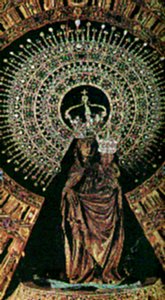 Our Lady of the Pillar - Saragossa, Spain (ca. 40 AD) After the crucifixion , resurrection and ascension of Jesus, his Apostles began to spread the message he left throughout Israel and shortly thereafter, through the Roman empire. One of these Apostles, James (the Greater), reportedly travelled as far west as Spain to the village of Saragossa in north east Spain. While James was there, he became disheartened because of the failure of his mission. Tradition holds that while he was deep in prayer Jesus' Blessed Mother appeared to him and gave him a small wooden statue of herself and a column of jasper wood and instructed him to build a church in her honor: "This place is to be my house, and this image and column shall be the title and altar of the temple that you shall build." The jasper column and the wooden statue can still be seen on special occasions at a church that houses them. About a year after the apparition James arranged to build a small chapel in Mary's honor, the first Church ever dedicated to the honor of the Virgin Mary. After James returned to Jerusalem, he was executed by Herod Agrippa in about 44 AD, the first apostle to be martyred for his faith. Several of his disciples took his body and returned it for final burial in Spain. The local queen, observing several of the miracles performed by James' disciples, converted to Christianity and permitted James' body to be buried in a local field. Eight centuries later, a cathedral in honor of St. James was erected after his gravesite was rediscovered by a local hermit. The hermit found the burial site after noticing an unusual star formation. The site for the cathedral was called Compostella (starry field) and it is a major pilgrimage site to this day.
Thank you for that information about St. James and his dedication to the Blessed Virgin Mary.
Disclaimer: Opinions posted on Free Republic are those of the individual posters and do not necessarily represent the opinion of Free Republic or its management. All materials posted herein are protected by copyright law and the exemption for fair use of copyrighted works.


