
Viva Cristo Rey!
Posted on 11/23/2005 7:51:38 AM PST by Salvation
Please notify me via FReepmail if you would like to be added to or taken off the Alleluia Ping List.
Thank you for the photo!
From: Luke 21:12-19
Discourse on the Destruction of Jerusalem
and the End of the World (Continuation)
| Wednesday, November 23, 2005 Blessed Miguel Agustin Pro, Priest, Martyr (Optional Memorial) |
||
|
Recipes:
Activities:
more
|
 |
November 23, 2005    Optional Memorials of St. Clement I, pope & martyr; St. Columban, abbot; Bl. Miguel Pro, priest and martyr Old Calendar: St. Clement I; St. Felicitas, martyr
The most famous of Irish monks, St. Columban was born around 525-530. Well educated and desiring to be a "pilgrim of God," Columban traveled to France and founded several well-disciplined monasteries as centers of religion and culture. Because of difficulties he decided to return to Ireland. A shipwreck directed him towards Rome and to the founding of his final monastery, at Bobbio in Italy. The aged Abbot died on this date in 615. His feast was moved from November 21. It is celebrated on November 24 by Benedictines and Ireland. Fr. Miguel Pro was born in Guadalupe, Mexico, in 1891. The Mexican government began a major persecution of the Church in 1911. Fr. Pro completed his studies in Belgium and was ordained a Jesuit in 1926. He returned to Mexico and performed his ministry heroically until November 23, 1927. He was caught and condemned for being a Catholic priest. Fr. Miguel Pro ended his life facing the firing squad with his arms outstretched until he became a living cross. He called out the words, Viva Cristo Rey! as his body was wracked with a hale of bullets. He was proclaimed "blessed" by Pope John Paul II on September 25, 1988. Before the reform of the Roman Calendar in 1969, this was the commemoration of St. Felicitas, a Roman martyr of uncertain date. She was buried in the cemetery of Maximus. Her name occurs in the calendar of the Roman Church in the fifth century.
St. Clement  St. Clement I of Rome (92-101) was one of the first popes; according to St. Ireneus, he was the third after Peter. Clement most probably died as a martyr. Otherwise little is known of his life. It is not certain whether he is the one Paul mentions as his companion in Phil. 4:3. St. Clement's letter to the Corinthians is authentic; in it he authoritatively intervenes in that strife-torn community, a memorable act in the early history of the papacy. St. Clement I of Rome (92-101) was one of the first popes; according to St. Ireneus, he was the third after Peter. Clement most probably died as a martyr. Otherwise little is known of his life. It is not certain whether he is the one Paul mentions as his companion in Phil. 4:3. St. Clement's letter to the Corinthians is authentic; in it he authoritatively intervenes in that strife-torn community, a memorable act in the early history of the papacy. The breviary gives these legendary details. Because of his zeal for souls, Pope Clement was banished to distant Chersonese; there he found two-thousand Christians who had received a similar sentence. When he came to these exiles he comforted them. "They all cried with one voice: Pray for us, blessed Clement, that we may become worthy of the promises of Christ. He replied: Without any merit of my own, the Lord sent me to you to share in your crowns." When they complained because they had to carry the water six miles, he encouraged them, "Let us all pray to the Lord Jesus Christ that He may open to His witnesses a fountain of water." "While blessed Clement was praying, the Lamb of God appeared to him; and at His feet a bubbling fountain of fresh water was flowing." Seeing the miracle, "All the pagans of the neighborhood began to believe." When Trajan heard of these marvels, he ordered Clement to be drowned with an iron anchor about his neck. "While he was making his way to the sea, the people cried with a loud voice: Lord Jesus Christ, save him! But Clement prayed in tears: Father, receive my spirit." At the shore the Christians asked God to give them the body. The sea receded for three miles and there they found the body of the saint in a stone coffin within a small marble chapel; alongside lay the anchor. "You have given a dwelling to Your martyr Clement in the sea, O Lord, a temple of marble built by the hands of angels." The body was taken to Rome under Nicholas 1 (858-867) by Sts. Cyril and Methodius and placed in a church dedicated to his honor (S. Clemente). This is one of the most venerable of the churches in Rome because it retains all the liturgical arrangements of ancient times. Excerpted from The Church's Year of Grace, Pius Parsch. Patron: Boatmen; marble workers; mariners; sailors; sick children; stonecutters; watermen. Symbols: Double or triple cross; tiara; fountain; anchor; maniple; marble temple in the sea; cross and anchor; nimbed lamb.
St. Columban, Abbot  St. Columban was born in West Leinster, Ireland, sometime between 540 and 550, and decided when he was a youth, to dedicate himself to God despite his mother's opposition. He lived for a time on Cluain Iris, an island in Lough Erne, with a monk named Sinell, and then became a monk at Bangor. With twelve other monks he was sent as a missionary to Gaul about 585. He built his first monastery at Annegray about 590, and it was so successful that he followed with two more, at Luxeuil and Fontes (Fontaines). Soon his followers spread all over Europe, building monasteries in France, Germany, Switzerland, and Italy. He aroused much opposition, especially from the Frankish bishops, by the Celtic usages he installed in his monasteries and for refusing to acknowledge bishops' jurisdiction over them. He defended his practices in letters to the Holy See and refused to attend a Gallican synod at Chalons in 603 when summoned to explain his Celtic usages. In 610 King Theodoric II of Burgundy, angered by Columban's denunciation of his refusal to marriage and his practice of keeping concubines, ordered all Irish monks banished from his realm. Columban was shipwrecked on the way to Ireland but was offered refuge by King Theodebert II of Neustria at Metz and began to evangelize the Alemanni in the area around Bregenz on Lake Constance. Though successful, he was again banished in 612, when Burgundy warred against and conquered Neustria; Theodoric now ruled over the area in which Columban was working. Columban decided to flee his old adversary and crossed the Alps to Italy, where he was welcomed to Milan by Arian King Agilulf of the Lombards. Columban founded a monastery at Bobbio, between Milan and Genoa, which became one of the great monasteries of its time—a center of culture, learning, and spirituality. He died there on November 23. Columban wrote his Monastic Rule, sermons, poetry, and treatises against Arianism. St. Columban was born in West Leinster, Ireland, sometime between 540 and 550, and decided when he was a youth, to dedicate himself to God despite his mother's opposition. He lived for a time on Cluain Iris, an island in Lough Erne, with a monk named Sinell, and then became a monk at Bangor. With twelve other monks he was sent as a missionary to Gaul about 585. He built his first monastery at Annegray about 590, and it was so successful that he followed with two more, at Luxeuil and Fontes (Fontaines). Soon his followers spread all over Europe, building monasteries in France, Germany, Switzerland, and Italy. He aroused much opposition, especially from the Frankish bishops, by the Celtic usages he installed in his monasteries and for refusing to acknowledge bishops' jurisdiction over them. He defended his practices in letters to the Holy See and refused to attend a Gallican synod at Chalons in 603 when summoned to explain his Celtic usages. In 610 King Theodoric II of Burgundy, angered by Columban's denunciation of his refusal to marriage and his practice of keeping concubines, ordered all Irish monks banished from his realm. Columban was shipwrecked on the way to Ireland but was offered refuge by King Theodebert II of Neustria at Metz and began to evangelize the Alemanni in the area around Bregenz on Lake Constance. Though successful, he was again banished in 612, when Burgundy warred against and conquered Neustria; Theodoric now ruled over the area in which Columban was working. Columban decided to flee his old adversary and crossed the Alps to Italy, where he was welcomed to Milan by Arian King Agilulf of the Lombards. Columban founded a monastery at Bobbio, between Milan and Genoa, which became one of the great monasteries of its time—a center of culture, learning, and spirituality. He died there on November 23. Columban wrote his Monastic Rule, sermons, poetry, and treatises against Arianism. Excerpted from Dictionary of Saints, John J. Delaney Patron: Against floods; motorcyclists. Symbols: Bear's den; wolves; foliated crucifix; fountain; sunbeam. Things to Do:
Blessed Miguel Agustin Pro  Miguel Pro was born January 13, 1891, at Guadalupe Zacatecas, Mexico. From his childhood, high spirits and happiness were the most outstanding characteristics of his personality. The loving and devoted son of a mining engineer and a pious and charitable mother, Miguel had a special affinity for the working classes which he retained all his life. Miguel Pro was born January 13, 1891, at Guadalupe Zacatecas, Mexico. From his childhood, high spirits and happiness were the most outstanding characteristics of his personality. The loving and devoted son of a mining engineer and a pious and charitable mother, Miguel had a special affinity for the working classes which he retained all his life. At 20, he became a Jesuit novice and shortly thereafter was exiled because of the Mexican revolution. He traveled to the United States, Spain, Nicaragua and Belgium, where he was ordained in 1925. Father Pro suffered greatly from a severe stomach problem and when, after several operations his health did not improve, in 1926 his superiors allowed him to return to Mexico in spite of the religious persecution in the country. The churches were closed and priests were in hiding. Father Pro spent the rest of his life in a secret ministry to the sturdy Mexican Catholics. In addition to fulfilling their spiritual needs, he also carried out the works of mercy by assisting the poor of Mexico City with their temporal needs. He adopted many disguises to carry out his secret ministry. In all that he did, he remained filled with the joy of serving Christ, his King, and obedient to his superiors. Falsely accused in a bombing attempt on the President-elect, Pro became a wanted man. He was betrayed to the police and sentenced to death without the benefit of any legal process. On the day of his death, Father Pro forgave his executioners, prayed, bravely refused the blindfold, and died proclaiming "Long Live Christ the King!"
St. Felicitas (or Felicity of Rome)  On July 10 we had the feast of the Seven Martyred Brothers; today their saintly mother receives special honor. Her body, together with that of her youngest son Silvanus, rests in the cemetery of Maximus; later her remains were transferred to the church of St. Susanna, where they still are honored. She was beheaded in 165 A.D. On July 10 we had the feast of the Seven Martyred Brothers; today their saintly mother receives special honor. Her body, together with that of her youngest son Silvanus, rests in the cemetery of Maximus; later her remains were transferred to the church of St. Susanna, where they still are honored. She was beheaded in 165 A.D. "That blessed woman Felicity, whose Birth-feast we are keeping today, had as much dread of leaving her seven sons living after her in the flesh, as have carnal minded mothers of seeing them go dead before them. When she was taken in the strong pains of persecution, she braced up the hearts of her children by bidding them cleave to the Fatherland above, and became their mother for the spiritual, as she had aforetime been for the fleshly life, bringing them forth for God by her exhortation, as she had brought them forth for the world by her body. And shall I not call this woman a Martyr? Nay, more than Martyr. The seven whom she trusted to God were seven children sent before her to death. She suffered first and triumphed last." Excerpted from a Sermon by St. Gregory the Pope Patron: Death of children; martyrs; sterility; to have male children; widows. Symbols: Seven swords; cauldron of oil and sword; sword with seven heads; eight palms. |
|
Daniel 5:1-6, 13-14, 16-17, 23-28 / Lk 21:12-19 Today's reading from the Old Testament prophet Daniel draws us into the center of a terrifying event. In the course of an extravagant royal celebration hosted by the King of Babylon, a disembodied human hand writes a mysterious message on the wall. Daniel is called to interpret it, and once again he tells the whole truth to the king: You have ignored God 'in whose hand is your life breath and the whole course of your life,' and therefore your days and the days of your kingdom are numbered. It would be too facile to chalk this up as a proper punishment rightly imposed by a righteous God upon a corrupt and unworthy servant. To do that would be to miss the fact that the punishment, as always, came from inside the king. That's where his sin was, ignoring God, giving no thanks, never seeing himself in the perspective of eternity, never seeing his own deep need for something more than himself and his armies and his possessions, and never seeing his need for God's wisdom if he were ever to make a life and be a true leader. Laid end to end like that, the king's life sounds rather like a death wish. Indeed it was, and the king murdered his own future. His sin was inside and so were its consequences: a shrunken soul, a foolish heart, an empty spirit which knew nothing of God. That's an ending we surely don't want for ourselves. So remember where your life is coming from, moment to moment, and with God's help build a heart and a life that have a future and no ending. |
Thank you! I hope you just cut and paste those commentaries and that you don't have to type them.
God bless you and have a great and peaceful Thanksgiving.
Clement's letter to the Corinthians:
http://www.newadvent.org/fathers/1010.htm
It was definitely a strong contender to make the canon of the NT.
When I first read it, two things struck me.
First, he's teaching and persuading the Corinthians to do the right thing. He's not imposing his authority on anyone; they got the ball rolling by consulting him, he's just telling them the facts.
Second, some of the phrasing sounded extremely familiar. Like it could have been in an encyclical written last year.
Faith-sharing bump.
Here's wishing a Happy Thanksgiving to all FReepers reading this thread.
| Lk 21:12-19 | ||
|---|---|---|
| # | Douay-Rheims | Vulgate |
| 12 | But before all these things, they will lay their hands upon you, and persecute you, delivering you up to the synagogues and into prisons, dragging you before kings and governors, for my name's sake. | sed ante haec omnia inicient vobis manus suas et persequentur tradentes in synagogas et custodias trahentes ad reges et praesides propter nomen meum |
| 13 | And it shall happen unto you for a testimony. | continget autem vobis in testimonium |
| 14 | Lay it up therefore into your hearts, not to meditate before how you shall answer: | ponite ergo in cordibus vestris non praemeditari quemadmodum respondeatis |
| 15 | For I will give you a mouth and wisdom, which all your adversaries shall not be able to resist and gainsay. | ego enim dabo vobis os et sapientiam cui non poterunt resistere et contradicere omnes adversarii vestri |
| 16 | And you shall be betrayed by your parents and brethren, and kinsmen and friends; and some of you they will put to death. | trademini autem a parentibus et fratribus et cognatis et amicis et morte adficient ex vobis |
| 17 | And you shall be hated by all men for my name's sake. | et eritis odio omnibus propter nomen meum |
| 18 | But a hair of your head shall not perish. | et capillus de capite vestro non peribit |
| 19 | In your patience you shall possess your souls. | in patientia vestra possidebitis animas vestras |
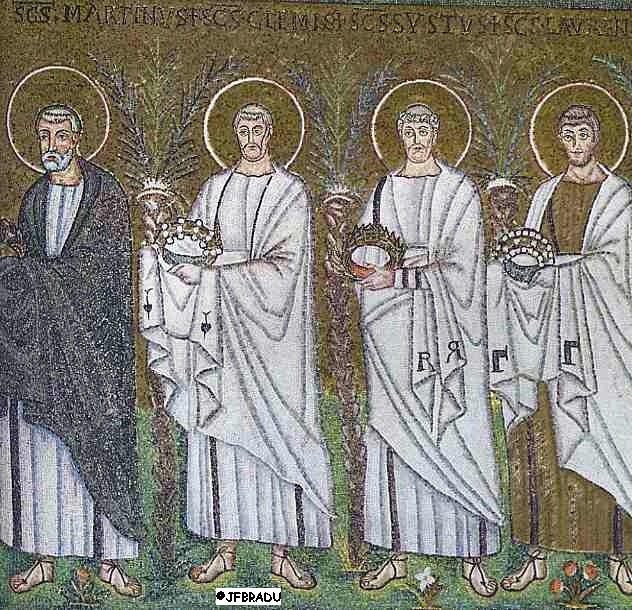
Outstanding painting. Father read from the prayers for martyrs tonight too.

Wednesday November 23, 2005 Thirty-fourth Week in Ordinary Time
Reading (Daniel 5:1-6, 13-14, 16-17, 23-28) Gospel (St. Luke 21:12-19)
In the readings today, we see a point that we all know and believe, yet at the same time in a lived-out reality we do not always put it very well into practice, that is, God is the Lord of all creation and all history and absolutely nothing in this world or in our individual lives happens without His permission. That is something, again, that we all know, but being able to live it is hard.
We can look, for instance, at the first reading where we hear about how God allowed Nebuchadnezzar, the king of Babylon, to sack Jerusalem and even to pillage the temple and take the gold and silver vessels from the temple and put them in the treasury of his own false gods. God did not do anything about that until King Belshazzar, as we heard in the first reading, decided to have a party and use the very vessels from the temple of the Lord to drink wine out of. That would be as if somebody broke into the church and stole the chalices and used them to drink Coke. We would be horrified by somebody having something like Coca-cola in a chalice that was made for the Precious Blood. That is the same basic idea of what happened. We can say, “Well, why didn’t God do something right away? When Nebuchadnezzar destroyed the temple and stole the vessels, why didn’t God do something immediately?” It was because the people of Israel were so sinful and they needed to be purified. In order to make a point, God even allowed the temple to be sacked.
If we move from there to the Gospel reading, we hear Our Lord telling us that some of us are going to be handed over–even by parents and brothers and relatives and friends–we will be put into prison, and some will be put to death. Again, we look at this and say, “But why would God allow that?” It is because, number one, He said, This is the means by which you will be able to give testimony to Me. It is an opportunity for us, number one, to be able to express our faith; number two, it is the means by which we will become saints; number three, it is the way that we will give the greatest glory to God.
He goes on to say, You will be hated by all. Now this is one of the hardest parts of being Catholic, I mean truly Catholic, that is, if you are going to uphold the truth, people will hate you because they do not want the truth. Remember, Jesus said, If they hate you it is because they hated Me first. It is not us that they hate as individuals–it is the truth that they hate, and the truth is Jesus Christ. The worst part is that it is the very people in the Church who are the worst of all. The ones who you would expect to support you while you are trying to do what is right, they are the ones more than anyone who are going to ridicule you, undermine you, and even try to destroy you. That is very frustrating for most people. But this has been the pattern for two thousand years and it is not going to change now.
In fact, it is one of the things that the Church will often look at in canonization processes. If somebody is going to be a saint, one of the first things the Church will ask is: How were they treated by the people in the Church? And then the second question: How did that person deal with the way they were treated by the people in the Church? And by the people in the Church, it is not just the people sitting in the pews; it is the bishops and the priests. So we have to understand that if we are truly going to live our lives for Jesus Christ we are going to be treated the same way He was. If Jesus was alive today (physically alive, that is), the bishops and the priests and the people in the pew would hate His guts and they would treat Him the same way the priests and the high priest and the people treated Him two thousand years ago. Human nature has not changed. Now we would like to say, “We wouldn’t do that,” but the fact of the matter is that unless we are steeped in prayer we would be doing the exact same thing. If we look at the people who were steeped in prayer, Anna and Simeon, for instance, they recognized Our Lord and they glorified God. If you look at the people who were supposed to be serving God but were not prayerful, they hated Him. That is the pattern that is going to remain.
As long as we are not being obnoxious about what we are doing and people do not like what we are doing, then we are doing just fine. Where the real test comes in for us is whether we are going to remain faithful to the Lord, or whether we are going to water things down in order to be accepted by those who are more worldly. Really, when it comes down to it, we have a choice. Do we want to be accepted by Jesus, or do we want to be accepted by those who are more worldly? The Church is going to be persecuted, the people in the Church are going to be persecuted, each one of us, if we are going to be faithful to Christ, will be persecuted. Jesus told us that if we deny Him before men, He will deny us before His Father in heaven. That is where the real crux of the question comes: Are we going to be willing to remain faithful to Christ right to the very end? What if we were to be put into prison for our faith? What if we were to be tortured for our faith? What if we were to be put to death for our faith? If we cannot handle the peer pressure, if we cannot handle the other people in the office, if we cannot handle our family members, what are we going to do in the face of torturers if such a thing should ever happen to us? Now we see why God allows these things to happen in our lives–so that our faith can grow stronger, so that we will be able to give witness to Christ, and so that we can give God the greatest glory and become saints.
* This text was transcribed from the audio recording with minimal editing.
 |
Wednesday, November 23, 2005 Meditation Daniel 5:1-6,13-14,16-17,23-28 Mene. Tekel. Peres. What would your reaction be if you saw a hand without a body attached writing such ominous words on your dining room wall? The terrified King Belshazzar turned pale, his limbs gave way, and his knees knocked together! Perhaps wondering if he did something that would cause such a frightful vision, he first called his “wise men” and then eventually God’s wise man, a faithful Jewish exile named Daniel. Before offering an interpretation, Daniel first gave Belshazzar a history lesson. He reminded the king how his father, Nebuchadnezzar, had ruled over a great kingdom, but had hardened his heart and walked in pride. God stripped him of his glory until Nebuchadnezzar humbled himself and acknowledged the sovereignty of Yahweh. Daniel explained to Belshazzar that he had yet to learn from his father’s lesson. Like Nebuchadnezzar, he too had exalted himself and worshipped false gods—even praising them while drinking from the vessels he had taken from the Temple of Jerusalem. Belshazzar had advanced his own kingdom and not God’s kingdom, all at the expense of justice, mercy, and peace. Therefore, God sent him a personal message. Mene: God has numbered his days and his kingdom has come to an end. Tekel: God has weighed him on the scales and found him wanting. And peres: God has decided to divide his kingdom and give it to the Medes and Persians. How can we avoid Belshazzar’s fate? We can choose to learn from history and walk in humility, not pride. We can love, exalt, and honor the one true God. Then our actions will reflect God’s justice, his mercy, and his peace. If we do so, we will hear God tell us that he has numbered our days and accounted them for good, that he has weighed us on the scales and declared us blessed, and that he has not scattered us but united us—both with him and with each other. What a beautiful legacy! “Jesus, I want to reflect your love to everyone around me. I want to build up your kingdom and not just my own personal realm. Lord, help me to hear your voice as you guide me to walk in humility, justice, and love.” (Psalm) Daniel 3:62-67; Luke 21:12-19 |
|
Disclaimer: Opinions posted on Free Republic are those of the individual posters and do not necessarily represent the opinion of Free Republic or its management. All materials posted herein are protected by copyright law and the exemption for fair use of copyrighted works.

