Skip to comments.
Catholic Caucus: Daily Mass Readings, 08-08-05, Memorial, St. Dominic
USCCB.org/New American Bible ^
| 08-08-05
| New American Bible
Posted on 08/08/2005 7:08:22 AM PDT by Salvation
August 8, 2005
Memorial of Saint Dominic, priest
Psalm: Monday 35
Reading IDt 10:12-22
Moses said to the people:
"And now, Israel, what does the LORD, your God, ask of you
but to fear the LORD, your God, and follow his ways exactly,
to love and serve the LORD, your God,
with all your heart and all your soul,
to keep the commandments and statutes of the LORD
which I enjoin on you today for your own good?
Think! The heavens, even the highest heavens,
belong to the LORD, your God,
as well as the earth and everything on it.
Yet in his love for your fathers the LORD was so attached to them
as to choose you, their descendants,
in preference to all other peoples, as indeed he has now done.
Circumcise your hearts, therefore, and be no longer stiff-necked.
For the LORD, your God, is the God of gods,
the LORD of lords, the great God, mighty and awesome,
who has no favorites, accepts no bribes;
who executes justice for the orphan and the widow,
and befriends the alien, feeding and clothing him.
So you too must befriend the alien,
for you were once aliens yourselves in the land of Egypt.
The LORD, your God, shall you fear, and him shall you serve;
hold fast to him and swear by his name.
He is your glory, he, your God,
who has done for you those great and terrible things
which your own eyes have seen.
Your ancestors went down to Egypt seventy strong,
and now the LORD, your God,
has made you as numerous as the stars of the sky."
Responsorial PsalmPs 147:12-13, 14-15, 19-20
R. (12a)
Praise the Lord, Jerusalem.Glorify the LORD, O Jerusalem;
praise your God, O Zion.
For he has strengthened the bars of your gates;
he has blessed your children within you.
R. Praise the Lord, Jerusalem.He has granted peace in your borders;
with the best of wheat he fills you.
He sends forth his command to the earth;
swiftly runs his word!
R. Praise the Lord, Jerusalem.He has proclaimed his word to Jacob,
his statutes and his ordinances to Israel.
He has not done thus for any other nation;
his ordinances he has not made known to them. Alleluia.
R. Praise the Lord, Jerusalem.
GospelMt 17:22-27
As Jesus and his disciples were gathering in Galilee,
Jesus said to them,
"The Son of Man is to be handed over to men,
and they will kill him, and he will be raised on the third day."
And they were overwhelmed with grief.
When they came to Capernaum,
the collectors of the temple tax approached Peter and said,
"Does not your teacher pay the temple tax?"
"Yes," he said.
When he came into the house, before he had time to speak,
Jesus asked him, "What is your opinion, Simon?
From whom do the kings of the earth take tolls or census tax?
From their subjects or from foreigners?"
When he said, "From foreigners," Jesus said to him,
"Then the subjects are exempt.
But that we may not offend them, go to the sea, drop in a hook,
and take the first fish that comes up.
Open its mouth and you will find a coin worth twice the temple tax.
Give that to them for me and for you."
TOPICS: Activism; Apologetics; Catholic; Charismatic Christian; Current Events; Eastern Religions; Ecumenism; Evangelical Christian; General Discusssion; History; Islam; Judaism; Mainline Protestant; Ministry/Outreach; Moral Issues; Orthodox Christian; Other Christian; Other non-Christian; Prayer; Religion & Culture; Religion & Politics; Religion & Science; Skeptics/Seekers; Theology; Worship
KEYWORDS: catholiccaucus; catholiclist; dailymassreadings; dominicans; ordinarytime; stdominic
Navigation: use the links below to view more comments.
first 1-20, 21-26 next last
For your reading, reflection, faith-sharing, comments, questions, discussion.
1
posted on
08/08/2005 7:08:25 AM PDT
by
Salvation
To: nickcarraway; sandyeggo; Siobhan; Lady In Blue; NYer; american colleen; Pyro7480; livius; ...
Alleluia Ping!
Please notify me via FReepmail if you would like to be added to or taken off the Alleluia Ping List.
2
posted on
08/08/2005 7:10:54 AM PDT
by
Salvation
(†With God all things are possible.†)
To: All
3
posted on
08/08/2005 7:12:14 AM PDT
by
Salvation
(†With God all things are possible.†)
To: All
From: Deuteronomy 10:12-22
A Further Call to Faithfulness
(Moses said to the people,) [12] "And now, Israel, what does the LORD your
God require of you, but to fear the LORD your God, to walk in all his ways,
to love him, to serve the LORD your God with all your heart and with your
soul, [13] and to keep the commandments and statutes of the LORD, which I
command you this day for your good? [14] Behold, to the LORD your God belong
heaven and the heaven of heavens, the earth with all that is in it; [15] yet
the LORD set his heart in love upon your fathers and chose their descendants
after them, you above all peoples, as at this day. [16] Circumcise therefore
the foreskin of your heart, and be no longer stubborn. [17] For the LORD
your God is God of gods and Lord of lords, the great, the mighty, and the
terrible God, who is not partial and takes no bribe. [18] He executes
justice for the fatherless and the widow, and loves the sojourner, giving
him food and clothing. [19] Love the sojourner therefore; for you were
sojourners in the land of Egypt. [20] You shall fear the LORD your God; you
shall serve him and cleave to him, and by his name you shall swear. [21] He
is your praise; he is your God, who has done for you these great and
terrible things which your eyes have seen. [22] Your fathers went down to
Egypt seventy persons; and now the LORD your God has made you as the stars
of heaven for multitude.
Commentary:
10:12-16. With divine teaching skill, the sacred writer emphasizes the
special love the Lord is showing Israel: the Lord of heaven and earth has
"set his heart in love" on them (v. 15; cf. 7:7). It would be difficult to
express more tenderly God's love for his people (cf. the note on 7:7-16).
An uncircumcised heart (v. 16) is a hard heart, insensitive to God's calls
because it is closed in on itself. This is an image often used in both Old
and New Testaments (cf. e.g., 30:6; Jer 4:4; Acts 7:51; Rom 2:29). Christian
tradition sees circumcision of the heart as a figure of Baptism: "Now those
whose hearts are circumcised live and are circumcised by the new Jordan,
which is the baptism forgiveness of sins. [...] Jesus our Savior worked this
circumcision a second time through circumcision of heart of all those who
believe in Him and are cleansed in baptism. [...] Joshua, the son of Nun,
led the people into the promised land; Jesus, our Savior, promised the land
of life to all those who were ready to cross the true Jordan, who believed
and who allowed the foreskin of their heart to be circumcised" (Aphraates,
"Demonstrationes", 11).
10:17-22. It is easy to appreciate the beauty and majesty of this passage;
it is filled with profound respect for the greatness of God and with
tenderness towards the needy. Deuteronomy makes many appeals (e.g., 14:29;
16:11, 14) on behalf of orphans, widows and strangers (vv. 18-19). This
concern for the weak is a recurring theme in Holy Scriptnre (cf., e.g., Mal
3:5; Jas 1:26-27).
Source: "The Navarre Bible: Text and Commentaries". Biblical text
taken from the Revised Standard Version and New Vulgate. Commentaries
made by members of the Faculty of Theology of the University of
Navarre, Spain. Published by Four Courts Press, Kill Lane, Blackrock,
Co. Dublin, Ireland.
4
posted on
08/08/2005 7:14:17 AM PDT
by
Salvation
(†With God all things are possible.†)
To: All
From: Matthew 17:22-27
Second Prophecy of the Passion; the Temple Tax
[22] As they were gathering in Galilee, Jesus said to them, "The Son of
Man is to be delivered into the hands of men, [23] and they will kill
Him, and He will be raised on the third day." And they were greatly
distressed.
[24] When they came to Capernaum, the collectors of the half-shekel tax
went up to Peter and said, "Does not your Teacher pay the tax?"
25] He said, "Yes." And when he came home, Jesus spoke to him first,
saying, "What do you think, Simon? From whom do kings of the earth
take toll or tribute? From their sons or from others?" [26] And when
he said, "From others," Jesus said to him, "Then the sons are free.
[27] However, not to give offense to them, go to the sea and cast a
hook, and take the first fish that comes up, and when you open its
mouth you will find a shekel; take that and give to them for Me and for
yourself."
Commentary:
24-27. "Half-shekel", or "didrachma": a coin equal in value to the
annual contribution every Jew had to make for the upkeep of the
temple--a day's wage of a laborer. The shekel or stater which our Lord
refers to in verse 27 was a Greek coin worth two didrachmas.
Jesus uses things great and small to get His teaching across to His
disciples. Peter, who is to be the rock on which He will found His
Church (Matthew 16:18-19), He prepares by letting him see His dramatic
Transfiguration (17:1-8); now He gives Peter another inkling of His
divinity through an apparently unimportant miracle. We should take
note of Jesus' teaching method: after His second announcement of His
passion, His disciples are downhearted (Matthew 17:22-23); here He
lifts Peter's spirits with this friendly little miracle.
26. This shows how conscientiously our Lord fulfilled His civic
duties. Although the half-shekel tax had to do with religion, given
the theocratic structure of Israel at the time, payment of this tax
also constituted a civic obligation.
Source: "The Navarre Bible: Text and Commentaries". Biblical text
taken from the Revised Standard Version and New Vulgate. Commentaries
made by members of the Faculty of Theology of the University of
Navarre, Spain. Published by Four Courts Press, Kill Lane, Blackrock,
Co. Dublin, Ireland.
5
posted on
08/08/2005 7:15:45 AM PDT
by
Salvation
(†With God all things are possible.†)
To: All
Monday, August 8, 2005
Holy Father Dominic, Priest, Founder of the Order of Preachers (Feast) |
First Reading:
Psalm:
Gospel:
|
2 Timothy 4:1-5
Psalm 37:3-6, 30-31
Matthew 5:13-16
Although her constitution was very frail, her spirit was endowed with such singular strength that, knowing the will of God in her regard, she permitted nothing to impede her from accomplishing what seemed beyond her strength. -- Pope Pius XII at the canonization of St. Frances Xavier Cabrini |
|
6
posted on
08/08/2005 7:16:52 AM PDT
by
Salvation
(†With God all things are possible.†)
To: All
Catholic Culture

|
Collect:
Lord, let the holiness and teaching of St. Dominic come to the aid of your Church. May he help us now with his prayers as he once inspired people by his preaching. We ask this through our Lord Jesus Christ, your Son, who lives and reigns with you and the Holy Spirit, one God, for ever and ever. |
|
 |
August 08, 2005    St. Dominic, priest
At the end of the twelfth century the Church in France was ravaged by the Albigensian heresy, a doctrine which was not only entirely unchristian but which, in addition, constituted a social evil. Effective measures were required to be taken to combat it. Where others had failed, a Spanish canon, Dominic Guzman, succeeded. He was notable for his learning and love of poverty. The Order of Friars Preachers, which he founded about the year 1215, was endowed by him with these two characteristics; instead of manual labor, as practized by the Cistercian monks, he required his friars to work with their minds by preaching and teaching. He died at Bologna on August 6, 1221. His friend, Gregory IX, canonized him three years later. Before the reform of the General Roman Calendar St. Dominic's feast was celebrated on August 4 and today was the feast of Sts. Cyriac, Largus and Smaragdus. St. Largus and St. Smaragdus are two Roman martyrs. They were buried at first on the Ostian Way. Their bodies were later transferred, after the peace of Constantine, to a church built near the baths of Diocletian by a Christian of the name of Cyriacus. The cult of St. Cyriacus has been joined to that of the two martyrs. The Fourteen "Auxiliary Saints" or "Holy Helpers" are a group of saints invoked because they have been efficacious in assisting in trials and sufferings. Each saint has a separate feast or memorial day, and the group was collectively venerated on August 8, until the 1969 reform of the Roman calendar, when the feast was dropped.
St. Dominic
 The Martyrology gives the following: "At Bologna (upper Italy) the holy confessor Dominic, the saintly and learned founder of the Order of Preachers. He preserved his virginity inviolate and gained for himself the grace of raising three dead persons to life. By his word he crushed heresy in the bud and led many souls to piety and to religious life." The Martyrology gives the following: "At Bologna (upper Italy) the holy confessor Dominic, the saintly and learned founder of the Order of Preachers. He preserved his virginity inviolate and gained for himself the grace of raising three dead persons to life. By his word he crushed heresy in the bud and led many souls to piety and to religious life." Born about 1175 in Castile (Spain), Dominic hailed from the illustrious Guzman family. First he was a canon regular at Osma; then he founded the Dominican Order, which was approved in 1216. Alongside the Franciscans, it became the most powerful Order in medieval times, giving the Church illustrious preachers, e.g., St. Vincent Ferrer, and contemplatives, e.g., Sts. Thomas of Aquinas and Pius V, and contributing immeasurably to maintaining the purity of the faith. Through the example of apostolic poverty and the preaching of the word of God the Friar Preachers were to lead men to Christ. To St. Dominic is attributed the origin and spread of the holy rosary. The two contemporaries, Dominic and Francis, effected a tremendous spiritual rejuvenation through their own spiritual personalities and through their religious foundations. Of the two, Dominic was the realist who surpassed the other intellectually and in organizational talent. His spirit of moderation, clarity of thought, and burning zeal for souls have become the heritage of the Dominican Order. Legend has contributed the following rare anecdote as preserved in the Breviary: "During pregnancy, Dominic's mother dreamed she was carrying in her womb a little dog that held a burning torch between its teeth; and when she had given birth, it set the whole world on fire. By this dream it was made manifest beforehand how Dominic would inflame the nations to the practice of Christian virtue through the brightness of his holy example and the fiery ardor of his preaching." He died at Bologna upon hearing the liturgy's prayer for the dying: "Come, ye saints of God, hasten hither, ye angels!" Excerpted from The Church's Year of Grace, Pius Parsch.
St. Cyriac and Companions
 The Acts concerning these martyrs give many fictional details. Together with Sisinius, Largus and Smaragdus, Cyriac languished a long time in prison. Among the miracles that Cyriac worked was that of freeing through his prayer Arthemia, the daughter of Emperor Diocletian, from an evil spirit. Thereupon he was sent to the Persian king Sapor and performed a similar miracle in favor of his daughter Jobias. But after baptizing the king and 430 of his entourage, he returned to Rome. Upon orders from Maximian the Emperor, he was arrested, chained, and dragged to prison. Four days later he was taken from confinement, drenched with seething pitch, and tortured on the rack; in company with Smaragdus and twenty other Christians he finally was beheaded on the Via Salaria near the gardens of Sallust." The Acts concerning these martyrs give many fictional details. Together with Sisinius, Largus and Smaragdus, Cyriac languished a long time in prison. Among the miracles that Cyriac worked was that of freeing through his prayer Arthemia, the daughter of Emperor Diocletian, from an evil spirit. Thereupon he was sent to the Persian king Sapor and performed a similar miracle in favor of his daughter Jobias. But after baptizing the king and 430 of his entourage, he returned to Rome. Upon orders from Maximian the Emperor, he was arrested, chained, and dragged to prison. Four days later he was taken from confinement, drenched with seething pitch, and tortured on the rack; in company with Smaragdus and twenty other Christians he finally was beheaded on the Via Salaria near the gardens of Sallust." Popular piety has numbered St. Cyriac among the "Fourteen Holy Helpers." The existence of a martyr with this name seems well attested by the trustworthy Depositio Martyrum of 354. The remaining details in the above account are pure fiction. But the story may bring to mind that endless series of heroic souls who suffered for Christ even more dreadful tortures than those fiction describes. Excerpted from The Church's Year of Grace, Pius Parsch.
The Fourteen Holy Helpers
 The Fourteen Holy Helpers are invoked as a group because of the Black Plague which devastated Europe from 1346 to 1349. Among its symptoms were the black tongue, a parched throat, violent headache, fever, and boils on the abdomen. The victims were attacked without warning, robbing them of their reason, and killed within a few hours; many died without the last Sacraments. No one was immune, and the disease wreaked havoc in villages and family circles. The epidemic appeared incurable. The pious turned to Heaven, begging the intervention of the saints, praying to be spared or cured. Each of these fourteen saints had been efficacious in interceding in some aspect for the stricken during the Black Plague. The dates are the traditional feast days; not all the saints are on the General Roman Calendar. The Fourteen Holy Helpers are invoked as a group because of the Black Plague which devastated Europe from 1346 to 1349. Among its symptoms were the black tongue, a parched throat, violent headache, fever, and boils on the abdomen. The victims were attacked without warning, robbing them of their reason, and killed within a few hours; many died without the last Sacraments. No one was immune, and the disease wreaked havoc in villages and family circles. The epidemic appeared incurable. The pious turned to Heaven, begging the intervention of the saints, praying to be spared or cured. Each of these fourteen saints had been efficacious in interceding in some aspect for the stricken during the Black Plague. The dates are the traditional feast days; not all the saints are on the General Roman Calendar.
(1) St. George (April 23rd), soldier-martyr. Invoked for protection for domestic animals and against herpetic diseases. Also patron of soldiers, England, Portugal, Germany, Aragon, Genoa and Venice. (2) St. Blaise (also Blase and Blasius) (February 3rd), bishop and martyr. He is invoked against diseases of the throat. Blessing of the throats takes place on his feast day. (3) St. Erasmus (also St. Elmo) (June 2nd), bishop and martyr. He is invoked against diseases of the stomach and intestine, protection for domestic animals and patron of sailors. (4) St. Pantaleon (July 27th), bishop and martyr. Invoked against consumption, protection for domestic animals and patron of physicians and midwives. (5) St. Vitus (also St. Guy) (June 15th), martyr. Invoked in epilepsy, chorea ("St. Vitus' dance"), lethargy, and the bites of poisonous or mad animals and against storms. Also protection for domestic animals. Patron of dancer and actors. (6) St. Christopher (also Christophorus) (July 25th), martyr. Invoked against the plague and sudden death. He is the patron of travelers, especially motorists, and is also invoked in storms. (7) St. Denis (also Dionysius) (October 9th), bishop and martyr. Invoked against diabolical possession and headaches. (8) St. Cyriacus (also Cyriac) (August 8th), deacon and martyr. Invoked against diseases of the eye and diabolical possession. Also interceded for those in temptation, especially at the time of death. (9) St. Acathius (also Acacius) (May 8th), martyr. Invoked against headaches and at the time of death's agony. (10) St. Eustace (also Eustachius, Eustathius) (September 20th), martyr. Invoked against fire — temporal and eternal. Patron of hunters. Patron in all kinds of difficulties, and invoked in family troubles. (11) St. Giles (also Aegidius) (September 1st), hermit and abbot. Invoked against the plague, panic, epilepsy, madness, and nightmares and for a good confession. Patron of cripples, beggars, and breastfeeding mothers. (12) St. Margaret of Antioch (July 20th), virgin and martyr. Invoked against backache. Patron for women in childbirth. (13) St. Catherine of Alexandria (November 25th), virgin and martyr. Invoked against diseases of the tongue, protection against a sudden and unprovided death. Patroness of Christian philosophers, of maidens, preachers, wheelwrights and mechanics. She is also invoked by students, orators, and barristers as "the wise counselor." (14) St. Barbara (December 4th), virgin and martyr. Invoked against fever and sudden death. Patron of builders, artillerymen and miners. Also invoked against lightning, fire and sudden death.
|
7
posted on
08/08/2005 7:22:47 AM PDT
by
Salvation
(†With God all things are possible.†)
To: Salvation
| Mt 17:21-26 |
| # |
Douay-Rheims |
Vulgate |
| 21 |
And when they abode together in Galilee, Jesus said to them: The Son of man shall be betrayed into the hands of men: |
conversantibus autem eis in Galilaea dixit illis Iesus Filius hominis tradendus est in manus hominum |
| 22 |
And they shall kill him, and the third day he shall rise again. And they were troubled exceedingly. |
et occident eum et tertio die resurget et contristati sunt vehementer |
| 23 |
And when they were come to Capharnaum, they that received the didrachmas, came to Peter, and said to him: Doth not your master pay the didrachma? |
et cum venissent Capharnaum accesserunt qui didragma accipiebant ad Petrum et dixerunt magister vester non solvit didragma |
| 24 |
He said: Yes. And when he was come into the house, Jesus prevented him, saying: What is thy opinion, Simon? The kings of the earth, of whom do they receive tribute or custom, of their own children, or of strangers? |
ait etiam et cum intrasset domum praevenit eum Iesus dicens quid tibi videtur Simon reges terrae a quibus accipiunt tributum vel censum a filiis suis an ab alienis |
| 25 |
And he said: Of strangers. Jesus said to him: Then the children are free. |
et ille dixit ab alienis dixit illi Iesus ergo liberi sunt filii |
| 26 |
But that we may not scandalize them, go to the sea, and cast in a hook: and that fish which shall first come up, take: and when thou hast opened it's mouth, thou shalt find a stater: take that, and give it to them for me and thee. |
ut autem non scandalizemus eos vade ad mare et mitte hamum et eum piscem qui primus ascenderit tolle et aperto ore eius invenies staterem illum sumens da eis pro me et te |
8
posted on
08/08/2005 9:08:54 AM PDT
by
annalex
To: annalex
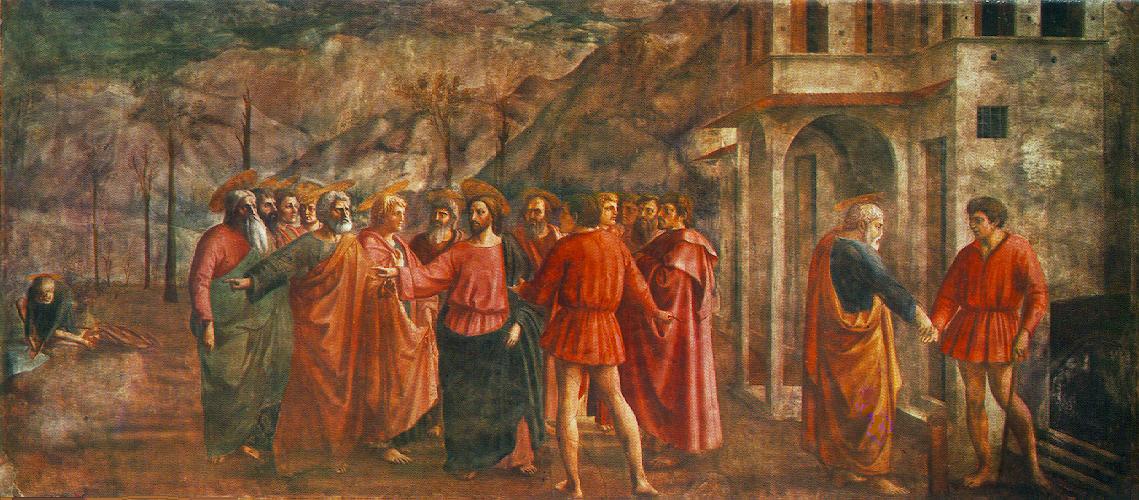
Tribute Money
Masaccio
1426-27
Fresco, 255 x 598 cm
Cappella Brancacci, Santa Maria del Carmine, Florence
9
posted on
08/08/2005 9:10:58 AM PDT
by
annalex
To: Salvation
During pregnancy, Dominic's mother dreamed she was carrying in her womb a little dog Ah. This gives an extra dimension to this medieval wordplay: the Dominicans were called -- perhaps, derisively and perhaps, sympathetically, -- as domini cani, the "dogs of the Lord". The joke held because the white chests and the brown robes reminded people of dogs, as was the peripatetic lifestyle.
10
posted on
08/08/2005 12:55:46 PM PDT
by
annalex
To: Salvation
11
posted on
08/08/2005 6:28:16 PM PDT
by
Ciexyz
(Let us always remember, the Lord is in control.)
To: Salvation
Prayers offered up for a medical condition. (The Lord knows my need.)
12
posted on
08/08/2005 6:29:15 PM PDT
by
Ciexyz
(Let us always remember, the Lord is in control.)
To: Ciexyz
13
posted on
08/08/2005 6:41:45 PM PDT
by
Salvation
(†With God all things are possible.†)
To: annalex
Interesting facts there. Never knew that.
14
posted on
08/08/2005 6:43:58 PM PDT
by
Salvation
(†With God all things are possible.†)
To: annalex
**To St. Dominic is attributed the origin and spread of the holy rosary**
I knew I had seen a connection somewhere between St. Dominic and the Rosary!
15
posted on
08/08/2005 6:59:17 PM PDT
by
Salvation
(†With God all things are possible.†)
To: All


Not long ago in a gathering of friends a matron candidly confessed that she stopped saying the rosary several years back because she could not get anything from' the continuous repetition of the "Hail Mary." Other persons joined her, especially the young generation, while others strongly defended the Marian devotion and ratified. Their intention of keeping it alive for, as long as they lived. All of them looked at me hoping for an answer. Confronted with the difficult task of answering with a five-minute homily or a three-hour seminar, I opted for a simple statement: the Rosary is a living expression of the Dominican Charism, rather than devotion. They were taken aback my answer and requested me to elaborate on the Rosary and the Dominican Charism. Part of that reflection I would like to share with you today, for it may answer some of the questions about the rosary that your friends have asked several times. I will centre my reflection on this question: Why are the Dominicans so involved in fostering this devotion? Let me answer with a simple explanation. St Dominic of Guzmán is the founder of both the Dominican Order and the devotion of the rosary. Both the Dominicans and the rosary incarnate St. Dominic's vision and mission: Contemplari et contemplata aliis tradere (to contemplate and to share with others the result of contemplation). This vision and mission of St. Dominic is reflected in the Dominican spirituality, which is characterised by being Christ-centred; by its devotion to the Holy Eucharist; devotion to Mary, especially in the mystery of Annunciation; and the Church, especially the suffering Church, by concern for the souls in purgatory. It could not be otherwise because Jesus Christ, the Holy Eucharist and the mystery of Mary inspire the Dominican friar or sister to be authentically Dominican: a Preacher and a Proclaimer. How does the rosary express this spirituality? The rosary should be understood as an expression of the Dominican Charism, namely to contemplate the mystery of God, and once the Dominican is filled with God', he should share this experience of God with others. A true preacher must imitate Mary who conceived Jesus, the Son of God, for the salvation of mankind. A Dominican must be filled with the Word of God, Jesus Christ (contemplari). But a preacher, like Mary, should not keep Jesus Christ for himself. He must bring this Jesus to others; he must give this Jesus, the Saviour, to others (Contemplata aliis tradere). The rosary is a Marian devotion, a prayer and a praise of Mary as the Mother of God. The rosary does not end in Mary. It leads to Jesus. Through the meditation of the mysteries, Mary gives Jesus to us. It is a way, through which the faithful follow and join Mary in reflecting on the events of the life of Jesus Christ for, as the Gospel tells us, "Mary kept and pondered all things in her heart." In this fashion Jesus Christ is behind every Hail Mary of the rosary. In the recitation of the rosary, Mary is not the end, but the way to Jesus. Ad Jesum per Mariam (to Jesus through Mary) is the motto of the true Marian devotee. Our Lady of the Rosary is Mary as the Mother of God (the Thoetokos): Our Ladv of the Rosary is Marv with the child Jesus. Mary who did not keep Jesus for herself but gave him to mankind to mankind. Mary is the giver of Jesus Christ to us Christians through the mediation of the mysteries of her rosary. The rosary has a liturgical inspiration and is a biblical prayer. It has a liturgical inspiration because it is structured after a book of the Bible called Psalter, which is composed of 150 psalms. The psalms constitute the fundamental element of the Divine Office which monks, friars, priests, nuns, sisters and many other Christians recite in the name of the Church. In ancient times many religious men and women could not read, and thus could not join the community in the recitation of the Divine Office, joined the community in praising God by reciting 150 Our Fathers. One Our Father for each psalm. Dominican brother-cooperators at the beginning of the Order followed the tradition of the monks. They recited 150 Our Fathers in lieu of the Psalter chanted by the priests. St Dominic, who was a devotee of Mary, commanded his friars to recite the Little Office of Mary, which is patterned after the Divine Office, thus it is composed of psalms and readings, but in a shorter way. When the brother-cooperators inquired about the way they could fulfil that obligation, St Dominic thought about the rosary. It should be a prayer to Mary, and there is no better prayer than the Hail Mary. Thus, he ordered the brother-cooperators to say the Hail Mary one hundred fifty times (150). But Dominic infused his charism into it by telling them to meditate on the mysteries of the life of Christ and Mary, the mysteries of our redemption. What mysteries? Dominic left this to the discretion of the individual, for his principle was, "Chain the body, let the spirit free." The Dominican Family followed the example of the brother-cooperators. In this fashion the rosary passed from the convent of the friars to the homes of the Dominican Family, and later on to the whole Christian world. The rosary is a biblical prayer. The basic prayers of the rosary are the Hail Mary and the Our Father which were lifted from the Bible. In the Bible we find many prayers, even prayers which our Lord Jesus Christ prayed to the Father, but the Our Father is the prayer he taught us to pray. It is the answer of Jesus to his apostles when they asked him: "Lord, teach us to pray as John taught his disciples." The Hail Mary is composed of two parts. In the first part, the greetings of the Angel Gabriel and Elizabeth to Mary as Mother of God are united to form a unit. Gabriel as a messenger of God brought Mary the message he received from God: "Rejoice, so highly favoured! The Lord is with you." In this way, we may say that the greetings of Gabriel were the greetings of God to His mother; while the greetings of Elizabeth were the greetings of humankind to the mother of man's Saviour. In the first part of the Hail Mary the mystery of incarnation and Mary's role in giving Jesus to mankind are recalled and praised. The Dominicans saw in this mystery the exemplar and paradigm of their Charism. Fra Angelico's Annunciations remind us of this. The second part is a "prayer" asking that Mary, the Mother of God, intercede for us who are sinners, so that the redemption and salvation of mankind that began at the Annunciation may be brought to fulfilment in us in heaven. Naturally, Mary and the reflection on the mysteries of Christ in the rosary lead us to God, One and Triune. The Glory be at the end of each mystery is an expression of praise and thanksgiving of the Christian soul filled with love and grace. The rosary brings man to the consideration of his final destiny through the contemplation of the life of Christ. Each mystery represents an event in the life of Christ and Mary, which serves as an example for a particular circumstance or specific moment in man's life. It may be reflected upon as isolated and appropriate to the particular situation a person finds himself in or as an integral part of the whole mystery of Christ. The mysteries of the rosary impel us to seek the things which are above, to understand that life is projected beyond the sepulchre, and that our glorification will come after the fulfilment of our mission on earth; just as Jesus and Mary obtained their glorification after they completed their mission in this life. Thus, the rosary in its mysteries becomes a program for Christian living. As a Marian devotion, the rosary brings us closer to Mary by praising her most exalted mystery: The Motherhood of God. Mary will continue fulfilling her role of bearer of Christ by giving us Christ as he appears in the mysteries. As a Marian devotion, the rosary invites us to imitate Mary, namely, to incarnate Christ in our souls by understanding, loving and desiring him. Once we are filled with Christ, we, in Mary's imitation, shall be able to bring him to others, thus in fact becoming "christophers" (Christ-bearers). Queen of the Holy Rosary, pray for us. Fr. Maximiliano Rebollo, OP |
16
posted on
08/08/2005 7:00:21 PM PDT
by
Salvation
(†With God all things are possible.†)
To: All
OUR LADY'S PROMISE TO SAINT DOMINIC CONCERNING THE ROSARY 
Most of us are familiar with the tradition that goes back many centuries, and which has been accepted in the writings of many popes, as to the connection of St. Dominic with the beginnings of the Rosary devotion. According to tradition, the occasion was the Albigensian heresy which ravaged Christendom, particularly in southern France during the latter part of the 12th and the beginning of the 13th centuries. St. Dominic was distressed at his lack of success in his preaching in countering this heresy, and in his desperation turned to the Mother of God for help. She appeared to him and told him to use her Psalter (150 HAIL MARYS) in conjunction with his preaching of the mysteries of our salvation, as an instrument in combatting the great heresy of his day.
Over the centuries, inspired by the teachings of St. Dominic and his followers, especially the Blessed Alain de Roche and St. Louis de Montford, the Holy Rosary has been treasured in the Church. In a profound sense, it is a summary of the Christian Faith. It has long been associated with innumerable miracles of faith and healing.
17
posted on
08/08/2005 7:01:52 PM PDT
by
Salvation
(†With God all things are possible.†)
To: All
 The image of Our Lady handing the Rosary to her white-robed son is a familiar one that reflects a devotion that is continued by the Dominican Sisters of Saint Cecilia. The beginning of October brings a time-honored tradition we call Rosary Sunday. On the first Sunday in October in the chapel of our Motherhouse, the Sisters recite the mysteries of the Rosary continually throughout the day. Beginning immediately after Mass, the Sisters take their places for half an hour each before the altar of our Blessed Mother. There, until Vespers, each Sister offers her prayers for the needs of the Church and for the conversion of the world.
Tradition has long connected Saint Dominic and his Order with the preaching of the Rosary. Dominic’s followers have been called the “Friars of Mary.” The fifteen-decade Rosary adorns our habit with the frequent reminder that we are united to the Son of God in the living presence of our Blessed Mother.

18
posted on
08/08/2005 7:03:00 PM PDT
by
Salvation
(†With God all things are possible.†)
To: All
American Catholic’s Saint of the Day
|
August 8, 2005
St. Dominic
(1170-1221)
|
|
 |
|
If he hadn’t taken a trip with his bishop, Dominic would probably have remained within the structure of contemplative life; after the trip, he spent the rest of his life being a contemplative in active apostolic work. Born in old Castile, Spain, he was trained for the priesthood by a priest-uncle, studied the arts and theology, and became a canon of the cathedral at Osma, where there was an attempt to revive the apostolic common life of the Acts of the Apostles. On a journey through France with his bishop, he came face to face with the then virulent Albigensian heresy at Languedoc. The Albigensians (Cathari, “the pure”) held to two principles—one good, one evil—in the world. All matter is evil—hence they denied the Incarnation and sacraments. On the same principle they abstained from procreation and took a minimum of food and drink. The inner circle led what must he called a heroic life of purity and asceticism not shared by ordinary followers. Dominic sensed the need for the Church to combat this heresy, and was commissioned to be part of the preaching crusade against it. He saw immediately why the preaching was not succeeding: the ordinary people admired and followed the ascetical heroes of the Albigenses. Understandably, they were not impressed by the Catholic preachers who traveled with horse and retinues, stayed at the best inns and had servants. Dominic therefore, with three Cistercians, began itinerant preaching according to the gospel ideal. He continued this work for 10 years, being successful with the ordinary people but not with the leaders. His fellow preachers gradually became a community, and in 1215 he founded a religious house at Toulouse, the beginning of the Order of Preachers (Dominicans). His ideal, and that of his Order, was to link organically a life with God, study and prayer in all forms, with a ministry of salvation to people by the word of God. His ideal: contemplata tradere: “to pass on the fruits of contemplation” or “to speak only of God or with God. “
Comment:
The Dominican ideal, like that of all religious communities, is for the imitation, not merely the admiration, of the rest of the Church. The effective combining of contemplation and activity is the vocation of truck driver Smith as well as theologian Aquinas. Acquired contemplation is the tranquil abiding in the presence of God, and is an integral part of any full human life. It must be the wellspring of all Christian activity. |
19
posted on
08/08/2005 7:07:07 PM PDT
by
Salvation
(†With God all things are possible.†)
To: All
Homily of the Day
|
|
Homily of the Day
| Title: |
What Needs Cutting Away? |
| Author: |
Monsignor Dennis Clark, Ph.D. |
| Date: |
Monday, August 8, 2005 |
|
|
|
Deut 10:12-22 / Mt 17:22-27
There's a curious metaphor in today's Old Testament reading. "Circumcise your hearts," it says. The rite of circumcision was instituted in Moses' time, and it was the means by which male infants became members of God's people. This cutting away was an indelible sign that a man had accepted God's covenant and was a member of his people. But it was on the outside, and that wasn't enough. Look to the inside, said the Lord. Look to your heart, the core of your being. That's where the cutting away has to happen. Cut away whatever there is in you that could cut you off from God or his people. It's the ultimate form of open-heart surgery that God is asking of his people.
So, what is there in us that's cutting us off from God or his people? What fears, or habits, or ways of thinking and living may be stealing real life away and keeping us from the full, rich lives that God intends for us? There IS something like that in every one of us, though often we're the last to see it.
If we trust in the Lord's love of us, we can look, we can see, and we can take that shrunken, misshapen part of our heart and give it to the Lord. Give it to the Lord and don't take it back.
|
20
posted on
08/08/2005 7:15:41 PM PDT
by
Salvation
(†With God all things are possible.†)
Navigation: use the links below to view more comments.
first 1-20, 21-26 next last
Disclaimer:
Opinions posted on Free Republic are those of the individual
posters and do not necessarily represent the opinion of Free Republic or its
management. All materials posted herein are protected by copyright law and the
exemption for fair use of copyrighted works.
FreeRepublic.com is powered by software copyright 2000-2008 John Robinson
