Posted on 02/27/2005 3:47:07 PM PST by NYer
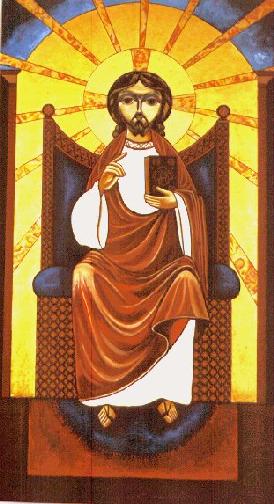
A new freeper has asked me to help him/her locate a copy of the above icon. My 'google' searches have come up empty, except for a group in Greece that will custom make any icon. For those unfamiliar with the backgrouond on this icon, here is the story.
Preface: A short introduction by Fr. Andrea d'Ascanio.
Testimony: The testimony of the Bishop of Grenoble, the Right Reverend Alexandre Caillot in whose diocese this occurred (2 pages).
The Father's message: Part 1 (5 pages)
The Father's message: Part 2 (4 pages).
"God is my Father!" This cry is being heard ever more frequently in today's world: people are coming to recognize that God is indeed their Father.
Consequently, we feel it our duty to publish a message, given to the world by God the Father through one of his creatures who was outstanding in her devotion to Him, Sister Eugenia Elisabetta Ravasio, and recognized as valid by the Church.
We consider it appropriate to introduce this work by quoting the testimony of a former Bishop of Grenoble, the Right Reverend Alexandre Caillot. In 1935 he set up a board OF EXPERTS, DRAWN FROM VARIOUS PARTS OF France, to conduct a diocesan enquiry which lasted ten years.
Its members included the Bishop of Grenoble's Vicar General, Mgr. Guerry, theologian; the Jesuit brothers, Fathers Albert and Auguste Valencin-Amons, who ranked among the foremost authorities in the field of philosophy and theology and were expert in evaluating such cases; the two doctors of medicine, one of whom was a psychiatrist.
We are sure that this message will help people to understand the deep tenderness the Father has for each one of us, and we hope that it will receive the widest possible circulation.
Andrea d'Ascanio
OFM Cap
The many miracles of grace worked by the Message have lead us to disseminate it gratis, especially in prisons, barracks and hospitals. In addition to English, it is available in French, Italian, Russian, Spanish and German.
MOTHER EUGENIA ELISABETTA RAVASIO
Who is Mother Eugenia, whom God the Father called "My beloved Daughter"' "My little plant"?
In our opinion, Mother Eugenia is one of the greatest lights of our times, the little prophet of the new Church, in which the Father is the center and apex of all mankind, and in which unity is the highest ideal of spirituality. She is a light given by the Father to the world at this time of chaos and darkness, so that we may see the road that has to be followed.
She was born in San Gervasio d'Adda (now Capriato San Gervasio), a small town in the province of Bergamo, Italy, on 4 September 1907, in a family of peasant background.
She received only an elementary education. After a few years working in a factory, she entered the Congregation of Our Lady of the Apostles at the age of 20 years. It was here that her great charismatic personality developed, leading to her election as Mother General of the Congregation at the age of only 25.
Quite apart from her spiritual qualities, her work in the social field alone would suffice to ensure her a place in history. In twelve years of missionary activity she opened over 70 centers - each with infirmary, school and church- in the remotest spots of Africa, Asia and Europe.
It was she who discovered the first medicine for the cure of leprosy, extracting it from the seed of a tropical plant. This medicine was later studied and developed further at the Pasteur Institute in Paris.
She encouraged the apostolate of Raoul Follereau, who, following in her footsteps and building on the foundations laid by her, is regarded as the apostle of the lepers.
During the period 1939-41 she planned and brought to fruition the project for a "Lepers' City" at Azopte (Ivory Coast). This was a vast center, covering an area of 200,000 sq.m., for the care of leprosy sufferers. It remains even today one of Africa's and the world's leading centers of its kind.
In recognition of this achievement, France conferred the highest national honour for social work, on the Congregation of Missionary Sisters of Our Lady of the Apostles, of which Mother Eugenia was Superior General from 1935 to 1947.
Mother Eugenia returned to the Father on 10 August 1990.
Her most important legacy to us is the Message of the Father ('The Father speaks to His children'), the only revelation made personally by God the Father, and recognized as authentic by the Church after ten years of most rigorous examination. We reproduce at the beginning of the text the statement issued by Mgr. Alexandre Caillot, Bishop of Grenoble, following the investigation.
It is noteworthy that the Father (in 1932) dictated the Message to Mother Eugenia in Latin, a language totally unknown to her.
To the best of my knowledge, there is no true Icon which shows God the Father. I think this nun was visited by a demon. The Fathers teach the Ineffable God and it is quite impossible for us to define or describe him beyond speaking of certain attributes or energies.
Interesting! In researching this icon, I came across an Orthodox web site which stated:
traditional Orthodox iconographic rules state that God the Father is NOT to be represented in any way. Therefore, the representation of the Father as the "Ancient of Days" is not permitted, even though iconographers do take their liberties and do write such icons.
If you scroll back up to my post to you, that link makes this statement:
Mother Eugenia alleges that God the Father said, "ALL THOSE WHO CALL ME BY THE NAME OF FATHER, EVEN IF ONLY ONCE, WILL NOT PERISH, BUT WILL BE SURE OF THEIR ETERNAL LIFE AMONG THE CHOSEN ONES."
� � Such is an absolute impossibility! If salvation can be achieved by simply � saying "FATHER" once in our life time, then we have been deceived by the � teachings of Jesus. Nor do we require living faith in Jesus, the Church, � or the Sacraments. This is EXACTLY what the messages of Mother Eugenia � are implying. Say "Father" just ONCE and your are saved! It does not � matter if you are a Catholic or not, you are still saved!
� � Such a teaching opposes most doctrines taught by the Catholic Church, the � Traditions, the teachings of the early Church Fathers, of the Church � Councils, the Holy Bible, and the Catechism of the Catholic Church.
� � Are we to believe that our salvation comes through Christ or that we � should bypass the Son and go directly to the Father? Jesus said,
� �
� "No one comes to the Father except through Me." [Jn. 14:6]� � Are we to believe that Jesus lied to us or that Mother Eugenia was subject � to a mental fabrication of her own mind (wishful thinking), mental illness, � or possibly, Satan himself?�
I am simply posting this thread at the request of another freeper. �
That's what the Father teach, but that's not what the Church practices. In St. Augustine, Florida, there is a small Greek Orthodox Church that has an icon clearly showing the Father (as an old man with a beard!), the Son, and the Holy ghost (as White Dove). That icon is actually the icon you kiss when you walk in, and a copy of it is on the iconostation.
On the island of Nysiros in Greece is a monastery that has a similar icon

Apparently, the Greeks are not the only ones who decided to stray from the teachings of the Fathers. here is an old Russian icon that depicts the Father

There is no doubt this is the Father. The inscription on the left reads "GD" (the third letter is a silent yer) which stands for Gospod (the line above the letters indicates standard Byzantine style ligature for commonly repeating words), meaning the "Lord" or "Master," "Ruler." And while we also call Jesus and the Holy Ghost Gospod, the "old man" betrays that it is the the Lord Father.
Saints carry a ligature "STI" (for svyati, or "holy") in Slavonic or "AG" (for hagios or "holy" in Greek).
Without being entirely sure, I have a feeling that the word on the right is "Sabaoth" (or "Savaoth"). The reason that I am not certain is the third letter that looks like latin V. Or is it Ypsilon? A greek Omega is used for "o", and the word appears written in three alphabets at the same time.
Theta was in use in Russia prior to the orthography reform.
The last letter is mute "hard sign", necessary to indicate male gender.
On the wider subject, I have seen both icons and frescoes of the Father in Russia, although they are indeed rare.

Interesting icons! History aside, do either of you have a resource in the US or Canada, that sells icons?
It is Savaot, which means "Almighty." The "v" looks a little strange -- missing the upper loop (it is really the Greek "beta" or vita). If anything it looks like the Slavonic adoptation of Greek ypsilon. There was a letter that resmebles latin "V" or "v" and was called izhitsa. It had a sound similar to German U with two dots (the lips are puckered as if one is to say "oo" but instead says "ee"). However, izhitsa was not used very much.
The "omega" (looks like "w") is a "long o" and the theta is somewhat interetsing because it is rather deformed. Theta was used for numeric values and was pronounced as a "t". The last letter is the voiceless yer that was used for all consonants at the end of the word.
Like I said, there is no doubt that the icon depicts God in the image of the Father, which is heresy. The Wisdom of God never assumed human form, and neither did the Spirit; only the Word becamse incarnate. The other manifestations of God's energies cannot be rendered as "human" or even as "animal" (i.e. dove).
Depictions of God's Wisdom as an "old man" arepagan. It is similar to the Greek gods who had human form. Greek pagan culture deified man. This deification of man went farther in the West than in the East, but both sides of the Church had its sahre of heresy and, apparently, do to this day.
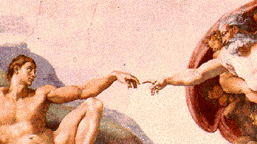
Michaelangelo's famous "finger of God" is an excellent example of depciting God (the Father) as Zeus.
Holy Theotokos Monastery, 111 Evergreen Rd, North Fort Myers, FL 33903-3830, USA (Tel 941-997-2846 or Bookstore at 941-995-3060). I believe the Mother is still Abbess Andrea.
...I thought your post was pretty funny.
40 years purgatory for me. I shall repent at the first opportunity.
Hey. Ever considered becoming a Catholic?
The "icon" you saw in the Greek monastery is something which is supposed to represent the Holy Trinity. Its part of that style I spoke about on another thread. We used to have one in the Narthex. It was removed some years ago.
I will never forget one Orthodox (Serbian) priests telling us a story that he went to someone's house for Slava of one of his parishioners (Slava is the patron Saint Day) which happnes to fall during a strict fast. When he showed up, the first thing he saw was a piglet on a spit! "Get rid of that immediately!" commanded the priest in disbelief that someone would do such a thing. But people do. And they paint an "icon" of the Father. Not out of sinister reasons, but because they don't know. Noone told them. And who is suppsoed to tell them? The priest and all of us. That's how the Church always worked.
That's why monasticism is the life of Orthodoxy. It keeps us honest and it keeps giving us Bishops.
Perhaps he was confused by the fact that Ypsilon sounds like V (after Epsilon). Or he simply put in a Latin V.
Theta and Ypsilon were in the Russian alphabet till the reform. I don't think Omega was. So the writer used one letter unique to the Greek alphabet, Omega, and one letter unique to the Russian alphabet, the hard sign (or yer). The "Gd'" on the left is of course pure Russian, but that he could copy from any number of icons. All this points to shaky literacy.
The icon does not look canonical in form, as well as it is heretical in substance, which is again consistent with a semiliterate maker.
Now I found this:

The text there explains:
Iconography of the Lord Sabaoth spread in religious wood sculpture in 18-19 centuries [in Perm region or Russia]. It was often used in the crown of icononstases.[...]
Very frequently a scultpure of Sabaoth giving a blessing was a part of crucifixes, where it is found on top plank of the cross. [...]
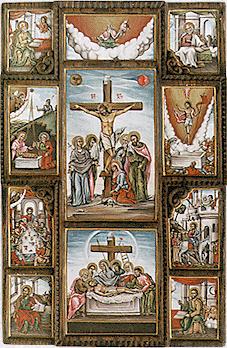
Also see this contemporary traditional Bulgarian icon, depicting Sabaoth in the top section.
Finally, this is Sabaoth the Architect, a French Bible miniature, 13 century.

Was, it didn't take.
The iconographer Lia Gaidiolo (spelling?) was from Padua I think. I recall she suffered greatly in her work, and the original of this icon like many things was lost in the Vatican when submitted for some sort of review. Admittedly, I could remember this incorrectly as it has been years since I even thought of this. But I believe this icon was actually written as a reconstruction of Lia's work. Someone else my have the full story.
The term "Savaot" is a Slavic word for Almighty. The depiction of God the Father is as "Lord Savaoth" is heresy, but this is something that has crept into every Christian discipline.
Comments?
Disclaimer: Opinions posted on Free Republic are those of the individual posters and do not necessarily represent the opinion of Free Republic or its management. All materials posted herein are protected by copyright law and the exemption for fair use of copyrighted works.