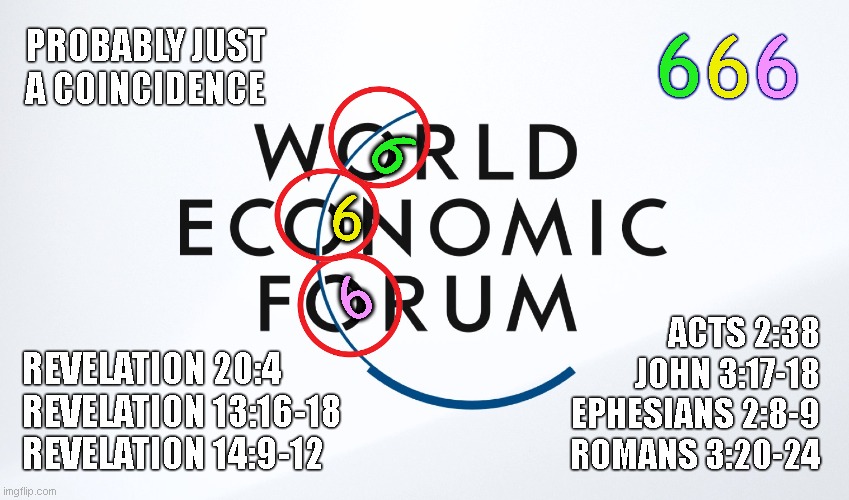
Oh, I dunno... maybe... THIS❓❓⁉️

People think it CAN'T possibly happen
CBDC, Digital Currency, Geofencing, Digital ID 🆔 ARE making it feasible
UNITED NATIONS
AGENDA 2030

Eat Zee Delicious Bugs, Global Citizen!
🐛🐜🐝🐞🦗🐛🐜🐝🐞🦗

Posted on 07/19/2026 6:53:43 PM PDT by DoodleBob
The definitional lines between globalization and globalism have long been blurred. For its part, globalization is best defined as a process or series of processes that integrate the world economically, politically and socially.
Globalism’s critical role
But what is globalism? Quite often, the term is used synonymously with the word “globalization,” as if the two words were interchangeable.
To be sure, the word “globalist” has come to be a battle cry — primarily on the political right, but is also one on the political left.
The “globalist” charge is alternatively (ab)used to describe either the creation of some imaginary and monstrous “world government” or an elite-driven ideology to drive globalization forward. In both cases, it supposedly leaves a country’s common people feeling even more powerless.
The irony in all this is that, in the case of many countries, the undeniable — and in many ways justified — level of frustration among the larger voting public is closely linked to the unresponsiveness of their own nations’ elites.
A definition of globalism: Helping everybody understand the world we live in
Given that globalism appears caught in the crosshairs of both the political right and the political left, is there a constructive way to define the term “globalism”?
Properly understood, “globalism” describes an approach to policymaking that is rooted in the factual acknowledgment of one very simple insight: Many of the complex and hard-to-tackle problems at the nation-state level ultimately also require global solutions.
Mind you, the emphasis here is on the “also.” It’s not about requiring “only” global solutions — or, worse yet, a uniform solution that is dictated by some central global command for all nations.
Therefore, the purpose of globalism is by no means a world government. It is not even an attempt to force global political integration. It simply represents an acknowledgment of the need for global policy coordination. It seeks to provide workable solutions to global problems via global coordination and nation-state implementation.
Acceptance of the concept of “globalism” does require one single leap of faith: One must be ready to give up the assumption that a nation has it entirely in its own hands to fix all of its problems.
What could possibly be wrong with the pursuit of globalism?
In view of the neo-authoritarians’ constant nationalist and populist drum beat against globalism, one has to wonder what on earth could possibly be the problem with pursuing that avenue?
After all, within the confines of their own nations, those same political leaders may not like the fact but would ultimately not dispute that it takes cooperation between the local, state or regional, and the federal or central government levels to get things done.
Notably, the need for global solutions can also come into play to tackle a problem just down the road from where one lives. Globalism essentially represents a pragmatic approach. It comes into play regardless of whether one likes that reality or not.
Not diminishing the importance of nation states
It is important to note that even in the age of globalism, the basic instruments for human progress have not changed — and using them certainly does not devalue the critical role of the nation state in any way, shape or form.
The core instruments for reaching agreement — basically multilateralism and accepting interdependence — also remain the same.
Nation states are — and remain — the key actors on the world stage. The reason for that is simple: In most cases, it is basically only states that can legitimately form the political will that is required for action — including at the global level. And only nation states can effectively implement international accords.
The answers are open, not predetermined
The one step forward that globalism, under this definition and liberated from ideological usurpation by either the political left or the political right, does represent is that it acknowledges one fact of life. This is the importance of considering the global context in many decisions that are being made — including at the local level.
It is also important to note that globalism does not presume or foreshadow global integration or determine specific outcomes. What globalism does is to promote more of an open-minded and open-ended solution-seeking mechanism.
In that sense, globalism unfolds and operates much like the approach that scientists used to uncover the manifold elements and developments that we now capture comprehensively under the term “evolution.”
Globalism put in today’s context
Put in today’s IT context, globalism is an open-source software that is accessible by all nations to examine, modify and implement in collaboration, and with the objective of constant improvement.
This also explains why globalism, in the proper and consistent definition, operationally ought to put strong emphasis on exploring “how the world really hangs together.”
The stress is always on the word “really.” As a reflection of reality, it notably does not at all exclude hiccups, stoppages and reversals with regard to the phenomenon of global integration.
Exploring the pros and cons of the contemporary path of human development
Globalism, in this understanding, notably also includes assessments of the pros and cons of the contemporary path of human development.
In making those assessments, it does not operate in a values-free space. Globalism does assume that certain human values are indeed preferable to others. Globalism could simply be thought of as a constantly changing code aimed at making globalization a resilient win-win-win process.
The pursuit of globalism remains a pivotal task, even if the number of its ardent opponents — largely among authoritarian leaders — is rising. They seek to cling to a level of national autonomy that is largely illusory and definitely brings far more disadvantages than what globalization, even in its U.S.-driven unfettered version, has wrought.
Broadly speaking, striving for globalism should not be viewed as a matter of ideology. It is driven solely by the recognition of the need for continued human development.
The “globalist” charge is alternatively (ab)used to describe either the creation of some imaginary and monstrous “world government” or an elite-driven ideology to drive globalization forward. In both cases, it supposedly leaves a country’s common people feeling even more powerless.
…is pretty good if you remove the smarmy language.
Or said differently, globalism is a commitment to open borders and global interests over national ones… The concept of “pooled sovereignty” suggests states can actually enhance their effective power by sharing authority in specific areas.
International Communism.
Globalism = Authoritarian Global Government
https://www.youtube.com/watch?v=4DgxkcR1O2c
Might want to see one of my more recent books, “A Patriot’s History of Globalism>”
The ‘Globalists’ are the builders.
Globalism = Authoritarian Global Government = anti-Christ Beast kingdom.
How is a definition constructive or not constructive? If it seeks to be either, then it ceases being a definition and is mere polemic.
USA loses; other nations win, mostly third-worlders working for pennies a day.
They don’t want to say “Lucifer’s kingdom” out loud.
So they send everyone into a coma with 600 word definitions.”
It is just Satanic rule with the Made in hell tag ripped off.
.
[Globalism = Authoritarian Global Government = anti-Christ Beast kingdom.]
Perhaps all these Globalist things are converging by Random Chance?
🤦♂️🤦♀️🤦 😆😂🤣🤣
Daniel 7:23
King James Version
23 Thus he said, The Fourth Beast
shall be the Fourth Kingdom upon Earth,
which shall be diverse from all kingdoms,
and shall devour the Whole Earth,
and shall tread it down,
and break it in pieces.
https://www.biblegateway.com/passage/?search=Daniel%207%3A23&version=KJV
>> Not diminishing the importance of nation states...It is important to note that even in the age of globalism, the basic instruments for human progress have not changed — and using them certainly does not devalue the critical role of the nation state in any way, shape or form.
“If you like your nation, you can keep your nation.”
>> If [a definition] seeks to be either [constructive or not constructive], then it ceases being a definition and is a mere polemic.
EXCELLENT point well stated. Thank you.
>> Perhaps all these Globalist things are converging by Random Chance?
If there were no God that might be the case.
However... ;-)
There is always going to be some degree of globalism or something like globalism now. That is, no country is able to cut itself entirely off from the rest of the world, like Japan or Korea until the mid-19th century. That doesn’t mean that anything and everything that can be called globalism or globalization is good.
Countries trade with others on the basis of mutual benefit, not because some international organization dictates it to them.

As long as Islam exists, swords need to be at the forefront.
But God...
Isaiah 46:9-10
New King James Version
9 Remember the former things of old,
For I am God, and THERE IS NO OTHER;
I am God, and there is NONE LIKE Me,
10 Declaring the End
from the Beginning,
And from Ancient Times
things that are not yet done,
Saying, ‘My counsel shall stand,
And I will do all My pleasure,’
https://www.biblegateway.com/passage/?search=Isaiah%2046%3A9-10&version=NKJV
Disclaimer: Opinions posted on Free Republic are those of the individual posters and do not necessarily represent the opinion of Free Republic or its management. All materials posted herein are protected by copyright law and the exemption for fair use of copyrighted works.